
Polka Dots for Poppy – written and illustrated by Amy Schwartz
Holiday House, 2016
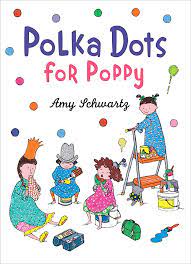
Sometimes a child develops an attachment to a particular color or pattern. Plaid, pink, houndstooth, unicorns, can all become elements of style and of her personal identity (some examples are here and here and here and here). The much missed Amy Schwartz, as gifted an author as an illustrator, has many books that capture how children feel about themselves and the world and people around them. In Polka Dots for Poppy there are four sisters and a mother who understands each one’s need to be different. (Schwartz, who grew up in a family of four daughters, dedicated the book to the memory of her mother, Eva Schwartz.). She combines realism about family life and the fairy tale archetype of multiple children and a parent, only happier and healthier.
The four girls are not the sisters in Little Women, but readers can’t be blamed for thinking about them, either. Instead of Meg, Jo, Beth, and Amy, these sisters are Ava, Isabelle, Charlie Ann, and Poppy. They all. need new school clothes, requiring an outing with their patient but determined mom. These four are not obsessed with external standards of fashion. They first appear in simple nightgowns and pajamas (Charlie Ann), and their mother is wearing flowered pajama pants and a purple robe. Her outside clothes, leggings and a jumper, resemble these in simplicity.
Ava favors princess dresses, Isabelle demands purple, Charlie Ann is eager for cowboy clothes, and Poppy craves polka dots so much that she doesn’t even ask for it in a complete sentence: “Polka Dots!” The other sisters have specific visions of their desired outfits, which are made complete by crowns, pockets, and even apples for the cowboy’s horse. Poppy is singularly focused. Polka dots are enough all by themselves. Schwartz creates characters through a minimum of carefully selected words, and active, bright pictures. There are scenes are daily activities, including trying on cowboy boots in the shoe store and riding the escalator up to the “girl gear” department. There is also a two-page spread of the sisters’ ideal designer pieces floating against a black background punctuated by stars.
A basket of art supplies appears on the floor of the girls’ bedroom, and later plays an important role in establishing Poppy’s creativity and persistence, as well as her sisters’ supportive natures. (A sketchpad and paints also accompany the book’s dedication.) Dressing up and acting out are paired together, as the girls enjoy toast and chocolate milk, decked out in their dream apparel. Concrete tools from their project lie randomly on the floor, the ball of yarn, scissors, and stray markers left as evidence of their cooperation and imaginative solution to a problem. Poppy is triumphant, with even the soles of her shoes configured to be unique. As Amy Schwartz demonstrates with humor and empathy, sometimes children need to display who they are.
 Imaginary Elevators