Snail Mail

Gift & Box – written by Ellen Mayer, illustrated by Brizida Magro
Alfred A. Knopf, 2023
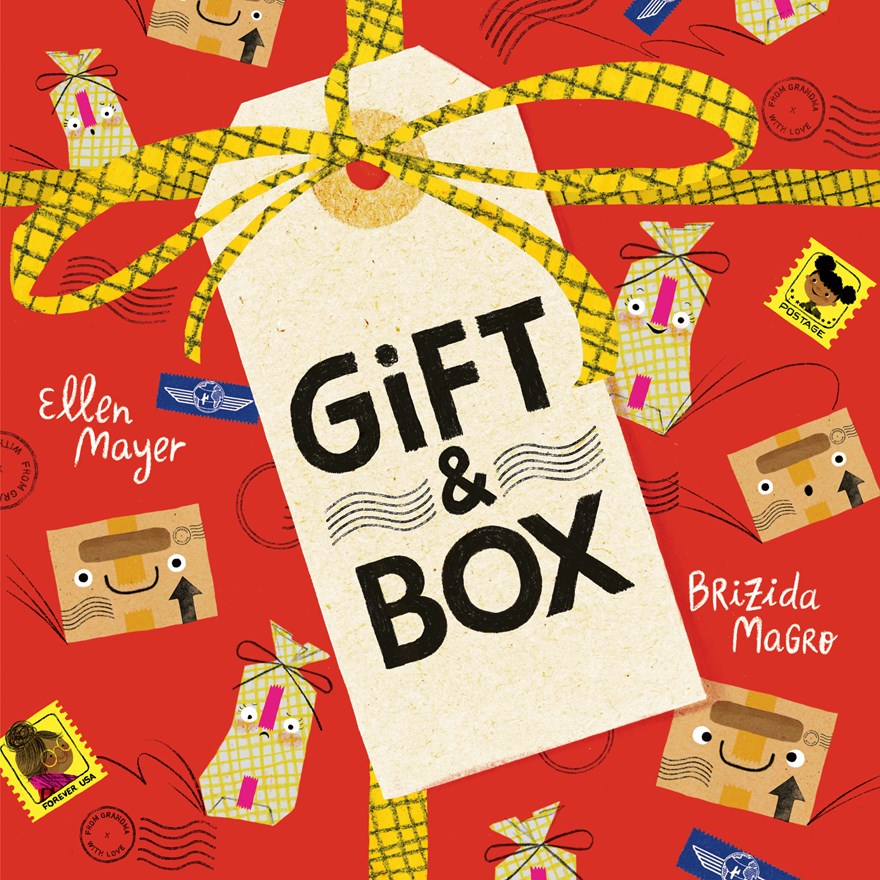
It’s good to know that there are still authors and illustrators celebrating the postal system.  Ellen Mayer and Brizida Magro’s wonderful addition to this genre opens with endpapers that display visually specific examples of snail mail. There are some real stamps, invented ones, postmarks, and snippets of correspondence.  In the tradition spanning Tibor Gergely’s Seven Little Postman, Rosemary Wells’s works, and Zoey Abbott’s I Do Not Like Yolanda, Gift & Box describes the unique experience of sending a letter or package via USPS. 

Two personified objects, a gift and a box, meet and employ their complementary skills to make someone happy.  The pictures are composed artfully.  The love between a grandparent and grandchild is also at the center of the story. (Regular readers of this blog know that picturebooks about grandmothers are one of my favorite subgenres; see here and here and here and here and here and here.) We see Grandma happily tying a bow on a bag decorated with lovely eyes and a friendly smile.  A scissor, string, tags, and scraps occupy the bottom of the page, with white space in between. There are also images of real stamps.  They are real not only in the sense of legitimate, but they are from the era when stamps were actually engraved, on woven paper in a range of beautiful colors. These three appear to be deep green, carmine, and bright blue-green. (If you look closely, the one cent “Industry and Agriculture: For Defense” stamp is reproduced with inverted lettering. This might be a deliberate choice.)

The gift and box work together.  Mayer emphasizes the cooperative aspect of their task: “Gift’s purpose was to delight. Box’s purpose was to protect.” Their long journey may be important, but it is also tedious at times, involving a lot of waiting. There is even some danger involved. There are collage elements in many of the pictures, reflecting the artist’s use of several media. (“The illustrations were created using rolled printmaking inks, crayons, handmade stamps, and paper collage, then assembled digitally.) Busy city streets are a context for the gift’s voyage, with earth and jewel-toned vehicles passing apartment buildings. The human figures have an Ed Emberley-style simplicity.
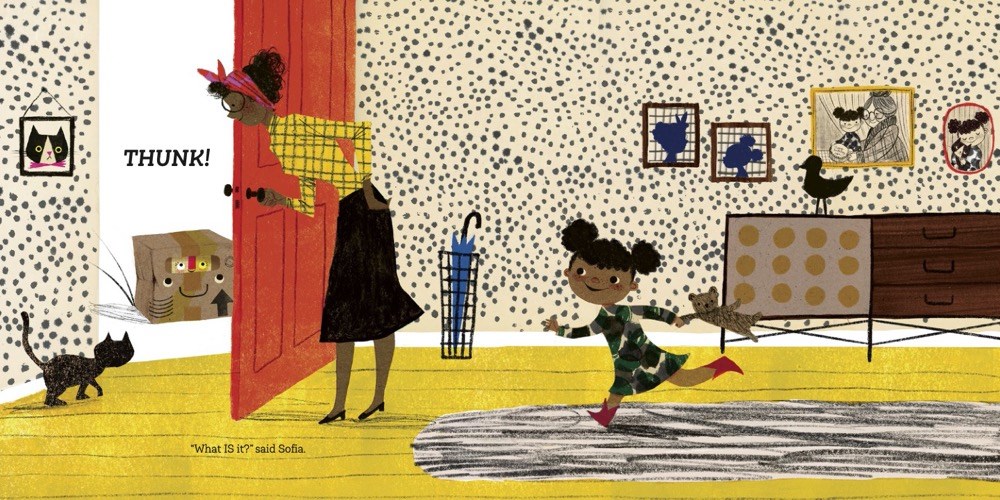
Eventually, the package arrives. A little girl, Sofia, asks her mother about the loud noise outside the door. Her mother opens the door expectantly. Their home is filled with mid-century design: a streamlined bureau, a bright blue umbrella in a wire stand. The pictures on the wall include one of Sofia and Grandma.  Sofia is delighted with her gift, but is reluctant to part with the box. Readers have been prepared throughout the story for the moment when gift and box, having accomplished their goal, will part. Instead, Sofia’s energy and imagination transform them into something new.
Traveling Dinosaurs

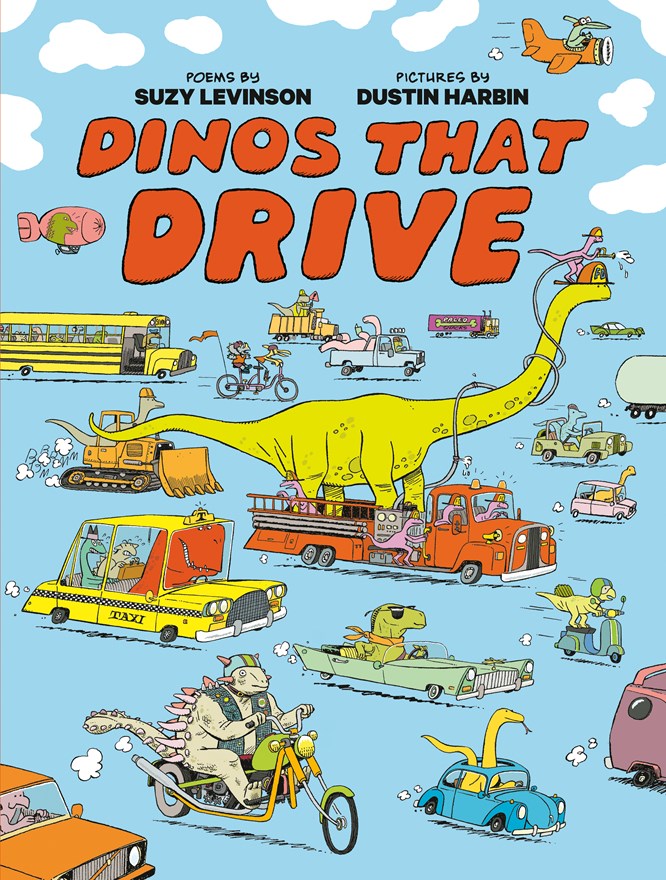
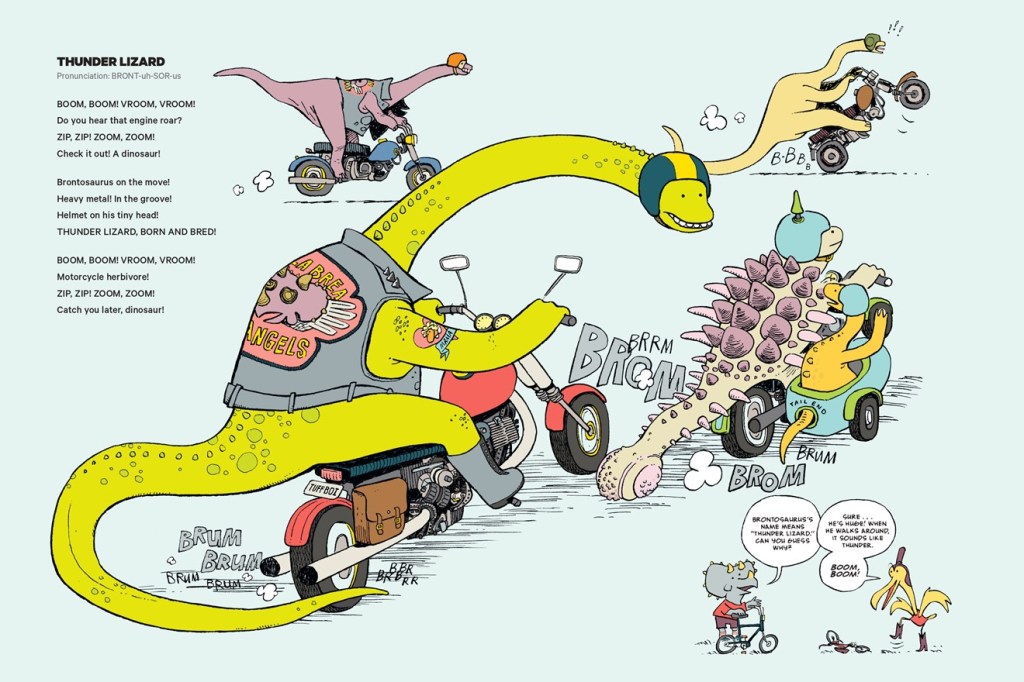
Dinos That Drive – written by Suzy Levinson, illustrated by Dustin Harbin
Tundra Books, 2025

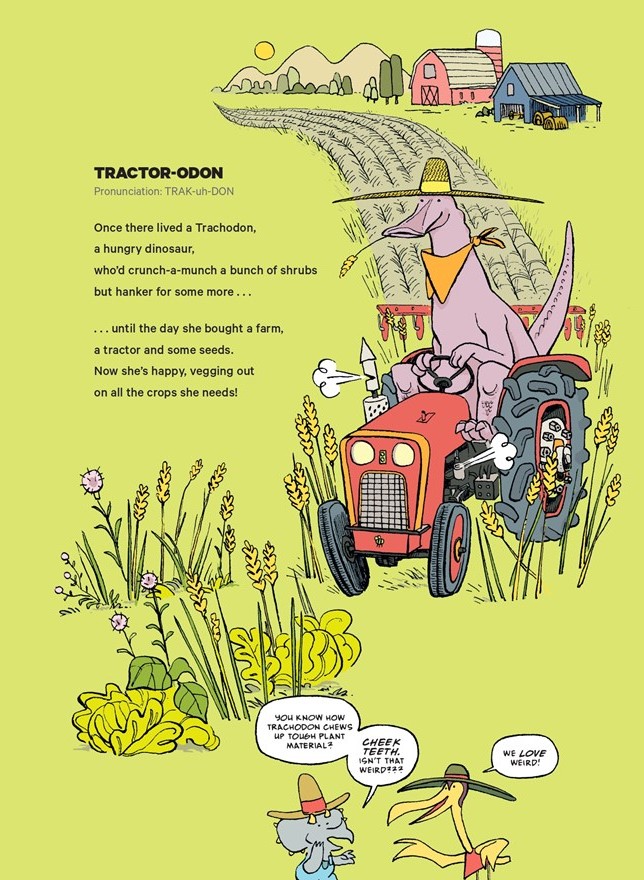
This fanciful and funny book of illustrated poems operates from the premise that dinosaurs engage in a number of human activities. In Dustin Harbin’s clever drawings, they drive tractors, trucks, and buses. They take care of kids, race motorcycles, and ferry fares across the city in taxis. Simultaneously, conversations in word bubbles between other dinosaur characters present accurate information about these prehistoric beasts: “Confession time: Pterodactyls aren’t dinosaurs! They’re actually part of a group of flying reptiles called ‘pterosaurs.’”

Susan Levinson’s poems are as diverse in form as the dinosaurs themselves. From tercets to rhymed quatrains to mini narratives, they all place characters in novel situations, as least for extinct animals. The Maiasaura is busy “herding hatchlings to ballet,” while the Triceratops needs a jeep to ensure that his massive horns don’t hit the roof.  The informational pictures at the bottom of each scene offer a kind of gloss on the fiction, an ongoing reminder that imagination and fact can work together.  Those horns are really a protection from predators, but the humor, bright colors, and animation style zaniness are a motivation to learn and a wild entertainment at the same time.

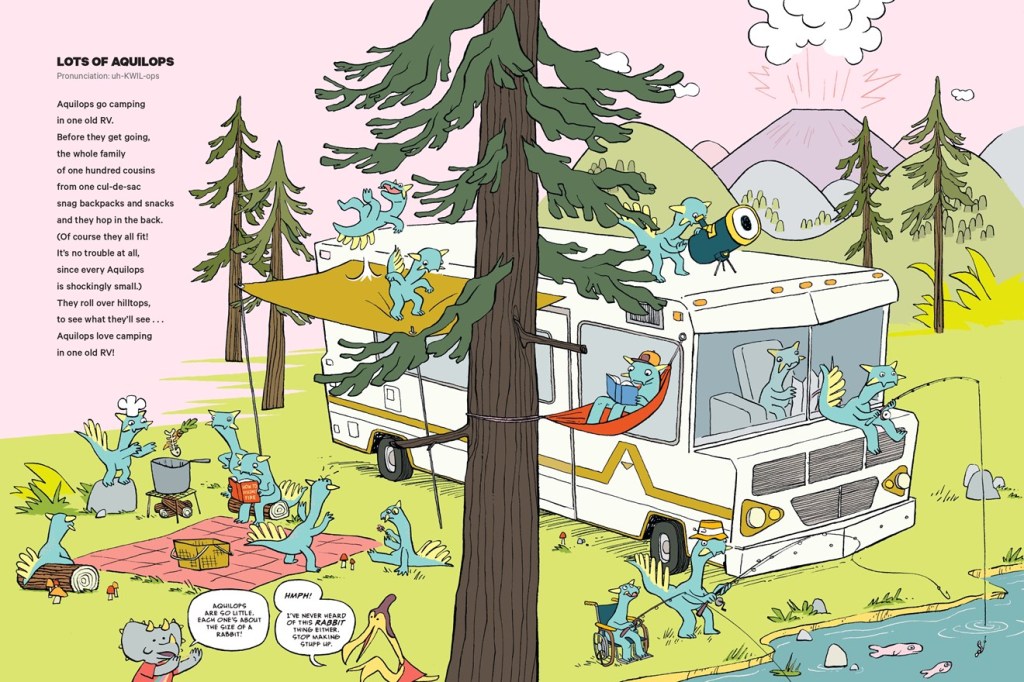
If dinosaurs as country music performers seems a stretch as long as a Titanosaur’s tail, the weeping, boot-wearing, Iguanadon may convince you otherwise, with his sad lament about being ditched for a Hadrosaur, the one with a distinctive duck bill. The Aquilops in their camper are an adorable reminder that not all dinosaurs were huge. One hundred Aquilops cousins easily fit in their RV, toting “backpacks and snacks.” After all, “Aquilops are so little, each one’s about the size of a rabbit!”

You might debate whether mixing outrageous fantasy with paleontology is the best way to teach kids about prehistory, but the concept demonstrates its own value in Dinos That Drive. Engaging even young children in a discussion about fact and fiction will drive their curiosity. Dinosaurs already have a special status in the worldview of kids.  They lived a long, long time ago, but have connections to some species today. The extinction event that ended their reign was dramatic, and knowledge about these “terrible lizards” is continually evolving.  Readers already know that; Dinos That Drive is an excursion that, nevertheless, sticks to the right path. 

Stellar Dendrites (Snowflakes)

Flurry, Float, and Fly!:The Story of a Snowstorm – written by Laura Purdie Salas, illustrated by Chiara Fedele
Bloomsbury Children’s Books, 2025

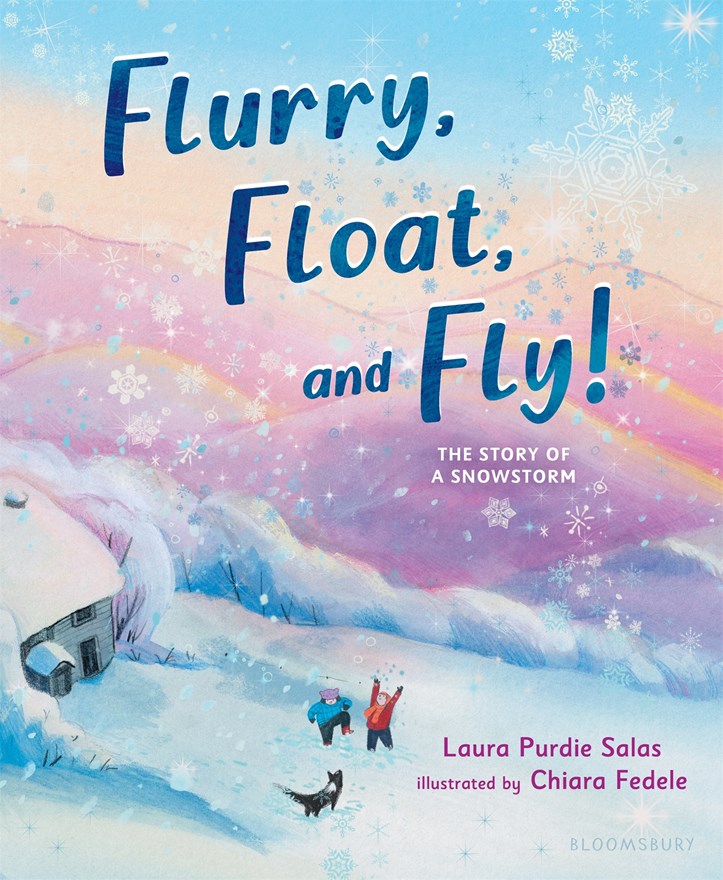
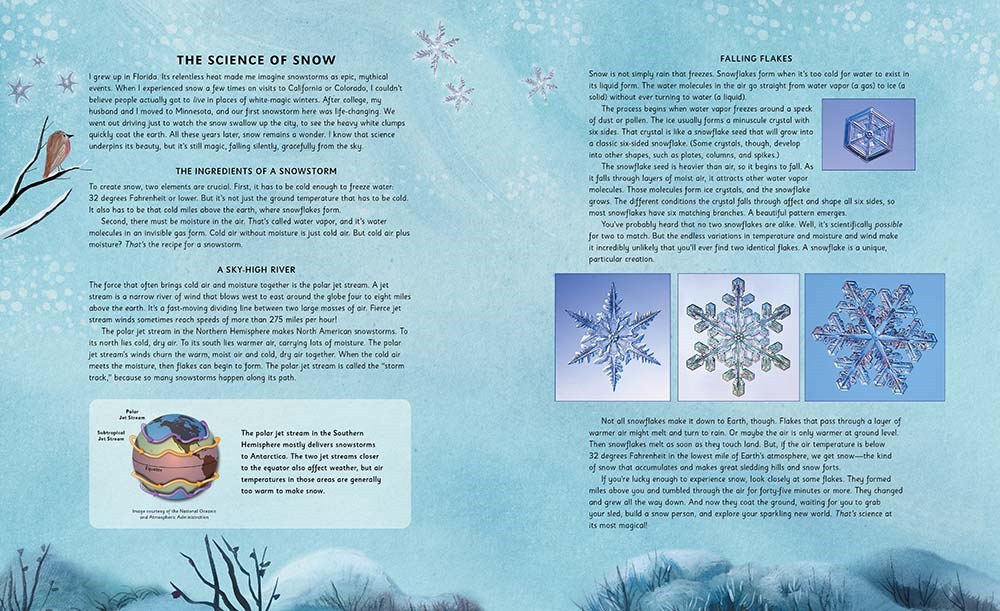
There are STEM picture books that integrate the informational content into a story, and others that place aesthetic appeal at the center, adding the scientific context in the backmatter.  The text of Flurry, Float, and Fly is full of momentum and joy, while the pictures, rendered in watercolor, gouache, and pencils with digital editing, are both bold and delicate. Jewel tones are placed against pastel or muted shades. Snow itself is a precise phenomenon, explained in detail in a separate section, “The Science of Snow.” The unparalleled wonder of welcoming a snowstorm emerges from every page. Regular readers of this blog know that snow books are one of my favorite genres (my most recent one before today includes links to the earlier ones).

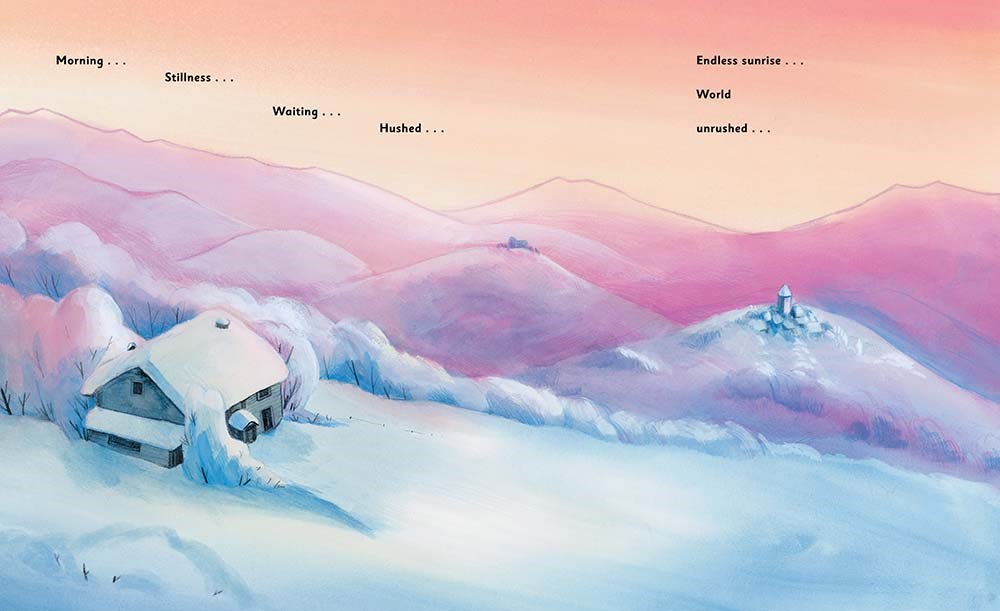
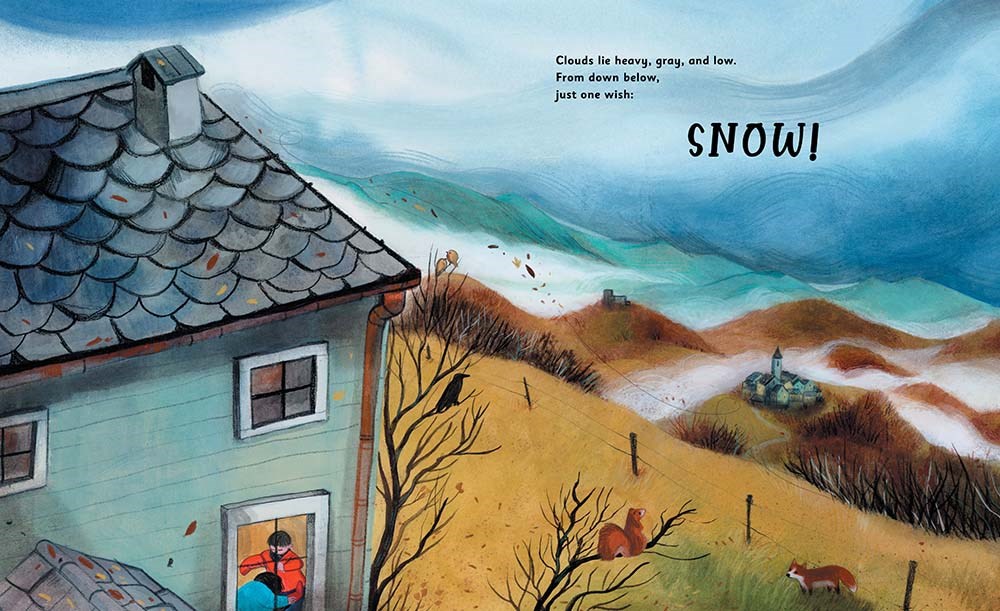
Laura Purdie Salas’s text and Chiara Fedele’s pictures are composed to interact perfectly (I reviewed Salas’ book on thunderstorms here, and I have reviewed several books illustrated by Fedele—here and here and here–but this is their first joint effort I have seen). The bold black text is in a minimalist, poetic style. A house with a snow-covered roof in the foreground, other buildings in a distant background, and a blanket of white fill the bottom of a two-page spread. A pink and yellow horizon allows the words to speak quietly: Morning…Stillness…Waiting…Hushed.” Perspective supports the effect of comparing human activity to the expanse of nature. In one corner of a scene, two people are framed by the window of their house. In the center, a fox and a squirrel look up expectantly. In the distance, a town appears as if in miniature, while the blue and white sky appears ready to fulfill a wish for “SNOW!”

The words of the title actually first appear as a disappointment. Two children are ready with a sled, but they are sitting and standing on a bed of leaves.  Fedele’s use of color is dramatic within a quiet setting.  One child wears a bright red coat. The girl sitting on the sled has red boots, a cobalt blue jacket and violet hat.  The fox is red, as are two small birds sitting on the bare branch of a tree.  “No snow to flurry, float, and fly” is about to be replaced by its opposite.  Another picture reverses the position of house and outdoors, with a family sitting in the window on the right of the scene, and the “merging crystals” beginning to form and fill the sky on the right. The interior of the family’s room is shimmering gold and the green of their sweaters recalls the distant season of spring more than the forest green of winter.

There are allusions to the fact that snow is not formed out of poetry throughout the book, as in the reminder that “Water vapor clings to dust,/begins to form a slushy crust.” The carefully presented information at the book’s conclusion illuminates the intersection between different experiences.  “Columns don’t have arms or branches.  Instead, they’re simply tubes with six sides, like old school pencils.” Those old pencils might even be multicolored, aligning the complexity of a snowflake’s structure with the sheer excitement of a storm.

Bright But Fragile

Penelope’s Balloons – written and illustrated by Brooke Bourgeois
Union Square Kids, 2024

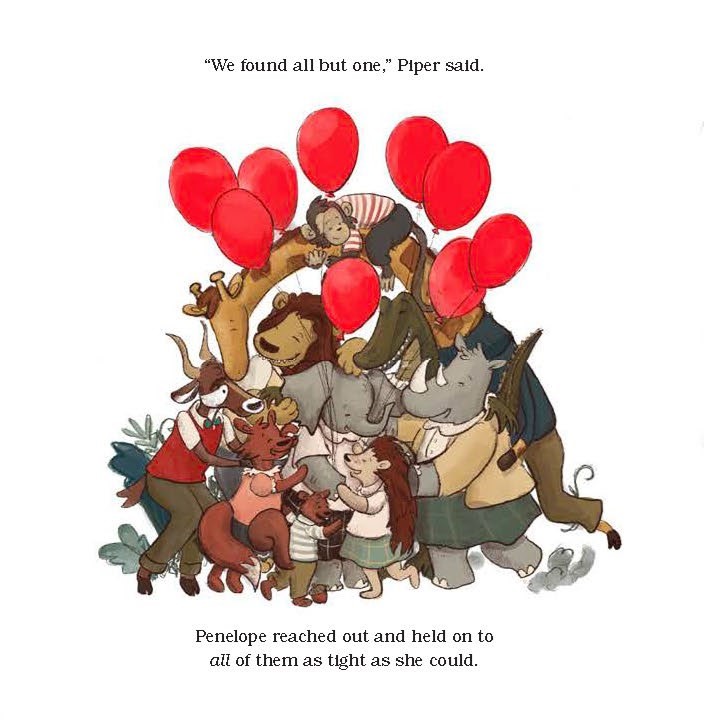
Children can become attached to unexpected objects. Some, like balloons, have a limited life span. In Penelope’s Balloons by Brooke Bourgeois, a young elephant who is “quiet…bright,” and “a bit particular,” cannot let go of ten red balloons, either literally or figuratively. She is happy lying on her back and watching them suspended in the air, but also keeps them close while eating or diving.

From the beginning of the story, it seems evident that there will be both a problem and a message here. Penelope’s balloon obsession does not prevent her from socializing, In fact, she has many friends of different species. The balloons only make her more “perceptible” and popular, to choose another adjective that is alliterative with her name. The problem is the fragile nature of her favorite item.  Her best friend, Piper, is a hedgehog; say no more. Allie is an alligator with sharp teeth. On the other hand, Gerry the giraffe is a good friend to have, her long neck offering some protection from potential piercing. 

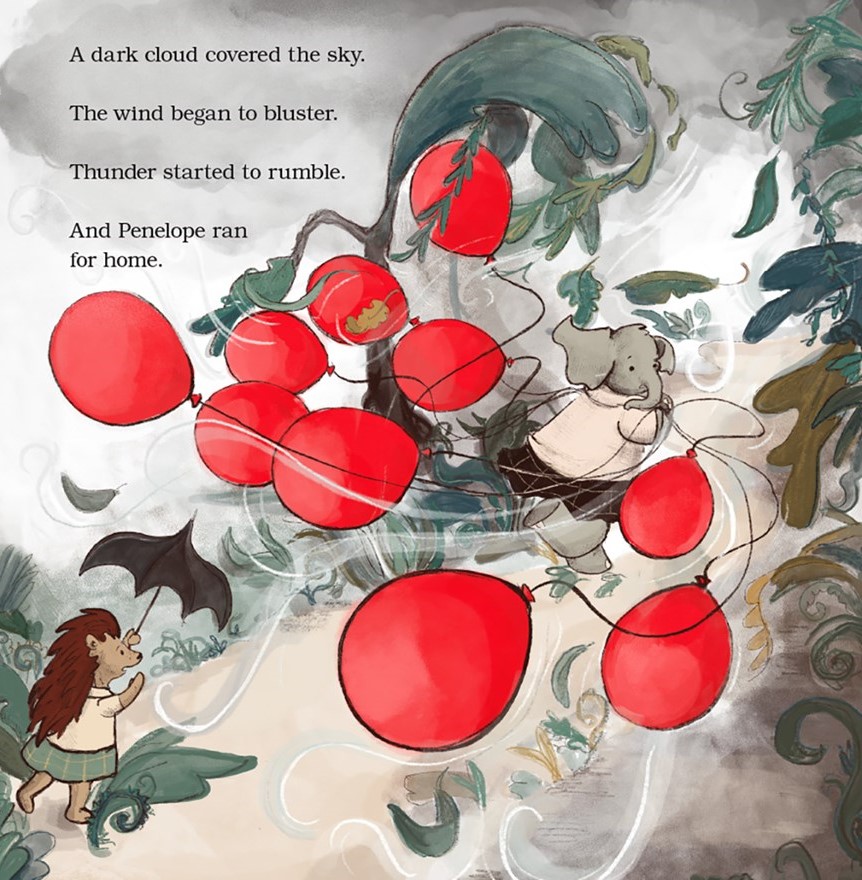
Eventually, Penelope learns the inevitable lesson about avoiding disaster. Sometimes you cannot.  A thunderstorm does not have functional points, but it’s invisible winds can still destroy. Forlorn, Penelope shelters in the forest. She is alone. This picture has no bright red to contrast with the gray and green foliage. Even her friend Piper’s comforting words cannot erase Penelope’s grief.  As Piper leads her across a thick branch serving as a bridge, the young elephant is hunched over, her ears falling like flaps over her face. All of a sudden, she seems old.

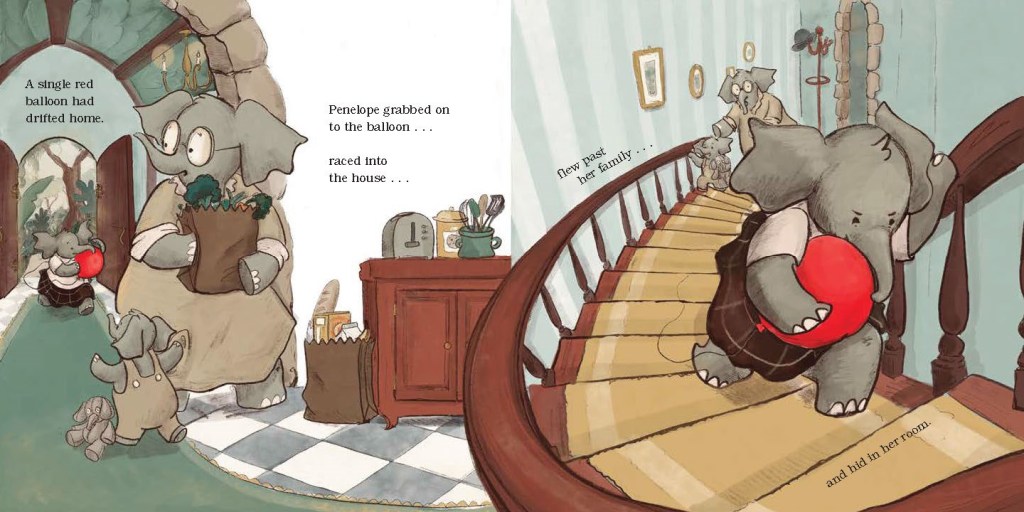
Arriving home, Penelope stands in front of the doors and rushes in. One balloon has survived and accompanied her. Now we meet her parents. Her mother seems almost confused, which is surprising. Surely her family is well-aware of her balloon problem. There is an expressive scene, viewed from the top of the staircase, of a determined Penelope racing her room.  Her mother and younger sibling are small and helpless figures receding into the background.

Penelope frantically sets to work creating an elaborate fort to protect the balloon. Her intense anxiety foreshadows the upcoming disaster, as well as the solution.  Sometimes, with patience, things will work out. The likelihood of this scenario, with the other nine balloons all magically reappearing, seems like pure wish fulfillment (as in Claire Keane’s Love Is). However, Penelope decides that giving her balloons, or, by extension, any beloved, a little space, is the best way to keep them close.  The author also suggests that Penelope’s strange attachment had actually been distancing her from her actual friends, “the sharp and spiky ones” who posed a threat to her happiness.

A word about Babar seems required. Any children’s book presenting anthropomorphized elephants seems, to some extent, an homage to Jean and Laurent de Brunhoff.  Certainly, some of her animal friends include monkeys, rhinos, and other residents of Celesteville. (Although the rhinos are not bad guys here.) Penelope is certainly less sophisticated and cosmopolitan than Babar, but there is still a sweet reminder of how animals with human qualities offer a unique connection with children.  There is more than one lesson in Penelope’s Balloons, and the book is well-worth sharing with them.

The Fruit of Your Labor

Hello Baby, It’s Me, Alfie – written by Maggie Hutchings, illustrated by Dawn Lo
Tundra Books, 2026

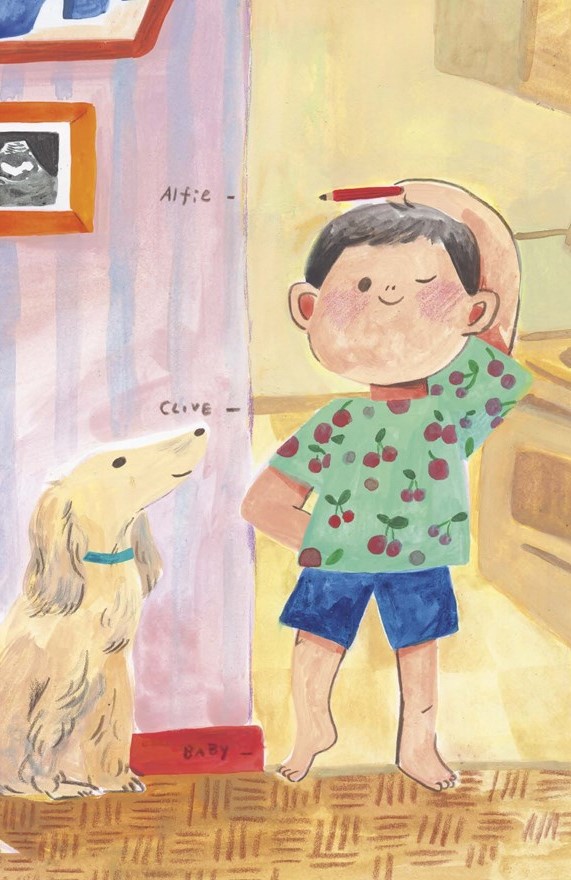
A long time ago, 1938, or 1931 if you lived in France, Babar the Elephant learned of his triplets’ birth with the sound of a cannon. Since them, many more children’s books have appeared with the purpose, more explicit than in the work of Jean de Brunhoff, of preparing older siblings for the birth of a new baby.  Hello Baby, It’s Me, Alfie belongs in the top rank of these works.  Narrated from the point of view of Alfie, the soon-to-be big brother, Maggie Hutchings’ and Dawn Lo’s picture book is totally believable. It is also artistically distinguished, illustrated with vibrant colors reminiscent of Fauvist painting, rendered with pencil crayons and gouache. Hello Baby is funny, tender, and thematically consistent. Each page is full of carefully composed images placed at varying angles, adding up to fully realized home life, both indoors and outside. When Alfie promises that “my heart is pretty big. So I’m sure I’ll find space for you,” your own heart will resonate with empathy.

The consistent motif that defines the book is Alfie’s curiosity and love, framed by the famous fruit comparisons used to measure a baby-on-the-way.  Someone, probably his devoted parents, have explained the baby’s growth to Alfie, and he is constantly adjusting his expectations. The endpapers prepare us with big, splashy examples of children’s artwork. Fruit is a great subject when you are learning to draw. We enter Alfie’s kitchen, where his bearded and apron-wearing dad is cooking, while his Mom patiently explains that a baby is growing inside her. Alfie’s wide-eyed expression registers surprise, perhaps disbelief.

You know Alfie’s parents, or at least you have met them or seen them in our neighborhood. They are real people, Mom in her green maternity overalls and Dad holding an ultrasound image to show Alfie who is soon to arrive.  Alfie is excited to follow the fruit comparison. He is even wearing a tee shirt covered with bright red cherries as he notes his own height, and learns that the unborn sibling, at 12 weeks, is “as big as a perfect plum” It helps to be concrete when providing children with explanations, especially for events with monumental consequences.

There is a fine line between emotion and sentimentality; Hutchings and Lo succeed in evoking a strong response without veering into patronizing territory. When Alife lies against his mother’s belly and feels the baby kick, he interprets this prenatal action as a sign of love, reminding the now mango-sized creature that his older brother is full of love, as well. Alfie communicates essential information to his sibling, including the fact that sometimes fear is part of life. When his dog is frightened of thunderstorms, Alfie hugs him..  This statement is not random; he intuits how vulnerable this future baby, now the size of a mere cauliflower, might feel when he joins their family.

At Alfie’s fourth birthday party, the pictures highlight a lovely bit of formality, with his mother now wearing a black and white polka-dotted dress accented by a pearl necklace. Dad takes a photo portrait of the scene. If you are a parent, I know you may be thinking that Alfie doesn’t actually know what to expect. The addition of a baby is not, at least at first, going to be unmitigated joy for him. It will be difficult. Again, there is an allusion to past and future feelings. Alfie has painted a rainbow for the baby, but he ran out of the yellow needed to complete his creation.  “That’s what the crying was about.” Maybe. He is upset enough to need a reassuring embrace from his father.  His mother is now really large, but still almost beatifically calm. 

The book ends, not with the typical picture of a newborn, but with Alfie looking into the crib that his father has carefully assembled.  The inside of the dustcover is a prenatal growth chart measured by pictures of produce. I will summarize by returning to Babar, because the stunning visual quality of this book elevates it way above the level of handy didactic works on the same theme: “Truly it is not easy to bring up a family…But how nice the babies are! I wouldn’t know how to get along without them any more.” Words to live by, for Alfie and his growing family.

Chanukah 2025/5786

Hanukah Money – written by Sholem Aleichem, translated and adapted by Uri Shulevitz and Elizabeth Shub, illustrated by Uri Shulevitz
Greenwillow Books, 1978

This year’s celebration of Chanukah has been marked by a horrific tragedy. The slaughter of 15 people, with many more injured, is now inseparable from the religious and cultural festival this year, but it cannot destroy the meaning of the holiday.  The great Yiddish author Sholem Aleichem (1859-1916) often wrote about both suffering and resilience. In his short story “Hanukah Money,” translated and adapted, and illustrated by Uri Shulevitz (who died earlier this year), Sholem Aleichem relates the tale of two young brothers eager to receive the traditional gift of gelt while their family observes the holiday. (Everyone knows of Sholem Aleichem, and you can find more of my reviews of Shulevitz’s brilliant work here and here and here.)

The boys’ mother is busy cooking latkes (potato pancakes). Their father recites the blessing on the candles. He understands the boys’ impatience, and rewards them with their small gift. While they spin their dreidels, their father and Uncle Bennie play checkers, discussing strategies of the game as if it had grave importance: “‘What’s to be done, what’s to be done, what’s to be done?’ intones father.” More relatives arrive and bring coins. The boys’ innocence, within their clearly impoverished home, reflects both their unawareness of material deprivation, and their joy in this occasional opportunity to delight in relative plenty.  Even counting the coins becomes a ritual and a game framed by playful language: “One chetvertak and one chetvertak makes two chetvertaks, and another chetvertak makes three chetvertaks, and two grivenniks is three chetvertaks…”

Shulevitz’s pictures, resembling sepia engravings, feature exaggeratedly comic figures. The children seem like small adults and the adults themselves have child-like limitations.  Some of the objects surrounding them are Hebrew prayer books, a wall of Jerusalem’s Tower of David, and a chanukyiah (menorah) displayed in the window.  When one brother dreams that the cook, Breineh, flies into the room, she is carrying a platter, not of latkes, but of paper bills. “Motl swallows rubles like pancakes,” before going back to sleep. Money is abstract and fungible, but available food fills an immediate need. The boys’ needs are briefly fulfilled in the unique customs of the Festival of Lights.

Jane Austen’s Birthday

Cozy Classics: Pride and Prejudice and Cozy Classics: Emma –by Jack Wang and Holman Wang
Chronicle Books, 2016

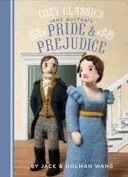
To celebrate the genius of Jane Austen 250 years after her birth (1775-1817), read or re-read her brilliant novels. If you would like to introduce very young children to her work, or just marvel at the incredible artistry of Jack Wang and Holman Wang, you might share with them the Cozy Classics board book versions of Pride and Prejudice and Emma. The Wang brothers create their own felted figures and photograph them, producing original and accessible stories that are not mere novelties. Granted that the text is limited: “dance,” “write,” “read,” “walk,” and “marry.” The detailed illustrations distill the story and offer an opportunity to embellish as you read with children.

For older readers, links to my posts on other biographies and imaginative encounters with Jane Austen and her characters are here and here and here.

Let It Snow

The Snow Theater – written and illustrated by Ryoji Arai, translated from the Japanese by David Boyd
Enchanted Lion Books, 2025

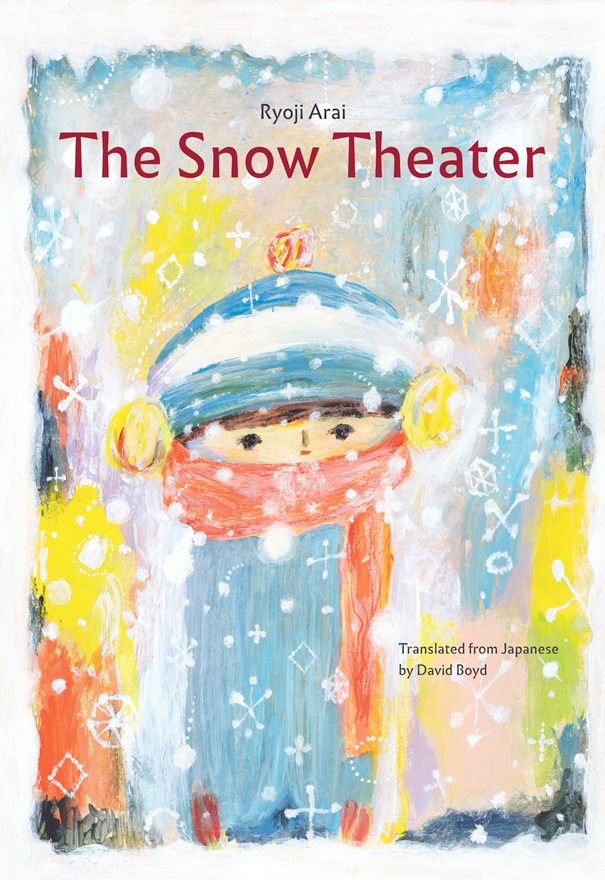
The art of Ryoji Arai’s The Snow Theater demands strong adjectives: intense, stunning, original, but also: unpretentious, dream-like, and accessible. The reason for this contrast, aside from the artist’s incredible gifts, is the imagery’s blend of naiveté and sophistication, with splashes of color as well as carefully delineated figures. Arai’s pictures capture what it feels like to be a child, and specifically to be captivated by the experience of snow. Snow as theater is not at all artificial, from a child’s point of view. It is a gift, perhaps unanticipated, that then takes on different qualities, including joy. It is familiar, but can also be strange.

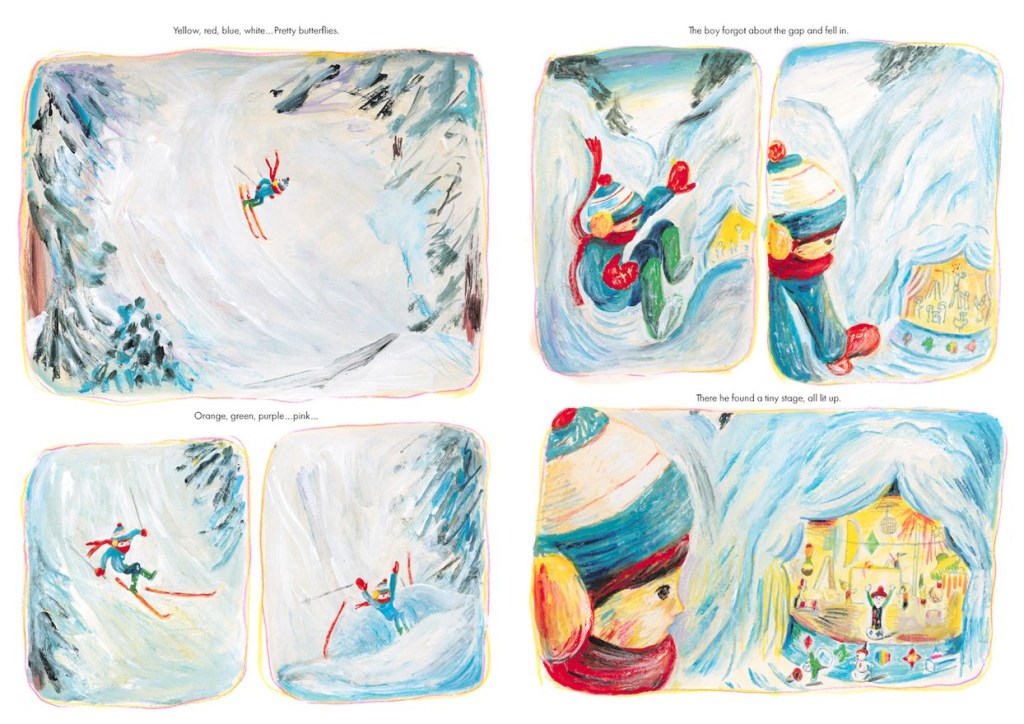
There are innumerable children’s picture books about snow, and many are excellent, beginning with the Ezra Jack Keats classic The Snowy Day (see some other examples here and here and here and here and here and here and here). The Snow Theater is not unique, but both its design and philosophy and language are distinctive enough to merit acclaim (it is translated by David Boyd, who has translated some of the Chirri and Chirra books, also published in English by Enchanted Lion). It opens indoors, where two boys are “keeping warm” and “looking at a book.” The first picture has the reader looking towards them from outside, where they are framed in the window, almost like residents of a dollhouse. Then, a two-page spread is divided into several more specific descriptions of their activity, and one larger scene of it result. At first they are sharing a picture book about butterflies in a cooperative spirit. Then, the friend of the boy who lives in the house “badly wants to borrow the book,” and the idyll is ruined. That adjective, “badly,” prepares you for the act of, perhaps accidental, aggression that results when the book is damaged.

Now the boy is devastated. Worse, the book is actually one of his father’s favorites, adding a dimension of anxiety to an already tense situation. Arai traces the arc of the boy’s feelings. They boy had wanted to share the book with his friend, not only because they both liked butterflies, but in order to communicate its special status in his family. Worried, he leaves the house and begins to ski through the snow. Suddenly, he finds himself looking into a miniature theatrical production. There are “snow people,” including ballerinas. They surround him physically, occupying his senses. Then the scale seems to change, as he sees “a large theater in front of him.” Yet the performers, who include singers, still appear to be tiny. “Everybody floated quietly to their places, like freshly fallen snow.” There are echoes of Tchaikovsky’s Nutcracker, with impressionistic colors. Snow people reflect the color of rainbows. Icicles are suspended from their limbs and odd pieces of scenery, like an Easter Island head, occupy the elaborate background.

Then the show ends. As in The Nutcracker, viewers wonder if the performance was a dream, or if the protagonist had really undertaken a mysterious journey. The kinetic, and ephemeral, experience of a snowstorm seems to have been the boy’s escape from emotional difficulty. He reaches across the snow to find his friend against a field of butterflies, only some of which are enclosed within a book. The boy’s father appears with the awaited resolution: “Let’s get you home.” A cup of hot cocoa by a warm stove brings back domestic security, but the song of the snow people is reprised in the boy’s memory.

Freedom from Hunger

Maddi’s Fridge – written by Lois Brandt, illustrated by Vin Vogel
Flashlight Press, 2014 (paperback edition, 2022. Reading app available:
https://apps.apple.com/us/app/maddis-fridge/id6748969593)

Thanksgiving is associated with families sharing a plentiful amount of food, but not all Americans have access to this custom.  Freedom from hunger is a human right. Historically, it has been an American right, even if this ideal has not always been realized.  Norman Rockwell’s iconic paintings depict the Four Freedoms that President Roosevelt had a promoted during World War II as a reminder of the war’s purpose.  Maddi’s Fridge is a non-ideological picture book for children.

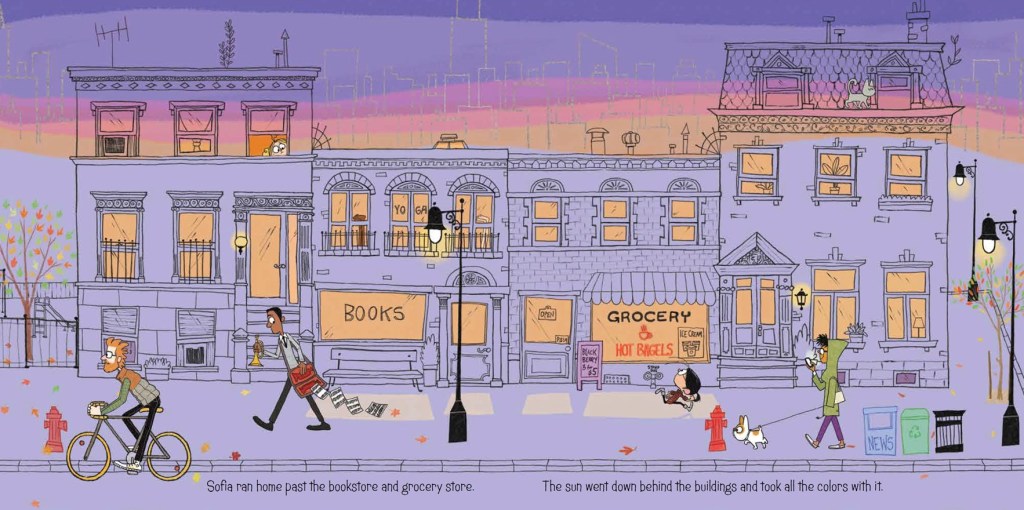
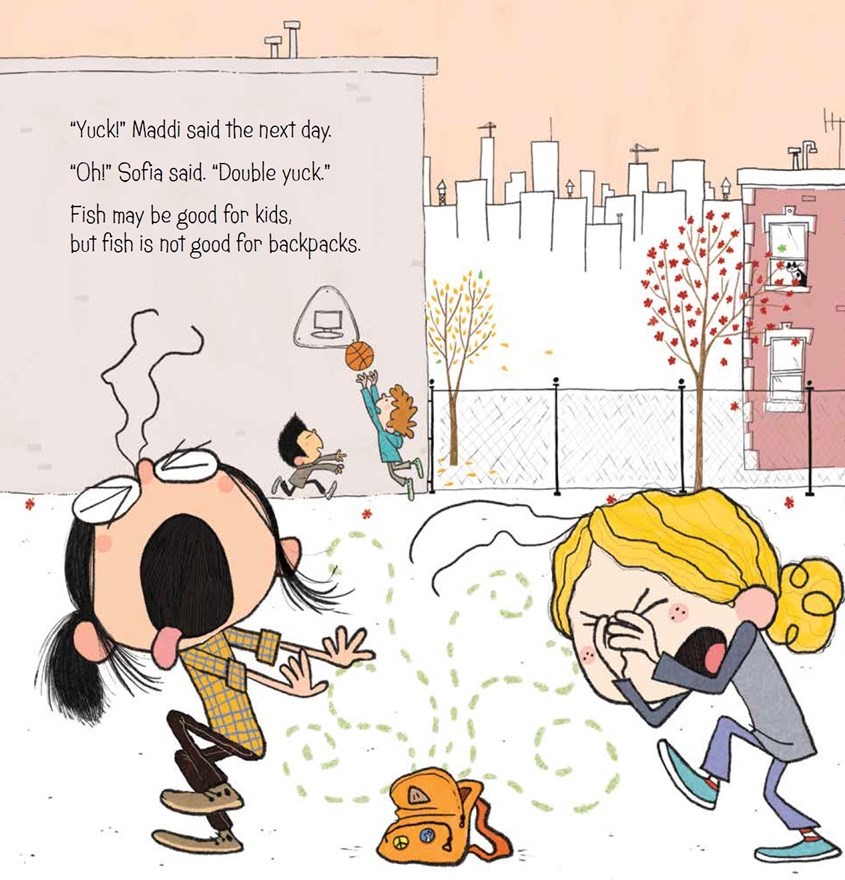
It does not discuss the social and economic programs needed to combat income inequality; that is not its purpose. Lois Brandt and Vin Vogel present the problem of hunger through the friendship of two girls, Sofia and Maddi. Sofia has always assumed that her well-stocked refrigerator is the norm. When she learns that her friend’s is virtually empty, Sofia needs to help her friend without betraying a secret.

Vogel’s illustrations are understated and appealing.  They convey a sense of community, even a modern version of Rockwell’s, as well as a touch of mid-twentieth century animation.

Sofia’s family is well-fed, with the inventory of her refrigerator even including dog food. Brandt enumerates each item for human consumption: chicken, yogurt, cheese, carrots, bread. In contrast, her friend Maddi’s refrigerator has barely enough to sustain her and her younger brother.  Brandt and Vogel show, in words and images, the asymmetry of the situation without elaborating on its cause.  Instead, Sofia’s dilemma is central to the story.  How can she help Maddi? Bringing foods for the two friends to share as they play outside will not address the problem.

Adults reading with their children may anticipate Sofia’s decision, but children will not necessarily predict the outcome.  Maddi’s Fridge presents an opportunity to discuss why breaking a promise of secrecy may be not only permissible, but crucial.  The book’s afterword provides further suggestions for filling empty fridges, on an individual and communal level.  The book’s relevance today is a sad statement about the refusal to ensure that all children are cared for, but it at least represents an intelligent and sensitive way to shed light on the problem.

Ready, Set, Anne

Anne: The Chapter Book Collection – adapted by Kallie George, illustrated by Abigail Halpin
Tundra Books, 2025

Anne Dares – adapted by Kallie George, illustrated by Abigail Halpin
Tundra Books, 2023

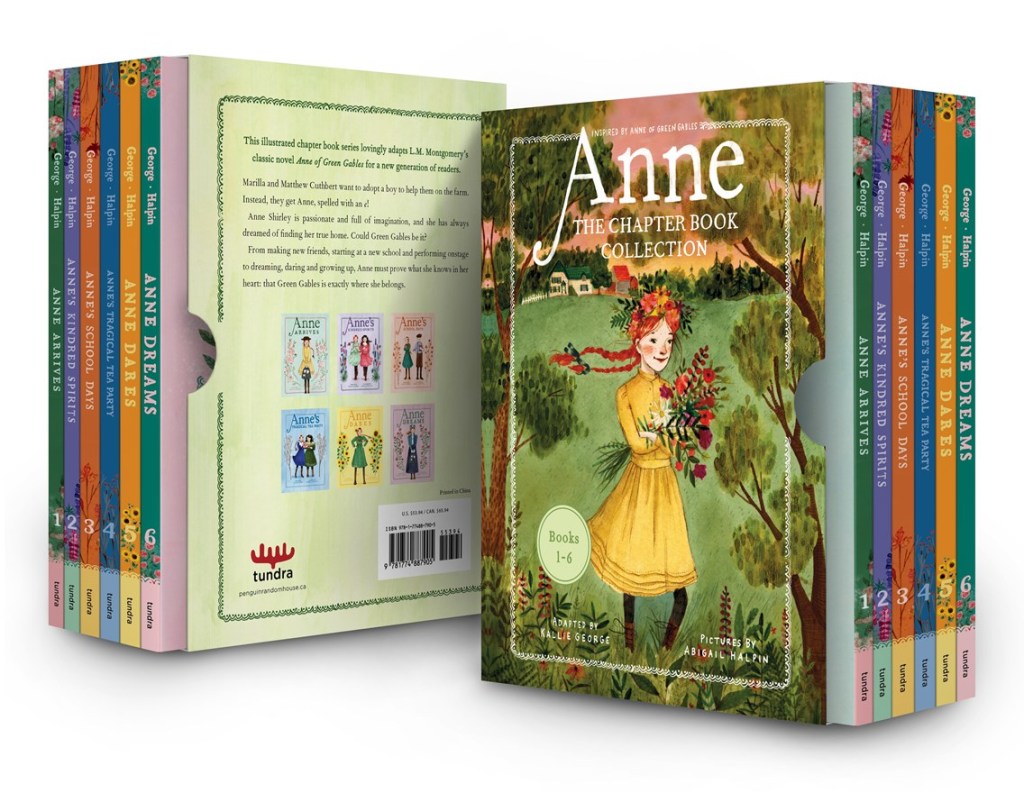
For fans of Kallie George and Abigail Halpin’s wonderful collaboration in bringing the work of Lucy Maud Montgomery to chapter book readers, Tundra has issued a boxed set of paperback editions.  As you will read on my earlier posts (see here and here and here and here), this series is both an accessible introduction to the original Anne of Green Gables, and each volume a  wonderful illustrated novel that stands on its own merits.  Abigail Halpin’s pictures offer her own perspective on the characters and setting, and Kallie George has succeeded in writing an homage to Montgomery’s vision, not a bland imitation.

In Anne Dares, the bold aspect of Anne Shirley’s personality propels her to take some risks.  These include the physically daring walking on the edge of a fence, as well as the courage to perform in her school’s recital. The fence-walking stunt even requires her to ignore the advice of kindred spirit Diana. Ever conscious of a dramatic situation, Anne assures her friend, “And if I do perish,…you can have my pearl-bead ring.

Her performance involves facing her apparent nemesis, Josie Pye, as well as Gilbert Blythe, the boy whose thoughtless teasing will prove to be a mere mask over his true feelings. Her new puff sleeved dress, a gift from her beloved father figure, Matthew, gives her some of the strength she needs in front of an audience.  The dress is both a cherished article of clothing, as well as a tangible proof of the love that now characterizes her home life, although her initial arrival had provoked skepticism.  On stage, at first “she thought she might faint.” Daring or not, she is still afraid. Fortunately, “she knew she must live up to those puffed sleeves.”  Montgomery’s heroine, re-imagined by Kallie George and Abigail Halpin, lives in two worlds, where undeniable difficulties and dreams of beauty are intertwined.