Remarkable Quest

The Magic Library of Waterfall Way – by Julie Abe
Bloomsbury Children’s Books, 2026
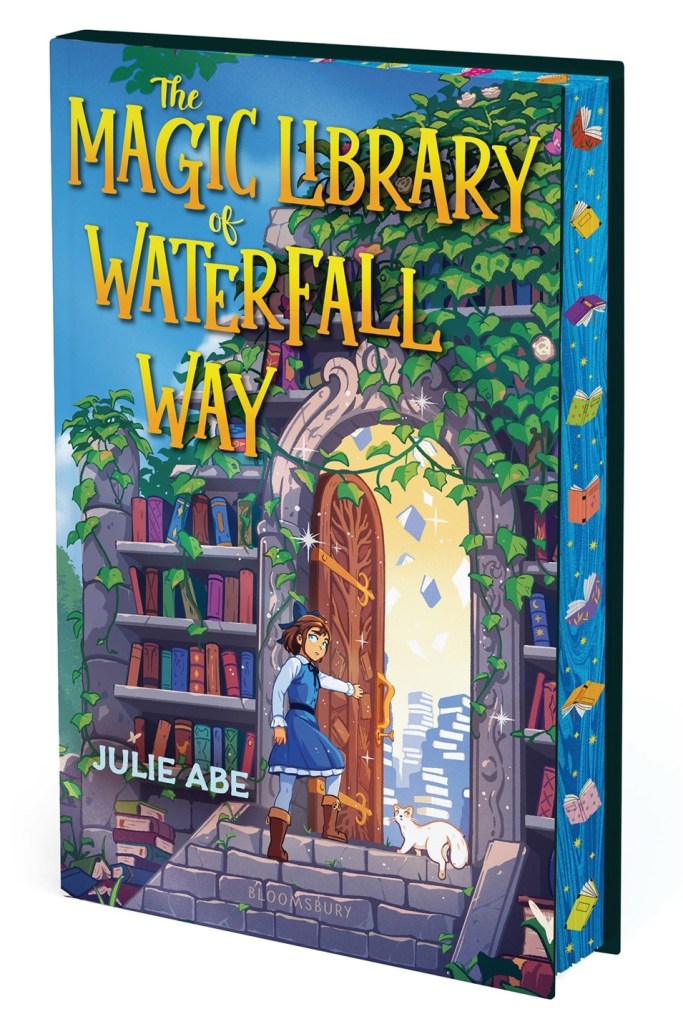
Imagine that you’re a child whose fate will be determined by your membership in one of the following categories: Extraordinarily Remarkable, Quite Remarkable, Slightly Remarkable, or Unremarkable. Of course, those harsh judgments often seem to be part of any childhood. In Julie Abe’s middle-grade novel, Lyra Hunt is an orphan on a quest. In order to avoid the dreaded fate of her status, she will need to find a guild that will accept her. As in many of the classical works of children’s literature that seem to have inspired the author, Lyra’s sensitive and bookish nature is paired with courage. With the help of mentors and friends, she will determine her fate.

Guild matchers are responsible for placing everyone in the Alterran Empire in their appropriate niche. With each child’s status unalterably decided by the age of one year, at a Prophecy Reveal event, there seems to be no escape from this rigid practice. Not surprisingly, high-status people seem to perpetuate their own privilege, as the Slightly Remarkable but utterly inept boy who is accepted into the Guild of Warriors when his parents make a donation. Lyra has no such option available. Her parents had been members of the now defunct Guild of Paperweights; even the lowly Guild of Pinecone Collectors rejects her.

This dismal scenario is rendered even more difficult by the constant propaganda emanating from the Guild of the Crown News, an official organ of the regime. Some chapter titles are derived from its lies, while others are countered by the truth. “Books must be protected at all costs. And I must protect those who will read them, too,” is The Chronicles of Lyra Hunt. Books matter, and so does having the courage to speak out and defy authority.

Sensory descriptions of the idyllic magical village where Lyra finds refuge enhance the narrative. (“From the bakery across the street, a whiff of freshly baked baguettes washed over us.”). Judicial use of magical elements also lends a cinematic touch, with inanimate objects assuming lifelike powers: “’The faucet’s upset. My apologies.’ When it noticed me, the water began to stream ominously.” Brief, but powerful, statements reinforce the source of Lyra’s strength, as when the generous and wise Gemini, Master of the Guild of Scholars, explains that books have been a key to her survival, especially in a world where “most prefer the, well, simplicity of the Guild of the Crown’s newspaper and books.”

By the end of the novel, Lyra and those who support her quest have subverted categories and gone some distance towards replacing acceptance with skepticism, both about official lies, and the sense of helplessness those lies are meant to engender.
A Deal Not Made in Heaven

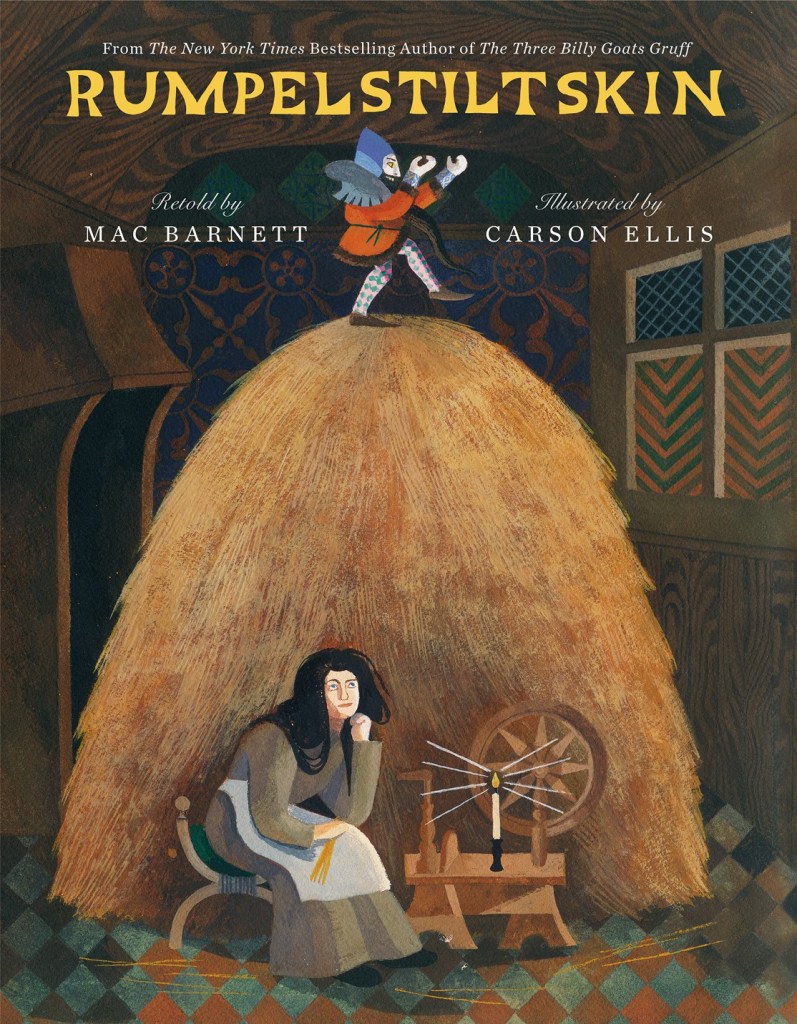
Rumpelstiltskin – retold by Mac Barnett, illustrated by Carson Ellis
Orchard Books (Scholastic), 2026

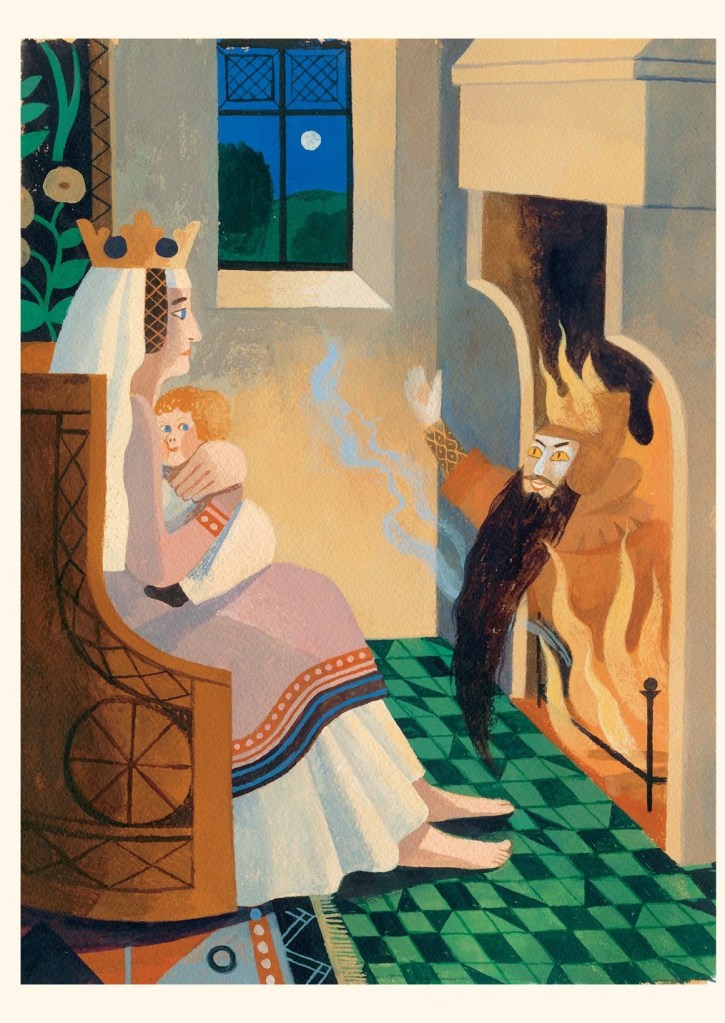
Folklorists and authors, from the Brothers Grimm to Jane Yolen, have been drawn to the story of Rumpelstiltskin, the calculating little man who tries to deprive a woman of her child.  Artists, from the classic illustrators Arthur Rackham and Walter Crane, to Paul Zelinksky and Paul Galdone,  have depicted its characters in strikingly different styles. Now, Mac Barnett and Carson Ellis have created their own response to this haunting tale.

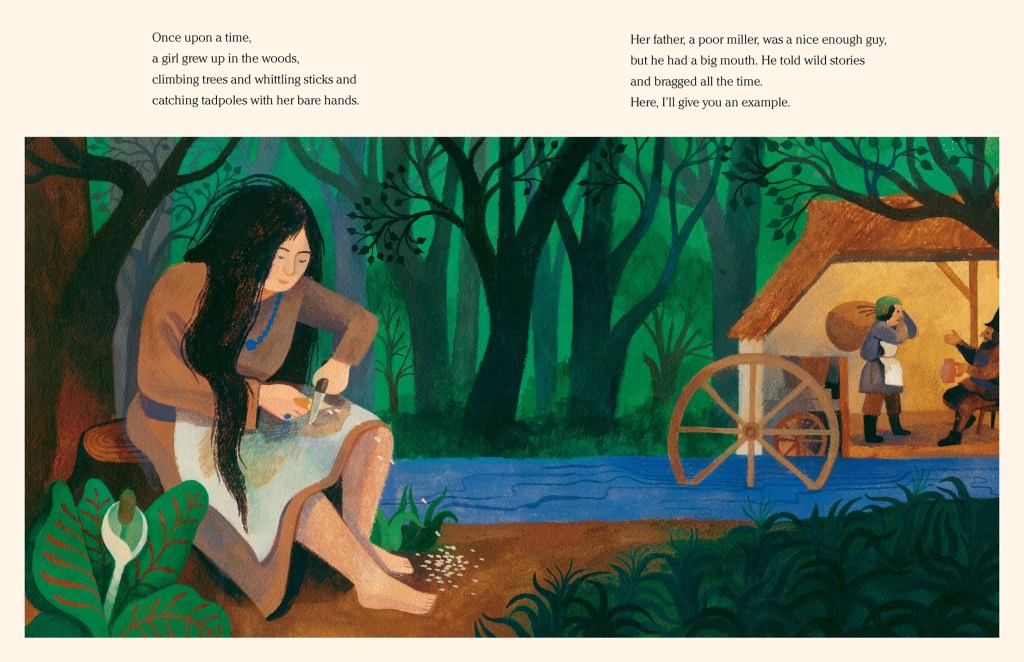
As many fairy tales do, this one begins with a poor girl and her struggling father. Older readers familiar with the genre may anticipate a change in social and economic class, but younger ones may not.  This girl is highly capable, “climbing trees and whittling sticks and catching tadpoles with her bare hands.” Ellis shows the young craftswoman intent on her work, with her father a distant figure in the background.  He is a miller, but, although that is his professions, Barnett gives him a distinct, and irritating, personality. He has a “big mouth” and he brags. Life cannot be easy for his daughter.
The miller is either so socially inept or so bold, that he strikes up a conversation with the king, who is passing through town. This king is no more humble than his working class subject; Barnett reports that he is “chewed on a pheasant wing,” and “took a sip from a chalice,” as he casually strikes a deal with the miller to, possible, marry the laborer’s daughter.  The king is a hard man to impress. Neither beauty nor personality strike him as unusual. But when the miller claims that his daughter can spin straw into gold, the king is sold.

Soon the girl is living in a castle, where she learns that there are two possibilities for her future in this nightmarish scenario of the patriarchy. She will either produce the gold or be killed.  Before long, Rumpelstiltskin shows up, although she knows him only as “the little man.” Psychologically, he isn’t diminutive, but, rather, truncated.  Taunting her with his amazing ability to actually turn the straw into gold, he demands successively greater payment for saving her life. Eventually, his price is her first-born child.

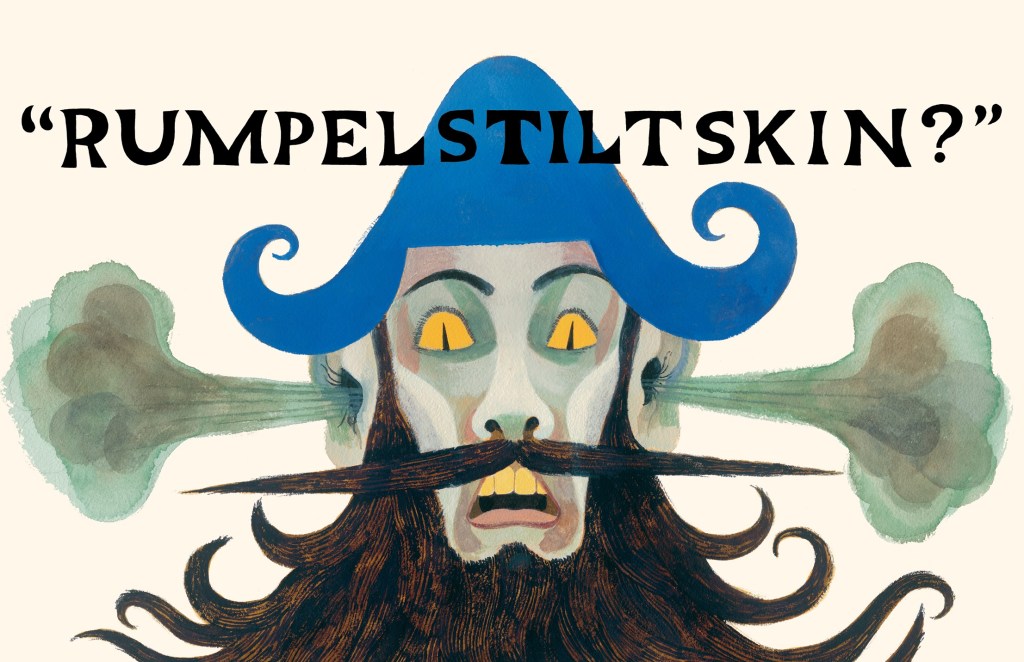
As people will do, the girl, now a queen, puts this terrible eventuality out of her mind. She has a little boy, and her love for him is so absorbing that she cannot imagine that her tormentor will force her to make good on her desperate promise.  Among other elements, Rumpelstiltskin is a story about the power of language.  The man returns, and tells the queen that she has three days to guess his name.  Of course, he assumes that she will never be able to come up with his odd moniker, and the three days allow him to indulge his cruelty. Barnett and Ellis weave words and text together in a cascade of colorful guesses. “Cuthbert, Argyle, Ludvig, and Boniface,” are all possibilities, rolled out on Ellis’s elegant scroll of cursive words.  The list grows to three pages, placed against white space for maximum effect. “Nidnod, Sheepshanks, and Lancelong” are all rejected. The queen’s son has the modest name of Tom, after both his father and grandfather, which, as Barnett points out, would not seem to deserve the honor. 

Improbable events happen in fairy tales.  The queen’s final guess causes smoke to spew out of Rumpelstiltskin’s ears in rage. The combination of fantastic and plainspoken words and imagery gives this version of the tale an inimitable twist.  The queen survives, even if the men in the story are never held accountable for their stunning selfishness.

Pride and Resistance

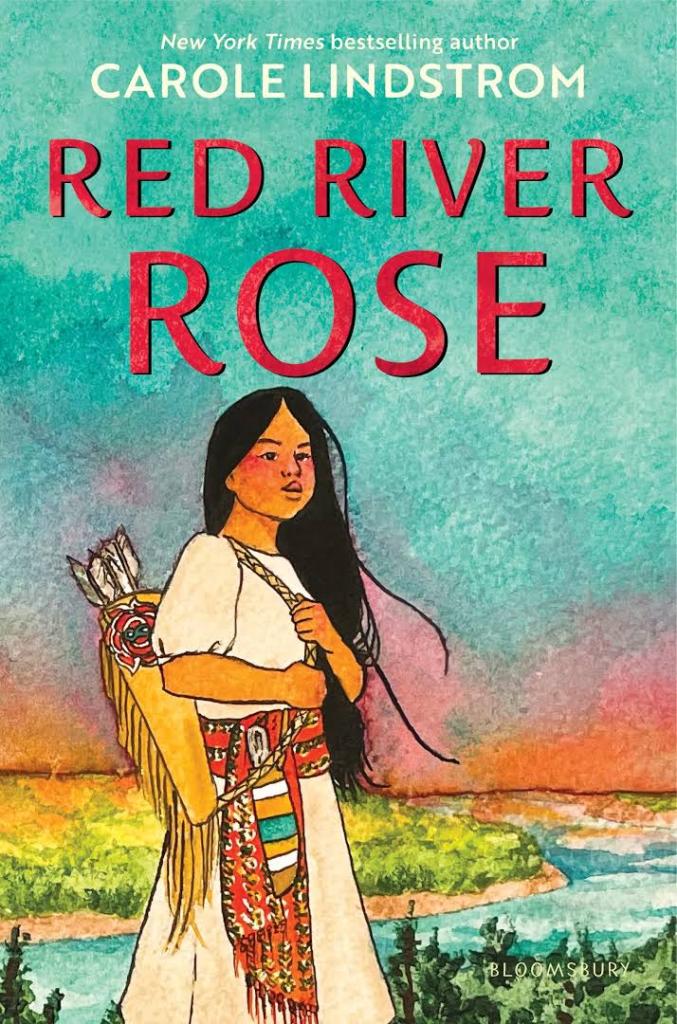
Red River Rose – Carole Lindstrom
Bloomsbury Children’s Books, 2026

In Red River Rose, Carole Lindstrom further develops the characters she presented in her picture book with Aly McNight, The Gift of the Great Buffalo. As Lindstrom explains in her author’s note, Rose’s story is rooted in a commitment to telling a story related to Laura Ingalls Wilder’s Little House books, from an indigenous perspective. Lindstrom’s work is not a refutation of Wilder’s, but her own, original, interpretation of the conflicts between settlers of European origin and the original inhabitants of lands in the Americas. Red River Rose is set during the late 19th century, specifically the North-West Resistance in Saskatchewan of 1885. At that time, First Nations and Métis peoples fought the Canadian government’s seizure of their lands.

Lindstrom’s distinctive narrative style is compelling. Her characters are individuals, not archetypes. Rose frequently refers to the moral ambiguities inherent in her choices, including that of armed resistance. Her father is courageous, particularly in comparison to other men in the community, and to Catholic clergy, who caution against resistance and advocate a passive acceptance of the Métis’s seemingly hopeless determination to reclaim their land. Rose’s mother is equally strong, holding her family together through deep love and a command of essential domestic skills.

Rose visualizes the beauty of her land and community, and Lindstrom’s poetic language communicates to readers the roots of the Métis’ intense identification with their home. “Rose wanted to burn the memory of the ferry sitting atop the sparkling water and the hawks soaring off in the distance into her brain forever. If she were a painter, she knew exactly what she would paint.” That identification allows her to counter the contempt of teachers or religious leaders who warn against the Métis’s struggle, warning Rose to “keep that talk at home” when she raises the possibility of fighting against oppression.

Ambroise, a boy Rose’s age, is her companion and equal; the two work together to devise plans that will support those adults who will fight against the government. Eventually, Rose assumes an active role herself, forced by circumstances to blur the boundaries between childhood and adulthood. Rose is highly intelligent; nothing in her character suggests duplicity, but she learns to use every skill necessary to acquire information, communicate it to others, and make her own decisions. Her father’s increasing trust in Rose affirms her choices, as when she remembers having supported her people by helping to locate a herd of buffalo. At that time, her father’s response was a complex mixture of anger at the risks Rose had taken, and gratitude for her bravery.

That conflicted response takes form in Rose’s consciousness. Her father reports the Métis battle against the Canadian Mounted Police, characterizing the fight as “a thing of beauty.” At the same time, Rose experiences grief for everyone’s losses, even for the Police and their families. She also recognizes the potential for change, as when “mean girl” Melanie, who had shown only contempt for the idea of resistance, begins to seem like a different person. The impact of fear and suffering had brought out aspects of her character that Rose had never seen. “Under different circumstances, she could learn to like Melanie.”

Victory has different forms. Although they did not achieve their ultimate goal, Rose, her family, and her community had the integrity to stand up “for themselves, for their homes, and for their way of life.” Red River Rose is not a story of glorious triumph, but of the refusal of individuals working together to protect what they love, and to sustain their vision of justice.

Cats Scratch If You Hold Them Too Tight

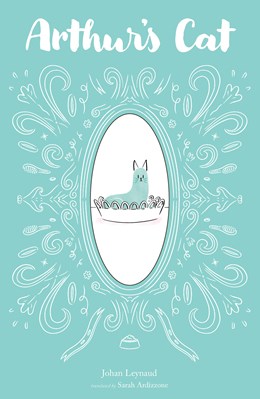
Arthur’s Cat – written and illustrated by Johan Leynaud, translated from the French by Sarah Ardizzone
Eerdmans Books for Young Readers, 2026

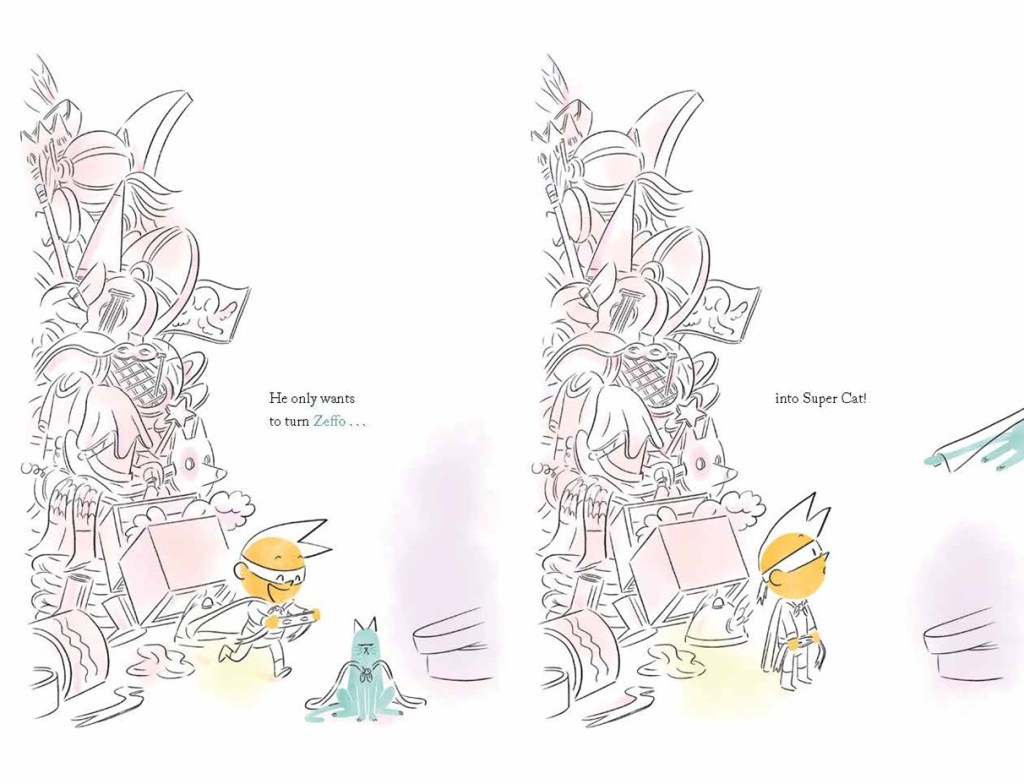
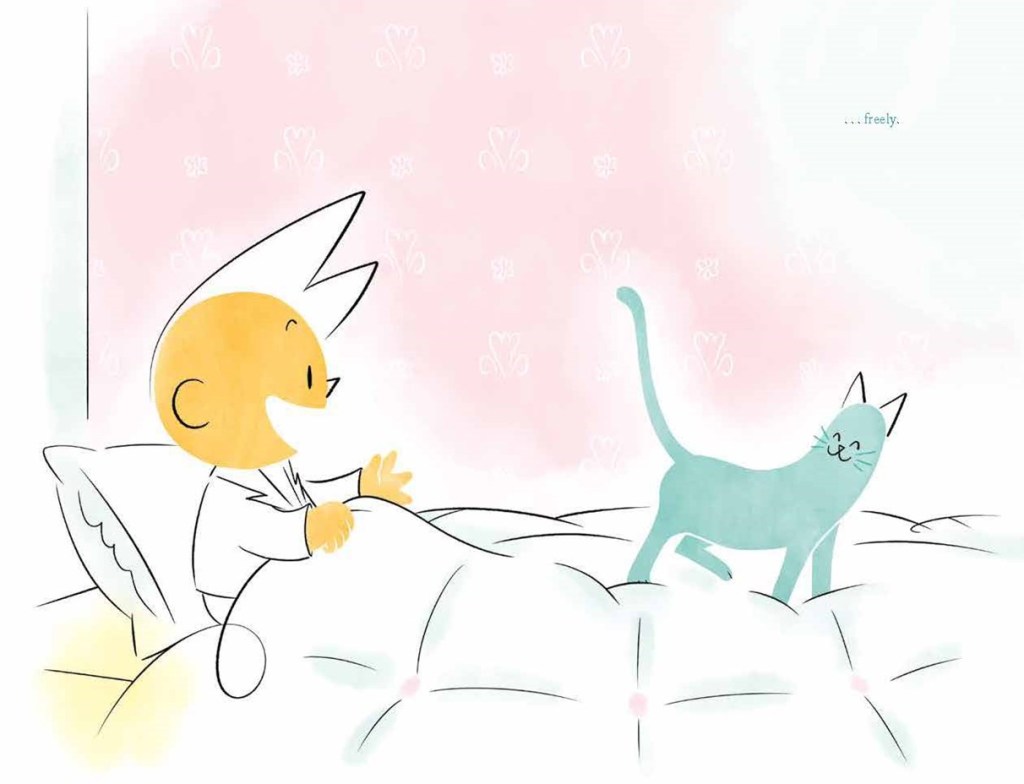
Arthur is a little boy who loves his cat, Zeffo. They are inseparable. The problem is that boy and cat have somewhat different definitions of love. Arthur would like to hold Zeffo tightly and read to him. But he also insists on styling Zeffo’s fur and applying perfume to him. (images). Arthur’s Cat is a book that helps children to think about what it means to love someone, hardly a unique subject. There are many wonderful books that explore the same idea. (such as this and this.). Johan Leynaud’s text and artwork are distinctive. The pictures, rendered in pencil, ink, felt, and pen, and digitally, are simple and luminous, conferring a dual quality which makes them both realistic and strikingly stylized. The book is beautiful, without a trace of preachy sentimentality.

Most of each scene is in black and white, with pastel touches. Zeffo is sky blue, and Arthur has a gold face and limbs. His hair and clothing are white, outlined in black. Leynaud’s use of line is so skillful that each picture seems to emerge fully realized. A pyramid of cluttered objects rises to the left of a page, and Arthur gleefully runs towards his beloved cat. Zeffo objects to being forced into a superhero costume and flies off the facing page. At the same time that the images are reminiscent of animation, there is a stillness to each picture, encouraging the reader to respond to each one individually.

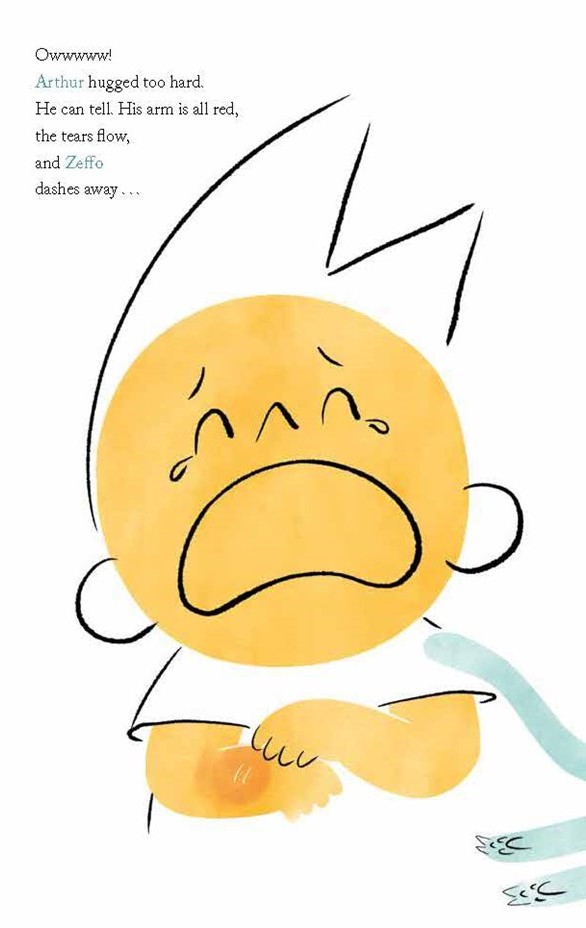
Composition is key to establishing contrast between boy and cat. Arthur jumps into the air, hoping to have fun with Zeffo, who sits on a tree branch, refusing to join in Arthur’s momentum. A game of hide-and-seek is an incentive to escape for the desperate cat. Finally, Zeffo has reached his limit and scratches Arthur, leaving a visible wound. Even the light red on Arthur’s arm seems, in the context of his previous uncomprehending happiness, serious enough. He is in tears.

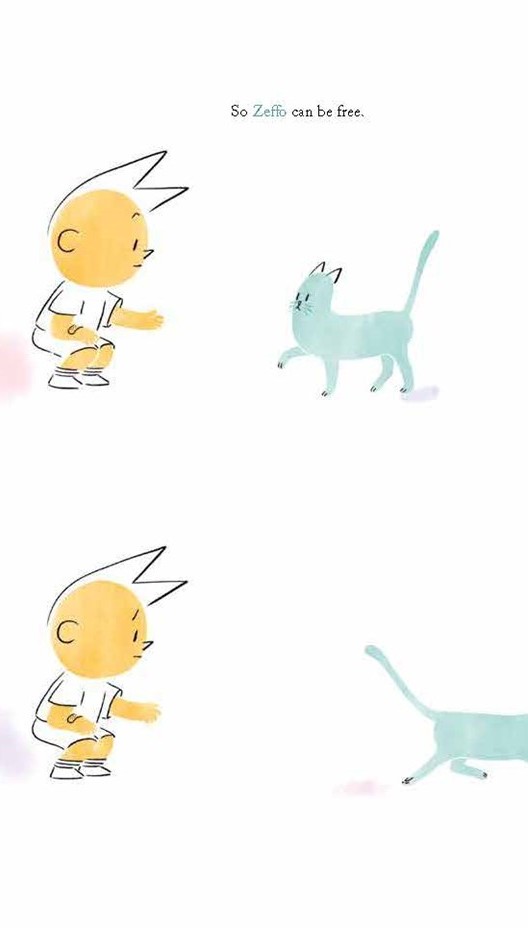
Eventually, Arthur and Zeffo reconcile. The boy has begun to realize that love doesn’t confer the freedom to subject his pet to constant control. Zeffo also recognizes that he needs Arthur. This idea is visualized in a scene of tentative approach and flight, where Zeffo seems open to playing with Arthur but, once again, turns from him, his body divided as he escapes the page. Leynaud grants Zeffo the freedom to “hang back,” and even “be suspicious.” There is gentle humor in a picture of the boy crawling along as shower curtain rod and the cat turning his head to look at him, although it also seems dangerous! It’s fun to play, but when the game is over, Arthur again resists the confines of the page.

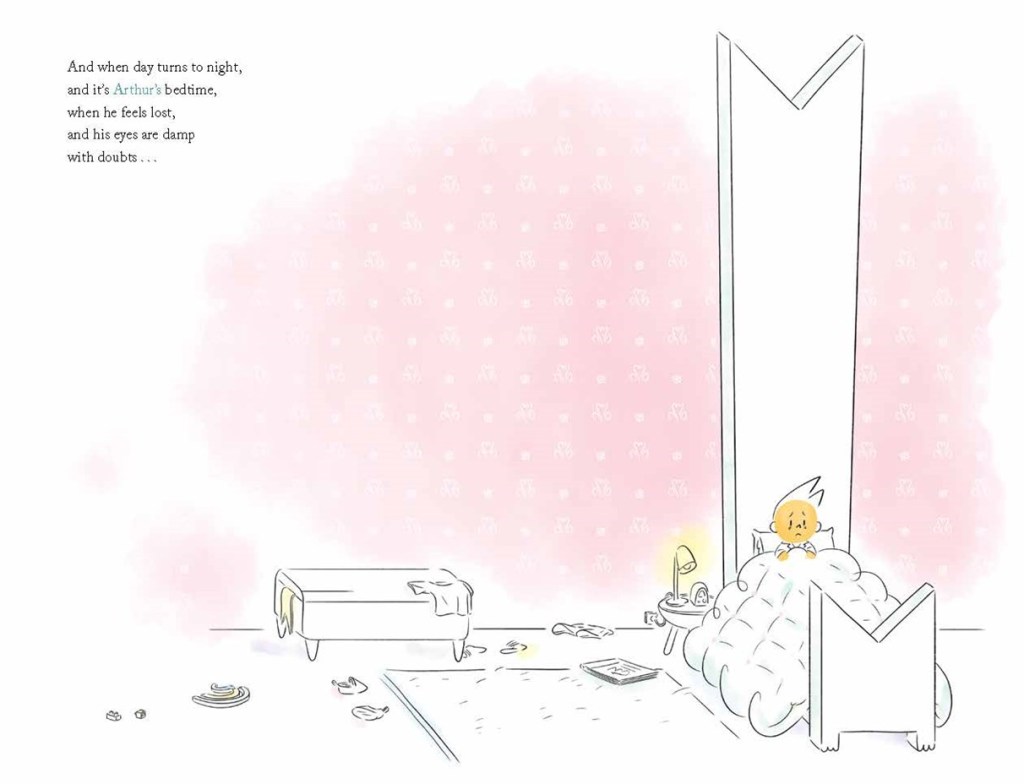
An anxious Arthur sits up in his elaborate bed, in a picture that calls to mind the illustrations for James Thurber’s Many Moons, by either Louis Slobodkin or Marc Simont. The enormously high headboard on the right side of the page seems ironic in light of the minimalist disorder of objects to the left. When Zeffo climbs up onto Arthur’s fluffy quilt, the patience of both boy and cat has been rewarded.

Not Here to Cause Trouble

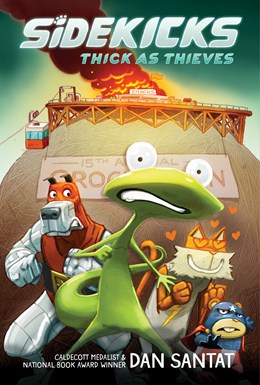
Sidekicks: Thick as Thieves – written and illustrated by Dan Santat
Scholastic Graphix, 2026

Sidekicks: Thick as Thieves, is the second volume of Dan Santat’s Sidekicks series.  This graphic novel combines frenetic action with thoughtful dialogue about some serious questions. Among these are the nature of families, the difficulty of making tough decisions, and accepting that no one is skilled at everything he or she tries to do. And for adults, add to that list how difficult it might be to retire, even if you are a superhero.

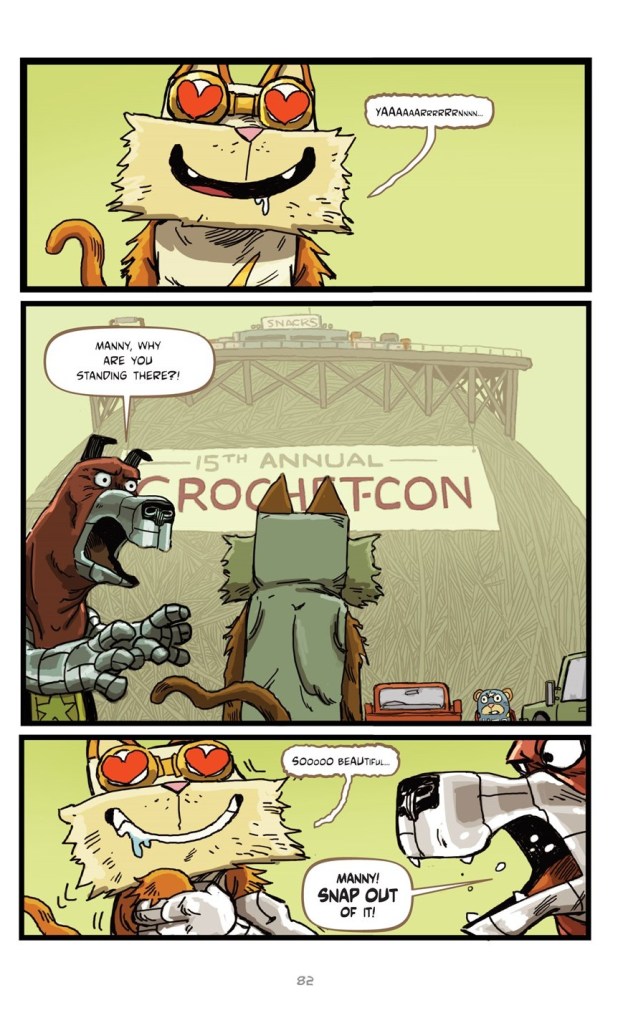
When the book opens, Captain Amazing, also known as Harry James Blake, is about to, reluctantly, take a vacation. His sister Kelly is accompanying him to Crochet-Con, a convention of hobbyists that includes the display of a gargantuan ball of yarn.  Harry has recently taken up the hobby, and he‘s not good at it. He won’t win any prizes, except for participation. But he’s getting older, and now that his peanut allergy has been revealed by his nemesis, Dr. Havoc, his superhero days have been further compromised.

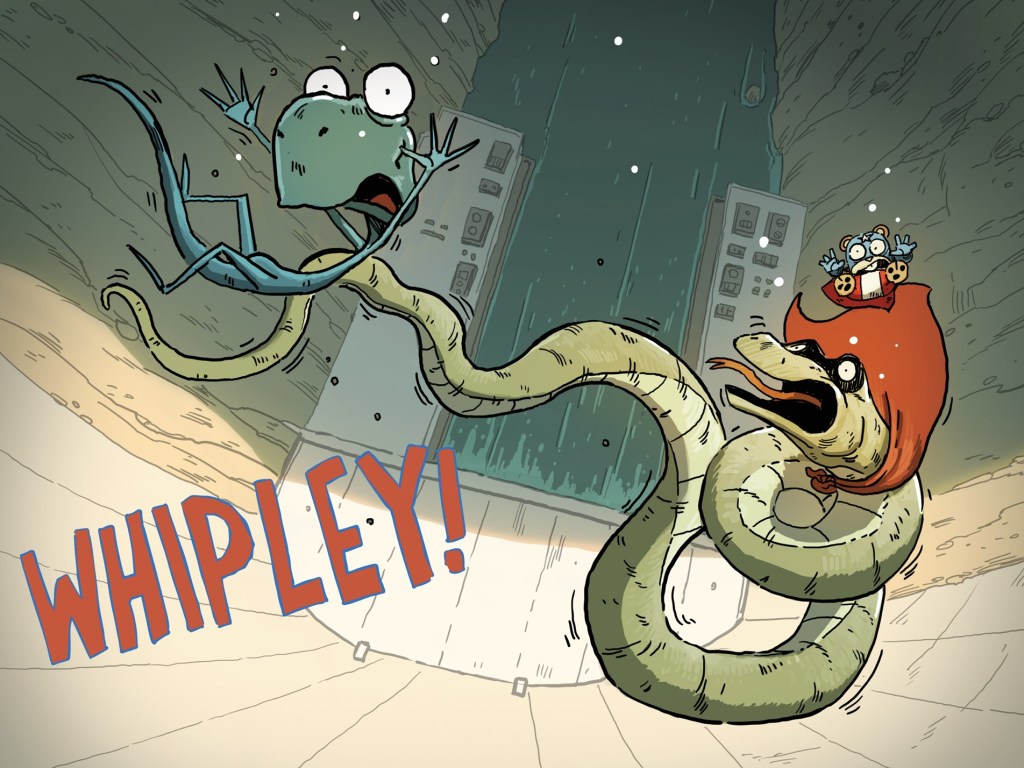
Meanwhile, back at the Society of Superheroes, there has been a data breach, and also a possible betrayal.  Shifty, Roscoe, Manny, and Fluffy are trying to put the pieces together, and Shifty’s brother, Whipley, makes a surprise appearance. The two siblings are thick as thieves, sort of. Shifty looks up to Whipley as a paternal figure, but in a complex series of revelations, it turns out that Whipley’s morals are rather flexible. Is anything and everything permitted if someone claims that he is only taking questionable actions to care for someone he loves?

Santat’s bad guys are scary, and the damage they inflict shows viscerally on their victims’ faces. Classic superhero action and robotic terror are confronted by gentle animals, confused, but also clever.  When Manny confesses his insecurities to Roscoe, “But I was worthless at the world’s biggest ball of yarn…I made careless mistakes,” Manny’s canine friend reassures him: “I have, too. That’s why we work together. You got my back, and I got yours.”  Santat’s gift for neatly summarizing difficult issues is visible here, as in all his books. Without a trace of condescension, he reminds readers that no one is perfect, but, just maybe, good can still defeat evil.

Fairies Have Problems, Too

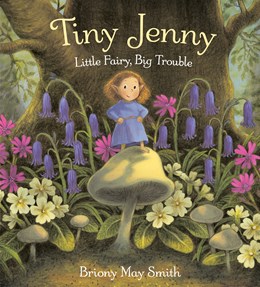
Tiny Jenny: Little Fairy, Big Trouble – written and illustrated by Briony May Smith
Anne Schwartz Books, 2024

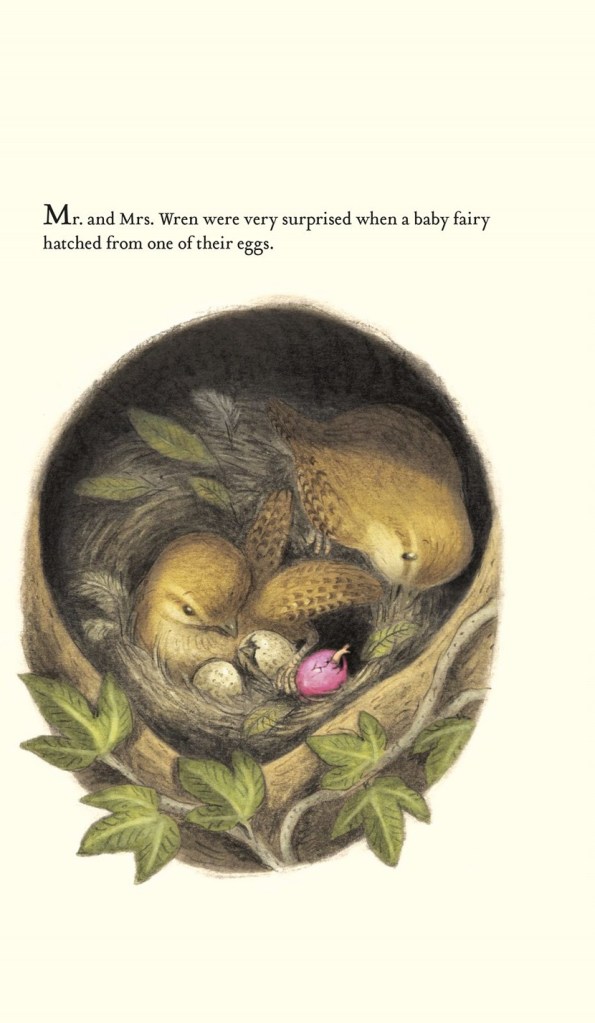
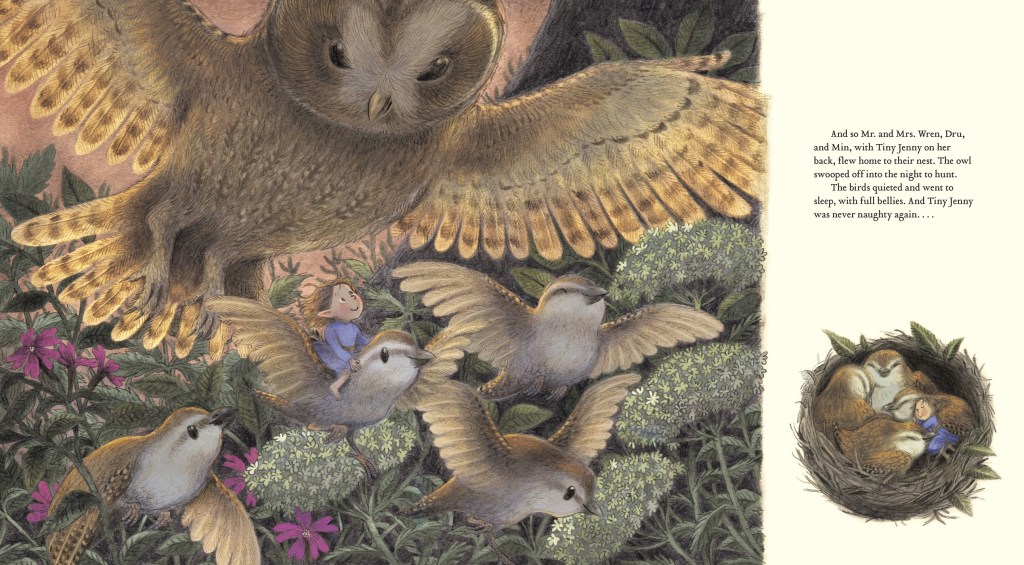
Briony May Smith‘s Jenny is a changeling, a fairy hatched from a wren’s egg, much to the family’s surprise. She has no wings, sort of like the reverse of Horton’s long-anticipated newborn in Horton Hatches the Egg. Like Hans Christian Andersen’s Thumbelina, she has to navigate her way through a dangerous world.  There are many lovely books about fairies who have a range of origins and play a variety of roles (see my reviews here and here and here).  The wrens name her Tiny Jenny and dedicate themselves to raising her, but perhaps not thinking through all the potential problems.

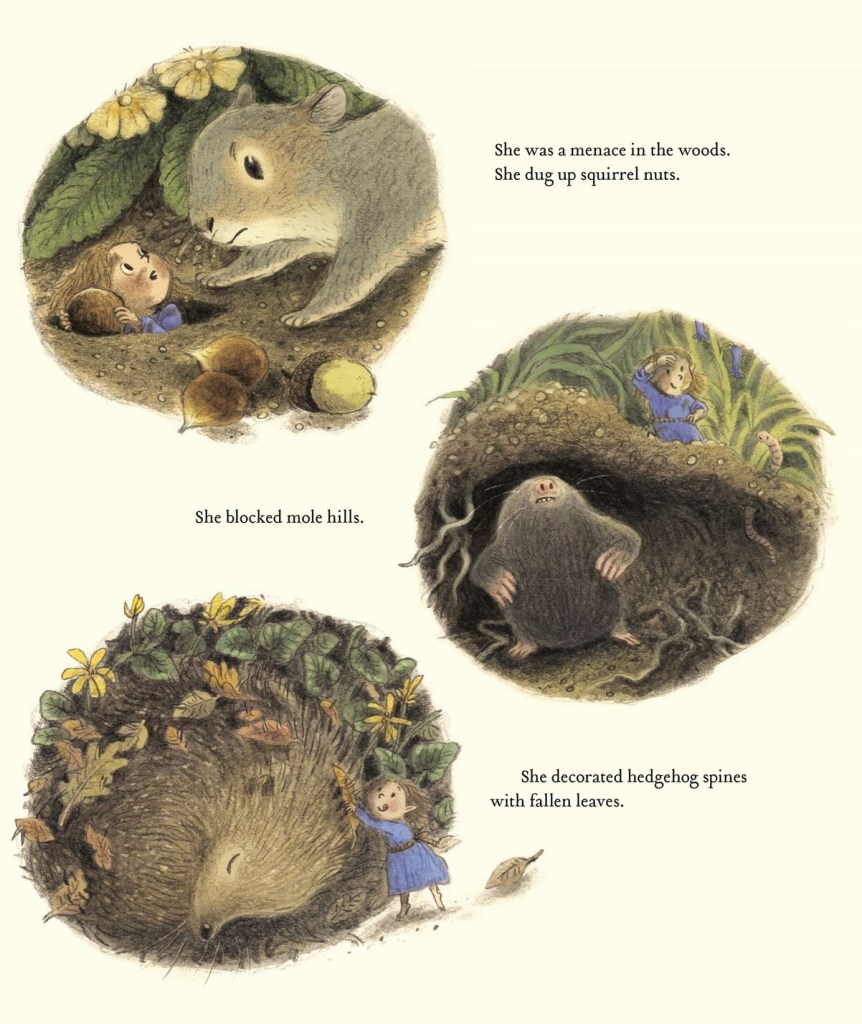
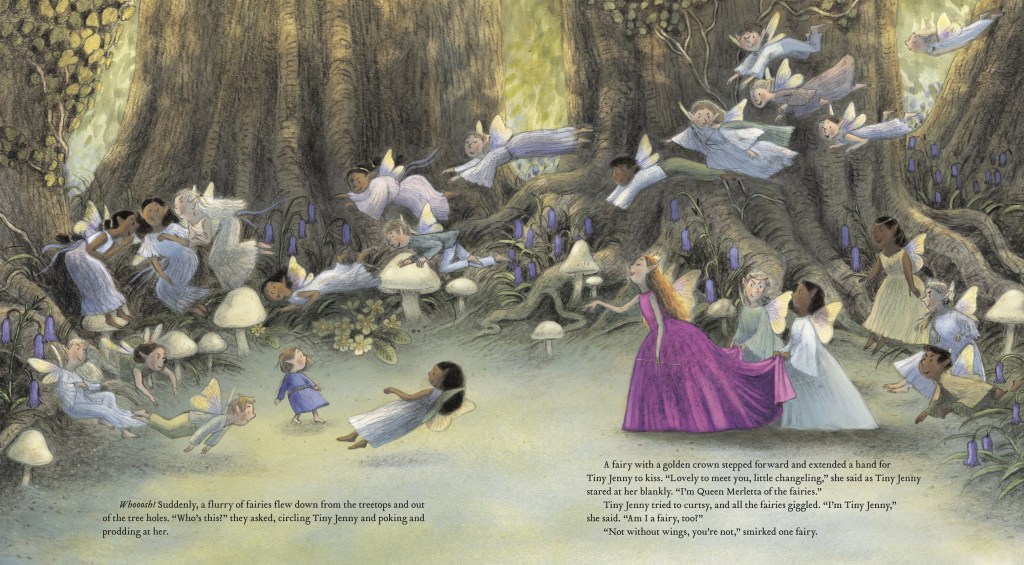
Wrens can fly, but wingless Jenny cannot. She manages pretty well, finding stems and brambles to eat, and even decorating her friend the hedgehog with leaves. Not every part of her day concerns survival.  One day, Jenny overhears some of her woodland friends, or least creatures she had thought were her friends, talking about her.  It isn’t pretty.  They find her most endearing traits to be annoying. When a wise owl uses his renowned quality to point out that she is not a wren, but a fairy, he also encourages her to go out and find some of her own kind to prove her true identity. She stumbles into a fairy ring, an action generally associated with bad results, at least for non-fairies.  She is pictured among a circle of oversized, from her point of view, mushrooms, as she looks up quizzically. All of a sudden Tiny Jenny finds herself surrounded by fairies. There are boy and girl fairies, ones in flowing dresses and others in trousers.  They move effortlessly because, unlike Jenny, they have wings. These fairies are not so nice. They prod her skeptically. Merletta, their queen, extends her hand to Jenny for the required kiss. Naturally, “Tiny Jenny stared at her blankly.” One fairy actually smirks at Jenny’s confusion, and her lack of wings.

The solution to her problem seems imminent, as Queen Merlette assures Jenny that she only needs wings in order to complete her fairy transformation.  Then come those ominous fairy tale words: “But first you must prove yourself worthy.” What follows is a kind of mild fairy hazing.  Jenny is relegated to the back of the line of fairies wielding wild garlic and bluebells. Disillusionment follows, as Jenny learns that fairies are not nearly as nice as wrens. Instead of foraging for food, they steal. Queen Merletta is a proto-dictator, calling out commands to “ATTACK.” When they inform Jenny that she has passed their test, she responds with the self-assurance rooted in the unconditional love of her wren parents. “No, I don’t want to be a fairy,…You’re mean, you’re bullies.” Jenny doesn’t care about getting wings anymore. Soon she is home, eating mushrooms, and sleeping in her nest, while reserving the right to occasionally be restive and annoying. There’s no place like home.

Into the Woods

Camp Monster – written by Kate Messner, illustrated by Falynn Koch
Bloomsbury Children’s Books, 2026

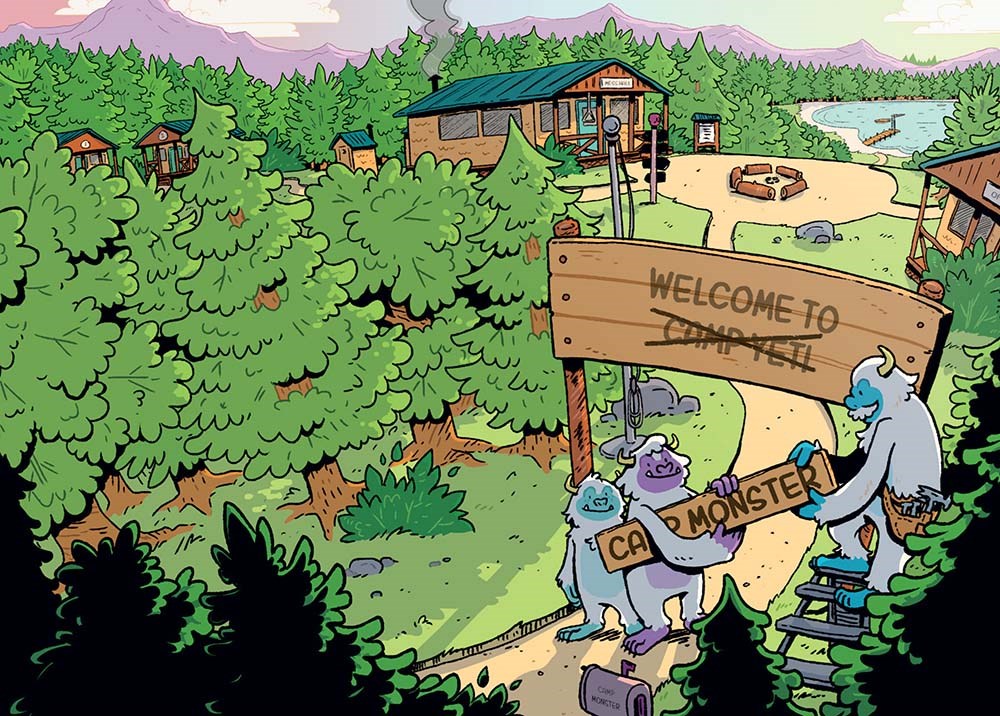
Too many people, not enough yetis. At least that seems to be the problem when Tasha’s parents decide to re-launch the summer camp that had served their species.  Only by welcoming a more diverse group of monsters will they have a chance of success.  Tasha describes this dilemma in a letter to her Gramp Abominable. She is consumed with excitement about sharing the experience of his own youth, even with her mother’s ominous warning about humans lurking in the woods, ready to spoil their fun. Kate Messner and Falynn Koch’s graphic novel about a camp populated by yetis, goblins, vampires, and griffins describes everyone enjoying a harmonious time together.  Not really.

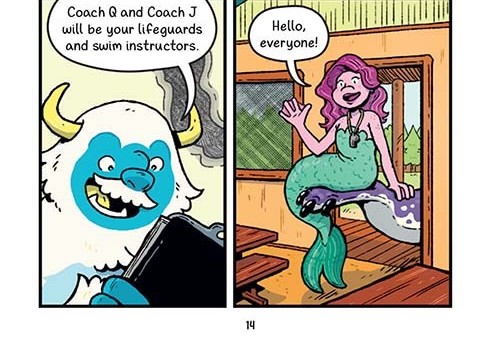
The prominently displayed Code of Conduct for arriving campers lists some familiar dos and don’ts, along with other prohibitions, such as “No turning your fellow campers into frogs or anything,” and the seemingly aspirational, “We treat one another with respect at Camp Monster.”  The swim instructor is a mermaid, which certainly sounds more promising than Ms. Sphinx, the cafeteria manager.  Imagine having to answer a riddle, with dangerous consequences, before you can eat. 

Interspersed with comic strip and word bubble pages are profiles of campers and letters home.  The expectation that everyone would get along turns out to be unrealistic, what with goblins creating a robotic monster out of spare parts, and Lupo undergoing weird metamorphoses.  Isabelle, an ogre with an artistic soul, has a countercultural preference for the feminine term, “ogress,” which “sounds much more elegant.”  She hates sleeping in a rustic cabin, but is convinced that the lead role in the camp musical will be awarded to her.

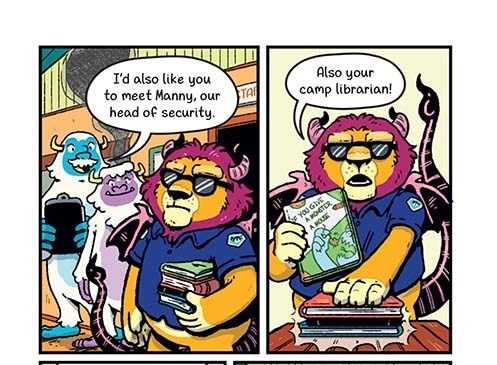
There are some restrictions on projects in Maker Space: no magic allowed. But the camp librarian, Manny, has a well-stocked literary treasure house of classics such as If You Give a Monster a Cookie, One Ogre, Two Ogre, Red Ogre, Blue Ogre, and The Very Hungry Cyclops, with remarkably familiar cover art.  When swimming lessons seem unfairly biased against the more aquatically challenged monsters, the instructor decides to accommodate everyone, defining success according to effort. 

There is a point at the center of all the fun.  Humans, or least evidence that suggests their presence in the woods, become a frightening possibility.  No one is sure, but where there are horse’s hoof prints and candy wrappers, can humans be far behind?  When the terrified campers decide to build a wall, and force the alleged humans to pay for its construction, Tasha the warm-hearted yeti points out that walls are “ineffective.” Some monsters have more common sense than others.  There are some surprises in the plot, and humor for both young readers and adults.  Summer camp can be a time for relaxation and growth, as well as fear mongering and terror.  At the end of the first session, there are some loose ends, but also campers who are eager to return.

Bright But Fragile

Penelope’s Balloons – written and illustrated by Brooke Bourgeois
Union Square Kids, 2024

Children can become attached to unexpected objects. Some, like balloons, have a limited life span. In Penelope’s Balloons by Brooke Bourgeois, a young elephant who is “quiet…bright,” and “a bit particular,” cannot let go of ten red balloons, either literally or figuratively. She is happy lying on her back and watching them suspended in the air, but also keeps them close while eating or diving.

From the beginning of the story, it seems evident that there will be both a problem and a message here. Penelope’s balloon obsession does not prevent her from socializing, In fact, she has many friends of different species. The balloons only make her more “perceptible” and popular, to choose another adjective that is alliterative with her name. The problem is the fragile nature of her favorite item.  Her best friend, Piper, is a hedgehog; say no more. Allie is an alligator with sharp teeth. On the other hand, Gerry the giraffe is a good friend to have, her long neck offering some protection from potential piercing. 

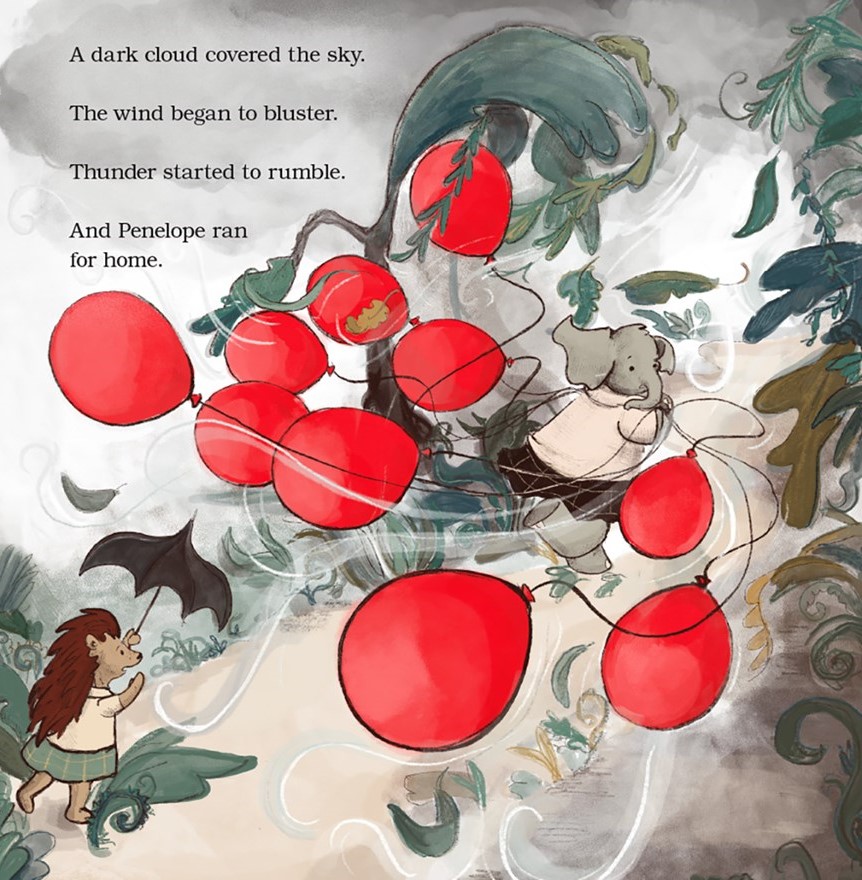
Eventually, Penelope learns the inevitable lesson about avoiding disaster. Sometimes you cannot.  A thunderstorm does not have functional points, but it’s invisible winds can still destroy. Forlorn, Penelope shelters in the forest. She is alone. This picture has no bright red to contrast with the gray and green foliage. Even her friend Piper’s comforting words cannot erase Penelope’s grief.  As Piper leads her across a thick branch serving as a bridge, the young elephant is hunched over, her ears falling like flaps over her face. All of a sudden, she seems old.

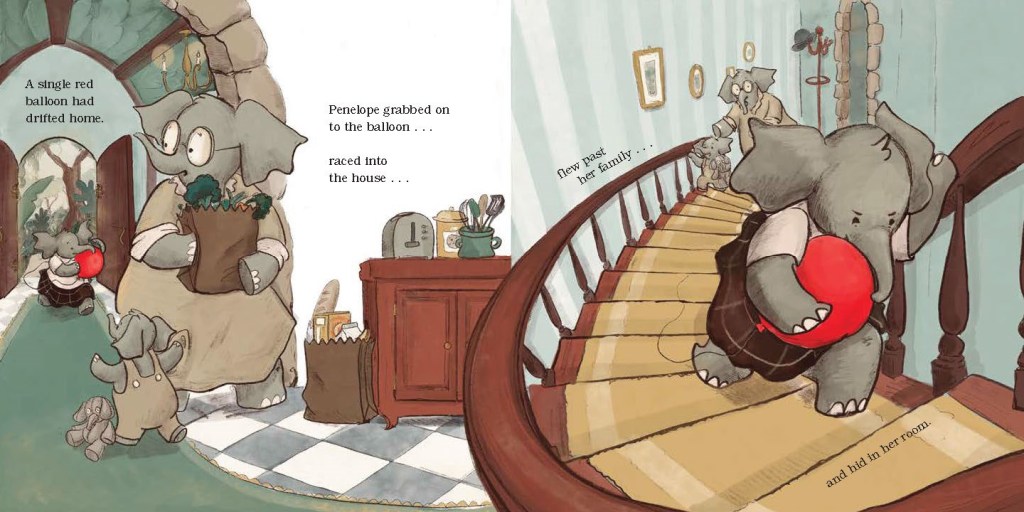
Arriving home, Penelope stands in front of the doors and rushes in. One balloon has survived and accompanied her. Now we meet her parents. Her mother seems almost confused, which is surprising. Surely her family is well-aware of her balloon problem. There is an expressive scene, viewed from the top of the staircase, of a determined Penelope racing her room.  Her mother and younger sibling are small and helpless figures receding into the background.

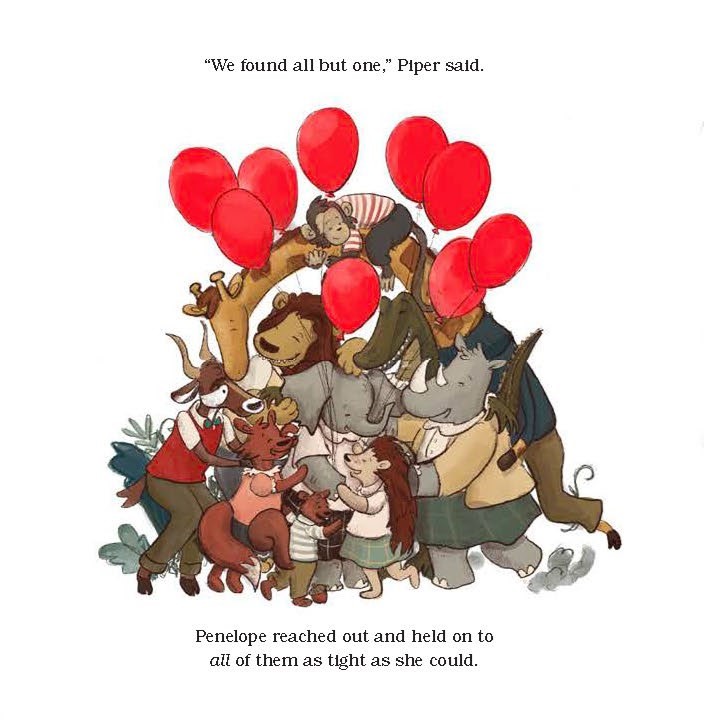
Penelope frantically sets to work creating an elaborate fort to protect the balloon. Her intense anxiety foreshadows the upcoming disaster, as well as the solution.  Sometimes, with patience, things will work out. The likelihood of this scenario, with the other nine balloons all magically reappearing, seems like pure wish fulfillment (as in Claire Keane’s Love Is). However, Penelope decides that giving her balloons, or, by extension, any beloved, a little space, is the best way to keep them close.  The author also suggests that Penelope’s strange attachment had actually been distancing her from her actual friends, “the sharp and spiky ones” who posed a threat to her happiness.

A word about Babar seems required. Any children’s book presenting anthropomorphized elephants seems, to some extent, an homage to Jean and Laurent de Brunhoff.  Certainly, some of her animal friends include monkeys, rhinos, and other residents of Celesteville. (Although the rhinos are not bad guys here.) Penelope is certainly less sophisticated and cosmopolitan than Babar, but there is still a sweet reminder of how animals with human qualities offer a unique connection with children.  There is more than one lesson in Penelope’s Balloons, and the book is well-worth sharing with them.

In the Pocket

The Newest Gnome – written and illustrated by Lauren Soloy
Tundra Books, 2025

The Pocket is where the gnomes live, in Lauren Soloy’s remarkable universe of small creatures dedicated to choosing hats, telling stories, and generally explaining and appreciating the world. I was impressed with the first gnome book, The Hidden World of Gnomes, and I’m thrilled that Soloy and Tundra believed in them, and that they merited a second look (I’m also a fan of Soloy’s other work, as you can see here and here and here).  Although the gnome books are rooted in tradition and folklore, they are also new and singular.

When the book begins, the existing gnomes, including Cob Tiggy, Twiggy Dell, Minoletta, and Beatrix Nut, are about to welcome a newcomer to the Pocket.  These creatures, whose names evoke both Beatrix Potter and a kind of cosmopolitan flare (Minoletta, Hotchi-Mossy), need to meet in their mushroom circle to discuss the latest Pocket resident. When Grolly Maru arrives, they sense the need for reassurance, similar to Winnie the Pooh’s helpful and sustaining words: “Everything will be all right.”

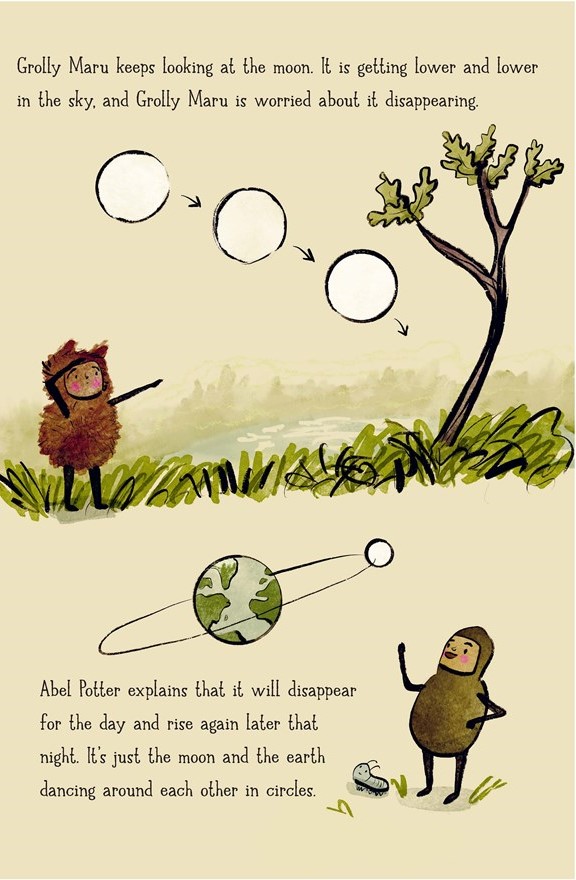
After a good night’s sleep under the mushrooms, the gnomes will be prepared to teach Grolly Maru essential skills. As in Babar’s Celesteville, every inhabitant has a specific job and role to play. When Grolly Maru expresses concern that the changing moon may eventually disappear, does this reflect and anxious personality, or just a basic lack of familiarity with the environment?  It’s up to the reader to decide, but since Abel Potter shows Grolly Maru other round and spherical items from nature, it doesn’t matter.

The pictures feature gnomes interacting with one another, along with close-ups of objects that fill their lives: dandelions, yarrow, marbles, ants, and suggested exercises.  There is a recipe for Bonnie Plum’s baked apple with blackberries, which, considering the scale of gnome to ingredients requires both hardware and strength.  The gnomes are artisans, designing grass baskets: “It’s not as easy as it looks!” (Who would expect it to be easy?). Their overarching purpose is constant fidelity to the idea that each individual is unique, but that we are all part of something greater. Lauren Soloy’s artistic vision is fully realized, in a universe of beauty and comfort, populated by small beings with great wisdom.

Bewitched, Bothered, and Bewildered

The Witching Hour – written by Jennifer Harris, illustrated by Adelina Lirius
Tundra Books, 2025

My mother used to refer to “the witching hour,” that time late in the day when babies, toddlers, and young children seem to act a bit possessed. Whether because they have managed their impulses as best as they can for many hours, or need limits and reassurance, or are just exhausted, this can be a difficult moment for parents. The “hour” may seem like multiple hours.  Jennifer Harris and Adelina Lirius (I reviewed another of her works here) have captured the phenomenon so perfectly in their new picture book that you and your children will be under their spell. Indeed, as Harris solemnly states, “Anything can happen in the witching hour.”

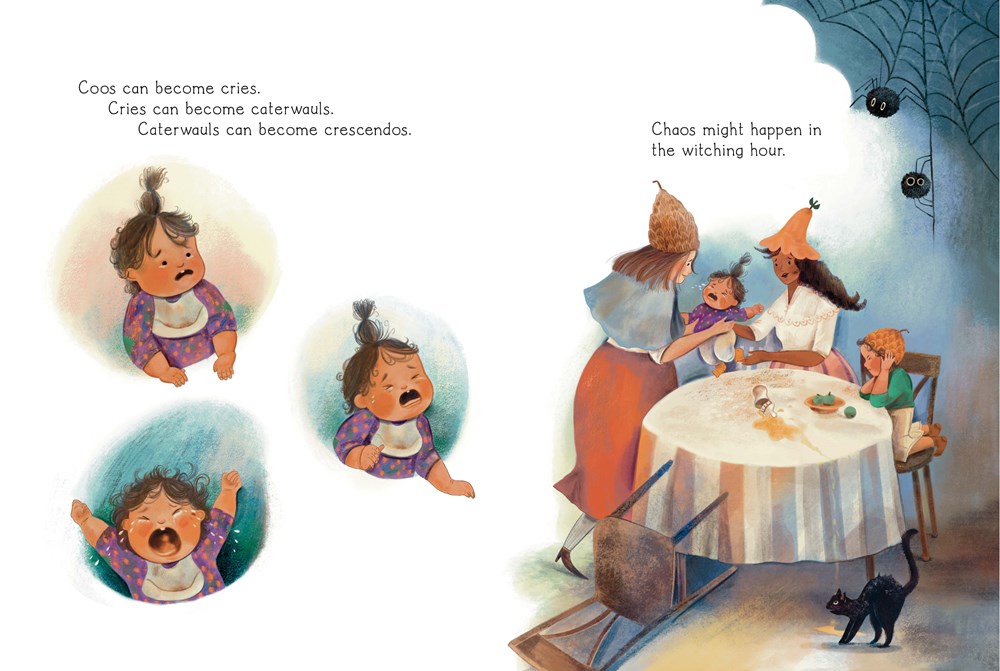
The two mothers in the book are paragons of patience, trying every inventive solution you might imagine, and then some.  First, the acknowledge that anything, “or even nothing at all,” can set the chaos in motion.  A baby overturns a cup of liquid on a table enclosed in a lovely tree trunk. Yes, we all recognize that scene.  An older child wearing an acorn cap looks on, clearly worried about the next phase.  The author is honest in calling it “chaos.” It takes both moms to extricate the screaming toddler from her highchair. An adult chair is overturned, a black cat arches its back, and the sibling covers her ears in terror.

One of the most frustrating features of the witching hour, when it happens, is escalation. “Coos can become cries.  Cries can become caterwauls. Caterwauls can become crescendos.”  Harris uses every figure of speech at her disposal: alliteration, onomatopoeia, literary allusions, rhythm.  Perhaps your child can be calmed by a favorite stuffed animal. The moms try a variety of real wildlife, finally settling on the owl. You know the feeling of relief: “Definitely the owl. Thank goodness for the owl.”

If you were hoping for fairies, you won’t be disappointed.  They arrive and join in the music and dancing, in a kinetic scene of joy mixed with desperation. Lirius’s fabulous pictures evoke an entire universe where the fantastic and the familiar are effortlessly blended. Earth colors predominate and the domestic interiors are as welcoming as those in Dutch still paintings. One mom holds the baby, who looks momentarily transfixed. The other mom is dancing upside down, her feet fixed to a magical broom.  Fairies usually command attention, but here they are a great audience. When the show ends (who could sustain that level of energy), the moms come down to earth. 

There are still many comforting possibilities to try: “this bottle, this banana, this bat.” The moms are creative and full of hope, waiting for the moon to signal that at least for today, it’s time to sleep. Suspension of disbelief sets in for this lovely family of nurturing witches. Tomorrow they we ready to start again, with all the resources at their disposal. For readers, this home of friendly spider webs, baskets of knitting yarn, and a quaint wood stove, seems uncannily real. For the duration of the story, you will be living among friends, and the supernatural is just, natural.