From Generation to Generation

When I’m a Moshom – written by David A. Robertson, illustrated by Corrie Hill
Tundra Books, 2026
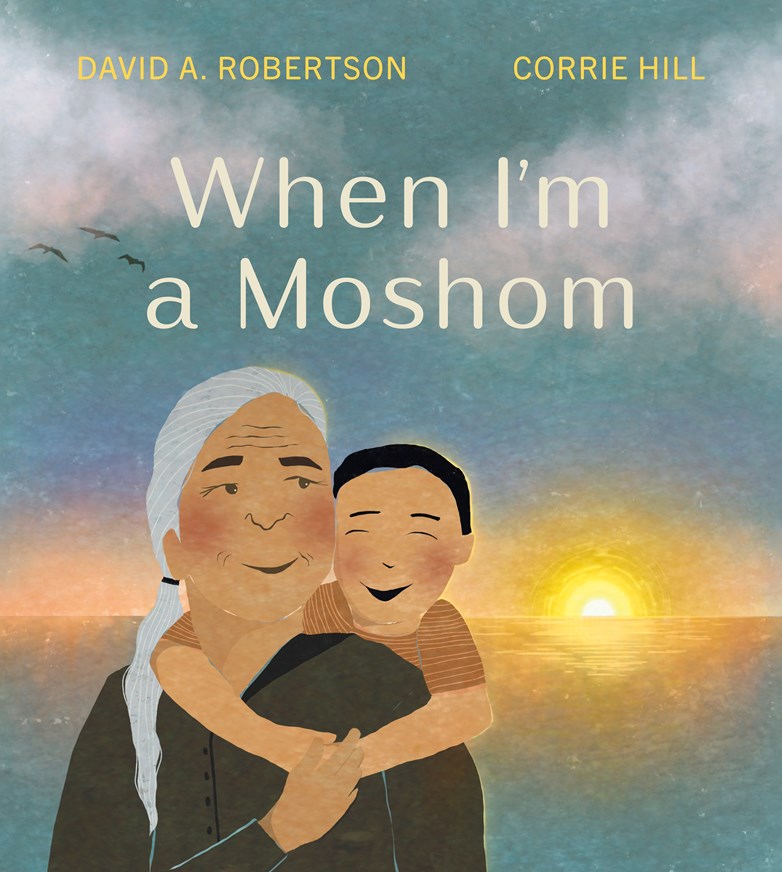
There are many wonderful books about the relationship between grandparents and their grandchildren, but When I’m a Moshom is one of the best I have read.  I chose the title of this post from the Hebrew expression, L’Dor Vador. David Robertson and Corrie Hill’s book is rooted in Indigenous culture, specifically from the Swampy Cree, but also applicable to other communities.  But when I read it, I couldn’t help thinking of the Jewish concept of the respect and love that unites generations and ensures continuity. One of Robertson’s many gifts as a writer (see my reviews here and here and here and here) is his ability to distill ideas laden with the deepest significance into clear and resonant language that children will understand.

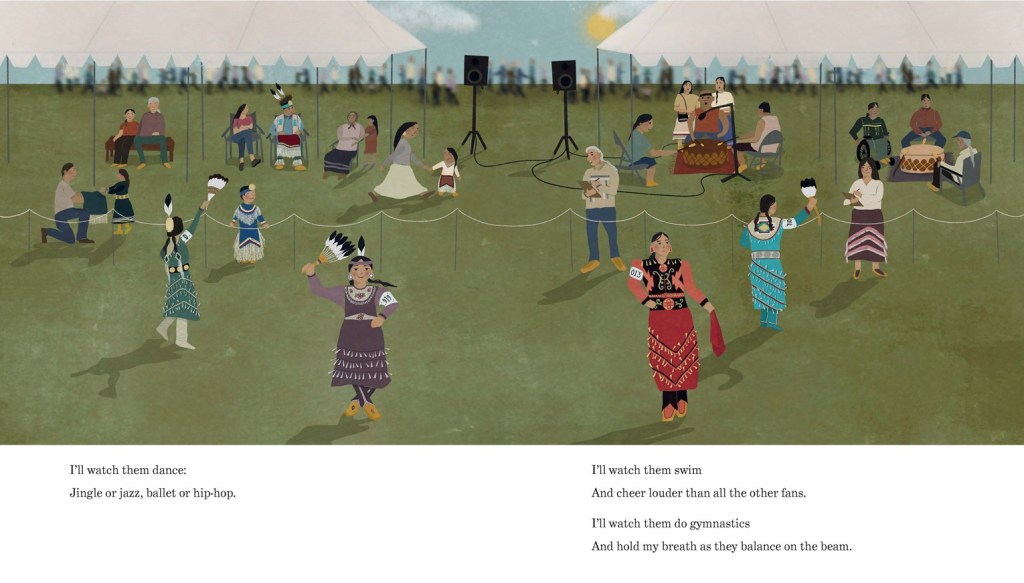
Grandparents, ideally, are an emotional haven for their grandchildren. (see, for example, here and here and here and here and here and here and here and here and here and here and here and here and here and here and here and here). Robertson enumerates why this is so, as he embodies the spirit of his own grandfather, in the narrative voice of a child, but also an adult, invoking the past and planning for the future. In that future, imagined, role, he will attend all their activities. In Hill’s picture, we see children participating in an Indigenous dance performance, small delicate figures in earth and jewel color tones composed against a grassy background. The future Moshom also refers to the broadly popular swimming and gymnastics, noting that he will cheer loudly, but here we see a grandfather, with his long white braid, quietly taking notes as the children dance. He could be scoring their performance according to standards, or noting individual instance of skill and beauty.
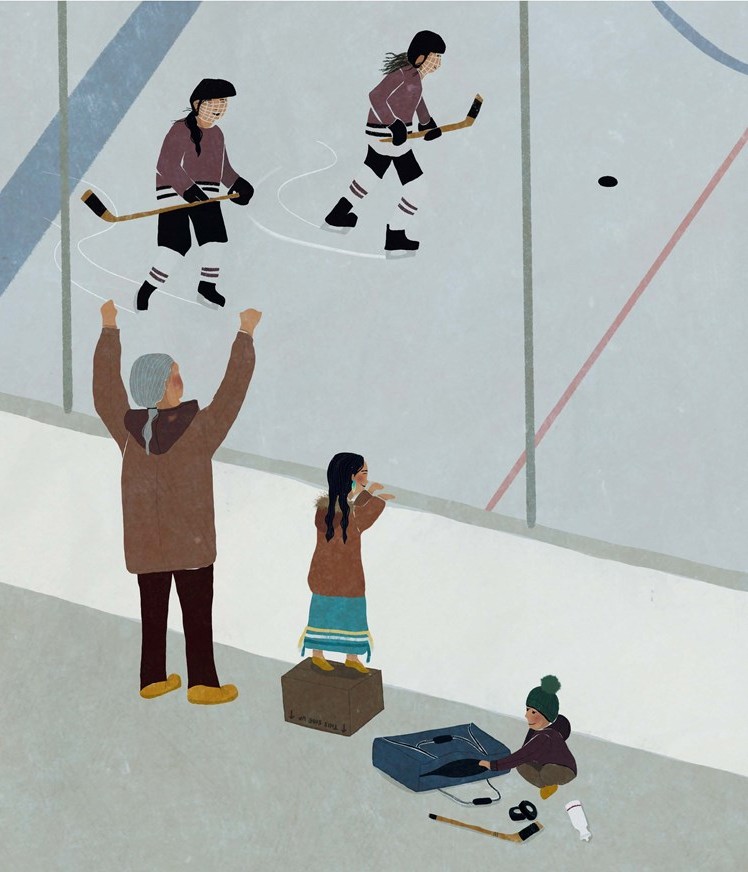
Watching a hockey match played by older children, a younger girl is raised on a stepstool in order to view the game, while an even younger child sits to the side, entranced by the sporting equipment. Moshom is available to everyone simultaneously.  Throughout the book, the balance between universal and particular cultural experiences is understated and implicit.  Moshom sits in a comfortable-looking armchair while three of his grandchildren stand nearby. “I’ll smudge with them in the morning, And we will cleanse our bodies, our minds and our spirits.”  (Readers may want to learn more about the custom of smudging, a specific set of practices involving spiritual support.) The narrator characterizes the “sacred teachings” that Moshom will pass on to his grandchildren, he uses unambiguous language about his purpose: “To help them seek mino-pimātisiwin, the good life. Because Moshom lived that way, so I think I can, too.”  It’s hard to think of a better phrase to encapsulate the preservation of wisdom. (An author’s note, and a glossary help to guide the reader.)
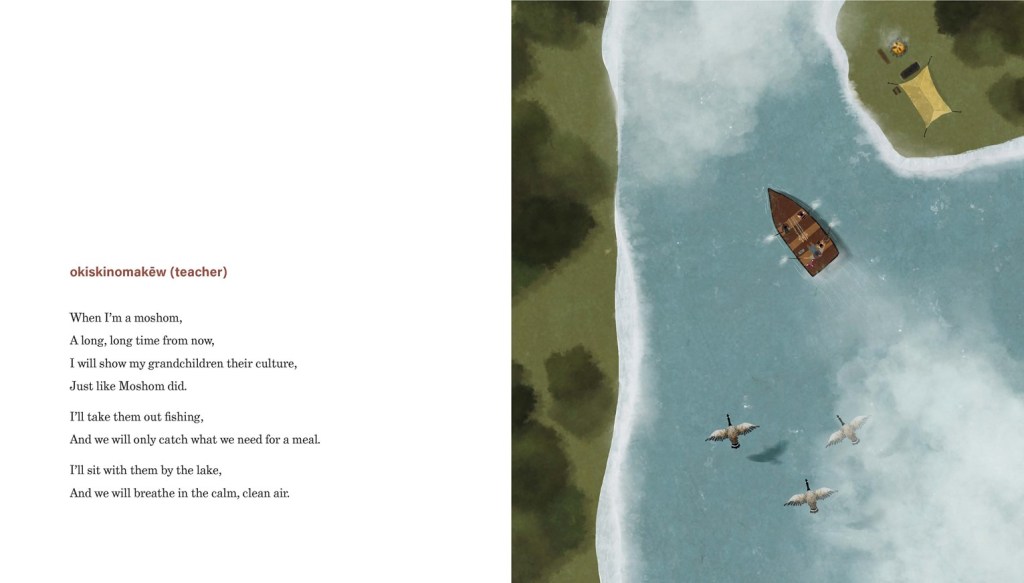
Respect for the environment and the human body is part of a Moshom’s teaching. In Hill’s picture, a bird’s-eye view, a fishing boat moves slowly through the waters, followed by a flight of birds, while an adjacent campsite points to the purpose of the outing. A later scene returns to the campsite, portraying the family holding hands, with the youngest member held in Moshom’s arms.  While the food is cooking, everyone looks out across the water to the hills and trees.  The frenetic activity of multitasking is negated, replaced by focus on what is most important.

The book provokes strong emotions, from grandparents and grandchildren.  Moshom teaches the Cree language by speaking to his grandchildren. “I will speak Swampy Cree to my grandchildren, Just like Moshom did.  I’ll tell my grandchildren, “api,” and they will sit down.  I’ll tell my grandchildren “nīpawē, and they will stand up.” Preserving language is central to all cultural transference.  Again, the specific words will resonate with speakers of Swampy Cree, but also with those who teach and learn Spanish, Chinese, Hebrew, Ukrainian, or any other language.  As I read this page, I heard an echo of the English translation of the Hebrew Shema, which refers to teaching the words to one’s children, and of repeating the words “when you lie down and when you get up.” Of course, I don’t mean to imply that David Robertson was referring to this prayer, but rather that he has conveyed the essence of intergenerational love and commitment, inclusively of any tradition.
Pride and Resistance

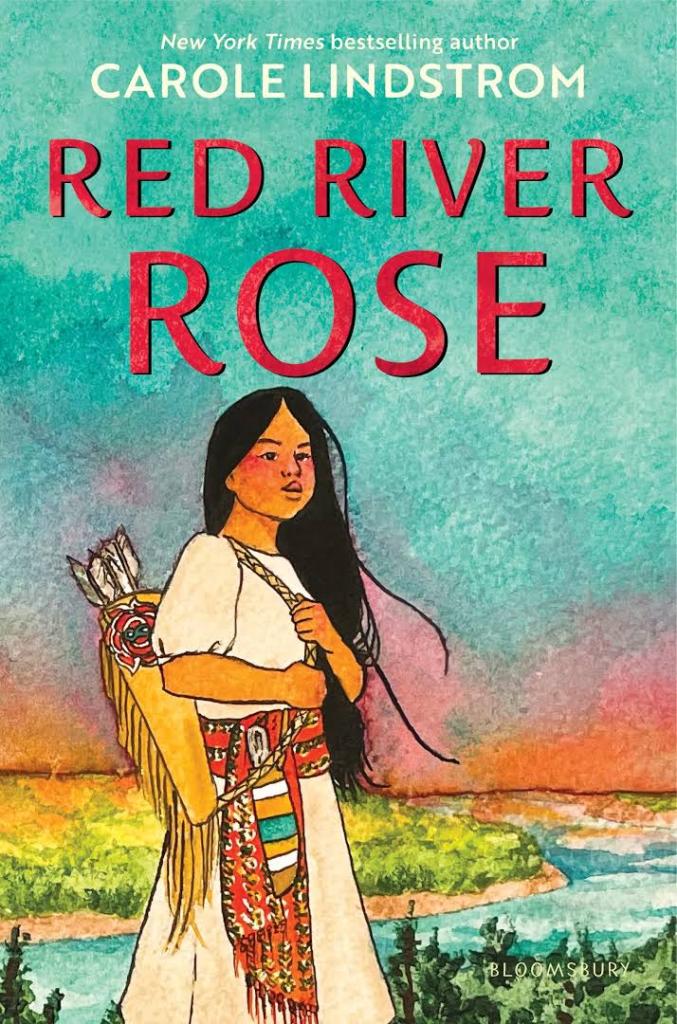
Red River Rose – Carole Lindstrom
Bloomsbury Children’s Books, 2026

In Red River Rose, Carole Lindstrom further develops the characters she presented in her picture book with Aly McNight, The Gift of the Great Buffalo. As Lindstrom explains in her author’s note, Rose’s story is rooted in a commitment to telling a story related to Laura Ingalls Wilder’s Little House books, from an indigenous perspective. Lindstrom’s work is not a refutation of Wilder’s, but her own, original, interpretation of the conflicts between settlers of European origin and the original inhabitants of lands in the Americas. Red River Rose is set during the late 19th century, specifically the North-West Resistance in Saskatchewan of 1885. At that time, First Nations and Métis peoples fought the Canadian government’s seizure of their lands.

Lindstrom’s distinctive narrative style is compelling. Her characters are individuals, not archetypes. Rose frequently refers to the moral ambiguities inherent in her choices, including that of armed resistance. Her father is courageous, particularly in comparison to other men in the community, and to Catholic clergy, who caution against resistance and advocate a passive acceptance of the Métis’s seemingly hopeless determination to reclaim their land. Rose’s mother is equally strong, holding her family together through deep love and a command of essential domestic skills.

Rose visualizes the beauty of her land and community, and Lindstrom’s poetic language communicates to readers the roots of the Métis’ intense identification with their home. “Rose wanted to burn the memory of the ferry sitting atop the sparkling water and the hawks soaring off in the distance into her brain forever. If she were a painter, she knew exactly what she would paint.” That identification allows her to counter the contempt of teachers or religious leaders who warn against the Métis’s struggle, warning Rose to “keep that talk at home” when she raises the possibility of fighting against oppression.

Ambroise, a boy Rose’s age, is her companion and equal; the two work together to devise plans that will support those adults who will fight against the government. Eventually, Rose assumes an active role herself, forced by circumstances to blur the boundaries between childhood and adulthood. Rose is highly intelligent; nothing in her character suggests duplicity, but she learns to use every skill necessary to acquire information, communicate it to others, and make her own decisions. Her father’s increasing trust in Rose affirms her choices, as when she remembers having supported her people by helping to locate a herd of buffalo. At that time, her father’s response was a complex mixture of anger at the risks Rose had taken, and gratitude for her bravery.

That conflicted response takes form in Rose’s consciousness. Her father reports the Métis battle against the Canadian Mounted Police, characterizing the fight as “a thing of beauty.” At the same time, Rose experiences grief for everyone’s losses, even for the Police and their families. She also recognizes the potential for change, as when “mean girl” Melanie, who had shown only contempt for the idea of resistance, begins to seem like a different person. The impact of fear and suffering had brought out aspects of her character that Rose had never seen. “Under different circumstances, she could learn to like Melanie.”

Victory has different forms. Although they did not achieve their ultimate goal, Rose, her family, and her community had the integrity to stand up “for themselves, for their homes, and for their way of life.” Red River Rose is not a story of glorious triumph, but of the refusal of individuals working together to protect what they love, and to sustain their vision of justice.

A Different House, A Different Perspective

The Gift of the Great Buffalo – written by Carole Lindstrom, illustrated by Aly McKnight
‎Bloomsbury Children’s Books

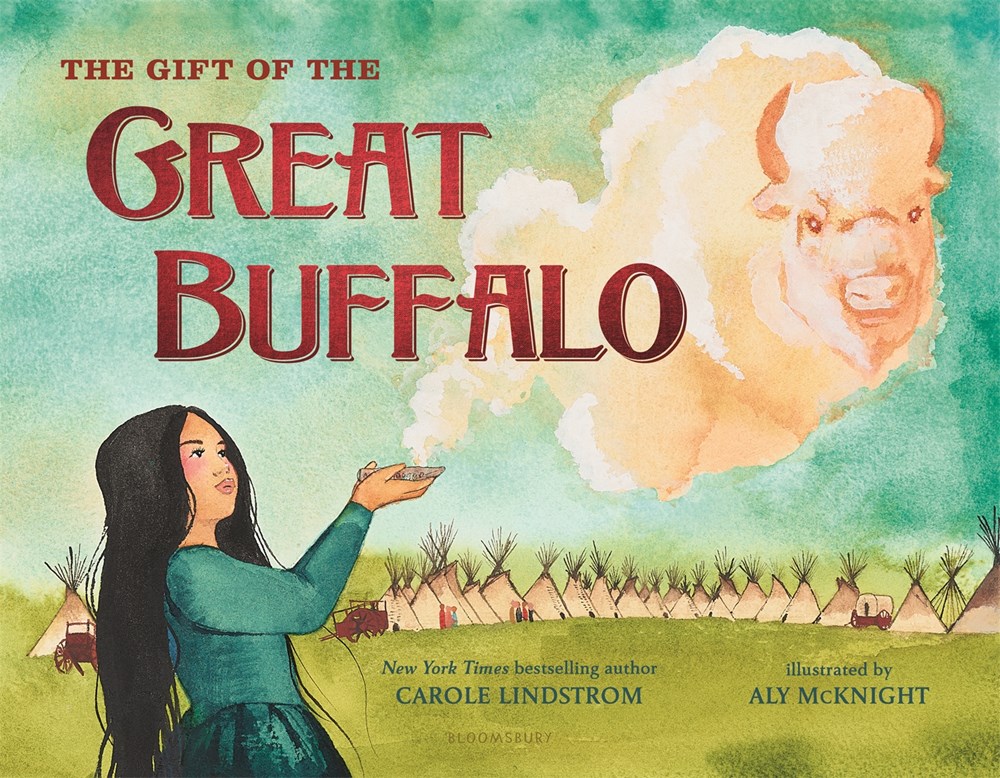
Rose lives on the prairies, in a Métis-Obijwe indigenous community. Preparing for the buffalo hunt that will sustain her people, she is eager to actively take part.  This elegant picture book takes place in the 1880s, and, like Laura Ingalls Wilder’s Little House on the Prairie series, Rose’s dwelling is small and homemade.  However, as author Carole Lindstrom explains in her detailed “Author’s Note,” she was motivated to tell Rose’s story by her own sense of distance from Wilder’s accounts.  The Gift of the Buffalo offers the perspective of the Native Americans who are a shadowy and distorted presence in Little House. Lindstrom and the artist, Aly McKnight have not created a rebuke, but rather, an alternative and illuminating vision.

I have written about the complexity of Laura Ingalls Wilder’s works (see here and here and here and here and here), which, along with racism, include a great deal of ambiguity about how a young girl interprets the conflicting messages of her parents and community about the people whose land they have appropriated.  The Gift of the Buffalo would stand alone for its excellence, even without the essential commentary that Lindstrom and Ally McKnight offer about the reality of an autonomous world, which is not merely a frustrating background for the story of Wilder’s pioneers.  Rose is an intelligent and perceptive child. When her father discourages her from accompanying him on the buffalo hunt, insisting that “that’s no place for you. Besides, Ma needs you more,” she cannot accept his restriction. 

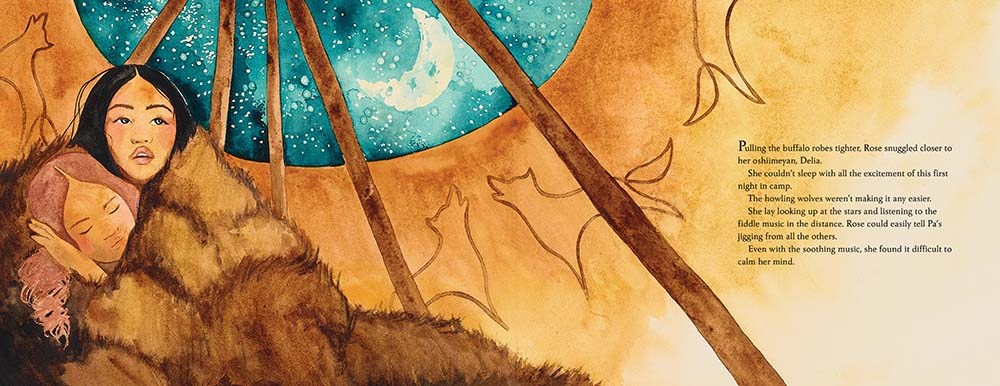
Rose’s decision to defy her father is not based principally on her individual needs, although there is an implicit statement about the independence of a young girl. She is deeply concerned about her family and friends. Lying in bed next to her oshiimeyan (younger sister), both of them enveloped in buffalo robes, she is excited about the hunt.  When she later hears adults express concern about their lack of success, she knows that she will need to step forward. Pragmatism is connected to spirituality; Rose will communicate directly with the spirit of the animals that, in the Métis consciousness, will give their lives to sustain their fellow beings. 

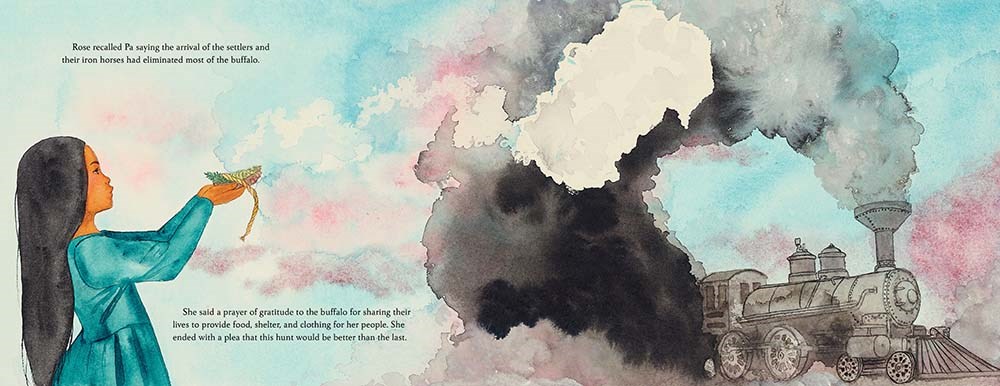
The watercolor and graphite illustrations are stunningly beautiful.  Earth and jewel colors, expressive faces, and alternating dark and light, frame realistic depictions infused with metaphor.  Rose, in a blue dress that complements the lighter blue of the sky, offers up a prayer of gratitude, in advance, expecting that the buffalo will “provide food, shelter, and clothing for her people.” Her father sometimes wears a wolf skin when hunting, and Rose assumes the mantle of his authority by putting on the special garment and identifying with the wolf. This ritual enables her to hear the buffalo assure her that her efforts will be productive: “We offer our lives for our relatives.” This evidence of mutual connection contrasts sharply with the exploitation of settlers, who had exhausted the supply of animals, even hunting for sport.

After the hunt, Rose’s father gently admonishes her. She had located the buffalo, but only by breaking his rule.  His suggestion that she might, in the future, accompany him on a hunt, shows  recognition of her needs as well as those of the tribe.  Readers will find familiar elements in Rose’s story of independence and growth, as well as an invitation to learn about a different house, family, and world.

What Makes Us Happy

I Would Give You My Tail – written by Tanya Tagaq, illustrated by Qavavau Manumie
Tundra Books, 2025

This tender, subtle, book, about a boy awaiting the birth of a sibling, is set among the Indigenous people of Nunavut, northern Canada. It is both unique to their culture and universal in its expression of gratitude, both to people and the environment in which they live. The title refers to a conversation between two hares, echoed by other animals, and finally by the brother welcoming his new sister to the world they will share. The language seamlessly weaves together the language of the physical world and metaphor. The pictures, created in colored pencil, draw from Inuit folklore, as well as the specific qualities of the characters.  Sharing is a concept central to the book, part of the overall vision of happiness passed from one generation to the next.

Assuming a child’s perspective in a book for children may seem natural, but it’s not so easily accomplished. Here, from the first page, readers will empathize with the boy, Kalluk’s, feelings of expectation and some anxiety, as he awaits a profound event in his life.  Tanya Tagaq is straightforward in presenting the situation: “Kalluk’s mother is in labor and about to have a baby.” Even the repetition of seemingly redundant terms, “labor,” and “about to have a baby,” reflects the way that children incorporate reality. Qavavau Manumie’s illustration shows the pregnant mother touching her kneeling son in a gesture of reassurance, before he sets out to bring his grandmother to help.

Unhappiness is, realistically, part of Kalluk’s range of feelings at this moment. He asks two hares why they are happy, and learns how the qualities that they need to survive, speed and cleverness, are fulfilling ones. A brook is happy because of the fish who inhabit it. Mothers, animals or human, are happy with the offspring to their care. Explanations are kept to a minimum. Kalluk can sense the sincerity of all the responses.

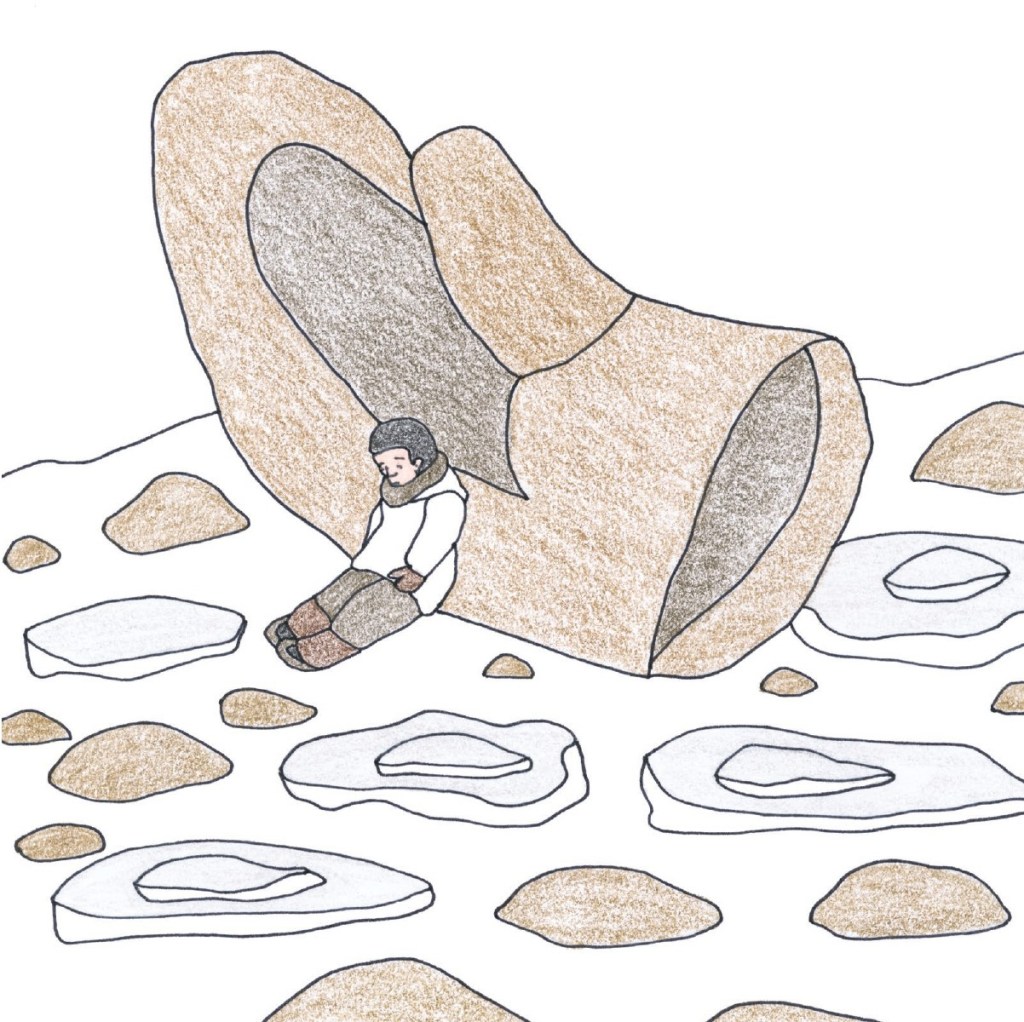
A picture of Kalluk seated with his back against a giant mitten embodies his feelings of gratitude tinged with sadness. He clearly misses his mother, thinks of the warm mittens she has created for him, and sends her “all the love in his heart.” The way in which that message is convened does not need to be articulated.

Meeting his grandparents, Kalluk has reached the confirmation of all the previous lessons about gratitude and love. His grandmother, Anaanattiaq in their North Qikiqtaaluk dialect, is unapologetically depicted as old; she “stands up slowly, bones creaking and cane shaking.”  Any diminished physical strength is no obstacle, as she states purposefully, “Let’s go greet the new one.” Walking home, the boy asks her about her source of happiness. When she answers “peace,” he requests an elaboration. This dialogue is different from those with the animals. She tells him in the most direct language that peace grows inside each person, as he or she makes a series of choices in life. The right choices will make you proud, and grant “lots of peace,” the kind that is meant to be shared.

When Kalluk and Anaanattiaq come upon “a conspiracy of ravens,” the squawking, lively birds are friendly towards them.  Their requirement for happiness is “knowledge,” a slight variation of the other animals’ answers. Their grandmother, the ravens assure Kalluk, is full of knowledge. That knowledge is put to the most important use when she arrives at Kalluk’s home, where his mother has already given birth and his breastfeeding the baby whom he is now prepared to teach everything he has learned.  Gratitude for food, water, family, and the ability to choose well, are the gifts he brings to her, as well along with a declaration of love.  I Would Give You My Tail is like a perfect circle, enclosing the reader in the complete circle of Kalluk’s journey.

Miigiwe – Giving Away is Good

An Anishinaabe Christmas – written by Wab Kinew, illustrated by Erin Hill
Tundra Books, 2024

Finding a children’s book that may be identified as an instant classic is not to be taken for granted. One book that fits that category is An Anishinaabe Christmas. It brings to mind Dylan Thomas’s A Child’s Christmas in Wales, the versions illustrated by both Edward Ardizzone and Chris Raschka, not because of any direct similarity, because the books are very different. Both classics evoke a particular, but also universal, immersion in childhood. You leave the book, and return to it, with a feeling of peacefulness without sentimentality.

A young child from an Indigenous community is going with his parents to visit their extended family on the reservation.  It is winter solstice, an inseparable element of their culture’s celebration of Christmas. Baby, as he is called in the book, looks serious, even puzzled, as his mother and father bundle him up and get ready for their car trip. Their evident excitement is in contrast to his hesitation; this experience is typical of childhood. He is concerned that Santa will not find him away from their home. The cultural signifier of this gift-giving figure so common in the West then transitions to the specific deep roots on the Anishinaabe people.

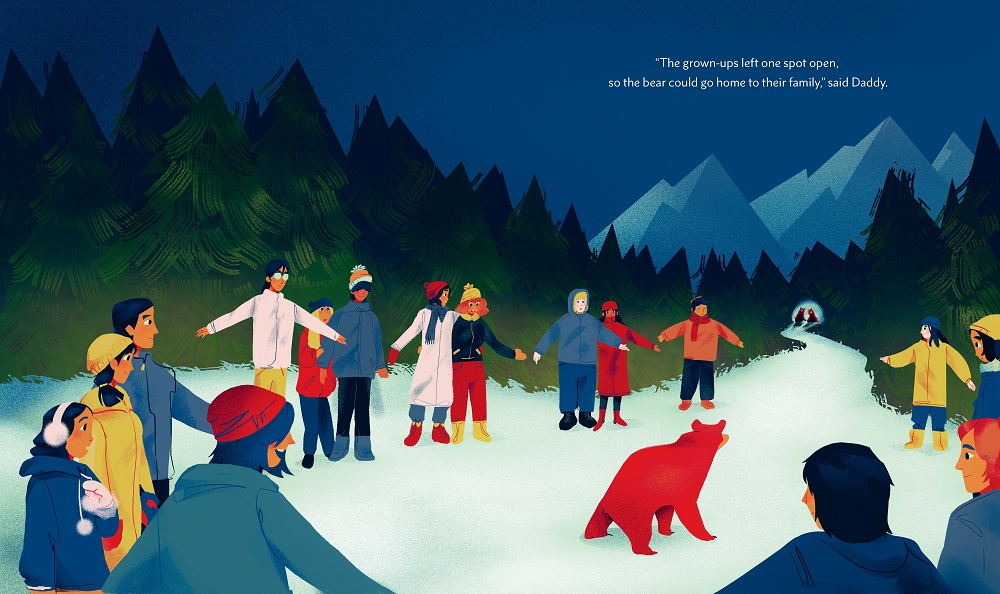
As they drive from the city to the country, the family passes a sign warning not to feed the bears. This prompts a memory that connects Baby to her heritage, and to the natural world that is part of it. Her father repeats the story of how he and other adults had formed a protective circle so that a lost bear cub could find its home. The idea of communalities between humans and animals is organic to the picture, without any ideological explanations. “The bear has a family?” Baby asks. Of course it does, and the father not only answers, but uses the opportunity to introduce words in their native language. (Wab Kinew includes these terms in a glossary at the end of the book, along with an explanation of the cultural syncretism combining Christmas with Indigenous traditions.) The bear also has makwa, family, although it is distinct from the human one.  The bears’ makwa  will “snuggle up in their dens with their babies for Christmas.”

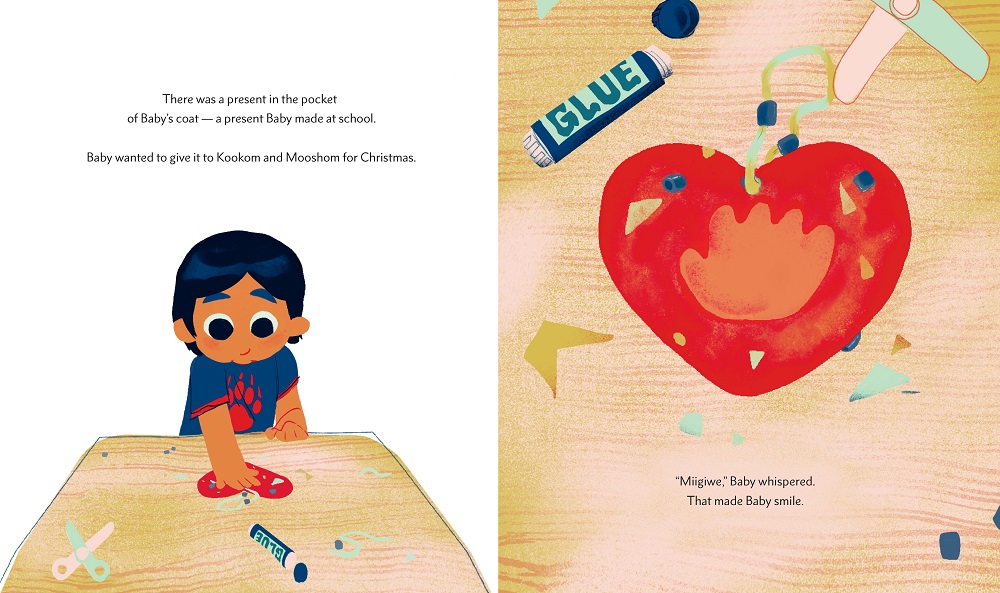
One thing the bear cub will not do is craft a gift for his grandparents, Kookom and Mooshom. The picture of this project is composed of carefully spaced elements, each one of which represents something important: creativity, love, simplicity, focus. Glue, scissors, a red paper heart, become a concrete expression of miigiwe, that Baby’s father has explained: “That means ‘giving away.’ And it’s good.”

The pictures by Erin Hill alternate outdoor panoramas, domestic interiors, and framed scenes of specific activities. A view of the family seated around a wood stove is set an angle and viewed from a slight elevation. Relatives embrace, but there is empty space between different sections of the picture.  Kookom and Mooshom are thrilled to see their grandchild, but they listen carefully to his narration of the car trip. He has processed the truths his father communicated and his repeats them, with understanding, to the older generation. Do you have grandparents? Are you a grandparent? Do you remember your grandparents? You will never forget these scenes.  The family goes outdoors, where they sing about the poetry of winter while playing drums. Whatever winter holiday you celebrate, An Anishinaabe Christmas will resonate as strongly as that chorus.