
Nice Work, Franklin – written by Suzanne Tripp Jurmain, illustrated by Larry Day
Dial Books for Young Readers, 2016
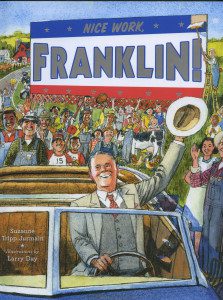
Franklin Delano Roosevelt, as Suzanne Tripp Jurmain points on the first page of this picture book biography, was a lucky man. He was born into wealth, and his personal qualities were a further asset to his inherent privilege. Jurmain begins Roosevelt’s story by suggesting he was driven by rivalry with is distant cousin, Theodore. Yet Franklin’s attempts to imitate Teddy’s more colorful characteristics eventually became the least relevant part of Franklin’s drive. Now, when we so recently had a president who finds humor in mocking immigrants, people with disabilities, and women, FDR’s story of ambition melded with a deep sense of duty is especially inspiring reading for children. Nice Work, Franklin, is informative, engaging, and artistically distinguished. It also conveys the message that disability is not an obstacle to great accomplishments.

There is quite a bit of text in the book, accompanied by Larry Day‘s kinetic and busy images that reflect immersion in American history, as well as in Franklin’s life. Readers learn that he is stricken with polio; a series of images depict him learning to move with the aid of crutches. The two-page spread gives the impression of separate animation cels cohering into movement. Several scenes focus on a collective America, including a crowded line of unemployed workers seeking help on a bread line. The ironic contrast between a billboard’s heartless admonition, “JOBLESS MEN KEEP GOING WE CAN’T TAKE CARE OF OUR OWN,” and their desperate persistence, links Franklin’s struggle to their own.
The scene of his first inauguration, in the midst of the Great Depression, shows a sea of diverse faces, all confronted with the same problem and in need of leadership. “Franklin stood up on his paralyzed legs and Americans saw that both sick people and sick nations could get better.” Of course, Roosevelt did not actually stand. He supported himself on the podium with his hands, offering an illusion at a time when disability carried an implacable stigma. Although the book simplifies many facts, it still expresses an essential truth about FDR’s presidency and the vast improvements his New Deal brought to the nation he served.
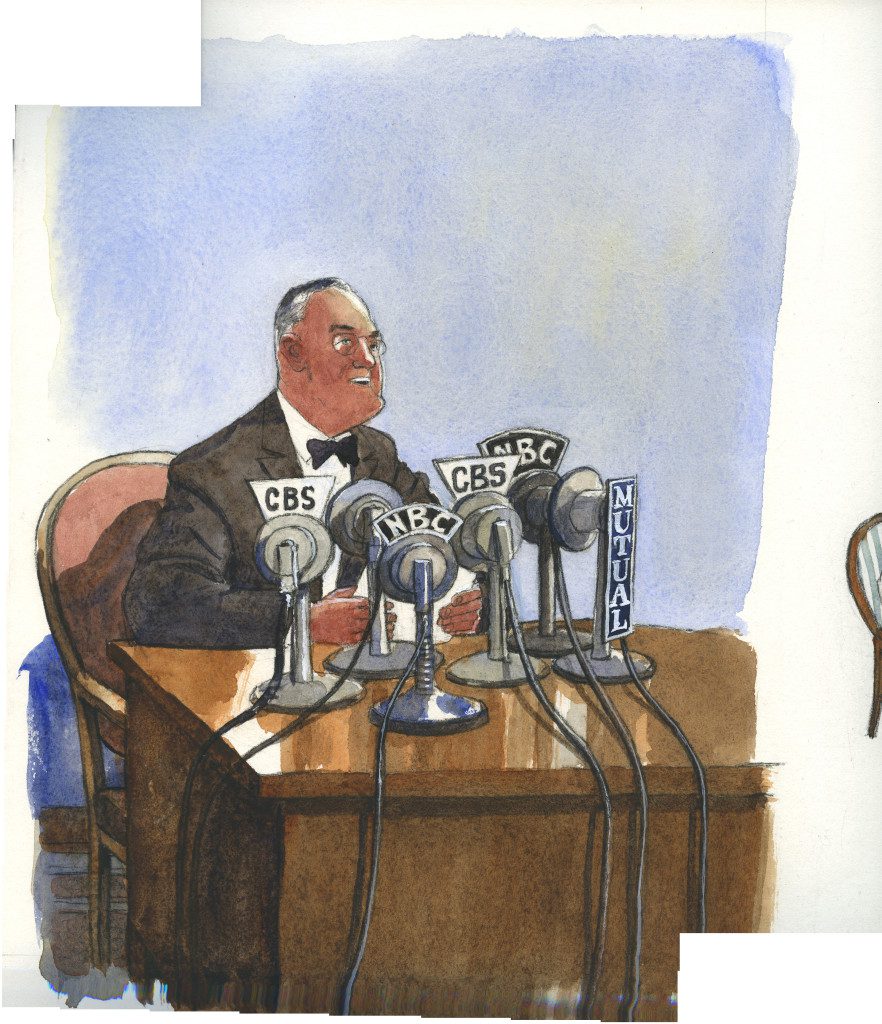
Wonderful period details encourage discussion with children. Roosevelt speaks into a bank of old-fashioned microphones belonging to each radio network, while families listen to him speak over the air waves in their living room. The sense that America was a vast sea of people and that each citizen was an individual comes across through nuanced facial expressions and gestures.

Finally, a map of the United States concludes the book. Instead of state borders or geographic features, it represents typical activities, including a Black family filling their car with gas, working people punching a clock and collecting pay checks, and an extended family enjoying a meal. A few of the images overflow the edge of the map, as if to remind us that the energetic complexity of our country cannot be contained within one frame. Nice work, indeed.
 Imaginary Elevators