
On the Edge of the World – written and illustrated by Anna Desnitskaya,
translated from the Russian by Lena Traer
Eerdmans Books for Young Readers, 2023


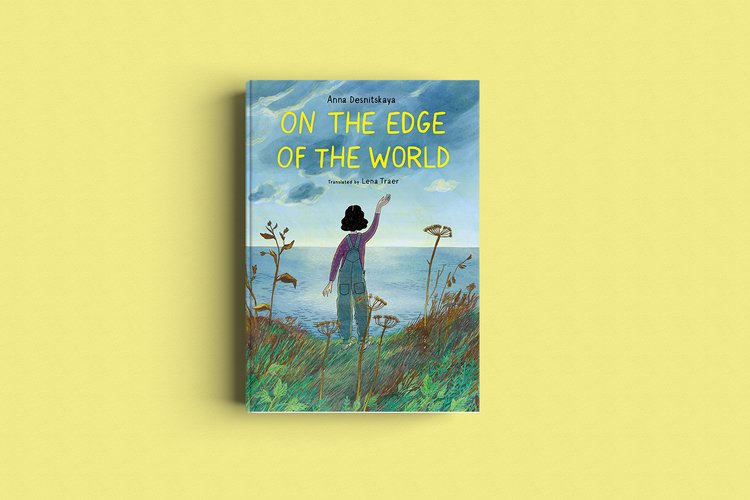
On the Edge of the World is a dual portrait of two lonely young people living on opposite sides of the world. Vera’s home is on the Kamchatka Peninsula in Russia; Lucas lives on the coast of Chile. In order to meet them, you will need to turn the book upside down. Their stories meet at the center. Each half of the story is a brief but deep insight into a child with a loving family who needs to find a friend. Their similarities and differences bounce off one another like the signals each one hopes to send out in their search for companionship. Both a realistic picture of childhood and a poetic exploration of distance—physical and emotional—On the Edge of the World is an exceptional work of picture book art.

The endpapers open a chart of Morse Code, a language that bridges the divisions of nationality. There is a map of the Kamchatka Peninsula, and an image of Vera. Like all the characters in the book, her physical features are keys to a distinct personality. Oversized glasses perched low on her hose, a self-conscious smile, and a pair of overalls over her purple shirt introduce a particular child in a remote place. To expand on her portrait, Anna Desnitskaya presents a group of artifacts that form a kind of museum of Vera’s life. She uses a flashlight on her searches, keeps a collection of feathers, and reads C.S. Lewis. She is not alone, as evidenced by her grandmother’s delicious cottage cheese pancakes, and the support of a mother who is “smart and funny,” clearly two essential qualities.
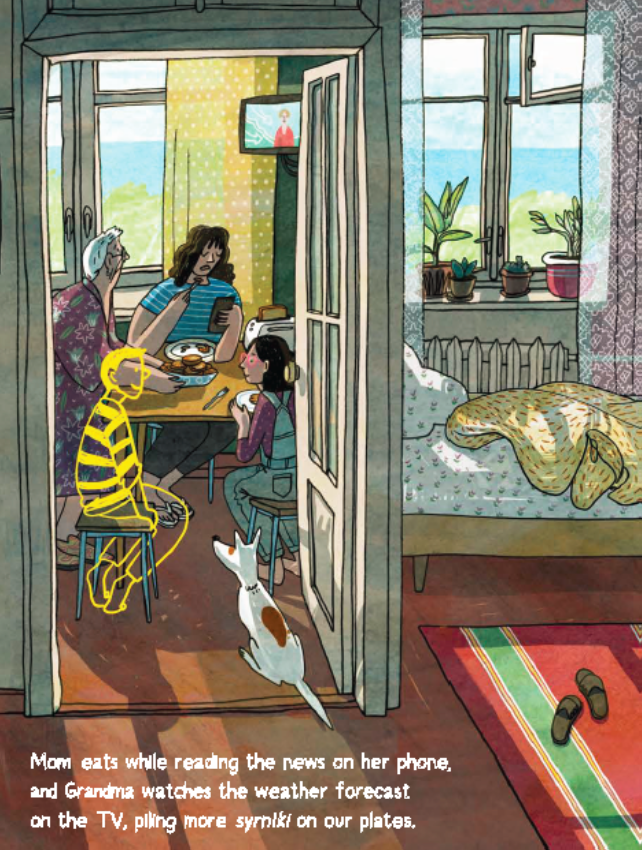
Every child needs a friend, and Vera’s community provides few choices of companionship. Small as her home is, Vera imagines that there would be room for one more inhabitant and this idealized figure appears as a ghostly but cheerful sketch in bright yellow outline. If her indoor environment is compact, the outside is vast. Desnitskaya convincingly draws both the snug kitchen, where her solidly built grandmother presides over a small stove, and the mountainous outdoors, where Vera plays ball with her imaginary friend.
Each picture combines stillness and motion, with earth colors both inside and outdoors, and carefully composed series of images against white space. Vera’s mother’s instructions for producing a sekretik, a whole full of personal treasures, appears next to an image of Vera and her friend in the woods, examining the collection together. She will not give up on her hopes for a companion.

Suddenly, the book transforms itself with three dramatic two-page spreads of wordless nature scenes, and then arrives in Chile, where Lucas is an uprooted urban child also coping with his abruptly new home. He also treasures valued objects, from ammonite fossils to a delicious hamburger. He also loves to read, and has a strong grandmother, although her encouragement comes via video call. Lucas conjures a magical outline of a friend, who, remarkably, is the outline of Vera. He also alternates indoor activities in shadowy interiors with climbing trees and visiting the beach with his father.

When both children defy the laws of physics by reaching across the world, their persistent hopes are rewarded. While it is a virtual cliché do describe a book as bridging the gap between young and adult readers, On the Edge of World embodies that quality with visionary power. Everyone was a child once, and Desnitskaya’s book conveys that combination of intense solitude and the conviction that someone is out there who will understand you and embrace you for who you are.

 Imaginary Elevators
One thought on “Looking Outward”