
A Garden Called Home – written by Jessica J. Lee, illustrated by Elaine Chen
Tundra Books, 2024

There is more than one layer to Jessica J. Lee and Elaine Chen’s new picture book. Narrated from the point of view of a young girl, it begins with a simple statement about the season: “Winter is arriving.” She looks out the window, her eyes full of expectation. But soon we learn that “Mama doesn’t like winter.” Her mother, from the much warmer, and to her more hospitable, climate of Taiwan, is living with her daughter in a much colder country, where even warm jackets and steaming congee cannot seem to elevate her mood. “She never wants to go outside.” The girl and her mother go to visit family in her mother’s homeland, but the consoling trip is a temporary solution to her mother’s sadness. The girl invents her own solution, immersing herself in the environment of both countries and encouraging her mother to experience joy.


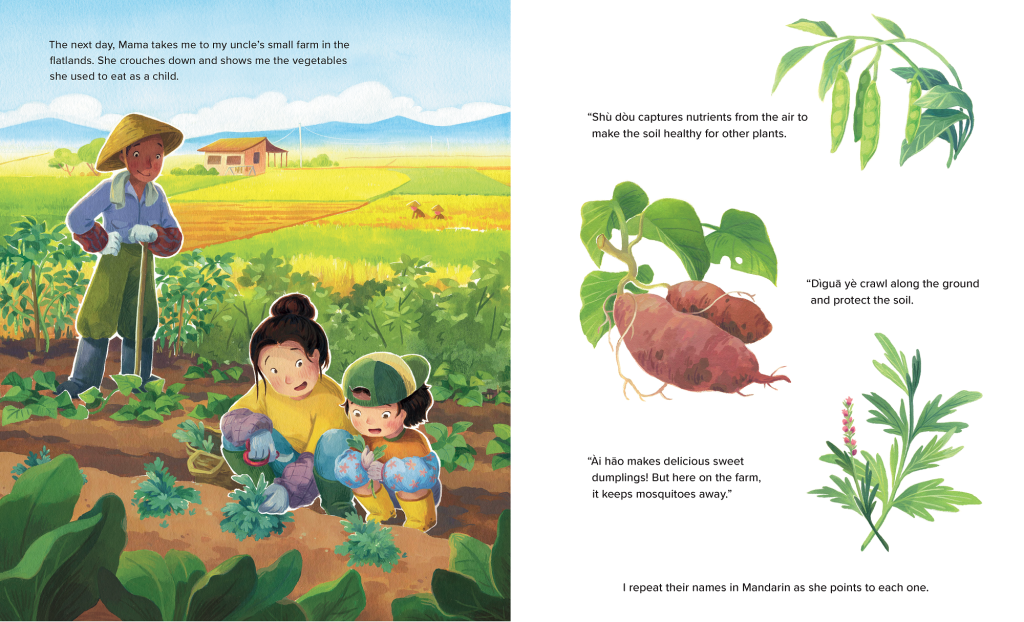
The mom’s reunion with her family is wonderful for her. The girl observes how her mother is suddenly outgoing, talking constantly to make up for the infrequency of her contact with people who matter to her. A busy food court meal shows the mom with eyes uplifted and her hands gesturing, while the girl herself seems baffled by change. Much of the trip centers on the natural world, with the girl’s mother patiently explaining the unique plants and geographical features. One point of contact is becoming familiar with the vegetables that had been part of her mother’s diet as a child. That knowledge takes root in her mind. She learns the names of each plant in Mandarin and repeats them.
The trip ends and they return home, but the girl is able to transform the way in which her mother views the world. Perhaps a more accurate metaphor than layers for this story would be the growing concentric circles of ripples on a pond, or maybe the inside of a tree trunk. At first, the mom remains indoors, as she had before the trip.
Her daughter’s response is to pursue the study of nature they had begun abroad, and to bring her new knowledge home as a gift to her mother. Her forays into the outside are alone, but she conveys the excitement surrounding them to her mother. Fungi on maple trees, nutcracker birds living on whitebark pines, and seeds with thick shells waiting to sprout are all part of the same process. With careful observation and systematic study, she constructs a picture and shares it: “I show Mama that nature here can be wondrous, too.”
A Garden Called Home begins with a tough premise. The girl’s responsibility for her mother’s emotional renewal could have ended in sadness. Instead, her fascination with the environment, her persistence in expressing that experience, and her mother’s hidden strength, allow their life together to bloom.

 Imaginary Elevators