It Bears Repeating – written by Tanya Tagaq, illustrated by Cee Pootoogook
Tundra Books, 2024
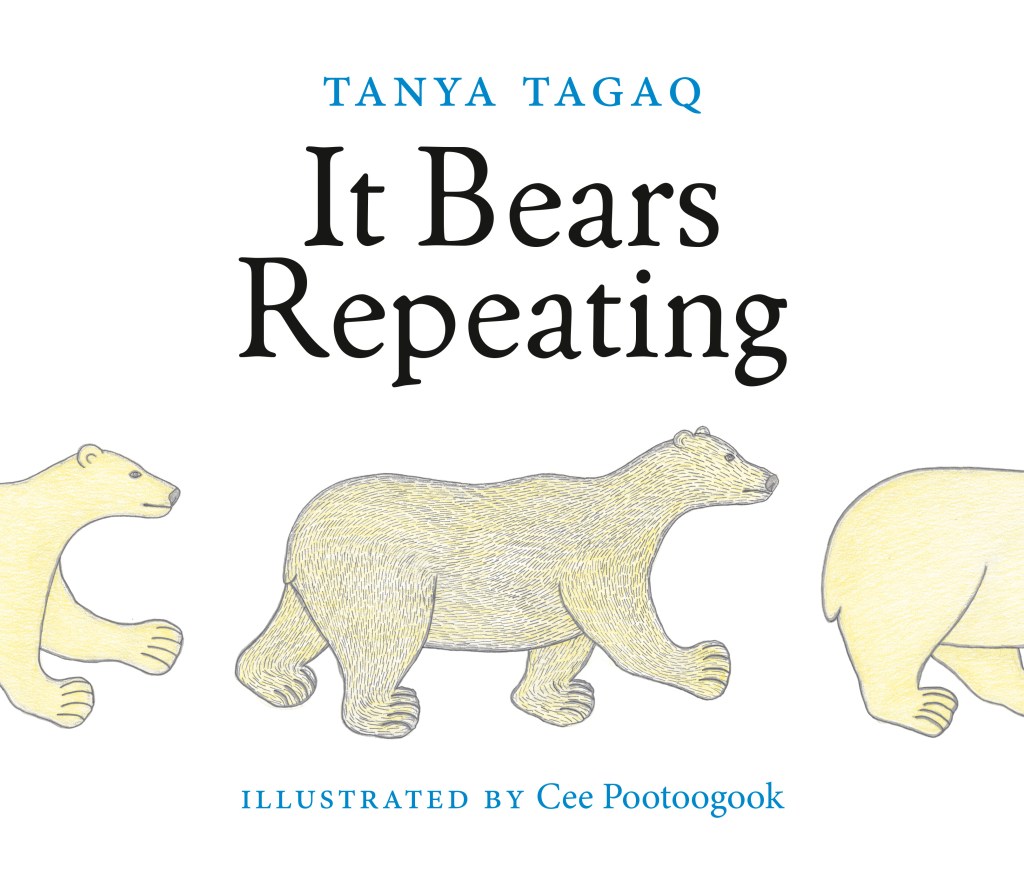
It Bears Repeating is an exceptional counting book for young children. If you are skeptical that “exceptional” is an accurate adjective for books in this category, this one will prove you wrong. The text and the pictures work together as a poem, characterized by an effective use of composition. Every page places the bears in a similar, but not identical scene. Every word counts, and they appear in both English and Inuktitut, with a translation and pronunciation guide included. Tanya Tagaq is an improvisational singer from the Nunavut region of Canada. Cee Pootoogook is a carver and printmaker, also from Nunavut.
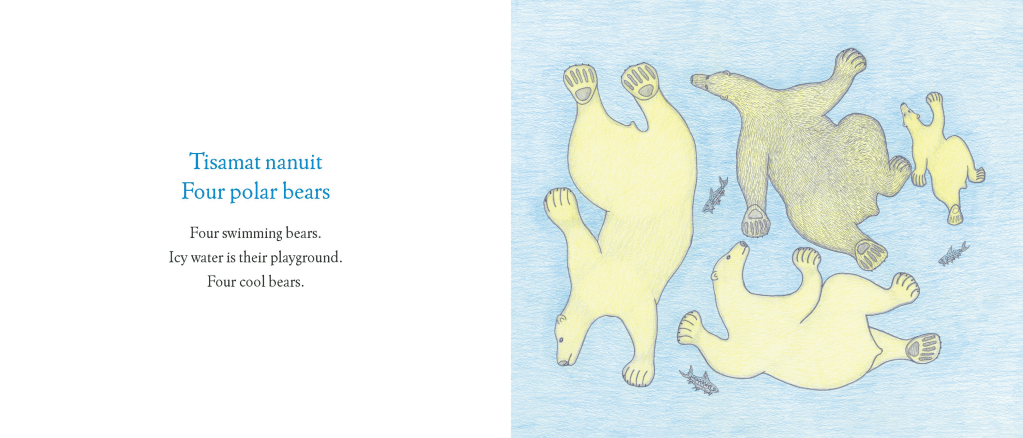
Opening the book, the illustrations have a kind of silent beauty. Once you begin reading, the rhythmic words seem to set the bears in motion. Pootoogook’s artwork is rendered in colored pencils. This is a medium which is both flexible and demanding. The color palette is deliberately limited, with blue and white backgrounds and pale yellow bears. Each bear is filled in with hatching, closely drawn dark vertical and horizontal lines. They have personalities, with the first bear being proud, tall, and long. As more bears enter, the pictures are full, but not crowded. “Four swimming bears./Icy water is their playground./Four cool bears.” The scene is both realistic and stylized, with the bears forming a pattern around the fish who share their home.

Each word resonates and tells a story. In the scene of six bears, the animals surround a hole in the ice, having stationed themselves carefully. There is a brief description: “Six staring bears, then a warning, “Seals beware!” and a further description that adds to the anthropomorphism, “Six crafty bears.” Children think this way about animals, and every culture also envisions their role in the universe and the way that humans perceive them.
Once the bears have eaten, in the scene for eight, they are “full,” “round-bellied,” and dancing together with obvious joy. They vary in size and color. They raise their arms and one bear in the front row kicks his foot so that readers see the bottom of his paw, the only bear in the picture to reveal that angle. The book seems perfectly crafted to engage a child’s attention, as well as for adults to appreciate its artistry.

It Bears Repeating is culturally specific and universal, and rewards repeated readings that are refreshing both literally and figuratively.
 Imaginary Elevators