
Sonia Sotomayor: A Judge Grows in the Bronx/La juez que creció en el Bronx – written by Jonah Winter, illustrated by Edel Rodríguez
Atheneum Books for Young Readers, 2009
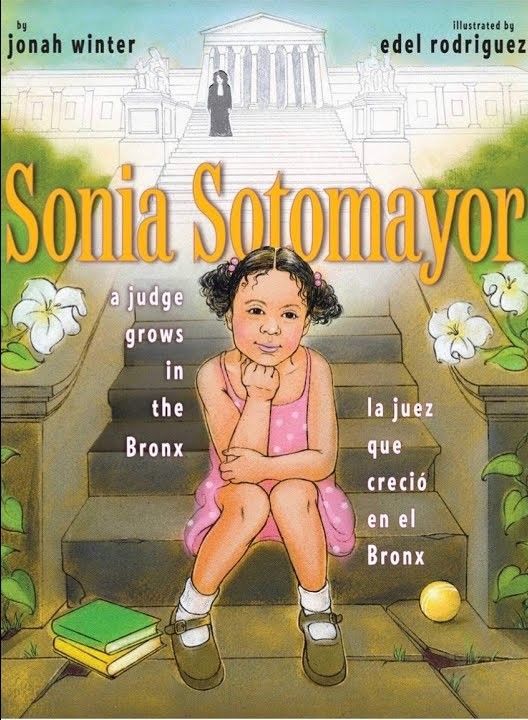
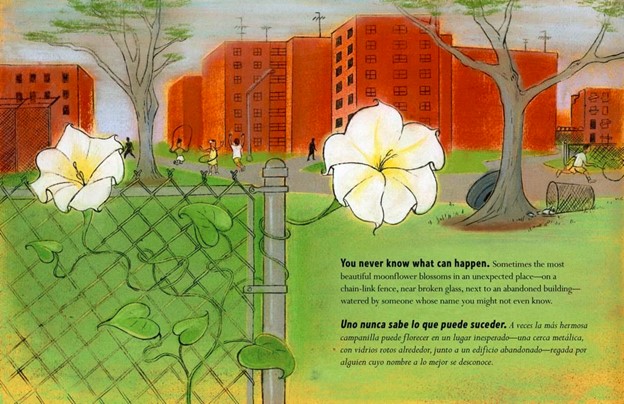
Tomorrow is July 4, Independence Day. We can all judge for ourselves the tremendous value of Sonia Sotomayor’s courage and her attempts to preserve democracy in the United States. Jonah Winter and Edel Rodríguez’s bilingual picture book biography of this American heroine is essential reading, or re-reading, with the children in your life. Someone from, as Winter calls it, “an unexpected place,” can use her strength to achieve success. In Sonia Sotomayor’s case, her widowed mother and extended family provided a nurturing beginning, allowing her to confront the obstacles which, seem to never end.

Winter has a flair for incorporating spoken language into his written text. He begins by explaining the most significant facts of Sotomayor’s early life. Her mother, a widow, worked unstintingly to support the family, who lived in public housing in the Bronx. Gatherings with relatives featured the warmth of Puerto Rican music, food, and warmth. Books were also a constant presence, both textbooks and the adventures of girl detective Nancy Drew. When Sonia was diagnosed with diabetes, she questioned whether persistence and imagination would be enough to solve problems like her literary role model, but she decided that the law would still be open to her as a career. Rodríguez’s pictures show Sonia’s emerging identity, immersed in a book, imagining herself as a detective, and finally raising her high school diploma high in the air.

Next came Princeton University. Winter captures the alien nature of this environment for Sotomayor. “Where were the subways? Where was the merengue music? Where were the people who looked like her?” Continuing his metaphor of the title, she became “like a flowering vine that would not stop growing.” When she became a lawyer, and then a judge, the same qualities of diligence and honesty that had defined her life became central to her professionalism. Impatient with lawyers who were not prepared, and as well as with judges who lacked empathy, she refused to dichotomize the intellectual and emotional qualities necessary to being fair and impartial. “In the world of judges, this made Sonia very special.”

When President Obama appointed Sonia Sotomayor to the Supreme Court, she confronted the ironic accusation of racism because of her pride in being Latina. The daughter of an indomitable mother, she has contended with prejudice and disability her whole life and dedicated herself to public service at the highest level. Winter and Rodríguez do not offer a fairy tale about miraculous coincidences. Some of Sotomayor’s gifts were innate; others were inculcated by her mother. She has flourished both in spite, and because of, adversity. Whether Princeton University, or a corrupt Supreme Court, “She would not just survive this strange new world, she would thrive.” On this July 4, we can only hope that the same is true for our fellow Americans.
 Imaginary Elevators