
A Star Shines Through – written and illustrated by Anna Desnitskaya
Eerdmans Books for Young Readers, 2024

Anna Desnitskaya, an accomplished author and illustrator (see my earlier review here), became a refugee when Russia invaded Ukraine. She has written an important book, a work of great beauty and simplicity about what it means to be uprooted from one’s home. Even if the book were not illuminated by beautifully minimalist words and images, it would still matter. It would still succeed as a human document. However, its outstanding effect is inseparable from its haunting tone and careful composition. A Star Shines Through is worth your time, and a space on your own bookshelf and that of your school and library.

In her author’s note at the end of the book, Desnitskaya explains its origins. She and her family were on vacation in Cyprus when they learned of the brutal attack on their country. Their home in Moscow, epitomized by the large star-shaped lamp that hung in their apartment’s window, would no longer be their lives’ anchor, as they fled to different places of, perhaps temporary, refuge. Standing within a beam of white light on a dark street, mother and daughter shelter under an umbrella. The residents of a foreign city speak a different language; the word bubbles above their hands are filled with incomprehensible white swirls.
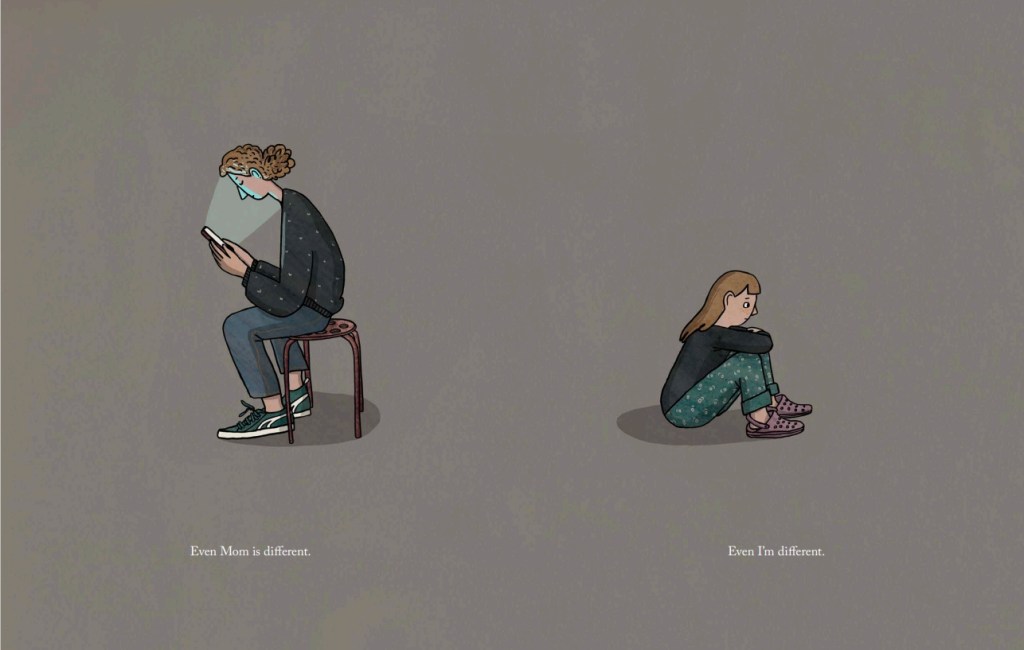
Each picture is a portrait of disconnection. The girl sits on a windowsill looking out at the darkness while holding a book. The smiling family who, after all, still have one another, eats around a table, but the text reveals a great deal in the one phrase, “Different food.” Even people themselves are not the same. On facing pages, the mother and daughter look in opposite directions as the adult stares at a cellphone and the girl sits alone, contemplating the fact that “Even I’m different.” Desnitskaya does not attempt to elaborate on these thoughts, which convey both sadness and dignity.
Then they make a star. A similar star appeared in earlier scenes, but perhaps it is a ghostly memory of the one in Moscow. Now they create a new one; when they display it in the window, it transforms everything. Although their star cannot replace their old life, it partly restores what seemed to have been lost completely. An ice cream truck on the street and its string of bright lights indicate that their new home is welcoming. The foreign language that surrounds them begins to make sense. Mother and daughter sit under the star together, accepting that nothing is the same, but everything is better. Shades of blue contrast a busy apartment building against the darker night sky, but the gold star in the upper window holds our attention. Even if you have shared other books about the refugee experience with the children in your life, this one fills its own niche. Communal support, gradual acceptance of change, and acknowledgement of sadness coexist in this honest portrayal of one family’s upended life.

 Imaginary Elevators