Spotty – written by Margret Rey, illustrated by H.A. Rey
Harper & Brothers, 1945 (Reprinted by Houghton Mifflin, 2006, and in collection Curious George and Friends, Houghton Mifflin, 2003)
My World – written by Margaret Wise Brown, illustrated by Clement Hurd
Harper & Brothers, 1949 (Reprinted by HarperCollins, 2001)
The Runaway Bunny – written by Margaret Wise Brown, illustrated by Clement Hurd
Harper, 1942 (Reprinted by HarperCollins, 2017)
Sometimes our memory of a picture book, like anything else, may be flawed. I was recently reading Margaret Wise Brown and Clement Hurd’s My World, a much less known but equally classic work to Goodnight, Moon. The books share anthropomorphized rabbit characters, both with the same almost uncanny level of similarity and difference. The bunnies dress like humans, but Goodnight Moon, with its third-person narrator, avoids assigning them human speech. My World’s first-person narrator is a child/bunny, whose speech is simple enough to also avoid direct human-animal comparisons.
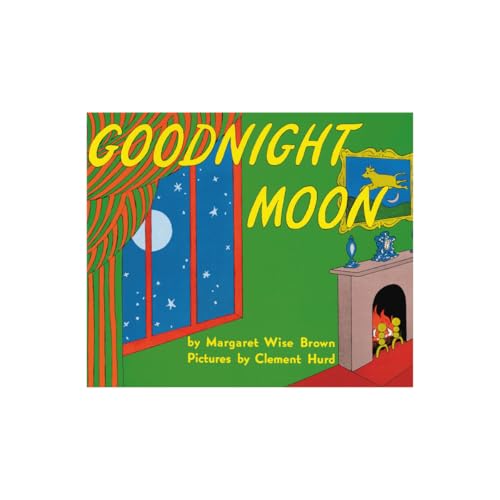

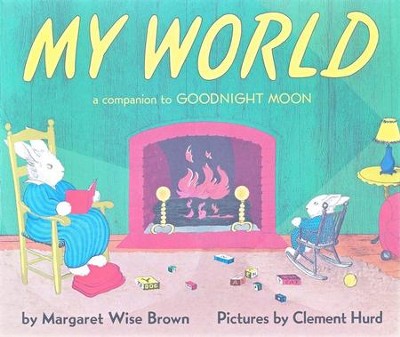

I was sure that the bunny family in My World enjoyed a meal which was a lavish display of exclusively carrots, but, when I arrived at the scene, I found that the children, parents, and grandchildren, had a greater variety of foods. They are pescatarians; the grandfather, or father, is carving a fish with traditional male expertise. I would guess that the couple at the carving end of the table are grandparents, judging by the style of the female rabbits’ dresses. One young bunny is seated on her father’s lap, but that may also be the grandfather’s lap, reversing the generations. The table includes a bowl full of carrots, but, in addition to the fish, there are also a green vegetable, and a red spherical food that are probably tomatoes. On the wall is displayed a scene from The Runaway Bunny, by the same author and illustrator. It’s the fishing scene, but the book famously ends with the abrupt but reassuring phrase from the mother bunny to her child, “Have a carrot,” followed by the two of them eating together in their burrow. You can decide if the mother bunny is overbearing or protective.
Spotty turns out to be the book with the all-carrot feast. The story is much more dated than Goodnight Moon, The Runaway Bunny, or My World. Instead of poetic cadences, there is a narrative meant to instruct children about racism, or other types of prejudice. Spotty is an admirable book in this regard, nothing to sneer at, especially given when it was written. Spotty is a brown-spotted bunny in a family where all the other children have white fur. The parents, pathetically, fail to take responsibility for their prejudice against him. To be fair, perhaps they are only experiencing legitimate fears about how society will treat him. They insist on blaming the grandfather, who allegedly has to be prevented from seeing his adorable grandchild.
This part of the story is so disturbing; I was hoping that, at the end, Grandpa would show up and tell them to take responsibility for their own deeply flawed parenting, but it doesn’t happen. (Another horrific detail is that Spotty tries to use a chemical spot remover to reverse the stain of his identity. When it doesn’t work, he runs away, after writing a heartbreaking letter to his obtuse parents.)

Spotty meets a little white bunny who has the same problem, reversed, in his own equally racist brood. (“That’s Whitie. She is…well, she is not quite like we are.”) Again, I have only the greatest respect for the Reys. While the writing in this book may not be Margret’s best, their shared goal in shedding light on racism, in a format that would appeal to children and help them to understand its irrational nature, is evidence of their decency. The pictures, as usual for H.A. Rey are wonderful. The meal is as unambiguous as the book’s message. No, bunnies don’t only eat carrots. But in this two-page spread, they do. Like the proverbial peaceable kingdom scenes, white and spotted bunnies sit arm in arm, managing to eat at the same time. There are three huge pyramids of carrots in a row across the table. The young offspring taught their parents some truths and the Reys, for all the flaws in the text, related to the childhood sense of being misunderstood.
 Imaginary Elevators
One thought on “Carrot Feast”