
Everyday Bean (Tiny Bean’s Big Adventures, Book #1) – written and illustrated by Stephanie Graegin
Tundra Books, 2025

There are many book series chronicling the adventures of best friends, some human and some animals. Frog and Toad, Ivy and Bean, Stella and Marigold, Mouse and Mole, Elephant and Piggie, are only some of the best-known and loved. The relationship between grandparents and their grandchildren also constitutes the core of picture and chapter books, as well as middle-grade novels (see a list of examples at the opening of this review). In Everyday Bean, Stephanie Graegin has given a little hedgehog and her grandma the same kind of symmetry as peer friendships, but simultaneously the unique empathy and protectiveness of a grandparent, and the loving trust of a grandchild. There is continuity with other books celebrating both friendship and family (such as the books by Lore Segal) but Graegin also offers a new verbal and visual picture of a unique connection.
A key element of Everyday Bean is balance. Each short chapter is an independent story, linking together in a thematic whole. Bean is tiny. Grandma is bigger, from Bean’s perspective, but still small from the viewpoint of the reader. We meet each one of them against a background of white space, emphasizing the scale of these personified animals. As they toast marshmallows together, Bean invents a story about “tiny ghosts,’ while Grandma prefers one about “giant marshmallows.” Bean reminisces about the blanket her grandmother had created for her when she was a baby. Somewhat mysteriously, the blanket kept shrinking, and ultimately became a bandana (another common kidlit theme). The reduction in size is not translated into reduced importance. While in Goldilocks and the Three Bears, each diminishing bowl of porridge, chair, or bed, is fraught with tension, the disparities in size between Bean and her grandma, blanket and bandana, all give a sense of security.
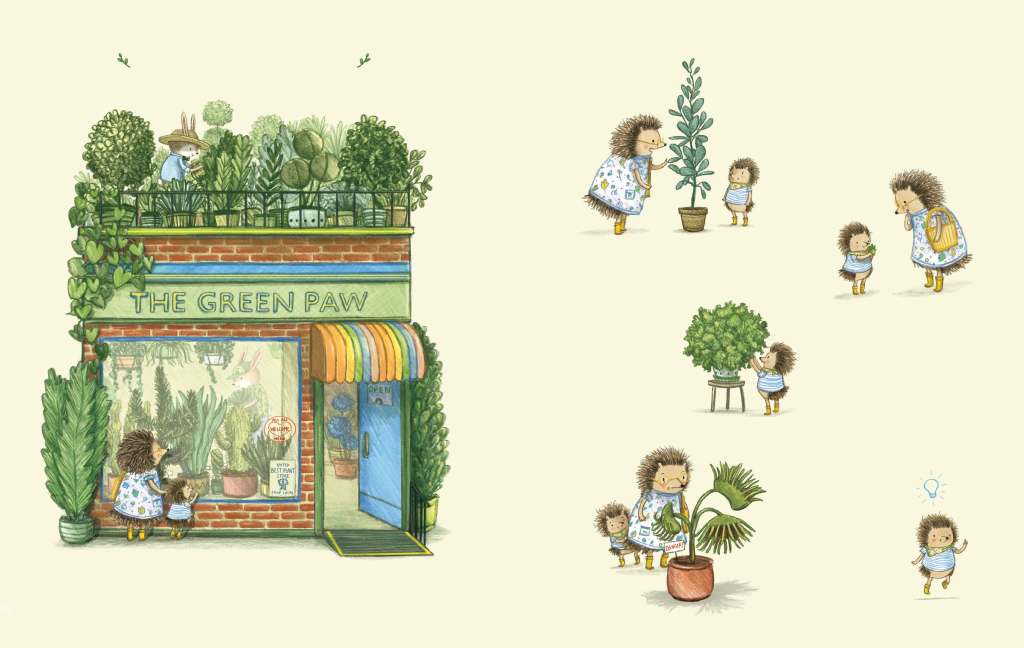
A visit to the plant nursery is one example of Graegin’s understated method. Mr. Green, the store owner, is a rabbit who is carefully attending his lush assortment of plants in the store window. The balcony of his brick shop is also densely filled with plants, in contrast to the following page, where white space allows Bean and Grandma to examine each possible plant without distraction. The exchange between the two is brief; they can intuit each other’s thoughts in this situation. The round, prickly cactus that Bean selects is perfect, because it embodies the qualities of both Bean and Grandma in each other’s eyes.

In “A Box for Bean,” Graegin revisits the cliché about a child preferring to play with an empty box to an elaborate toy. Grandma helps Bean construct a house out of the box, but then respects the child’s imagination, as Bean experiments with the box as a spaceship, pirate ship, and ice cream truck. There is a quiet image of parallel enjoyment, as Bean colors in the box while Grandma sits outside, in her own space, reading. This picture gives further evidence of the pair’s smallness, as flowers dwarf the box and Grandma’s teacup rests on a mushroom.

“Bean’s Bad Mood,” presents the difficult test of how a parent or grandparent responds to a child’s intense emotions. I was reminded of Little Bear, where the mother’s tenderness serves as a gentle test of reality, as in an imagined trip to the moon. Sophie’s patient grandma in Rosemary Wells’s Time Out for Sophie also came to mind. As Bean lies prone on the floor, enclosed in her “dramatic moping mood,” Grandma calmly assures her that bad moods are inevitable. In fact, she has anticipated this event: “I knew this would happen someday…Just be back by next Thursday. I’ll make you a sandwich.” Unhappiness cannot be avoided, but something simple to eat might mitigate its effects. Her well-stocked kitchen is neat and orderly. A portrait of Bean hangs on the wall. Grandmother and granddaughter wear matching boots, with only the older hedgehog using eyeglasses. Bean’s posture of mild defiance, with hand on hip, faces Grandma’s slight stoop, and her use of both hands to hold a cup. Each note in Everyday Bean resonates.
 Imaginary Elevators