
Piccolo – written and illustrated by Dan Yaccarino
Christy Ottaviano Books (Little, Brown and Company), 2025

Piccolo is not actually set in Rome, but rather in Bella Città, a marvelous place where animals speak Italian, visit cultural treasures, and eat delicious gelato. A lively shrew who enjoys riding his moped and frequenting cafés, the title character has several friends who help him when he goes in search of his favorite hazelnut ice cream. There are several detours along the way, and Piccolo will never say “no” to an amusing distraction, or a chance to help out.

Dan Yaccarino’s picture book world is generally reassuring. Populated by people, and the animals who sometimes are similar to them, his stories maintain a balance of challenges and happiness. Whether in Every Friday, whose father and son pair enjoy a special weekly time together, Doug Unplugged, where a young robot breaks free of his charger, or I Am a Story, an ode to literacy, readers connect to his colorful images and comfortingly familiar characters. Every Yaccarino book is different, but identifiable for its warmth and humanity.

Piccolo has created a list with his fountain pen while sipping espresso and planning his day. He “loves his friends very much,” and the truth of this statement, while obvious, is also proven by multiple examples. Enzo the hedgehog, Mr. Rosso the fox, and Brother Mantis are all greeted with an enthusiastic Buongiorno or Ciao.

Piccolo’s need for gelato is not so pressing that he can’t help Mr. Rosso, an artist, to carry his painting to the museum, or to ensure that Mrs. Gallina and her chicks safely cross a busy street. (This errand seems like an homage to Robert McCloskey’s Boston street scene in Make Way for Ducklings.)
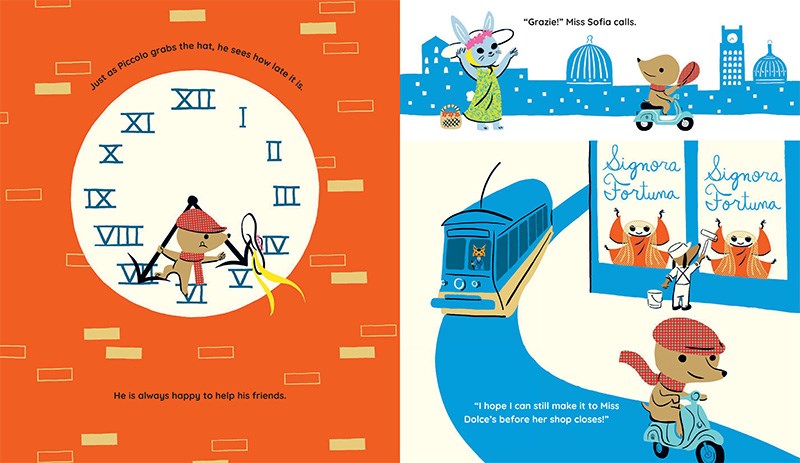
The cinematic scenes include Piccolo racing to rescue his friend Sofia’s hat by climbing to the top of Tempo Tower clutching the hands of its clock with bravery and skill. In another artist’s vision, this feat could be frightening, but Piccolo’s determined expression makes it clear that he is not taking an unnecessary risk. Not every one of his detours is so dramatic. He is also happy to retrieve a soccer ball from the fountain and play for a while, and to assist a young crocodile with his necktie. Yaccarino can easily devote his attention to the smallest actions as well as the most difficult ones. There is some real tension when Piccolo reaches the gelateria and presses his nose against the glass, his purple shadow illustrating the hour, and that “he is too late.” But when Miss Dolce arrives, her leftover hazelnut gelato becomes a simple problem to solve. Grazie, Dan Yaccarino, for this affectionate introduction to Italian culture, perfectly designed for young, and older, readers.

 Imaginary Elevators