
Chopsticks Are – written by Chloe Ito Ward, illustrated by Lynn Scurfield
Chronicle Books, 2026
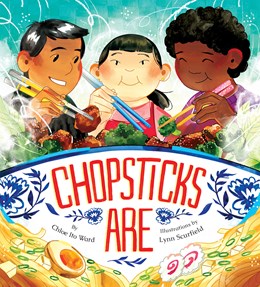
Chopsticks Are is a comprehensive, and incredibly beautiful, look at a ubiquitous utensil used for eating in many Asian cultures. The endpapers feature an array of different chopsticks tall enough to extend from the top to the bottom of the page, and the book concludes with illustrated background information, and a food index. The pages in between are a voyage shared with people, objects, places, and foods that all share a common bond, but are also quite distinct from one another. The audience for this informational book encompasses readers interested in food, Asian culture, beautiful artwork, and the unbreakable ties of family. In other words, this is a book for virtually anyone, offering aesthetic joy and enrichment.
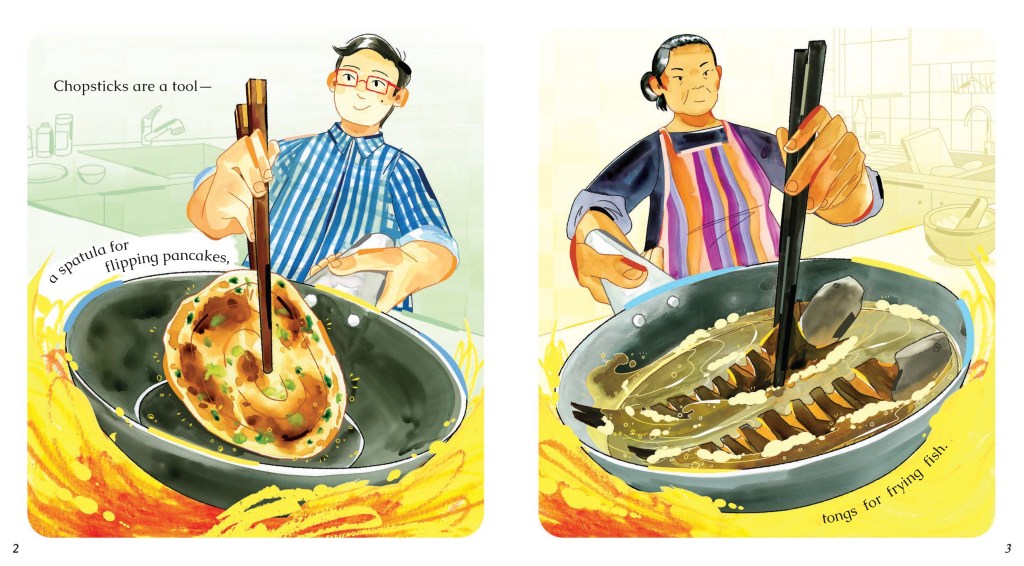
Chloe Ito Ward applies to chopsticks a simple definition; they are tools. Having established that fact clearly, she animates these tools by explaining their many uses. “Flipping pancakes,” and “frying fish,” as well as “whirling,” “whisking,” and “blending,” involve cooking. Some of Lynn Scurfield’s (I reviewed an earlier book of hers here) pictures portray people, while others focus on the hands that make infinite use of chopsticks. But they are also used for picking up food and bringing it to one’s mouth, a task that is acquired early in some cultures, but may seem awkward and daunting in others.
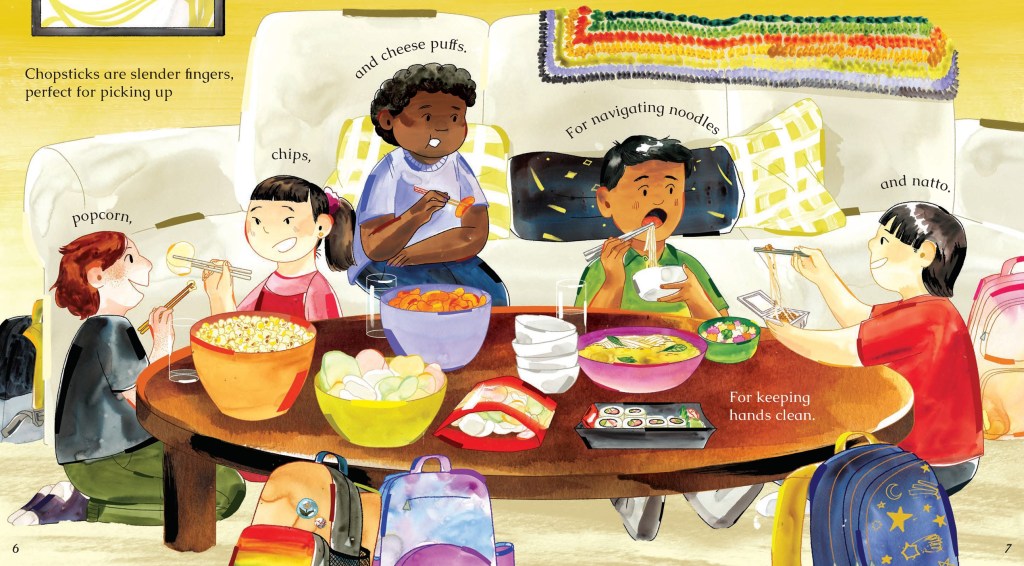
A scene of children eating emphasizes that chopsticks can lift Asian foods (“navigating noodles and natto”), as well as chips and popcorn. I have to comment on one particular scene of a Jewish family sharing a meal of Chinese food. There are men and boys wearing kippot and a woman with a traditional head covering. Those seated at the table are old and young, and of different races. I was very moved by the inclusivity of this specific scene, but there are several others with multi-ethnic and multi-generational characters, personifying the sharing of food and family traditions.
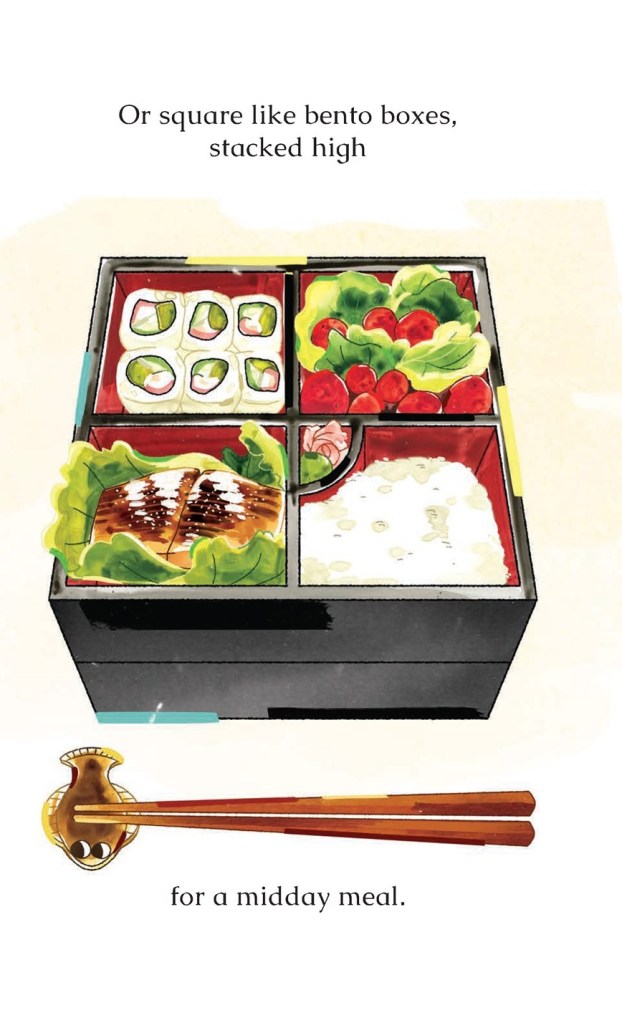
Scurfield’s images are rendered in acrylic ink and acrylic gouache, with lines created digitally. The colors are bright, with both earth and jewel tones. Faces, both old and young, are expressive. Foods are scaled to provide different perspectives, as part of pictures full of human activity, and composed against white space as larger items. The composition is a key element throughout the book. A round dish holding round dumplings is accompanied by chopsticks , to its left, resting on a holder with a blue border. In contrast, a square bento is underlined by a pair of horizontal chopsticks resting on a fish-shaped rest. Both pictures are captioned with alliterative phrases.
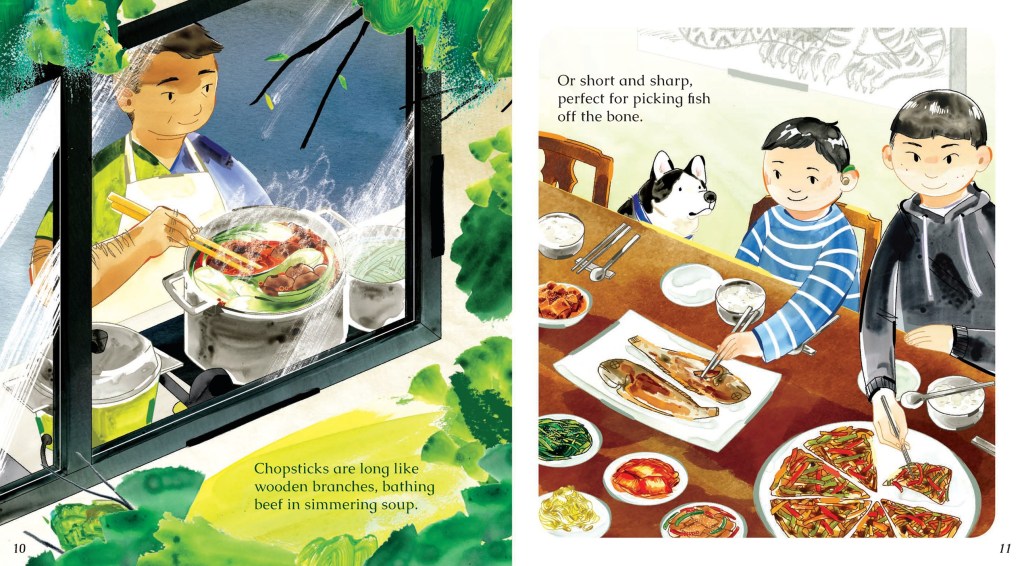
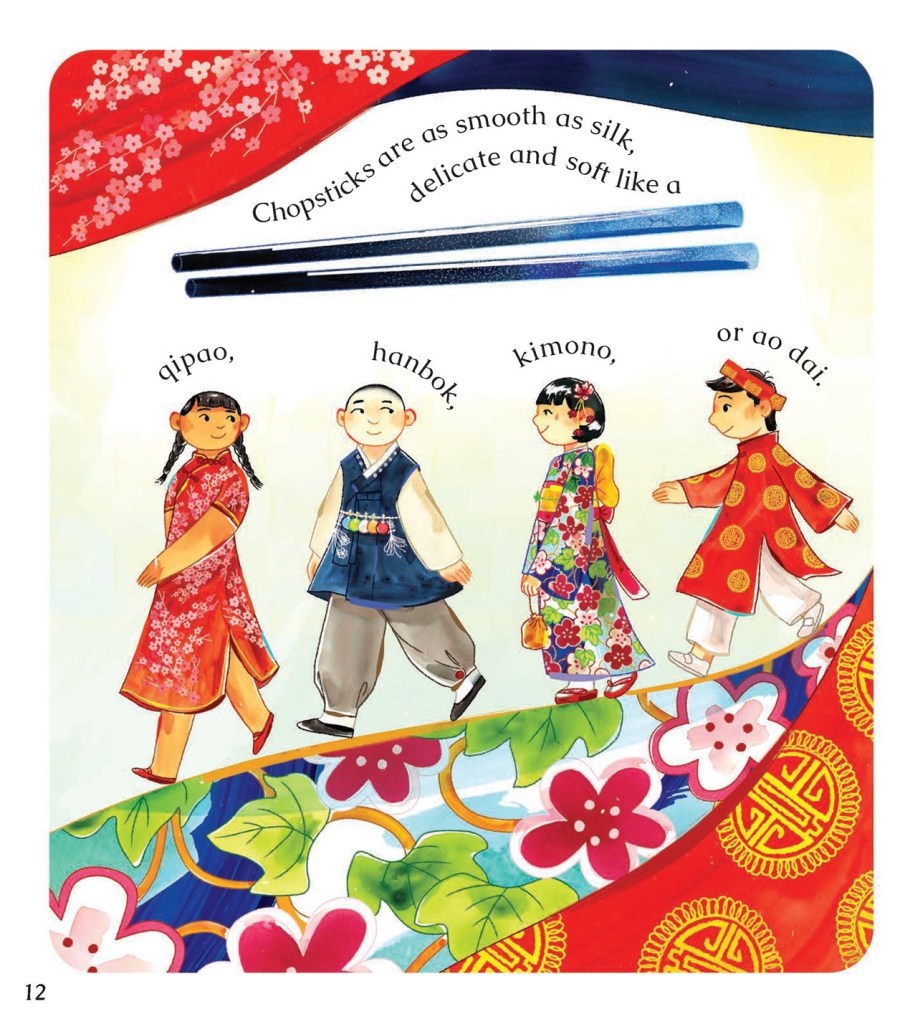
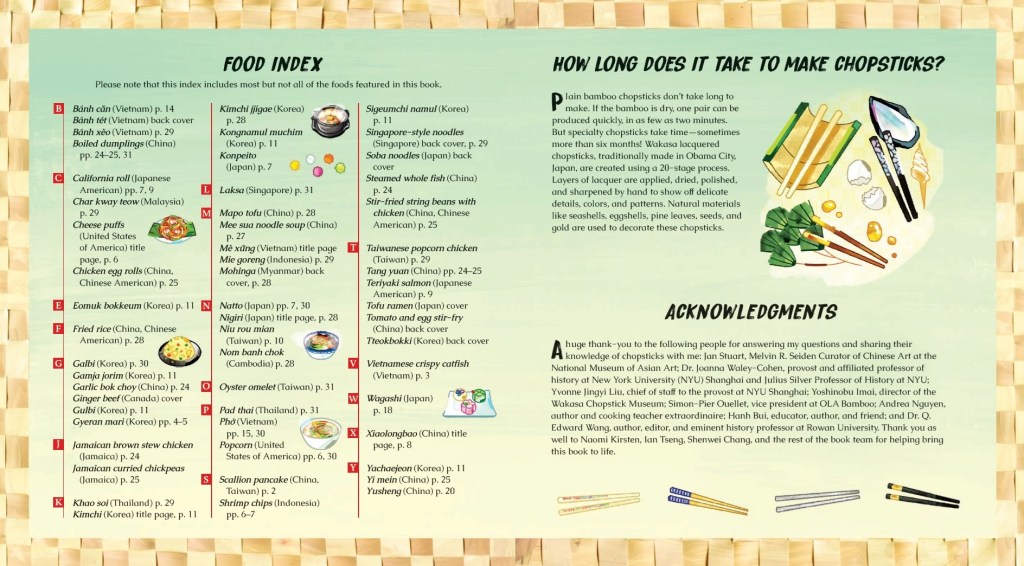
The depth of information in the backmatter is also integrated into the text. For example, chopsticks may be long or short. Looking at the pictures, you may also notice that the people using them may be tall, if adults, or shorter, if children. There are no wasted words or images, and every fact is related, if only be implication, to another. Food is not an isolated part of culture, as demonstrated on a page where people wearing different types of clothing seem to parade across a piece of fabric. Above them, a pair of oversized chopsticks forms a kind of roof, or border, to the image.
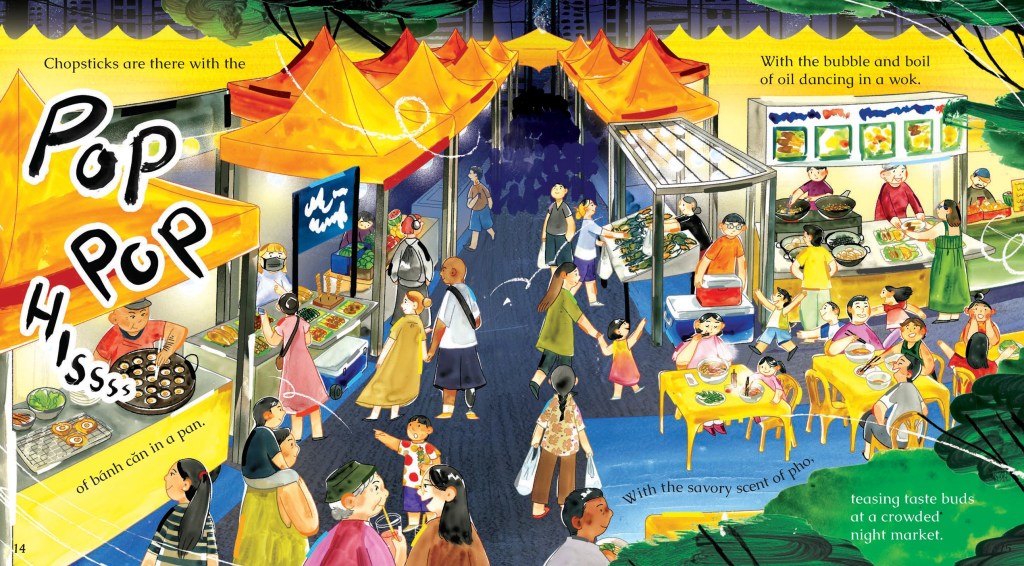
Buying and consuming food are central to families, and to larger communities. A market scene captures the way that eating unites all the shoppers and diners, depicted as separate groups and individuals, but also as participants in a larger and more unified world. Readers will spend time imagining the conversations here, between couples, parents and children, chefs and customers. A seamless connection between objects and the people who use them is another understated current, with pages that are veritable odes to chopsticks, “painted, patterned, or plain” to the bustling humanity that endow them with meaning. The book’s inexhaustible richness, both visual and poetic, will reward many shared readings.
 Imaginary Elevators