A Tribute to Byron Barton (1930-2023)

My Bus – written and illustrated by Byron Barton
Greenwillow Books, 2015

The Three Bears – written and illustrated by Byron Barton
HarperFestival, 1997 (originally published by Greenwillow, 1991)

Byron Barton’s wonderful body of work, including board books, for the youngest readers, illustrates the value of simplicity. He will be greatly missed. In his long career, he showed readers the importance of respect for children’s imagination, intuition about how they perceive the world, and unpretentious images and text. It’s impossible to select the best of his rich and varied contributions to children’s literature, but here are two places to begin.

“I am Joe,” My Bus begins. “This is my car. This is my bus.” There you have all the information needed to understand the story, which centers on counting animals who board different vehicles, but is also about the familiarity of a friendly character.  In bright, geometric images carefully placed in a community, readers follow Joe and his bus as they pick up a number of dogs and cats, and then deliver the animals to a plane, boat, and train. Where are they all going?  We don‘t know, because their destination matters less than their trip and means of transportation, always fascinating to children.  When Joe arrives home, one dog disembarks with him.  Wherever the other animals are headed, it’s reassuring to know that Joe has a dog and that they arrive home safely.  Two cats sit by a quiet bus resting under the moon. They may not belong to anyone, but they’re keeping the bus company.

There are an inexhaustible number of versions of The Three Bears. An author needs to justify each new one.  Barton’s starts out “Once upon a time there were three bears,” not disappointing any reader.  The cover shows the bear family and their house in the background. The opening pages change the perspective because, in spite of the sentence, there are no bears in the picture.  The house is surrounded by trees too numerous to count, each one a green circle on a small red trunk, accompanied by flowers on the ground. Mama Bear’s kitchen as a brick stove, and three bowls of porridge sit on a deep green table.  Again, the subsequent picture shift perspective, with the three bowls viewed through the window of the house.  An economic text highlights each event of the story, which has its own moment to settle in the reader’s mind.

Along comes Goldilocks, sampling porridge, breaking the little chair, and settling in for nap with her shoes neatly placed at the side of the bed.  When the bears return, they could not look less threatening, but children hear them exclaim their surprise at the unsettled condition of their home. No harm is done, but Goldilocks is definitely scared. She runs away and will never return.  The house reappears with the same trees, this time snugly set in their center instead of placed in the corner of a two-page spread. Home is what matters.  There are many other books about the bears to share with children, but Byron Barton’s sets them securely on the path to appreciating them when they are ready.  His work is inimitable.

Mike Mulligan’s Creator

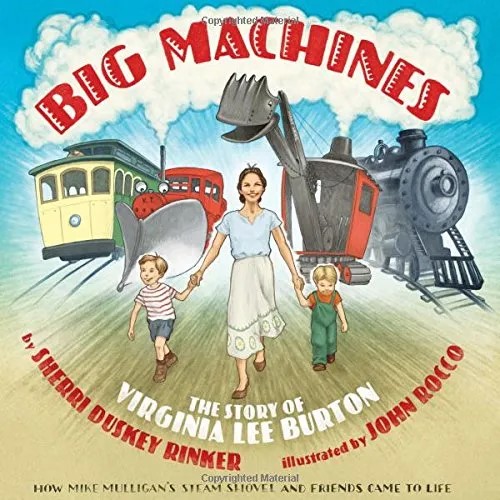
Big Machines: The Story of Virginia Lee Burton – written by Sherri Duskey Rinker, illustrated by John Rocco
Houghton Mifflin Harcourt, 2017

Explaining to children how creativity works is both challenging and rewarding. Presenting  the process through which an author and illustrator of picture books produced some of their favorite characters is especially significant.  In Big Machines: The Story of Virginia Lee Burton, readers learn how a multitalented artist with a consuming vision accomplished magic.  Burton brought to life machines about to be made obsolete, houses threatened by urban expansion, and steam trains bored with jobs.  (She even wrote and illustrated a comprehensive history of life on earth called Life Story.) Sherri Duskey Rinker and John Rocco have constructed an accessible path towards understanding Burton’s gifts, motivations, and lasting importance.

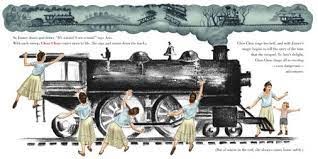
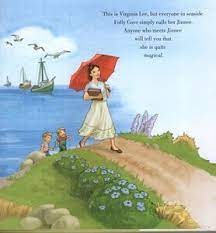
Although Rinker refers to Burton as “magical,” it is clear at the same time that she is down-to-earth. A mother, a dancer, a gardener, and a neighbor, Burton could be any member of her community, except that she is different.  “With a few taps of a wand,” Jinnee, as she is known, “creates animals. She can also make the seasons change, and conjure heroes and people of all sorts.”  There is a risk in emphasizing the almost mystical aspect of artistic creation, but both words and pictures depict how Burton’s wand is a paintbrush, and that her innate talent only allows her to conjure and create through hard work.

Burton appears at her desk from a bird’s eye view, meticulously drawing and erasing.  Rocco does not attempt to reproduce her style, but rather to suggest it, perhaps even to conjure her artwork in a reflection of the way she herself created a world.  The machines that she loved are the central focus of the book. 

We see her, standing along the track with her son, drawing a life-sized steam train. Michael, her little boy, had inspired her work on Mike Mulligan. He observes his mother’s vision of Mary Anne come to life in all its functional detail.  Katy the snowplow transforms a blank sheet of white paper into bright color, as Burton draws and paints the tough red Katy into a determined character.  Burton and her children stand alongside the completed scene.

Readers may be reminded of Crocket Johnson’s Harold with his purple crayon, resolving dilemmas by drawing, but the meld of fantasy and reality in Burton’s biography has a somewhat different purpose.  Standing inside the little house as she draws it, the artist is not saving herself from danger or finding a missing home. Instead, she is realizing an idea of art and engineering as complementary, with both approval of change and nostalgia for inevitable loss. 

Burton’s sons are worried at the little house’s imminent displacement by “Roads! Buildings! Traffic!” and the inevitable darkened skies they bring.  But a flatbed truck hauls the house to safety and the big city remains. Rinker and Rocco establish that Virginia Lee Burton’s life wasn’t one of either/or, but of both/and.  Even as Mary Anne is rewarded for her hard work with a useful role in retirement, and Maybelle the cable car stubbornly keeps her route,  Burton’s genius is the animating force behind these contrasting approaches to progress. The artist’s “wavy and curvy, swoopy and swervy” lines are still a constant presence in the world of children’s books.

The Monsters at the Beginning, Middle, and End of the Book

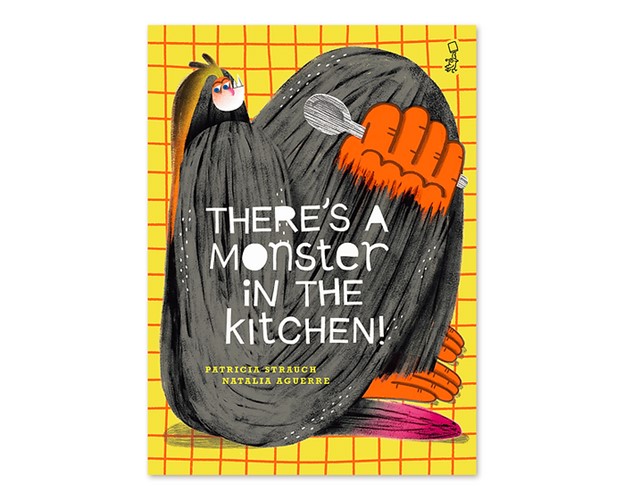
There’s a Monster in the Kitchen – written by Patricia Strauch, illustrated by Natalia Aguerre, translated from the Spanish by Kit Maude
Tapioca Stories, 2023

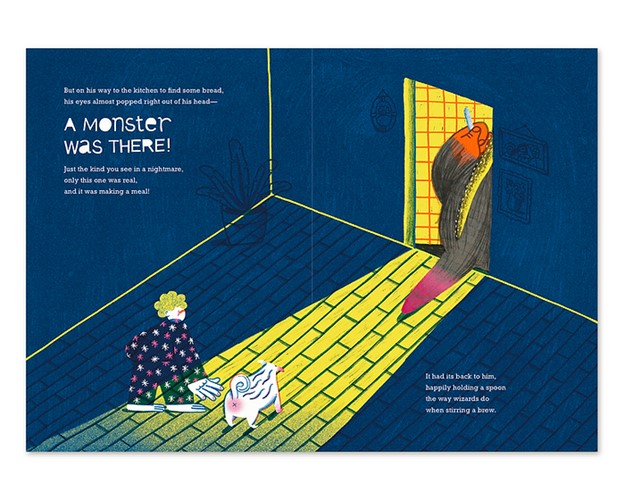
There are a legion of children’s books exploring the question of what constitutes a monster.  From the many versions of Beauty and the Beast, to stories about the legendary golem of Jewish legend, to Sendak’s friendly but frightening wild things, and even lovable Grover’s The Monster at the End of This Book, authors have raised some intriguing possibilities.  Can a seemingly hideous being be nothing worse than misunderstood? Might he be just as scared of you as you are of him?  With a text that pushes boundaries and pictures which are ghastly and lovable at the same time, There’s a Monster in the Kitchen! Offers a new perspective on an old story.

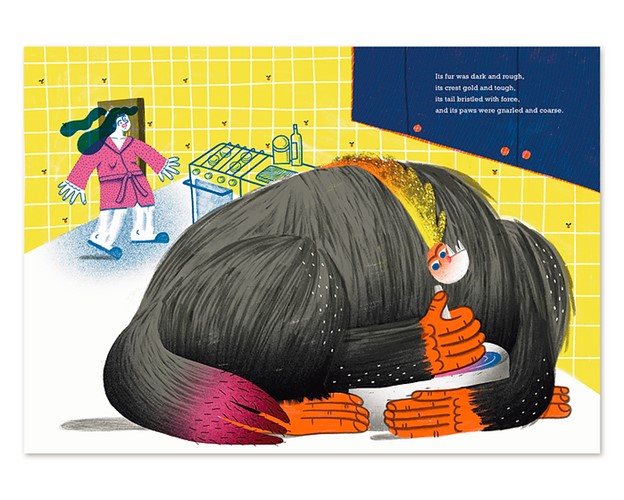
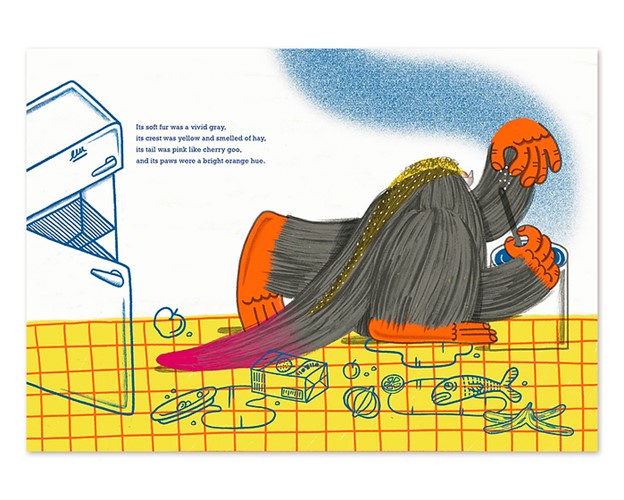
A little boy, Matías, wakes up one morning ready for breakfast.  His bedroom is cluttered with the contradictions of childhood, with a comforting blanket and friendly artwork on the walls disturbed by curtains decorated with spiders and an alarming toy featuring a human eyeball.  Right away, the reader is alerted that Matías is about to confront some variety of terror, but also that, like many children, his own imaginings have primed him for the experience.  When he enters the kitchen, an ominously empty refrigerator, and the orderly countertop drawn on a grid but littered with disorganized food items, let him know that he is not alone.  A horrific monster has made himself at home.

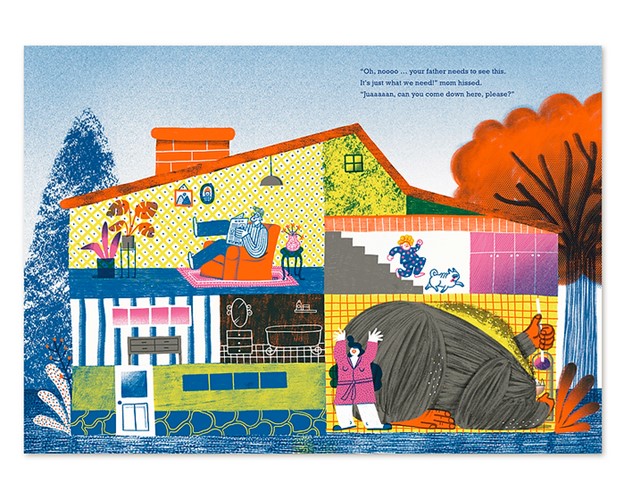
Patricia Strauch’s words and Natalia Aguerre’s images play with the idea of monstrosity. The huge creature’s fur is soft and its tail cherry-pink, yet later the same fur appears rough and its claws are “gnarled and coarse.” Matías’s mother runs to the kitchen anticipating rodents or roaches, the adult versions of monsters.  The monster’s Picasso-inflected features show his own feelings of terror when he confronts the strange figures who seem intent on his destruction.  Aguerre’s portrayal of the father emphasizes the relative identity.  Seated on the top floor of his house quietly reading a newspaper, he hardly seems capable of threatening anyone.  Yet his oversized eyeglasses, unruly hair, and casual striped shirt are potentially as scary to the monster as pointy paws and sharp teeth.

After the monster flees the house like a terrified Goldilocks discovered by bears, the parallel nature of two different worlds comes into focus.  Narrating the day’s events to his family, the monster spreads his arms in the same gesture of disbelief acted out by the human father.  Not only that, but the quiet domestic interior of the creature’s home features a vase of flowers, a small bookshelf, and a tasteful landscape painting on the wall.  The word bubble encasing his description captures the most disturbing visual elements of the humans, with their “spine-tingling, pasty skin” and “their scary, murderous eyes.”  The boy resembles a zombie, the mom looks about to use her ladle as a deadly weapon, and the dad’s strong embrace of his wife and son seems menacing, not protective. 

All’s well that ends well, as the monster, relieved by the chance to tell what had happened, falls asleep curled up on a pillow.  Like Matías, he uses art to explore his experiences, as evidence by the picture posted above his bed.  There’s a Monster in the Kitchen avoids the hazards of cliché, instead propelling readers into a world where familiar and estranged elements collide, and are only partially resolved.  There is no suggestion that monsters and humans will meet again in a moment of reconciliation, only that they will each continue their lives undisturbed, within the embrace of their families.  Children reading the book may consider whether, given their similarities, coexistence could be an option.

Women Scientists Getting Credit Might Seem Like a Miracle

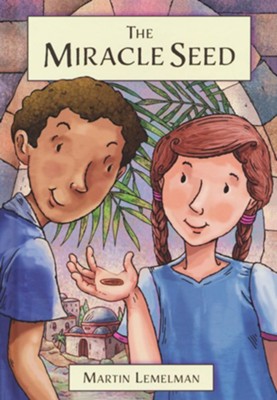
The Miracle Seed – written and illustrated by Martin Lemelman
Eerdmans Books for Young Readers, 2023

Given the popularity of books for young readers about under-recognized women scientists, finding one with a distinctive premise is always welcome.  Martin Lemelman’s graphic work of non-fiction celebrates two scientists working in Israel to revive an extinct date palm. He integrates several themes, including Jewish history, the science of botany, and the under-representation of women in the sciences.  The collaborative work of Dr. Elaine Solowey and Dr. Sarah Sallon succeeded in pollinating ancient plant material and producing a date that had not exited for a thousand years.  Lemelman carefully contextualizes their “miraculous” project as part of the Jewish people’s roots, and also paints a vivid picture of the women’s friendship, predicated on mutual respect and shared goals. 

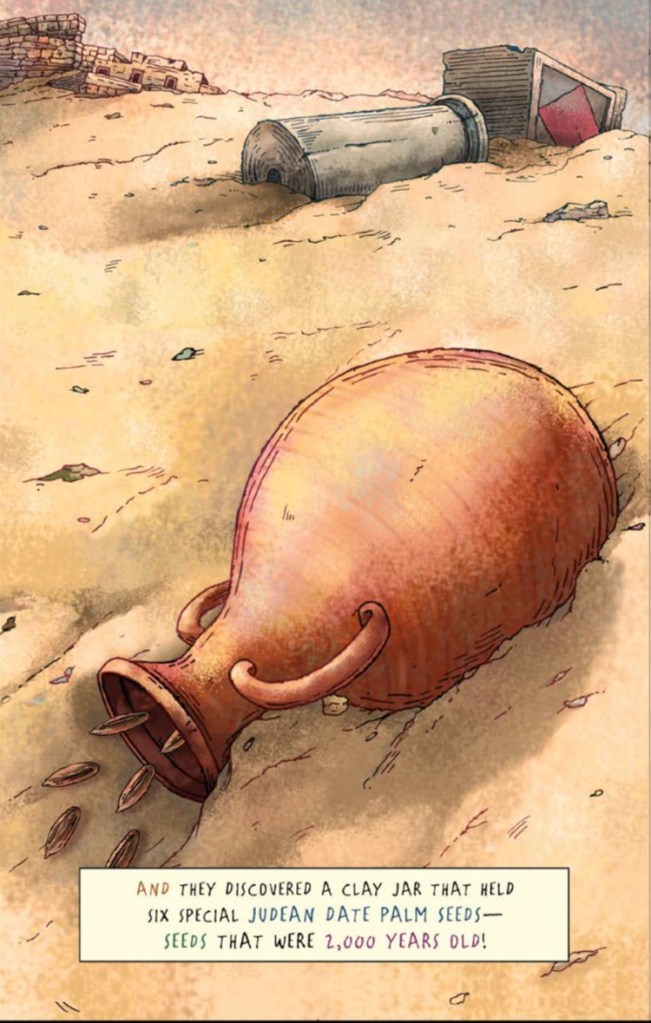
Science is not a miracle and Lemelman does not attribute the project’s success to the supernatural.  Instead, he establishes how the improbability of locating the date palm seed, preserving it, and finding two brilliant and dedicated women to engineer its rebirth evokes a sense of awe sometimes reserved for miracles.  Divided into sections, the book unfurls its story step-by-step, at first inviting readers to travel back to the time of the First Jewish War against Rome (66-73 C.E.), when the Emperor Titus destroyed the Temple in Jerusalem and left devastation in the aftermath.  Lemelman draws each scene cinematically, including ones at Masada, where artifacts of the rebellion lie in ruins. In 1963, archeologist Yigael Yadin and his team locate these items; his discovery appears in striking images and poetic text: “They unearthed broken baskets and bronze arrows…They unearthed beautiful mosaics and ragged clothing.” They also found a clay jar containing date palm seeds. 

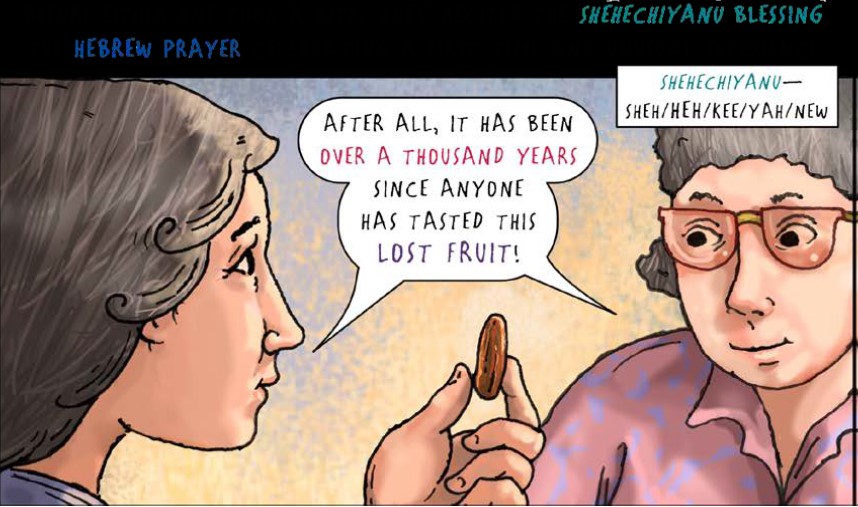
The story moves forward smoothly, emphasizing both innovation and continuity with the past.  As Solowey and Sallon employ the scientific method to achieve their goal, they refer, casually and affectionately, to Jewish religion and culture.  A seed is planted on the holiday of Tu B’Shvat, commemorating the New Year of the Trees, and soon sprouts. They assign biblical names to the male and female plants produced by their work, and they recite the Shehechiyanu prayer marking a new experience.  There is no contradiction between religion and science, because they operate in different spheres.  The two scientists respond to the results of their experiments from the personal identities, which are proudly Jewish.

In addition to photographs and an informative timeline, Lemelman includes an “Author’s Note” which is truly inventive, chronicling the story of how he came to write this book.  Honest, humorous, and unpretentious, it constitutes a brief book within the larger one, describing his formation as an artist and writer, conversations with his wife about the challenges of his work, and his excitement at find historical sources and artistic inspiration.  The section may be an appendix, but, in retrospect, it enhances the experience of reading by conveying excitement in the full process of writing a book.  Children, and adults sharing the book with them, may find that a bit miraculous, too.

It’s Time to Go Outside and Play

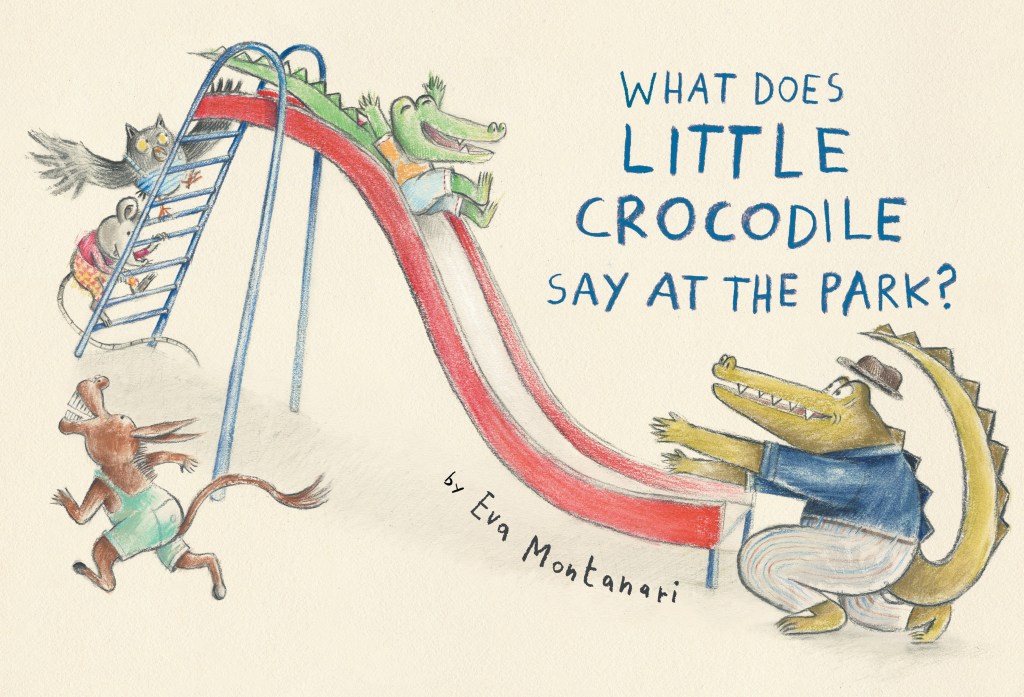
What Does Little Crocodile Say at the Park? – written and illustrated by Eva Montanari
Tundra Books, 2022
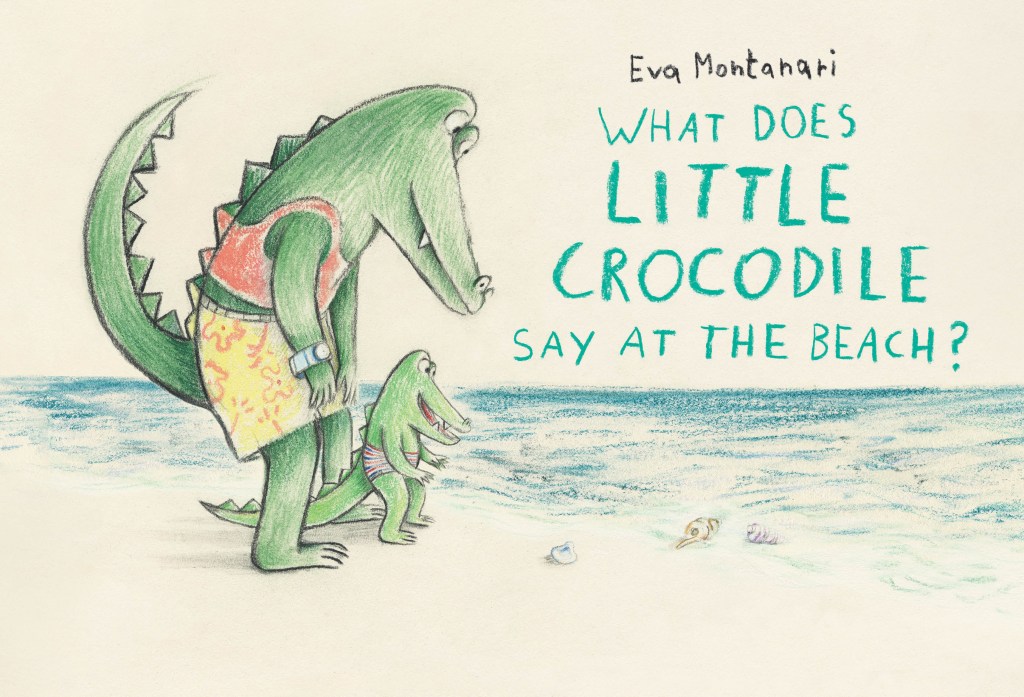
What Does Little Crocodile Say at the Beach? – written and illustrated by Eva Montanari
Tundra Books, 2023

Pictures books use a combination of words and images to tell a story. (There are wordless picture books, in which the pictures tell the stories by themselves.)  In Eva Montanari’s Little Crocodile series, the text is composed of simple vocabulary that would be familiar to a toddler or preschooler, and the pictures are her signature-colored pencil and chalk pastel scenes that seem almost tangible, and so bright that you imagine she has just laid down her art implements and finished the pictures.  It’s challenging to create believable, non-generic, characters with this proportion of words and images, but Montanari succeeds. Her crocodile child, friends, and family are lively individuals, interacting with one another in a way that will immediately evoke recognition from young readers.

The books ask what Little Crocodile will say, because he is just beginning to use language.  The events in his life are told from his perspective, as he experiences them, but also how he articulates them in few words.  At the beginning of What Does Little Crocodile Say at the Park, he is busily engaged building with blocks when his grandparents arrive.  Grandma calls him “Sweet Pea,” while Grandpa, communicating like a toddler himself, lifts him up with the “words” “Muah! Muah!” 

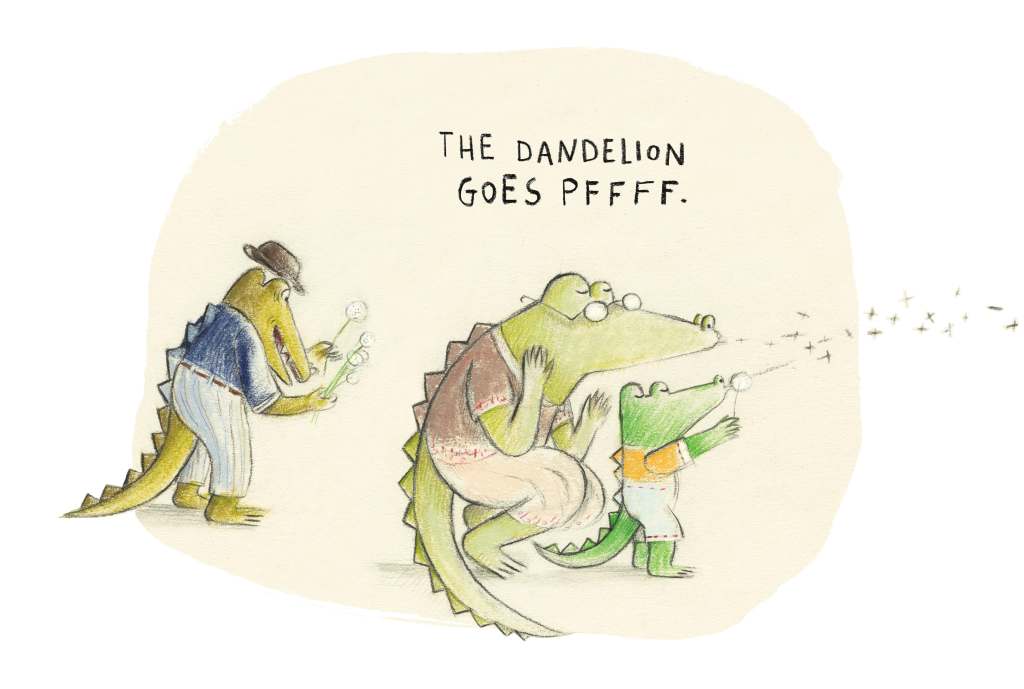
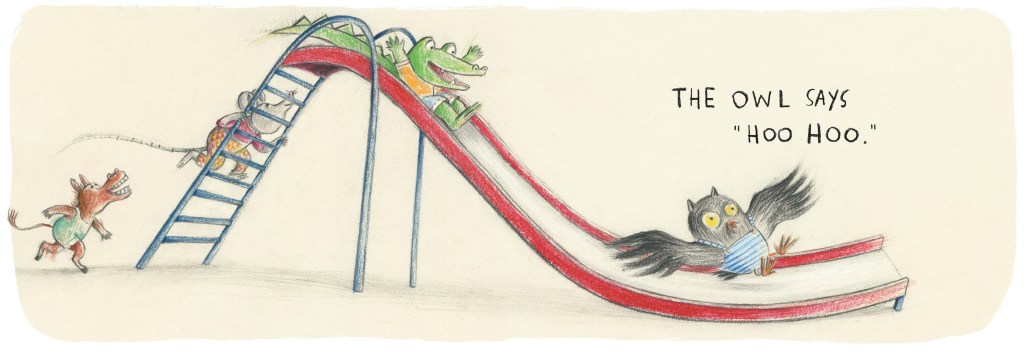
They do a lot of different activities at the park, each one a moment of joyous concentration. With Grandma’s help, Little Crocodile blows a dandelion’s seeds into the air, has a snack, and imitates the flight of a pigeon.  He feels independent enough to make friends with other animals, and is able to adjust when the inevitable conflicts arise over sharing.  A ride down the slide, following an owl, is a memorable moment, viewed in anticipation, as Little Crocodile is just about to begin his descent.

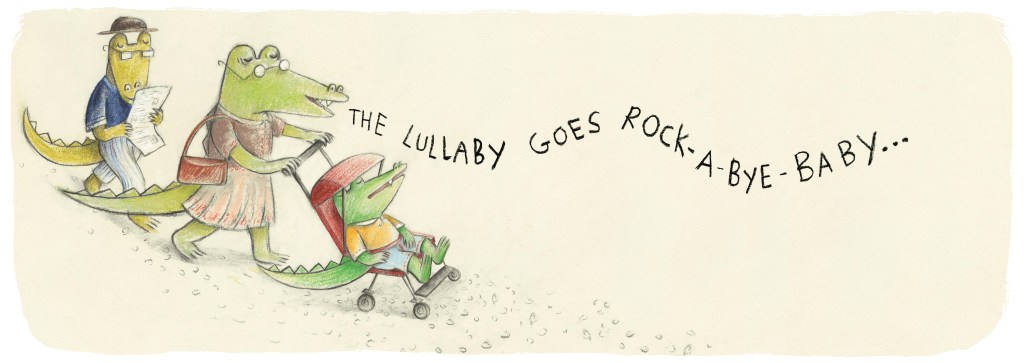
A satisfying conclusion to the book involves his farewell to friends, and a sleepy ride home in his stroller. Grandma, glasses perched on her face and pocketbook slung over her arm, happily pushes him.  Grandpa, also wearing glasses, walks while reading his newspaper.  Taking care of his grandchild has been rewarding, but he also wants to return to the adult world.

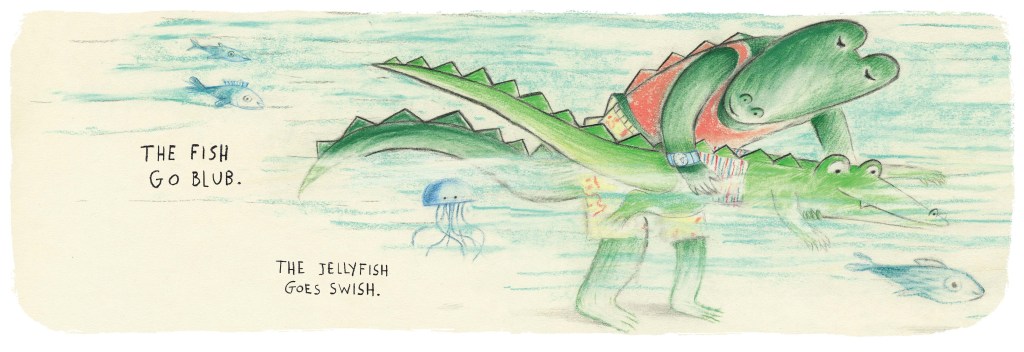
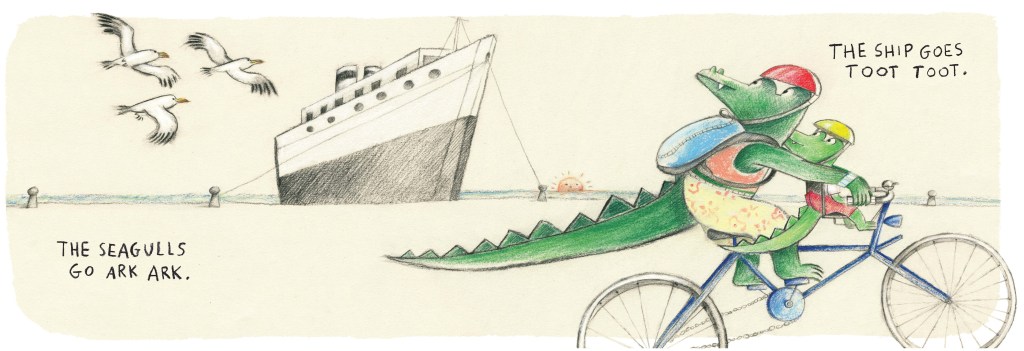
In What Does Little Crocodile Say at the Beach, the weather has turned warmer.  This time, a parent accompanies him, gently introducing him to the ocean’s waves and holding him as he practices swimming. Crocodile is comfortable and pleased, identifying himself with the fish and jellyfish around him. After a day of building sandcastles and swinging through the air he doesn’t want to leave, but the distraction of watching seagulls approaching a big ship is enough to calm him. Montanari’s adult characters relate to children’s needs, showing the practical sense of how to manage transitions. In fact, the parent crocodile, turning his head to look backward as he bicycles with his child, seems equally fascinated by the ocean liner.  He is an adult who clearly remembers what it felt like to be a child.

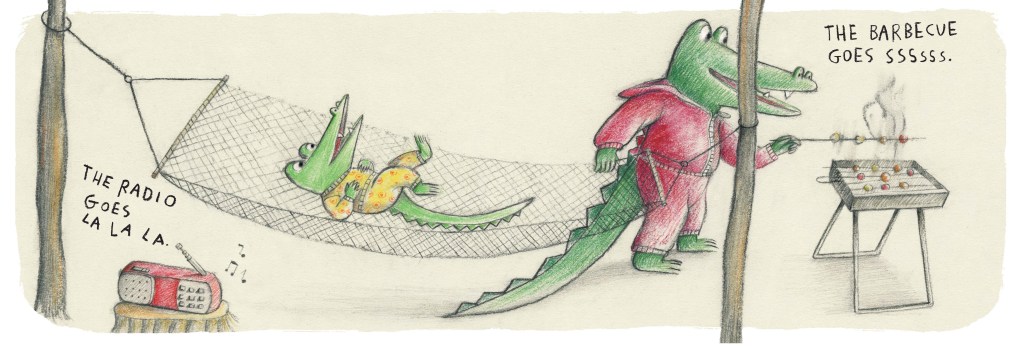
A barbecue ends the perfect day.  Little Crocodile, lying on a hammock, seems to be dancing on his back to the music as “The radio goes la la.” His parent, comfortably dressed in a post-beach running suit, cooking something on skewers that looks delicious. It’s no surprise that he is the more tired of the pair, falling asleep in the tent while his child, still awake, holds on to a flashlight.  Learning something new, enjoying unencumbered play, eating outdoors, made for a wonderful day, with the supportive companionship of a parent the best part of all.

Even a Talented Bear Can’t Perform All the Time

Bear Is Never Alone – written by Marc Veerkamp, illustrated by Jeska Verstegen, translated from the Dutch by Laura Watkinson
Eerdmans Books for Young Readers, 2023

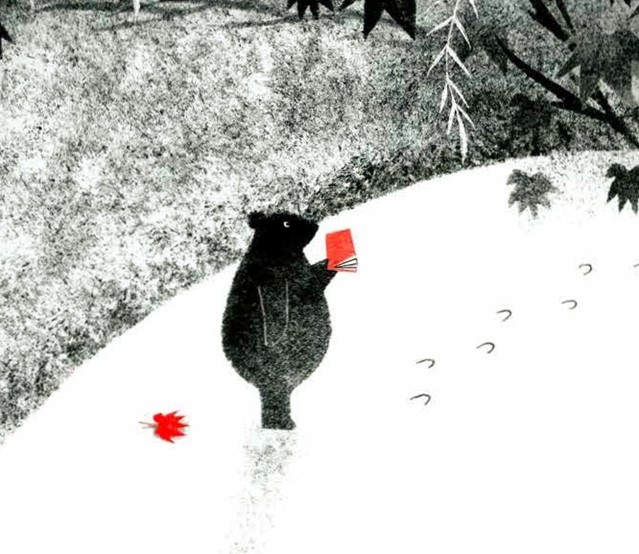
Bear is a gifted pianist, drawing crowds of animal friends to his concerts.  His music is so entrancing that the natural world is completely quiet when he plays.  His back to the reader, and his long arms stretched across the keyboard, Bear has a captive audience in the forest. No one tires of his music; only Bear himself becomes exhausted.  Marc Veerkamp and Jeska Verstegen (whose earlier work I reviewed for Jewish Book Council) gently present a problem to young readers. What happens when an artist’s work brings joy to everyone but reduces him to a virtual prison? More broadly, what should one do when his own needs are in conflict with those of others?

The books pictures are rendered in black and white, composed against a white background. A dramatic touch of red draws the reader’s eye to select images: the sun, flowers, a bird, and a book. The book plays a key role, since it belongs to a zebra, the only one of Bear’s fans who understands the musicians need to sometimes be alone.  The bear and zebra meet on facing pages, and begin to communicate with one another. For once, Bear is an individual.  The zebra’s special attribute is language. In fact, his stripes are lines of printed words, and the red book balances on his back. 

Music is performative, at least some of the time, while reading is not, at least most of the time.  When well-intentioned Zebra offers to read aloud to his new friend, Bear becomes frustrated, and even rude: “If you really want to do something nice for me, why don’t you leave me alone?” While a child would be more likely to feel comfortable uttering that challenge, adults reading the book will definitely relate to its honesty.   Zebra gets the message, and if he is offended, he chooses not to show it.  Bear stands, holding the book, and realizes that flexibility might be the answer to his conflict.  Each picture advances the story like a scene in a play, while the minimalist text deliberately leaves much unsaid.  Being alone together is a novel idea and it might work.

The book quiet acknowledges and affirms children’s need for friendship, empathy, and a simple rest from the demands of their busy lives. Veerkamp and Verstegen also raise subtle questions in a way which children will understand.  The difference between language and music, the complementary nature of solitude and friendship, and the need to establish boundaries are all implicit in the story. Even the imaginative contrast between the endpapers opening and closing the book gives a hint.  A crowd of animals outdoors precedes the story, while the back endpapers feature a teapot and cups sitting on a hill in the same outdoors.  The domesticity of Bear and Zebra’s new friendship and shared love of reading does not compete with their natural surroundings. Maybe Bear will return to the stage refreshed and renewed.

Keeping Misogyny in the Family

Ye Cannae Shove Yer Granny off a Bus: Favourite Scottish Rhyme – illustrated by Kathryn Selbert
Floris Books, 2018

Actually, you can. That is, you can throw her off the bus if she is your paternal grandmother, but not if she is your maternal one.  That’s the message of this brightly illustrated board book, which includes “lift and slide” and “lift the flap” elements.  While Scottish culture is not the only one to mock mothers-in-law or make a distinction between your two grandmothers, this book is a specifically Scottish production; the back cover encourages us to “PUSH granny…SING ALONG to the much-loved Scottish rhyme, in this brilliantly bonkers board book.”

Aside from the clever alliteration, the message seems to be that the book is all in good fun. No one really expects children to internalize its message and take action based on its silly recommendation. That’s why it’s “bonkers!” In fact, one might assume that the book is really for adults; I would certainly not read this to my grandchildren, although I’m not Scottish.  Again, I want to reiterate that the book’s message is broadly encountered in many other cultures across the globe. This book, however, packages it in an appealing and funny way, if you’re willing to overlook its repugnant misogyny. 

The bus in question has plaid seats, a recurring Scottish motif in the book. The children on board are multicultural, which, in an insidious way, implies that the message is up to date.  We see a young mom with glasses and red boots, tending to her child in a spiffy stroller.  Then we see Granny, the nice maternal one whom we’ve been warned not to eject from the vehicle. She is wearing a red tartan, and the same glasses as her daughter, emphasizing her lineage to the grandchild sitting on her lap.

Then the paternal granny appears. She also has grey hair, but no glasses.  She is not wearing a tartan plaid, but rather blue jeans and a lilac-colored cardigan, making her indistinguishable from any ordinary person. She may be old, but is not particularly grandmotherly, in the supposedly maternal way. Then, some ambivalence on the part of the illustrator surfaces. Father and daughter happily wave and smile (the girl is actually laughing) as they watch the father’s mother all from the bus. Don’t worry. When we lift the flap we watch her magically spring up into the air on bouncy coils. She is unharmed. 

The next scene shows what might happen if the child ignored the book’s recommendation, and actually pushed the wrong grandmother off the bus.  Granny’s arms is twisted around the pole on the bus door, in what looks like a painful way, but she is smiling.  There seems to be a double message.  Don’t do this, but, since the book is “bonkers,” no actual grandmothers have been harmed in its creation.

In the final pages, the family is seated together on the bus, with the maternal granny standing. Again, everyone’s face is happy. Lifting the flap, we see her arms become magically elongated. With one arm she is embracing her granddaughter, and with her other she is able to reach her toddler grandson in his stroller at the other end of the seated group.  Granny is giving him a tiny book on a keychain; it represents “Ally Bally Bee” another book in the publisher’s series based on Scottish nursery rhymes.

Why am I calling this harmless board book misogynist? Maybe it’s just a humorous acknowledgement of a broad prejudice against paternal grandmothers, a phenomenon which has been noted and analyzed by anthropologists and psychologists. (If you google the topic, you will find many examples, such as this article.) Of course, individual families don’t necessarily subscribe to these expectations. There may well be maternal grandmothers who are tossed from the bus and don’t smile at the insult.  Some paternal grandmothers are privileged to have close relationships with their grandchildren, even when they don’t wear plaid.

What about grandfathers? Do they share the privileges and the stigma based on their lineage? Historically, since they were generally less involved in providing childcare, perhaps the difference seemed less important.  Yet their control of financial resources was generally greater than that of grandmothers.  Maybe the beloved nursery rhyme just reflects deep seated suspicion and hatred of women.  If your child is older than the book’s intended audience, it might be interesting to share it with her and generate a productive discussion. 

Girl Reporter

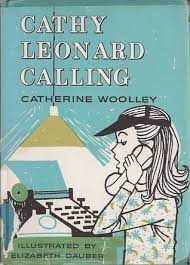
Cathy Leonard Calling – written by Catherine Woolley, illustrated by Elizabeth Dauber
William Morrow & Company, 1961

Cathy Leonard, from A Room for Cathy, is back. This time she has a job. In the era before “Intern Nation” she actually gets paid.  Even grownup writers often don’t today.  Her salary may not be much, but it’s enough to take her family out for a day of entertainment in New York City.  Cathy is only in fifth grade.  This is a big step up from her excitement at having her room painted, or making a new friend whose mother is a children’s book writer.

Cathy had been inadvertently networking. When the society reporter for the local paper decides to take a trip to Florida, she needs a temporary placement, and she thinks of the girl who seemed to be in the know when the editor, Miss Hobway, would call local residents looking for stories.  She explains the rudiments of the job to Cathy, along with some fun journalism lingo, like the meaning of sending in a “string” of articles.  There is a warning from Cathy’s mother. She can’t let the job interfere with schoolwork. There’s also a crusty editor named Mr. Stark, whose off-putting last name communicates how he feels about child reporters.

Here is the best part about Cathy’s ambitions. She’s a mid-twentieth century-child growing up in a small town, straitjacketed by the gender norms of her time. She wants to be a journalist and she wants to get paid for her work, although she feels hesitant to even admit that: “To her the money part of the job was unimportant.”

          Writing was a thrilling, wonderful thing to do, Cathy thought, and it opened doors
          of the whole world to you.  She could not get over the miracle of having this opportunity
          to write fall into her lap.

The “money part” may be trivial, but when that paycheck arrives, Cathy is pretty excited. The accompanying picture shows her racing down the stairs in her pleated skirt, holding the letter in one hand and its envelope in the other.

          There was only a thin pink slip inside.  Slowly she drew it out, gazing at it with a puzzled
          frown.  Then suddenly Cathy gave a shrill squeal, headed for the door, and flew
          downstairs, waving the paper…
          ‘This is my pay!…’
          ‘It’s a check!’
          ‘I’m going straight upstairs and telephone some people and earn lost more money!’

The lots more money won’t happen for a while. Eventually, even as she saves an old woman’s life and becomes herself the subject of newspaper articles, Cathy concedes that her job is interfering with getting good “marks” in school. She voluntarily resigns.  I couldn’t help but wonder if, as an adult, maybe with a husband and family, she would indeed be allowed to pursue her dream. Might she start a job, only to be told that her duties were interfering with housework and childcare?  By then, the second wave feminist movement would be underway. Maybe she would be able to be a journalist, and maybe even earn “lots more money.” (unlikely)

Cathy Leonard has ambitions, as did her creator, Catherine Woolley.

The Past, Distant and Less So

The Windeby Puzzle: History and Story – by Lois Lowry
Clarion Books, 2023

There are contemporary children’s books that, instead of following trends, challenge them. It’s hardly a surprise that Lois Lowry, the author of so many works that ask young readers to think about difficult issues, has once again made a memorable contribution to literature. The Windeby Puzzle suggests different possibilities about the life of a young person that ended during the Iron Age, in the first century C.E. Rather than writing a straightforward historical fiction, Lowry imagines who the adolescent, whose body was found in a peat bog in Germany in 1952, could have been. She frames stories about the events of their life, as well as suggesting their motives presented through narration of their interior lives, as well.  In alternating chapters, Lowry herself steps forward and describes the process through which she tries to recreate the past, acknowledging that she would never be able to accurately do so in the pre-modern setting of the book.  Most important, she encourages readers to think about both the limits and the potential rewards of reconstructing a distant past.

Lowry is specific in admitting that her construction of a feminist character, based on the time when the Windeby body was believed to have been female, is thoroughly anachronistic. We cannot impose the standards of justice and equality which people have come to expect today on a time when people’s lives were completely constrained by gender, glass, geographic setting, and other unchangeable factors.  But on the other hand, the fertile exercise of thinking about how a particular individual might have responded to those limitations is legitimate, as long as we understand the difference between literally, or just figuratively, rewriting the past. The dialogue, description, and poetry of her writing is, as usual, engaging and also beautiful, even when she addresses tragedy.

Everyone approaches a book in a different way.  This is in no way a criticism of Lowry’s achievement, but I could not avoid one disturbing connection that struck me from the beginning of the novel/meditation on history. It is 1952 in Germany. Workers cutting peat come across a body. They are disturbed. The bone they have come upon is not from an animal, but a human being. Perhaps it is evidence of a crime. They call the police.  This scene takes place a mere seven years after the end of World War II, and of the Holocaust.  The remains of thousands of Jews, sometimes their bones but sometimes only ashes, lie beneath the earth.  While some of the death camps were located in Eastern Europe, others, such as Dachau and Bergen-Belsen, were in Germany.  The people living in the vicinity of the camps were well aware of what was happening inside them. (This perspective even seems validated by an anecdote, on the website of the Penn Museum, about a World War II era bog find which was confused with a murder by the SS.

To me the contradiction of finding Windeby girl/boy, the zeal with which archeologists sought to determine how his or her life had ended, has an ironic shadow.  So many stories of lives cut short, as young or younger than the person’s at Windeby, deserve to be recovered and remembered, and many authors and historians have devoted their careers to that goal.  Sometimes the distant past seems less threatening to explore than the much more recent one, which, in 1952, was less the subject of inquiry than of deliberate denial.

A Force of Nature

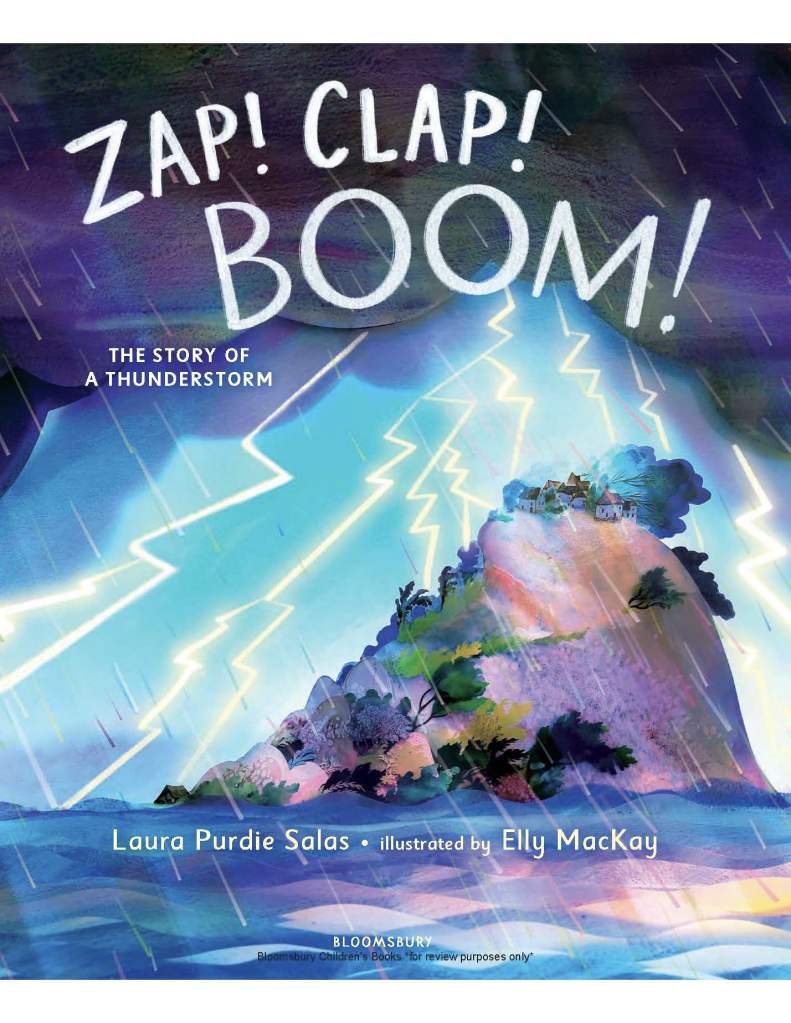
Zap! Clap! Boom! The Story of a Thunderstorm – written by Laura Purdie Salas, illustrated by Elly MacKay
Bloomsbury Children’s Books, 2023

The thunderstorm in Zap! Clap! Boom! is a little bit threatening and also exciting. The preamble to the storm is quiet and the aftermath is peaceful. Laura Purdie Salas and Elly MacKay capture the contradictory parts of this weather experience for children in a poetic narrative with fanciful pictures, leaving the scientific explanation for an accessible afterword.  The book is unusual in its presentation of both the beauty and the menace of a summer storm, immersing children in its representation of their feelings without qualifiers.

The text is economically presented, with each word having maximum impact.  The beginnings of the storm are only “a rising cloud,/a towering plume.” Then the sky explodes and the world feels its impact: “The world groans slowly,/shivers,/creaks.”  “A crackling, grumbling/sound of doom” precedes the sound effects capture in the title, and then the storm has passed. The combination of words and pictures gives the story a theatrical presentation, with layered paper and digital elements that emphasize the drama of this ordinary event.

Every page is carefully composed. Three children play against a pale blue sky, their game of kicking a ball continuing on to the next page, and the bright red ball reappearing in subsequent scenes.  A family of goats prances across the sky, evoking a Chagall painting.  They return to earth, finding shelter in a shed, but later take flight again.  The scale of people to their environment also changes, with the children sometimes rendered quite small in relation to nature, and on other pages taking center stage.  Deep colors are the setting when the storm is intense, as when the children, viewed from a brown-framed window, hover together against the dark blue of the sky and the forest green of branches unsettled by the storm.

After the storm ends, the children, the goats, and the bright red ball return to unencumbered enjoyment of the sunny day.  A parable of recovery and peace is set within a realistic depiction of a storm and its aftermath. There is even the sense of a lasting benefit, as “Diamond drops/dress trees and vines./Storm is over.”  At least for the moment, that’s true.  The explanatory afterword, “The Science Behind Storms,” offers further information and resources, as well as the message that access to knowledge complements the poetic lens of the book.