Connect the Dots

My Lala – written by Thomas King, illustrated by Charlene Chua
Tundra Books, 2022

My Lala celebrates one of the most endearing misconceptions of childhood. When toddlers decide that they are the center of the universe, and own everything that surrounds them, they might come into conflict with other family members or classmates. But Thomas King and Charlene Chua choose to celebrate the glorious recognition by one little girl that she owns the world. By focusing only on her, and the red dots that identify all her possessions, they interpret this state as one of pride in a growing autonomy. The book is funny and tender, with a rhythmic text and bold graphics. Children and adults will both relate, from different angles, to Lala’s joy in taking control.
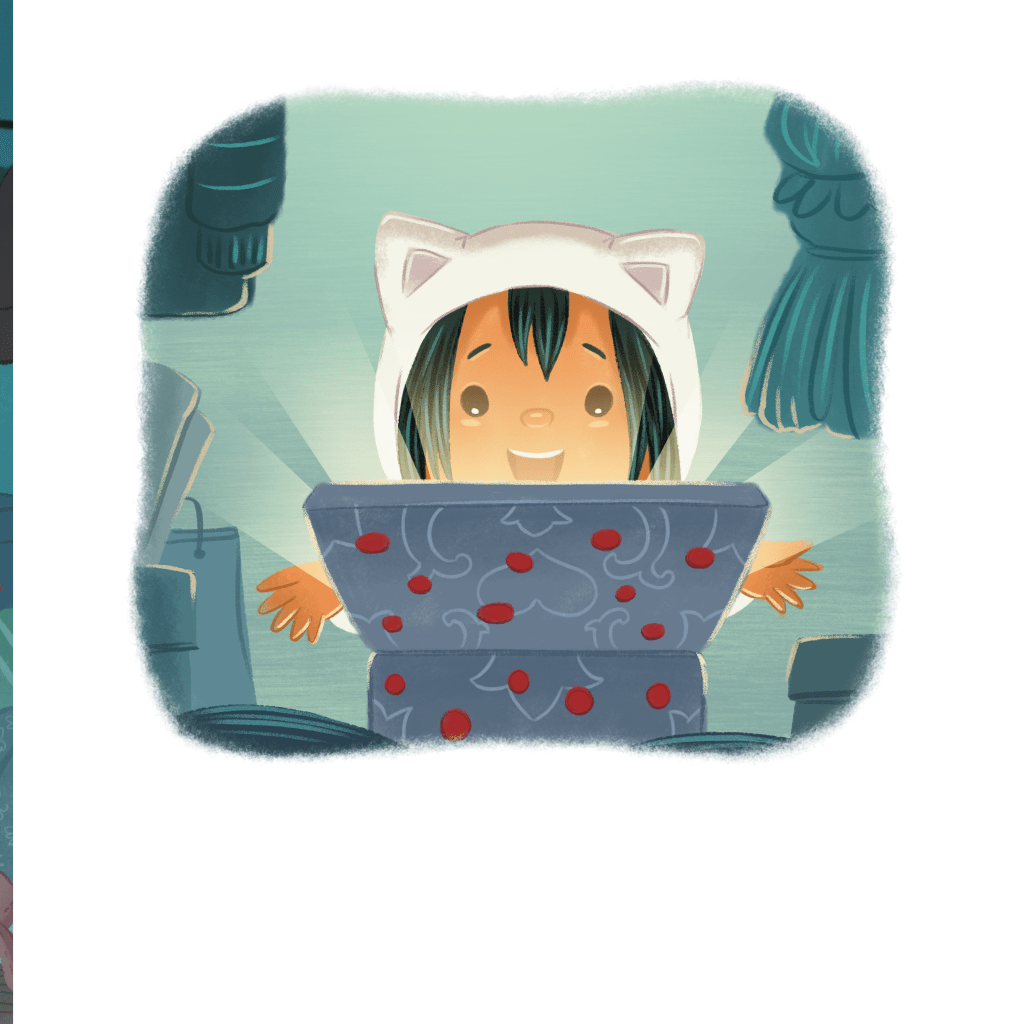
Lala both collects and creates red dots. They open and close the endpapers of the book, and mark every page in between. Lala’s sense of self-awareness begins when she wakes up one morning with a sudden epiphany: “One morning when morning came bright as a pear,/Lala decided that she owned the world.” Note that King describes this development as a decision. Lala is happy, determined, and energetic. Her animal costume pajamas suggest a small creature in the wild, but she is not reckless.  King and Chua depict childhood play as looking chaotic on the surface, but actually governed by purpose.  Her Lala box is magical and stuffed with treasures. 

She uses the dots to identify and claim special objects, from blankie to book, to the bright yellow raincoat hanging on a hook. In addition to affixing the red dot to each item, she awards them her own name: “One for My Lala blankie and My Lala book.” Lala tries on clothes to prepare for the weather. She tapes a red-dotted pirate hat on her hapless cat.

Naturally, she is an artist, clutching the markers that she uses to transform her bedroom walls into a gallery. Each picture shows the excitement of a child transforming her small stature relative to adults into an asset, by inhabiting every inch of space without inhibitions.  There is only one time in life when this is allowed; King and Chua let children know that it is a wonderful opportunity.

Resources are finite, but Lala doesn’t know that. In fact, when she runs out of dots, this temporary obstacle inspires her to action. Her coloring, snipping, and pasting are filled with frenetic energy, as she dances from page to page. The constant motion in this book is like a dance choreographed by a child. King and Chua convey complete empathy with Lala’s project, while maintaining the slightest distance from her perception of the universe. Lala’s insistence on ownership has no sense of envy, fear, or anger. She simply loves every article in her life and expresses that happiness in a bright, red dot.  My Lala captures that fleeting stage with simple perfections.

Making Ice Cream and Making News

The Sweetest Scoop: Ben & Jerry’s Ice Cream Revolution – written by Lisa Robinson, illustrated by Stacy Innerst
Abrams Books for Young Readers, 2022

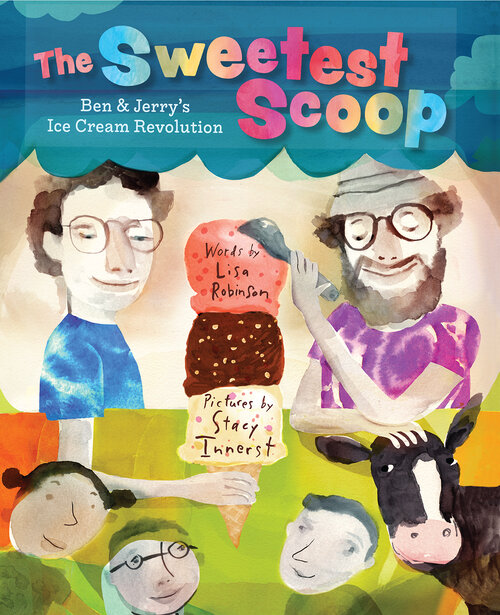
Any picture book biography for young readers will necessarily simplify its subject’s life.  Even the most laudable people usually have acted in ways which make them vulnerable to criticism.  Authors need to decide, based on the length, scope, and audience of the book, what needs to be included.  Ben Cohen and Jerry Greenfield are incredibly successful entrepreneurs who created a product and figured out how to market it.  They deserve credit for their accomplishment.  In Lisa Robinson’s account, the pair’s social activism really sets them apart, perhaps even more than their Chunky Monkey or Cherry Garcia.  The result is a kind of iconography, but with clever text, lots of humor, and outstandingly expressive pictures by the inimitable Stacy Innerst (see other of his books I have reviewed here and here).  The book is indeed sweet, even if Ben and Jerry’s ostensible role as revolutionaries is a bit overstated.

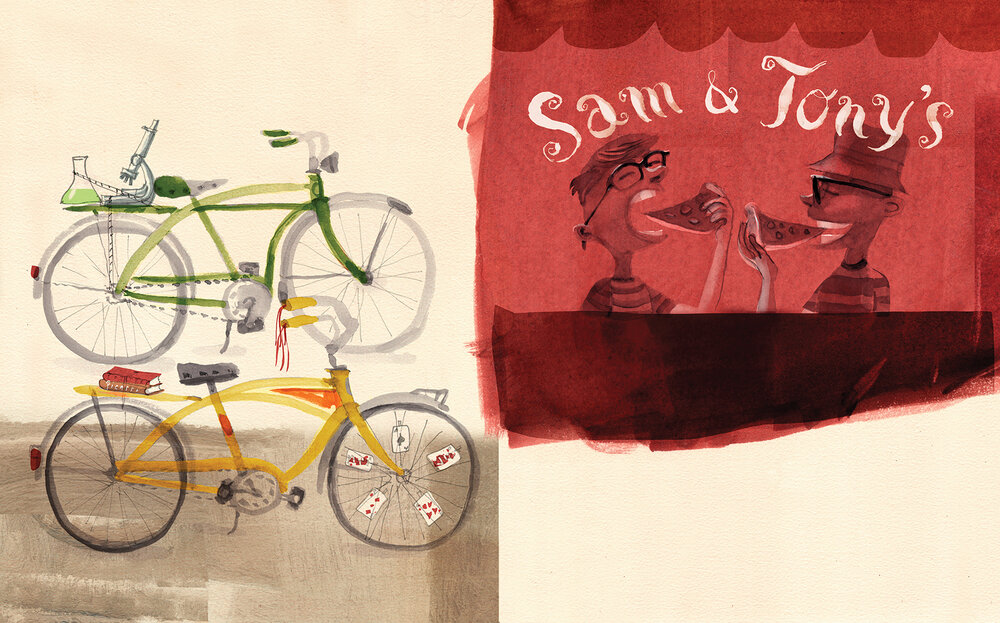
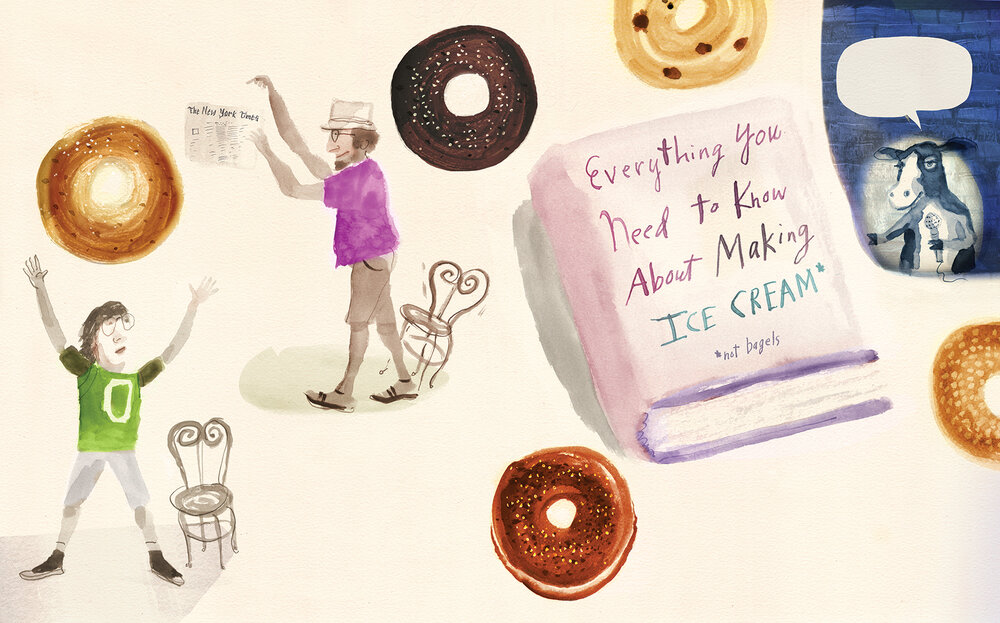
First, the best part of the book is Innerst’s art.  Whatever subject he illustrates, his pictures become an embodiment of that person and his or her era.  There are lifelike drawings that capture Ben and Jerry’s personalities, and fanciful elements such as joking cows and possible ice cream ideas floating over their inventors’ heads. Innerst’s color palette shouts “ice cream,” but the reader does not live by food alone. There are the boys’ bicycles with playing cards in the wheels’ spokes, the young pair confronted with a broken toilet in their gas station, and the serious faces demonstrating for peace in the 1960s.  Pictures offer free association, as in the small American flag atop a serving of Empower Mint, or again, those cows, this time taking a meeting with Ben and Jerry outdoors, under pastel clouds.

Young readers will be engaged by the legitimate story of Ben and Jerry as underdogs. They me as kids. They loved biking, art, science, and, of course, food. They showed an impressive work ethic, but met with many disappointments. When they decide to start their own business, “they will be their own bosses,” a goal attractive to children and adults alike.  Conceiving and developing every aspect of their unusual plan, Ben and Jerry go from mixing ingredients to getting it onto store shelves. When the corporate behemoth Pillsbury threatens to shut them down, these two socially conscious guys from Long Island complain to the Federal Trade Commission. Eventually, they have the last laugh, selling huge quantities of their ice cream all over the U.S. 

But this part of their story is almost a preamble, because “…the believed that they could use ice cream to help make the world a better place.”  Robinson describes their committed environmentalism, their foundation they started to fund social activism, and their advocacy for inclusion and diversity.  All this information is valuable, and inspiring to kids who may not have thought about corporate success linked to corporate responsibility. In fact, Ben and Jerry, like most people, have not always lived up to their own standards. Although the book emphasizes their concern for workers, they have sometimes opposed unionization in their company and their relationship with migrant workers in the dairy industry has included conflict. It is to Robinson’s credit that she includes on her “Timeline,” Ben and Jerry’s sale of their company to Unilever, “a multinational food corporation.”

Here’s an obvious part of Ben and Jerry’s biography which Robinson chose to leave out; they are Jewish.  So many aspects of their lives, from their Long Island beginnings, to Jerry’s rejection from medical school leading to better things, to the bagels and cream cheese, and the very social activism which defines the book’s message, are partly rooted in their Jewish identity. This identity is conspicuous by its absence.  Another absence from the book is their stand on selling ice cream in Israel’s Palestinian territories. No, they do not support the BDS movement, just Israel’s policies in that contested part of their country. But whether or not readers disagree with Ben and Jerry on this decision, there is no disputing its prominence in their public image.  They have every right to take that stand and to publicize what they consider to be an important issue.  Given Robinson’s explicit mention of so many causes espoused by them, from Black Lives Matter to LGBTQ rights, reparations for slavery, environmental protection, and giving their workers “free” ice cream, one can only assume that the author avoided the one issue which she thought would be controversial. Yet, there are undoubtedly readers who oppose all of Ben and Jerry’s other causes as well.  Who is the audience for this book?  Most likely, they are generally sympathetic to the Ben and Jerry story.  At the end of the day, Ben and Jerry’s persistence, creativity, and drive made a lot of ice cream lovers happy. Whether or not this equals a revolution, kids can learn a lot from their tale.

What Could Be That Loud?

Aaahhh! – written and illustrated by Guilherme Karsten, translated from the Portuguese by Eric M. B. Becker
Tapioca Stories, 2022

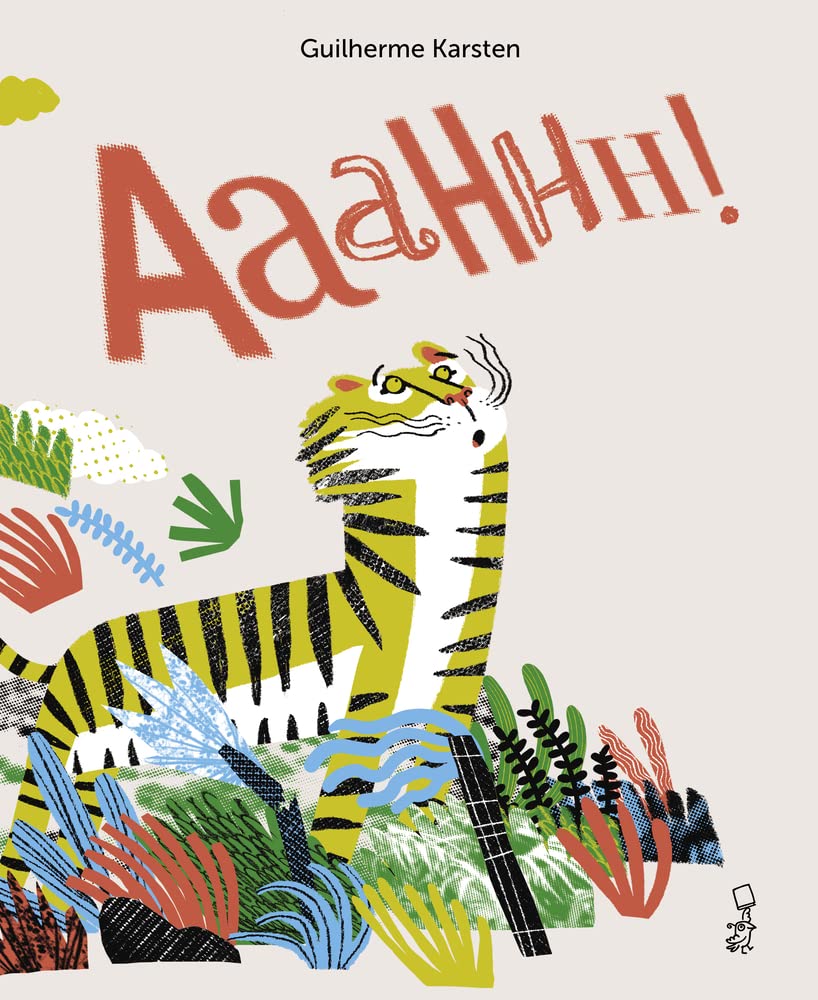
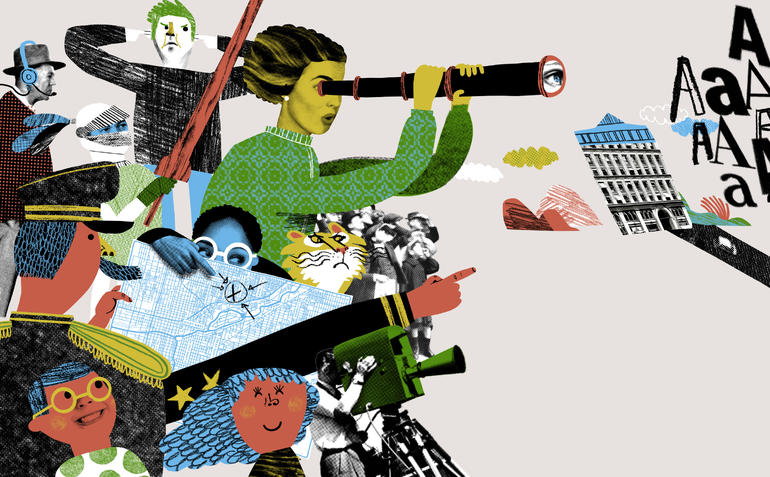
There could be plenty of different sources of an incredibly loud noise; children might be one of them. Guilherme Karsten’s new picture book, Aaahhh! Imagines the repercussions of one such scenario, with dazzling images that draw from contrasting influences and  techniques.  There is a method to the madness, as readers ultimately trace the chaos back to the beginning of a chain.  Each minute that elapses brings the unfolding disruption to a seemingly insignificant point. As any parent knows, children, not apparently rational adults, determine what is significant to them.

When I first opened the book, I immediately saw an homage to classic children’s book illustration, even if that homage was accidental.  Roger Duvoisin’s colorful midcentury buildings, as in The House of Four Seasons, or The Happy Lion, invite a view into the past. Yet the book is far from imitative, with digital collage combining with drawings to reflect the book’s theme of simultaneous events.  The text also mirrors that idea, as a group of people in front of a supercomputer pay careful attention as “…the piercing sound launches fierce tidal waves and rouses sleeping volcanoes.” Another scene invites participants from a nostalgic past childhood, including covered wagons and knights enroute to a joust, to join with rockets and jet planes to uncover the noisy mystery.

Other collages push the limits further, as an electric blender mixing letters of the alphabet feeds data into a printer.  There’s even a touch of steam punk, as a woman focuses an old-fashioned telescope with a disembodied eye at the opposite lens. When the disgruntled public finally learns the reason for their frustration, the young offender is calm.  On the one hand, the noise pollution has encouraged a social movement, with banners and a drum proclaiming “QUIET, PLEASE!” and “SAVE OUR EARS.” But suddenly, all the pent-up anger seems to dissolve, from the perspective of a boy whose minor trauma has come to its inevitable end.  What is wrong with everyone, he must be asking himself.  Perhaps his reaction wasn’t exaggerated at all; it’s adults who have transformed a mole hill into a massive mountain. 

Sometimes it seems as if adults and children operate in conflicting realms.  When scientists feel the need to rule out an invasion of aliens, or factories and schools close down, kids may simply be realizing their own quiet power to introduce change.  Karsten’s graphic arrangement of seemingly disparate images is a loud and colorful symphony, finally ending in a reassuring return to normal life.  This book will reward multiple readings.

Trees: Not All Vertical

The Family Tree – written by Sean Dixon, illustrated by Lily Snowden-Fine
Tundra Books, 2022

Children growing up today, even in nuclear families, probably know someone whose origins can’t necessarily be plotted on a traditional family tree.  Sean Dixon and Lily Snowden-Fine’s new picture book is about one girl, Ada, tracing her past and present through a complex network of relationships. The book is not didactic; its premise is not to offer a lesson in acceptance, but it does suggest that acceptance is a natural outgrowth of Ada’s individual experience. With a quiet and gentle tone, and a consistent metaphor, The Family Tree normalizes one child’s background and, by extension, the lives of all our children.

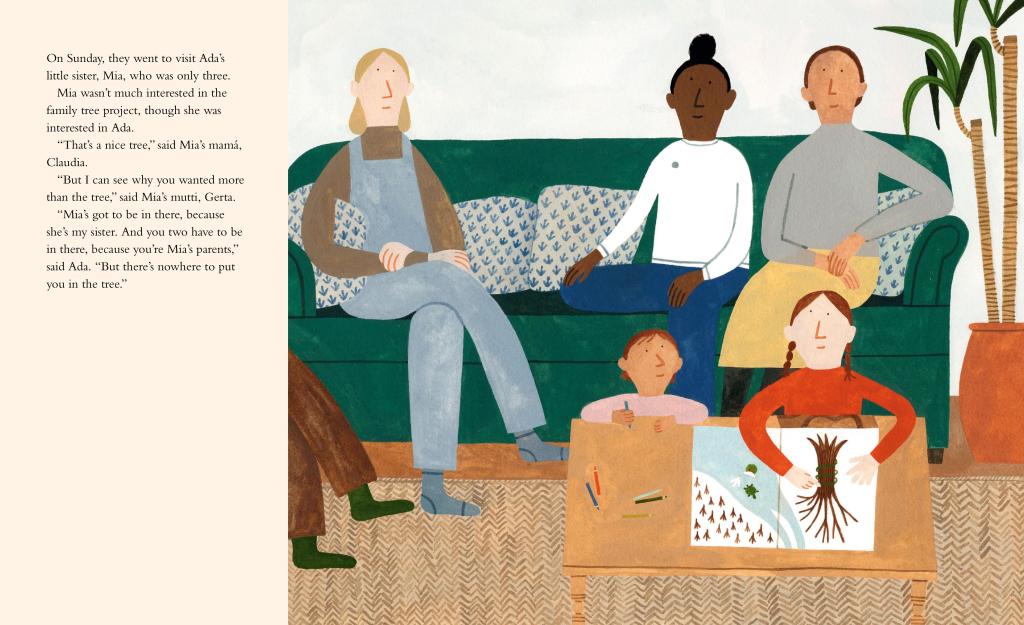
As soon the reader opens the book, the endpapers show that someone is going to create a work of art. The unpretentious result of that project will be Ada’s school assignment, one that initially caused her some anxiety.  Ada is adopted. The roots and branches of her identity seem unruly, compared to the teacher’s simple picture. Fortunately for Ada, and for the reader, her parents lead her by the hand instead of offering abstract reassurance.  As the book progresses, Ada visits a friend conceived through IVF, LGBTQ families, foster relatives, multicultural homes, and families assisted through surrogacy. No one carries a banner or feels the need to justify or explain how they came to find a loving home. 

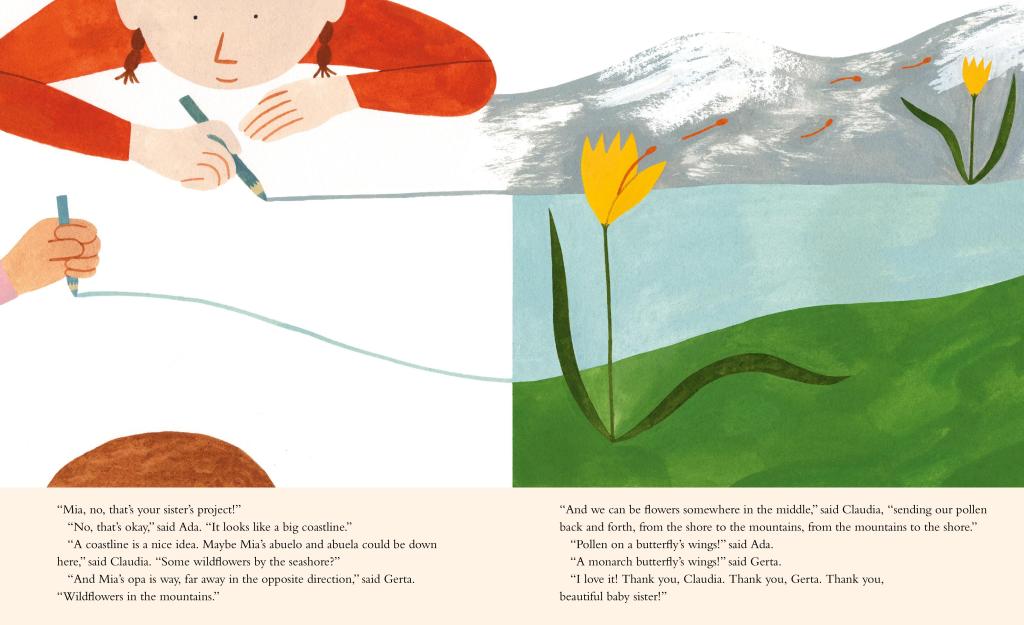
Ada’s family tree evolves organically as she traces her relationships, both biological and social.  The tree is a good start, but there are so many other elements that express who she is: a coastline, wildflowers, a butterfly, islands, and oceans.  Each one has a name representing the different people, in addition to her two parents, who have played important roles in her life. Ada’s approach to the project blends seamlessly with her quest; she is both a researcher and an artist finding an individual style. 

Snowden-Fine’s pictures are the perfect vehicle for Ada’s story. They have simplicity of a child’s artwork, but also touches of such diverse influences as Modigliani and the long and somber faces of medieval paintings. There is a bit of Matisse in the scene of Ada and her parents looking up at the starry sky. As children learn to navigate difficult questions, perspective is essential.  The Family Tree embodies that idea in both its sensitive words and images. Any family can enjoy this book.

Back to the Portal

The Great Bear – by David A. Robertson
Tundra Books, 2021

In The Barren Grounds, the first volume of David Robertson’s middle-grade novel trilogy, The Misewa Saga, readers met foster siblings Morgan and Eli, two Indigenous children living apart from their community. In the Great Bear, they both continue to struggle with issues of cultural and personal autonomy, and return to Misewa through the secret portal, activated through posting the drawings that are a product of Eli’s artistic gifts.  Again, Robertson’s accomplishment in the book is difficult to describe.  Blending fantasy with realism, psychological acuity, social commentary, and cultural traditions, he has created a riveting story that is more than the sum of its parts. (His nonfantasy work is also impressive.)

Everything is subtle in Robertson’s narrative world.  Eli and Morgan’s relationship with their foster parents is sensitively portrayed; they are good people who try their hardest to understand children whose experiences have been radically different than their own.  It would be easy to portray them as well-intentioned do-gooders who fail at every turn. Instead, their essential humanity and their limited ability to understand Morgan and Eli coexist.  When Eli’s identity makes him the object of cruelty at school, both his background and his individual personality combine to threaten the racist students, and both parts of him eventually become tools for his resistance.  Morgan deeply empathizes with him, but at the same time she feels overwhelmed by the absence of her mother, who is only a faint memory. She needs to reconcile the essential split between her life in the present and her lost Indigenous past. That process, by definition, will be difficult and incomplete, but she needs to undertake it.  

Memory is the key word in the novel, both on the personal level and that of collective experience. As Mihko, the anthropomorphic fisher, explains to the children: “When you know a place in this way, when you know it before you’ve seen it, it’s called blood memory.” Eli and Morgan’s journey to this place becomes even more complex than in the first novel, involving time travel and confronting how the choices they make may potentially affect the past.  Robertson expects that his readers will engage with difficult questions, and he offers them the motivation which this type of reading requires.  There are references to popular culture, but also allusions to literary classics.  Characters evolve, circumstances change, and a certain instability is always part of the picture. But so is strength. Morgan and Eli gradually come to understand that “What was to happen had to happen.” The Great Bear is not a prescription for resolving this paradox, but an exciting story of two brave young people using the wisdom of their community to emotionally survive.

Joe Krush: Classic American Illustrator (1918-2022)

The Fish from Japan -written by Elizabeth K. Cooper, illustrated by Beth and Joe Krush
Harcourt, Brace & World, 1969

Joe Krush was born on May 18, 1918.  I just learned that he died a few weeks ago on March 8th, just shy of his 104th birthday. Along with his wife, Beth (who died in 2009), he illustrated many wonderful books, picture books and illustrated novels, poetry, and a dictionary. Their deeply informed knowledge and practice, as well as their humanity and humor, will remain with you, as it now has for generations of readers. Beth and Joe Jrush worked with many authors, including Beverly Cleary, who passed away herself last year at just shy of 105 herself. I have written about Joe Krush for The Horn Book and several times on this blog

Joe Krush almost always drew incredibly detailed black-and-white images, which are now part of his incredible legacy. But one book, The Fish from Japan is in color.  It may be one of his and Beth’s least-known works, which is all the more reason to draw attention to it on the birthday of this inimitable artist.  If you are not familiar with Beth and Joe’s work, please find some of their books. Their deeply informed artistic traditions, as well as humanity and humor, will strike you, as it now has for generations of readers.

Cleverly created by prolific mid-century children’s author Elizabeth Cooper, Harvey is a little boy who wants a pet. Where have we heard, or read, this story before? He can’t have one. His mom, a cheery mid-century housewife enlivened and individualized the way the Krushes always managed to do in their drawings, thinks that a letter from his uncle will cheer him up. Mom is wearing an apron over her shirtdress, cozy slippers, and a bandanna on her head as she vacuums their house.  The letter looks promising, as it carries six foreign stamps.  Harvey is thrilled to learn that he can expect a fish from Japan!

The fish turns out to be a beautiful Japanese kite, probably much more distinctive than the turtles in Harvey’s classroom. It’s also really big, as we notice in a full-color illustration of Harvey holding it up with a look of disappointment and confusion on his face. Other pictures are rendered in yellow and black, including the one where Harvey raises expectations by addressing his class, promising to bring in the fish when it arrives. The class includes both Black and Asian children. Their teacher wears glasses, and seems as kind as Beverly Cleary herself

Part of the plot involves Harvey’s imaginary compensation for his embarrassing inability to produce a fish. He brings in a completely “transparent,” i.e. unreal, fish, and manages to convince his classmates that it is in a little box, and is quite rare.  The teacher is so adept at child psychology that she goes along with this well-intentioned fraud. In one picture two boys, one Black and one white, get so caught up in the excitement that they imitate the “fish’s” barely perceptible motions.  Both boys are wearing ties, and one has glasses and plaid pants.  We are transported to the past with these pictures, but also remain in the Krushes’ world of universal childhood.

I purchased this book used; it is obviously out-of-print. Someone had inscribed at the bottom of the title page, “Beth and Joe Krush drew the pictures in this book. Good Reading!” I can’t really add to that. Goodbye, Joe.

National Council of Teachers of English to Gatsby: “Move Over!”

This is not a book review, but rather my response to a recent piece on School Library Journal, a follow-on to an earlier, longer piece about the results of a survey. In collaboration with the National Council of Teachers of English, the editors of that publication pursued a project called “Refreshing the Canon.” In case you did not know the meaning of that term, they helpfully provide one: “books considered classics by U.S. educators.” Reading this news filled me with dismay, but not surprise.  Both SLJ and the NCTE have long expressed concern about representation and diversity in literature, a perfectly legitimate subject for discussion in the educational community. They also advocate attracting students to literature by offering them contemporary books which, superficially at least, seem to reflect their own lives.  Reading these recent works is a terrific idea, but, without the tradition behind them, it creates a sadly superficial image of how reading enriches our lives and deepens our understanding of our world

I fully understand that this list does not represent book burning, book banning, or official censorship. It is not the equivalent of Florida’s outrageous attack on LGBTQ students or on math textbooks that dare to mention social inequality or the contributions of Black mathematicians.  However, the National Council of Teachers of English is not, presumably, proceeding from the same motives as the governor of a red state determined to roll back political, economic, and social progress. That organization, along with SLJ, should be committed to protecting and promoting literacy and to encouraging the highest standards for students and other young readers.  The entire tone of “Refreshing the Canon” sends the message that the books on this list are past their shelf life, whether in the library or in a student’s living room.

What is the problem with the books on this list? Some, apparently, fail to meet the criteria of “relevancy of subject and theme, diversity and representation, and the contemporary needs and interests of current students.”  The first failing is obvious in some of the books, and I don’t wish to repeat the arguments about whether or not The Adventures of Huckleberry Finn can be addressed in the context of its era and still considered one of the greatest American works of literature.  I actually believe that the second part of the stated requirements, “relevancy,” may be more insidious.  It’s entirely clear that reading Shakespeare is more challenging than reading contemporary poetry.  Perhaps it is unrealistic for most students to take on his poetry or drama as independent reading, although some would welcome the opportunity to do so.  Other books are the list would seem less obviously “irrelevant.” 

At first glance, the inclusion of Catcher in the Rye might seem puzzling. It’s short, and its central premise is the insensitivity and essential “phoniness” of adults.  But apparently the compassion, empathy and biting humor in its exposure of mid-twentieth century hypocrisy is too difficult to read today.  There are still cultural and political references, as well as language, which are as seemingly distant as the world of Shakespeare. 

Then there is The Great Gatsby. Again, it is not a daunting four hundred plus pages like The Grapes of Wrath. If progressive ideals are part of the equation in choosing books, Fitzgerald’s brilliant novel is a profound questioning of the American dream and, like Steinbeck’s, of capitalism itself.  Yet SLJ confidently proclaims that, along with To Kill a Mockingbird, it can be found “topping the list of titles that should go.” Make no mistake, the argument that this list is only a recommendation is belied by the language used in making its case.

Finally, the graphic presented reveals which books were considered most and least toxic.  Ayn Rand’s Anthem earned fewer objections than Gatsby, The Grapes of Wrath, or the works of Shakespeare. Rand’s poorly-written endorsement of individualism and capitalism, a book which never even appeared on school reading lists until it began to be heavily promoted by corporate fans of her philosophy. Yet it provoked a milder reaction than some of the literature which is most powerfully critical of American inequality. Did everyone who responded to the SLJ survey read these books?

I hope that readers might be inspired to take a look at these works of literature, which are actually of varying quality, but all about to be tossed into the dustbin of history.  To paraphrase the quote often attributed to Trotsky, you may not be interested in Gatsby, but Gatsby is interested in you.  Pick up his book again and bring it back to your students with renewed excitement.

If You Meet a Fast and Dangerous Animal at a Tea Party

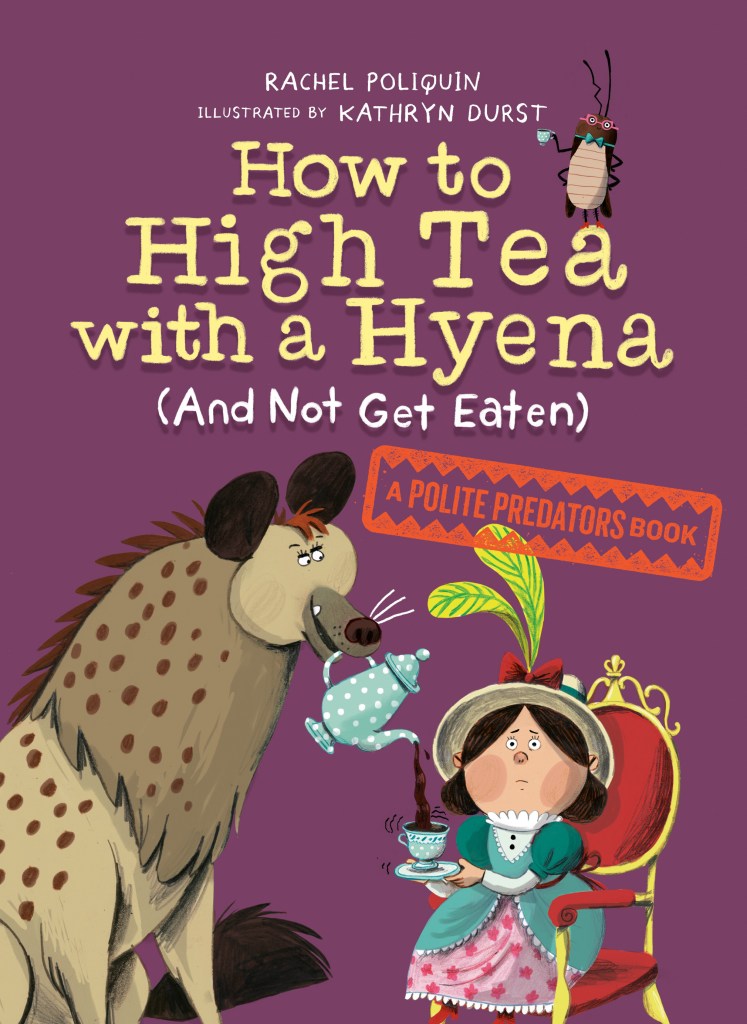
How to High Tea with a Hyena (And Not Get Eaten) – written by Rachel Poliquin, illustrated by Kathryn Durst
Tundra Books, 2022

If you’ve ever been concerned about social events going wrong, you will probably agree with this statement: “Besides, when planning a party, it’s always important to consider the WORST-CASE SCENARIO.”  However, your worst-case scenario probably didn’t include a powerful, predatory, and omnivorous animal.  If that animal is a hyena, you could be in trouble.  Finally, if you currently know very little about hyenas, you are the perfect audience for How to High Tea with a Hyena. Even if you had never thought that lack of knowledge about hyenas was a particular problem, the sly humor of this madcap informational book might convince you otherwise. Of course, the same holds true for the young readers in your life.

There are many introductions to wildlife for children, but few about hyenas. Of course, this book isn’t exclusively about hyenas, although children will learn an amazing array of facts about them. It’s also a clever approach to the natural world, convincing in its message that your previous assumptions about any topic may not be true, and there is always more to learn.  The narrator is a friendly cockroach sporting glasses and a bow tie, whose qualifications as a survivor over millions of years makes him the perfect guide for skeptics.  When he sets up the tea party scenario, hosted by a little girl named Ruby, readers will be ready for anything.

First, you will have to “Pick Your Hyena.” Rachel Poliquin selects her facts carefully, both informing and entertaining with a combination of accuracy and literary embellishment.  While it is eye-opening to learn about the four types of hyenas, it is a diverting digression to imagine that one of them, the aardwolf, will “…eat cockroaches like popcorn. And popcorn has no place at a tea party.” 

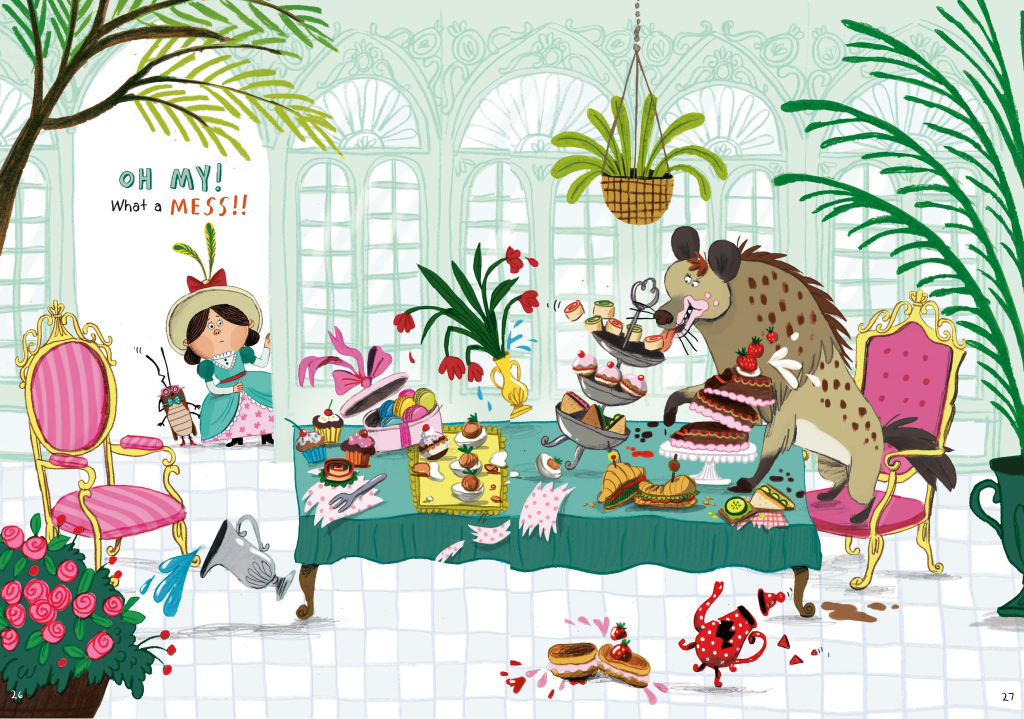
Kathryn Durst’s pictures begin with a basic premise, such as a beautifully arranged tea party whose delicate beauty is destroyed by the hyena in question. (I’ve written before how she’s great with animals.) Appealing sandwiches, pastries, and a polka dotted tea pot are reduced to chaos by the hungry animal. After all, as a subsequent fact-filled page points out, he can consume 30 lbs. of food within 30 minutes.  So no surprise there.

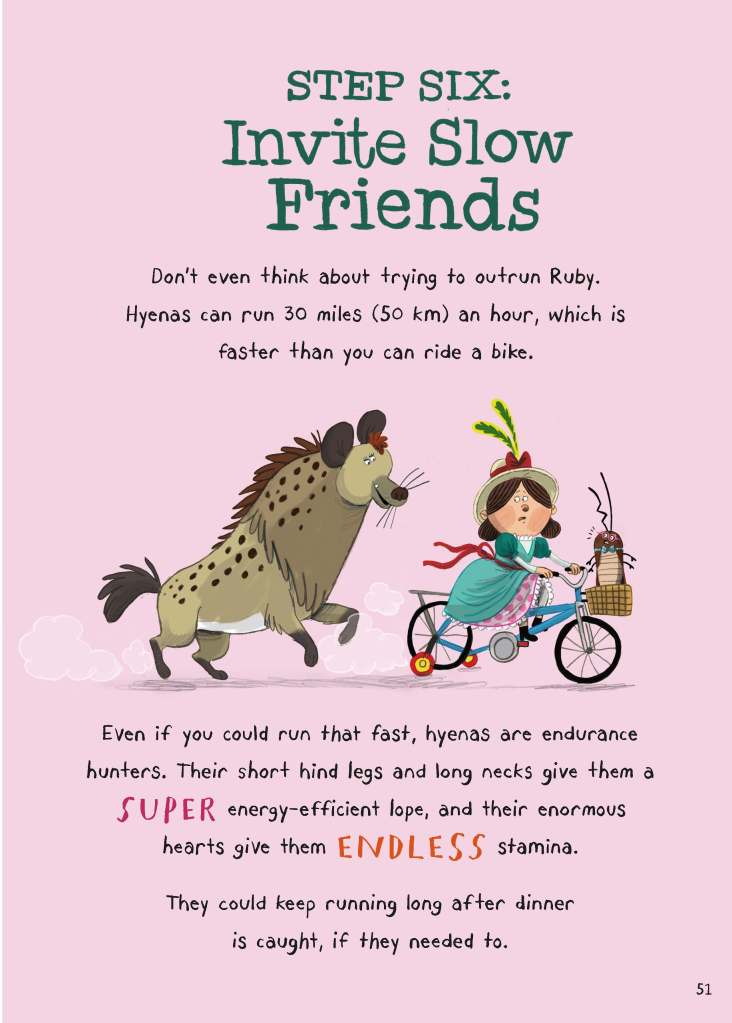
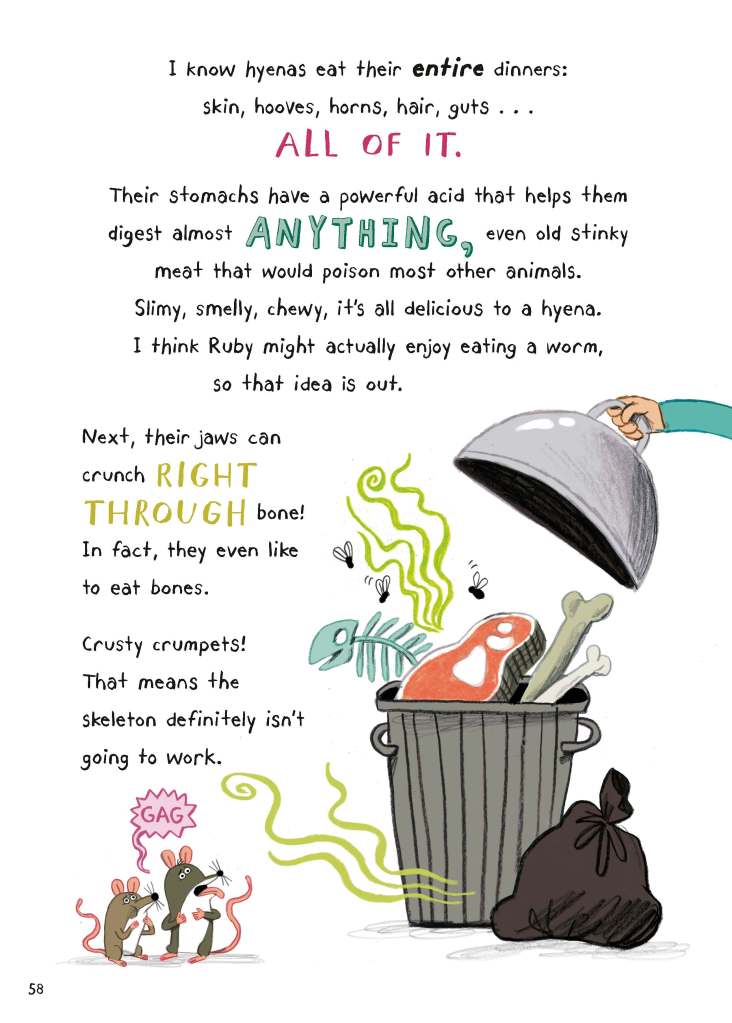
There are actually nine steps to planning party. Step Six instructs you to “Invite Slow Friends.” Hyenas are not only incredibly fast at responding to hunger, they are fast, period.  They are faster than Ruby, riding a bike in the naïve expectation that she can outrun her hyena guest.  If you’re wondering how being slow will protect you from a fast-running predator, the author offers many detours in her logical tour of the facts.  Following the twists and turns in the narrative eventually adds up to, as in the determining the pros and cons of specific menu items:; “Slimy, smelly, chewy, it’s all delicious to a hyena.”

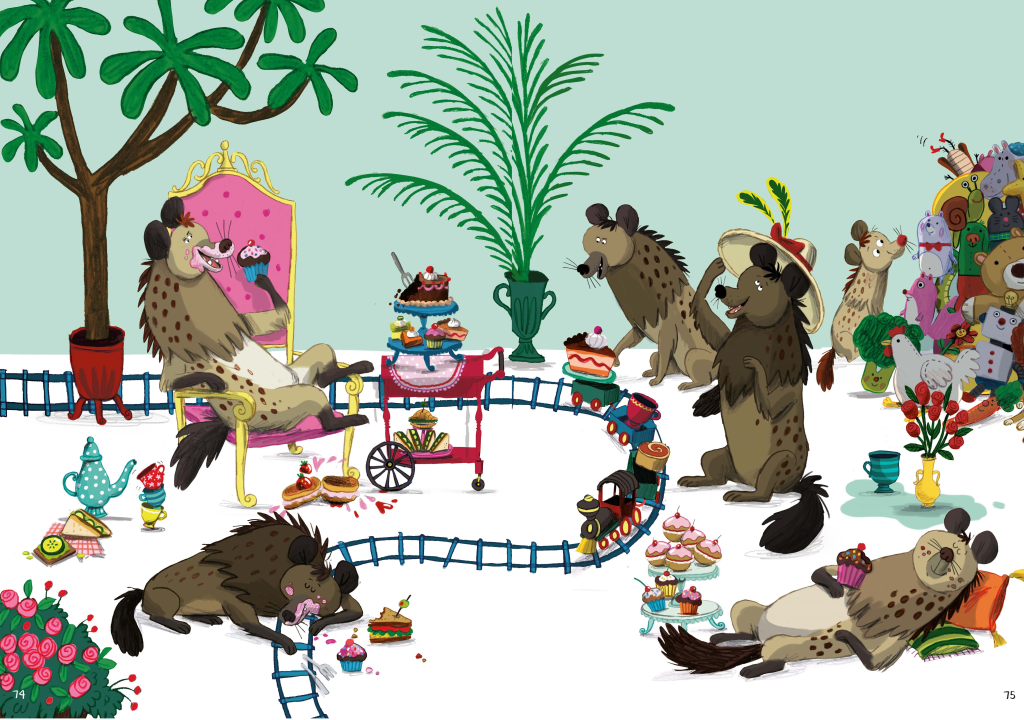
By the time the crowd of hungry hyenas has finished with their prey, the unusual hybrid character of Poliquin and Durst’s collaboration is apparent.  The animals could be boorish humans, leaving leftovers on the floor, trying on Victorian hats, even loading a model train set with uneaten food. Probably the only reason any of the items are left is because they stuffed themselves to exhaustion, falling asleep on the tracks.  At the same time, the child and adult who shared How to High Tea with a Hyena will put down the book knowing that hyena clans may have one hundred members, that they have bone-crunching teeth, and that their stomach acid can neutralize almost any toxin.  You probably didn’t know that, but now you do!

The Past is Not Gone

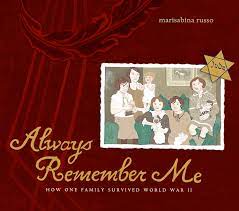
Always Remember Me: How One Family Survived World War II – written and illustrated by Marisabina Russo
Atheneum Books for Young Readers, 2005

In this fictionalized picture book memoir, a young Jewish girl, Rachel, talks with her grandmother about a past which the older woman had always considered too painful to disclose.  Finally Oma decides that she must tell her granddaughter the truth, even if her account carefully avoids, or generously emphasizes, different parts of her life: “ ‘I think you are old enough to hear the rest of the story now,’ she says, and pulls me closer.” As Yom HaShoah approaches this week, this book reminded me of the ongoing skepticism about the need to still write and publish children’s books about the Holocaust. We can question when, how, and through which media it is most productive and sensitive to take on the task, but the idea that learning about the Holocaust is simply too traumatic, or no longer necessary, is wrong.

Marisabina Russo has recently published an incredible graphic memoir, Why Is Everybody Yelling: Growing Up in My Immigrant Family, which covers some of the same material as this book, although in much greater depth and for an older audience.  She also has written another picture book, I Will Come Back for You, reflecting again on her experience as a child and grandchild of survivors.  Each one of her works stands on its own merits, but if you have not read Why Is Everybody Yelling, I urge you to do so!  (If you think you have read enough graphic memoirs, think again, because this book is outstanding.) Reading these three books together emphasizes the difficulties inherent in revealing truths about ones family, but also about how to narrate events of inconceivable horror.

Always Remember Me begins with the warmth of a family gathering, but then leads to a journey into the past. Oma’s story begins as an ordinary memory, evoked through the kind of selective details which characterize the process of remembrance.  Sabina was Rachel’s mother; her trips to the zoo in Germany bring back the fact that sea lions were her favorite animal there. When she was old enough to begin school, she carried the traditional Zuckertüte, a cone filled with treats, marking her first day there.  Everything seemed normal but, for Jews in Europe by the 1930s, nothing would ever be normal again. The allusions to German culture carry a subtext of irony.  Oma and her family had emigrated there from Poland, hoping to avoid the sometimes violent antisemitism of Eastern Europe.  But their love for their adopted homeland was rejected with grotesque cruelty.

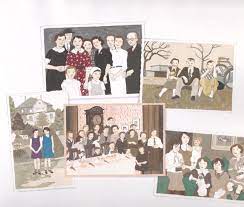
Russo’s text and pictures are inseparable.  An element of documentary realism, foreshadowing her later graphic memoir, is interwoven with impressionistic portraits.  One page features nine small pictures of different Jews, all of whom would be forced to bear on their identity cards “a giant red J as if we were criminals who couldn’t be trusted.” The Jews depicted range from an older man with a beard and yarmulke to others with the fully assimilated tie and pocket handkerchief of any middle-class German. Their personhood, as well as their lives, would be totally erased. 

Family pictures that accompany Oma’s story chronicle the bonds that kept everyone together, shortly before they would be torn apart.  Other primary sources, such as letters, currency, and passports, are transformed by Russo into artifacts of a vanished past. Oma was interned in Auschwitz; images from that time are rendered in gray and white, and convey grief and terror. Appropriately for a children’s picture book, they do not show the machinery of genocide, but they open a door to discussion of what actually happened there and in other concentration camps.

One of the most moving, and artistically distinctive, pictures in the book is a scene of matriarchs and the young Rachel.  The little girl sits on the floor in a dainty white dress with red trim. The leather bag over her shoulder is an almost odd contrast to her mid-century child’s outfit.  Behind her sit Oma, Sabina, and Aunts Emmi and Anni, looking down with love and pride at the child who represents the future of their family. She is privileged to have never known, and be unlikely to undergo, the terrible traumas of their own lives.  Marisabina Russo has undertaken a difficult task, as author, artist, and daughter, in her unforgettable books.

The Two of Us

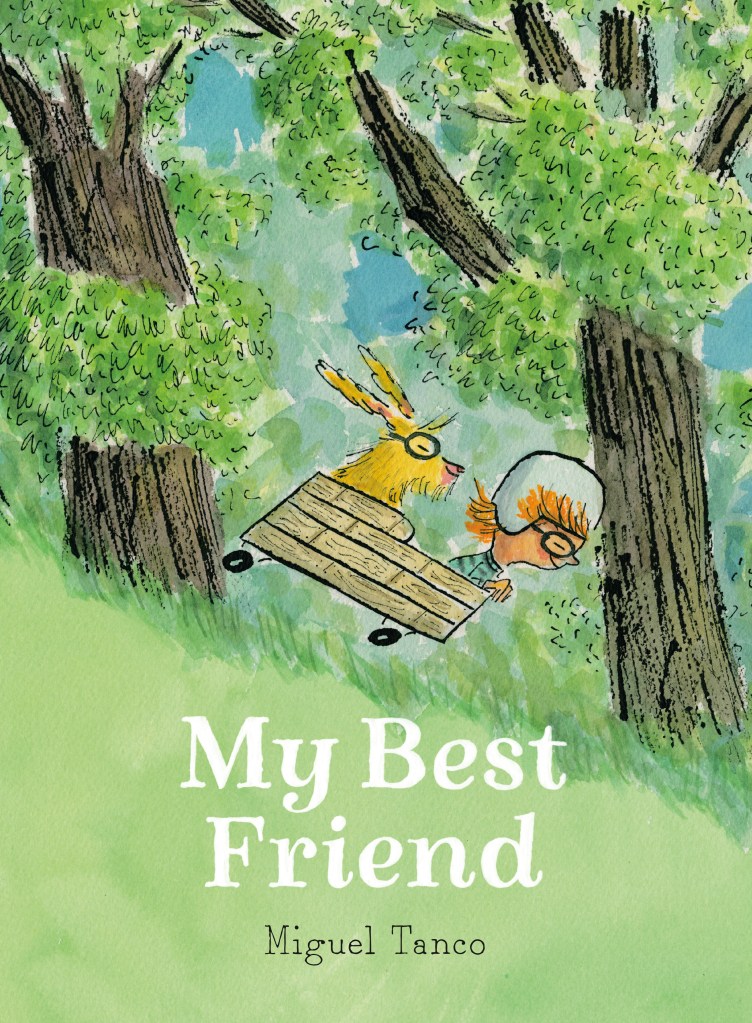
My Best Friend – written and illustrated by Miguel Tanco
Tundra Books, 2022

The narrator of this book is anyone who has ever appreciated the special companionship of someone who understands her.  Whether sharing a mutual dislike for taking a bath, or a shared affinity for ice cream, she knows that togetherness if part of those experiences. Friendship includes differences as well as similarities; one friend might walk on two legs and the other on four.  As always, Miguel Tanco’s inimitable gifts bring these examples to life with sweetness and humor, embedded in the traditions of classic children’s book illustration.

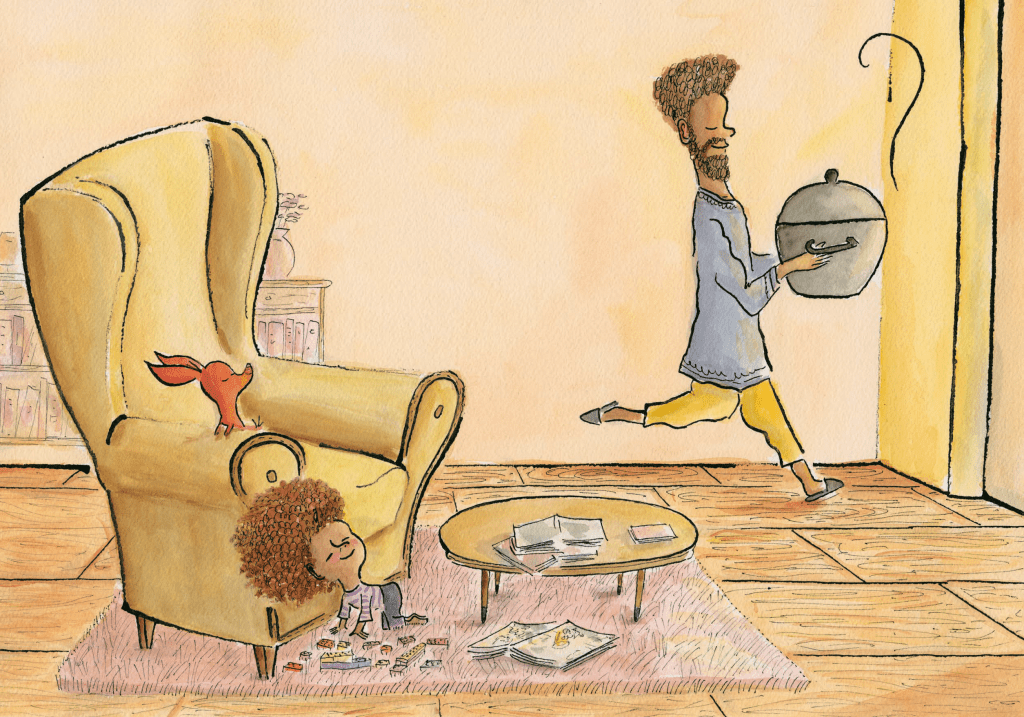
When you open a Miguel Tanco book, you enter a world of childhood that is gentle, but not completely idealized.  The children in this book, like their animal companions, are individuals. They grab snacks from the cookie jar, maybe without permission. They sit in the doctor’s waiting room nursing injuries, and they look forward to tasting a parent’s delicious cooking. (Some activities are species specific.  Only the children play with Legos.) The characters have wild hair, playful smiles, wear glasses, and use wheelchairs.  Their unaffected good nature could place them in the mid twentieth century, although the diversity of their backgrounds locates them in the present. 

Each sentence of the text is simple and straightforward, defining friendship as children experience it: “We never feel lonely when we are together,” “We give each enough strength.” Sometimes there is a simile: “My best friend is soft, warm and comfy as a ball of cotton.” The book’s theme calls for some irony, of the softest kind, such as remarking on a friend’s “powerful sense of smell,” or “great conversations.” Tanco is able to accomplish in few words what other authors might elaborate with examples.  He is always in conversation with children, exactly at their own level.  My Best Friend celebrates the joys of childhood; even unpleasant demands on merely bumps on the road. That bath which a child or dog hopes to avoid appears pretty inviting in an inflatable pool, supervised by a kind adult determined to make it fun. 

A walk in the pouring rain is delightful, set against the cobblestone streets and elegant buildings of a city that might be European, but not necessarily so.  Anyone who is acquainted with Tanco’s distinguished body of work can see the homage to Ludwig Bemelmans’s old house in Paris in this picture. While there are no straight lines of twelve little girls, the one girl in her bright yellow rain slicker, accompanied by a canine friend, might be Madeline’s modern-day descendant. 

There are many books for children about friendship, and some of them even welcome pets into the circle.  In My Best Friend, Miguel Tanco once again writes and draws for children, about children, and from deep in his own memories of what it was like to be a child.