
“Blessed is the match”: Yom Ha-Shoah/ Holocaust Remembrance Day

Yom-HaShoah_ss_505595794-324x160


mov 320 001 ik

I have several Jewish religious school textbooks from the twentieth century.  One, Highlights of Jewish History, by Mordecai Lewittes, illustrated by Sam Nisenson,  comes in four volumes, with the fourth, (1957), covering the Middle Ages through the foundation of the state of Israel.  There is no separate section on the Holocaust. Rather, in order to encourage a sense of pride, rather than despair, in children, the lesson on the greatest disaster in Jewish history is embedded in the story of the Jewish state.  Students learn about the sufferings of the Jewish people, but also about heroic resistance to the Nazis, even when this resistance was doomed.  After a section on the Jewish Brigade of British Mandate Palestine, the book introduces the freedom fighter Hannah Senesh, the embodiment in modern Jewish history of courage, selflessness, and women’s strength.

Senesh was a parachutist trained to land in enemy territory and rescue Jews.  As Highlights reports:

“On March 13, 1944, Hannah and 4 men parachuted into Yugoslavia where they immediately established contact with Tito’s partisans who greeted them with the words, ‘Death to fascism; freedom to the people’  After completing her mission Hannah resolved to cross the border into Hungary in the hope of rescuing Jewish survivors…

After crossing the border into Hungary Hannah Senesh was betrayed by peasants.  She was  executed because of her refusal to reveal the secret code of the partisans.”

The tone is typical of one type of post-Holocaust Jewish education, emphasizing Jewish agency rather than victimhood.  The details are powerful, even if they might cynically be viewed as dated today. (Yugoslavia is itself a tragic memory, and Tito’s legacy is mixed.) They are not.  The partisans are fighting a specific enemy: fascism.  They are risking their lives to save fellow Jews.  They are, sadly but predictably, betrayed by the gentile population, who are themselves victims of Hitler.

Senesh is perhaps best known is for her beautiful poem, which is also included in the book:

“Blessed is the match that is consumed while kindling
flames,

Blessed is the flame which burns in the secret chambers
of our hearts,

Blessed are the hearts which, for honor’s sake, will
cease their beating,

Blessed is the match that is consumed while kindling
flames.”

As the remaining survivors of the Shoah become few in number, it is even more imperative to design powerful and compelling materials for teaching today’s children and future generations.  Fascism: it was terrible then, and it is terrible now.  Anti-Semitism in all its endless varieties.  Hatred of immigrants and refugees.  How dated is this textbook, after all?

Race, Culture, Gender: 1964

Jenny Kimura – Betty Cavanna, Morrow Junior Books, 1964

jenny-kimura-betty-cavanna1

The culture of Japan has been in the news, due to interest in the unusual choice by the current emperor, Akihito, to abdicate in favor of his son, NaruhitoAkihito is the son of Hirohito, the emperor who, at least nominally, led Japan during its descent into fascism in the 1930s through its defeat by the Allies in World War II.  Viewed by many as a war criminal, the U.S. occupying forces, led by General Douglas MacArthur, made the pragmatic decision that allowing Hirohito to remain as a figurehead would facilitate the transition to democracy in his devastated country.

This history provides a setting for a fascinating teen novel from the 1960s, an era in which the U.S. perception of Japan was still undergoing a transition from ruthless aggressor to economic partner in the new alliances of the Cold War. Although Betty Cavanna was best known for her incredibly popular “malt shop” teen romances, she also tackled some difficult subjects.  In Jenny Kimura, a teenager raised in Japan by her Japanese mother and American father travels to the United States to meet and spend time with her paternal grandmother.  Both sets of grandparents are essentially estranged from Jenny and her parents, unable to comprehend the choice their children made in marrying outside of their respective cultures.  Although the novel includes the typical reflexive racism of its time, Cavanna also succeeds in creating a cast of characters who are struggling with some of these prejudices, and of a girl who is determined to develop her own identity and her own path in life.

When Jenny first lands in Hawaii, she is struck by the glaring contrast between the young native Hawaiian women, whom she perceives as “peacocks moving with stately grace among the ill-dressed visitors in a zoo,” and the Americans, who

“…repelled her…The men were so red-faced and brash, the women so inappropriately bedecked, with mink stoles over their arms and bulging straw carryalls crammed with treasures, that they looked   like cartoon characters.”

This scene of aesthetic dissonance is only the beginning of Jenny’s confusion, as everything that she has learned from her mother about respect, decorum, and gender roles is challenged by life in the U.S., first in Kansas City, and later on vacation on Cape Cod.

Lest you think that Jenny is stereotypically submissive and quiet, she is not. She constantly questions the balance between the greater freedom accorded to American women against the apparent superficiality and distance from tradition of their daily lives.  Jenny astutely observes her own grandmother, an affluent widow who lost one son in the Pacific and has been unable to forgive the other son who disappointed her.  She is not employed, but is active in community activities that demand a level of authority unfamiliar to Jenny.  She dresses in bright colors and short sleeves and she speaks her mind, sometimes appearing brash or insensitive: “She acted as if it were the most natural thing in the world that a sixty-two-year-old woman should be dressed like a girl and working like a man.”   Yet Jenny empathizes with her and struggles to connect with this contradictory but loving figure.

One of the more jarring elements in the book is the circumscribed role of African-Americans as servants.  Jenny’s grandmother employs a young woman, Leona, who has a completely subservient role in the household.  Without questioning the oppression of minorities in the U.S., Jenny forms a bond with Leona, discussing boys and other problems with a familiarity whose contradictions she does not truly understand.  Jenny is aware of skin color, at least her own, noticing that in Japan she would be considered fair-skinned, but in the U.S. she is problematically dark, at least when Alan, a boy who is a member of her grandmother’s social circle, becomes attracted to her.  As in most malt-shop novels, Jenny needs to determine how far she is willing to go to meet the behavioral standards of a clueless male, as opposed to living according to her own moral and emotional compass. During her Cape Cod vacation, Jenny meets George, a young Japanese-American man, who is also attracted to her.  She ponders the connections with they share, as well as the vast dissimilarities.  She also learns about the internment of Japanese-Americans through the experience of her parents at the Tule Lake detention center.

There are no easy resolutions in Jenny Kimura, a book that blends the conventions of the teen girl novel with serious consideration of difficult questions: race, gender, ethnicity, family conflicts, and their challenges to one intelligent young woman seeking to find her identity.  Betty Cavanna’s novel continues to provoke readers today.


Finding Your Passion…the Countdown

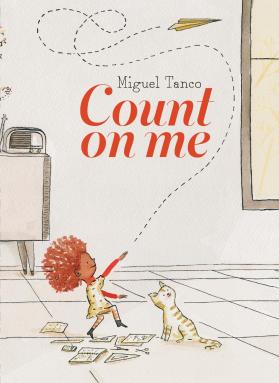
Count on Me – Miguel Tanco, Tundra Books, 2019

countcover

Miguel Tanco’s Count on Me isn’t just one more welcome affirmation that girls can love math, although it does convince readers of that premise. This gentle and exquisitely illustrated story describes one child’s path towards recognizing what she likes to do best.  Her route may have fewer detours than many others’, because it is so obvious to her that numbers, patterns, equations, and geometric forms are the heart of her daily life.  In addition (no pun intended!), our heroine has easy-going parents, immersed in their own pursuits, and thoroughly comfortable with allowing their daughter to find her own.  Every page of the book reinforces the importance of loving what you do and doing what you love, especially when nothing can compete with the beautiful fractals and polygons surrounding you.

modrian

Count on Me is set in an unspecified city: probably European, but it could as well be elsewhere.  We know there are museums, because the girl and her family are enjoying the view of a large canvas, maybe a Mondrian. The dad is an artist, and his creative messiness contrasts with his daughter’s analytical approach to board games, playground climbing structures, and even the array of food items set out on their dinner table.

lab

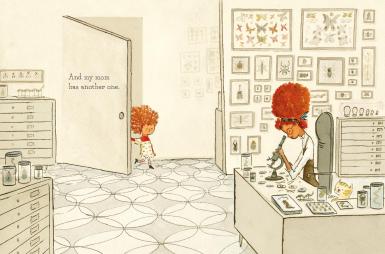
Mom is an entomologist; as the girl happily watches her peering at insects through her microscope, we can see the approval on her face for this absorption in detail, but the girl’s own interests are somewhat more abstract. Her brother’s tuba playing also brings a smile to her face, and she is happy to try different activities at school to test her convictions.  Playing Hamlet, being a chef, and attempting ballet are all worthy endeavors; she needs to be sure they are not for her.

“We live in a world of shapes and I like to play with them,” the girl realizes; Tanco explains to kids that self-knowledge is essential; without it, we might wind up as bad tuba players or unfulfilled scientists.  Even though her parents are wonderful, the book concedes that the outside world might find one’s passion to be a little weird.  When the girl stops at the top of the slide to make some notes because “It’s fun for me to find the perfect curve,” some of her friends stuck on the ladder are scowling in annoyance.  Yet she is undeterred: “I know that my passion can be hard to understand.  But there are infinite ways to see the world.”

house

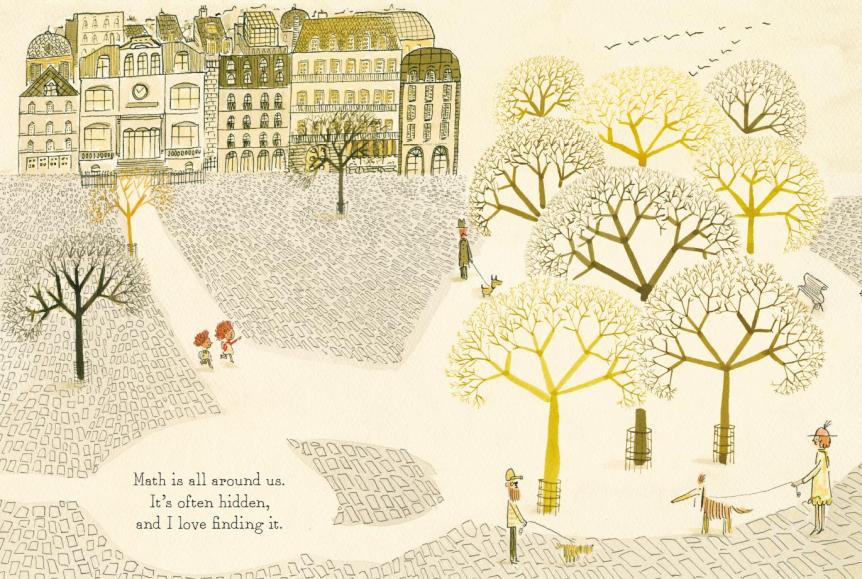
One way to see the world is in Miguel Tanco’s delicately detailed and allusive drawings, many in black and grey with striking elements of color.  I’m looking at the two page spread of the city, the little girl and a companion walking down a tree-lined path. The buildings in the background are a visual homage to Ludwig Bemelmans’s old house in Paris, where Madeline lived! (I don’t know if Tanco intentionally included this visual homage, but I almost expected to see Madeline herself testing Miss Clavel’s patience.)  The interior of the family’s house includes references to different eras: the mid-century intersecting circles on the floor of Mom’s lab, and the radio, straight out of the nineteen-forties, sitting on a bookshelf.

artclass

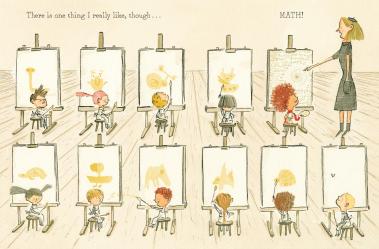
One two page spread manages to capture with both accuracy and humor the mind of a child who feels different. Each student in the girl’s art class sits in front of an easel. Some are actively at work, while others hold their brushes and expectantly look to the teacher for approval. We see whimsical animals, a portrait, and one student has drawn a tiny butterfly on an otherwise empty canvas. (She might be a good friend for our young mathematician.) The teacher, in an elegant plaid dress and matching beret, points at the heroine’s project, every inch of which is covered with equations, graphs, and polygons.  What is she saying? The girl smiles broadly, maybe nervously.  The teacher looks calm.  Readers may wonder about whether the conversation is going to induce self-doubt, or strengthen the girl’s resolve to follow her passion.

notebook

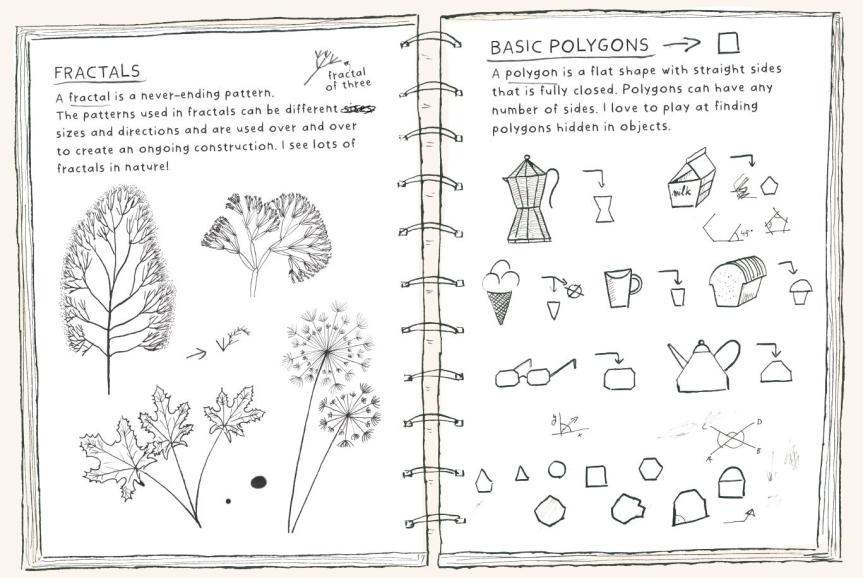
By the end of the book, we know that all those hours and days pondering shapes and resolving problems will lead to a very concrete kind of joy. The final section of the book is the girl’s portfolio. Presented as a spiral notebook and proudly labeled “My Math,” it contains line drawings and descriptions of fractals, trajectories, concentric circles, and more.  If Count on Me doesn’t convince you to quit running in concentric circles and follow your own trajectory, I don’t know what will.


Happy Birthday, Beverly Cleary

Ramona the Brave – Beverly Cleary and Alan Tiegreen, William Morrow and Company, 1975

ramona cover

This is not a review of Ramona the Brave, but, since my blog is named after an incident in the novel, I thought it would be a fitting way to pay tribute to an author for whom no tribute could be adequate.  In Chapter Six, “Parent’ Night,” six-year old Ramona is consumed with worry by the realistic fear that parent-teacher conferences will not be an unqualified success for her.

owl

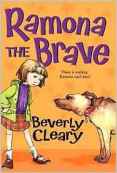
Having been instructed by her teacher to make a paper owl in Chapter Five, “Owl Trouble,” Ramona becomes infuriated because her classmate, Susan, has plagiarized her original creation of an owl wearing glasses. Ramona does the only thing an artist could do in this situation, at least a six-year artist with limited impulse control: she destroys both her own owl and her rival’s in protest, lest anyone believe that she, not Susan, had stolen someone’s intellectual property.


Fortunately, Ramona has a new closet, in the bedroom that her father has just remodeled. It is easy for her to transform the closet into an imaginary elevator, one which transports her from the world of real problems to the one of make-believe, to which she can briefly escape before the inevitable result of her parents’ meeting with her teacher confronts her:

“Ramona stepped back into her closet, slid the door shut, pressed an imaginary button, and when her imaginary elevator had made its imaginary descent, stepped out into the real first floor and faced a real problem.”

This paragraph contains a snapshot of Cleary’s genius: her understated language, the way in which she inhabits a child’s consciousness, the key repetition of “imaginary” to signal how essential a child’s imagination can be to coping with reality.  Ramona understands very well that her imaginary elevator, operated by an imaginary button, descends only in her imagination.  The consequence of her bad deed in school is going to come due.

Ramona’s family life, like her elevator, has its ups and downs.  Throughout the series, we share her difficult moments, as when her father is temporarily unemployed, and her mother returns to work.  (Not only that, but she enjoys her new job, and does not apologize for doing so.)  Yet, even as her parents refuse to indulge her understandable protest and insist that she apologize, they empathize with her pain.  In fact, Ramona’s mother makes her the winner, not because she is a better owl creator or a long-suffering victim of Susan’s nastiness, but because Ramona has a deeper appreciation of the project’s meaning:

“Susan is the one I feel sorry for. You are the lucky one.  You can think up your own ideas because you have imagination.”

Ramona’s imaginary elevator makes difficult moments livable; Beverly Cleary’s entire body of work has done not only that, but much more.  In honor of her birthday, let’s open her books and push the imaginary button to any floor.


People Who Weave Stories Can Stop the Freezing

The Story Web – Megan Frazer Blakemore, Bloomsbury Children’s Book, 2019

webcover

The premise of Megan Frazer Blakemore’s latest novel is a compelling one, especially for readers who love stories. If that seems like a redundancy, it’s not. Blakemore’s ten-year old heroine, Alice Dingwell, follows in a literary tradition of bookish girls whose lives are given purpose by reading: Anne of Green Gables, Jo March, Fern reading Charlotte’s famous web.  The novel also weaves in the natural world, as animals in the woods surrounding the small Maine town of Independence confer on how to save the economically depressed community, where people seem to be turning against one another and forgetting the narratives which they held in common. Blakemore’s characters are children who look up to their parents and the parents who sometimes fail them, as well as other adults who provide support and encouragement in the face of loss. Then there are Alice’s friends, Lewis and Melanie, with whom she shares imperfect relationships, but finally, common goals.  Readers will share the friends’ confusion and anxiety as they seek to prevent the collapse of their world, the terrible Freezing which sets in when humans cease to value the stories which bind them together, and the web’s strands fray and disintegrate.

Alice’s father has been hospitalized for PTSD, and she is holding on to the lessons she learned from him, some in a missing rare volume called The Story Web.  There is clearly deliberate echo in the novel of Madeleine L’Engle’s A Wrinkle in Time; the connection is not belabored, but is one of the many strands of Alice’s life.  As in L’Engle’s fantasy, a missing father renders Alice something of an outlier in the town. While several neighbors show compassion, others see his psychological wounds as a stigma. Even her best friend, Lewis, is unable to articulate his empathy for Alice.  Blakemore constructs a believable setting and cast of characters. Henrietta Watanabe is the quirky proprietor of “the Museum,” a shop housing the town’s treasures, but also a wise custodian of memories.  Alice’s mom is a hard works in a hospital, and is both loving and overwhelmed.  Her uncle Donny is the town’s hockey coach and a younger, and more whole version of his heroic older brother. Then there is the chorus of residents who are suspicious of anyone or anything different: a wounded veteran, a mysterious older woman deemed to be a witch, a moose who wanders into town to issue a warning.

One of the most striking aspects of The Story Web is its feeling of balance.  Chapters alternate between different characters’ perspectives, including animals.  Fantasy and reality interact seamlessly.  People are flawed and afraid, but able to grow.  The ending is not one of unalloyed joy, although it is hopeful. Alice’s father had helped her to understand that, it is not only the stories which people invent, but the ones which they choose to repeat, that define their lives and the lives of those around them.  The Story Web is an exciting book for middle grade readers and older, appealing to them on many levels, and raising as many questions as it resolves.

The World’s Beginning for Beginners

Creation Colors – Ann D. Koffsky, Apples & Honey Press, 2019

creationcover

In the beginning, Ann D. Koffsky created a beautiful book about the creation of the world. Well, this book is actually not the beginning of Koffsky’s career as illustrator and/or author of Jewish-themed children’s books, including her timely story about the importance of vaccination, Judah Maccabee Goes to the Doctor, illustrated by Talitha Shipman (2017).

Creation Colors is Koffsky’s vibrant reimagining of the biblical creation story, and is perfect for young readers of any religious tradition that incorporates the Hebrew Bible, as well as for any young readers who may enjoy its resonant message of inclusiveness in a different context.

cc_spread

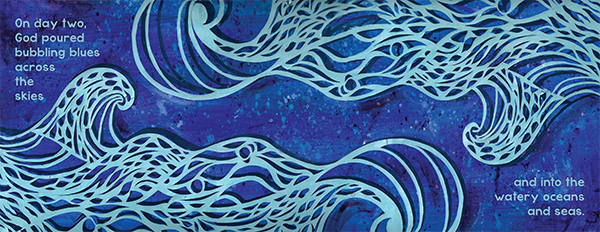
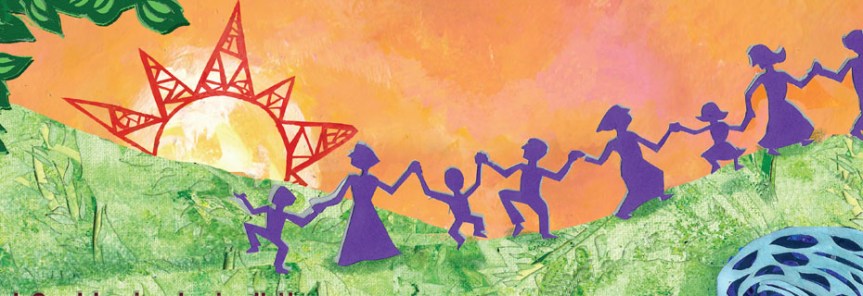
The simple and engaging premise of Creation Colors is that each one of the six days of creation, and the seventh day of rest, has a metaphorical link to one dominant color.  The void of the first day becomes stark black and contrasting white, the second day features deep blue skies and seas, and the sixth day has a golden background covered by people, “in every shade and hue.”  Koffsky’s bold paper cutouts and poetic text encourage young readers to experience the creation of the world as logical progression from the cosmos itself, to its animal inhabitants, and, finally, to people.  Whether caregivers choose to present this narrative as myth, metaphor, or literal truth, Koffsky’s words and pictures promote awe and appreciation of the world, in which children will place themselves, their natural environment, and their neighbors, both local and global.

In a graphically appealing afterword, Koffsky addresses her readers, to discuss the importance of color in their own lives.  She makes the seemingly obvious, but often overlooked, point that we might take the visual beauty of color for granted. In the same way, she hopes that her book will help young readers to look at all the products of creation with renewed focus.  Her numbered list of days and gifts is printed in different color fonts for each gift, from light and darkness, to the day of rest.

Creation Colors is designed to read to young children, but the consistency and directness of its language and images transcend age limits.  For older children and adults, it might also serve as a reminder to look through a new lens, maybe one made of paper cutouts, at the earth and the people who live here.

5545_ahp_banner


Paddington Bear: Preaching to the Choir

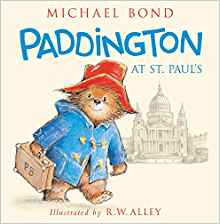
Paddington at St. Paul’s – Michael Bond and R.W. Alley, Harper, 2018

StPcover

The late Michael Bond (1926-2017) began writing in 1958 about a small bear who arrives at Paddington Station, London, as a vulnerable refugee from Peru.  Fortunately, he finds a home with the generous and tolerant Brown family, who help to acclimate him to his new environment, while responding kindly to all his childlike mishaps and well-intentioned mistakes.  This book was published posthumously, with illustrations by R.W. Alley, who has been interpreting Bond’s character for more than twenty years.  Readers are lucky to have this book, reassuring evidence that Paddington lives on.

The book is quite British, since the plot builds on Paddington’s visit to St. Paul’s Cathedral as an enthusiastic tourist, in a kind of “staycation” which is friend, Mr. Gruber, plans for him.  Things appear to be going more smoothly than previously for Paddington. For one thing, the cab driver who transports him is far more welcoming than his counterpart in the first Paddington picture book, who had gruffly warned him that “Bears is extra,” and, after noticing the results of a pastry accident, “Sticky bears is twice as much.”  The driver who takes Paddington and Mr. Gruber to the Cathedral offers helpful historical background about their destination. (Note that, unlike in the earlier book, passengers wear seatbelts.)

The religious identity of St. Paul’s is virtually absent from the book. Instead, Bond describes the inclusive nature of the activity taking place there: schoolchildren lie on their backs in a circle observing the magnificent ceiling, families enjoy a snack in the tearoom, and a vertical two-page spread captures a bear’s eye view of the cathedral’s ornate architecture. However, this is a Paddington adventure, so you can be assured there will be a glitch in the plans for an uneventful trip.

notes

On the way to the shop to buy postcards for his Aunt Lucy, who presumably still lives in Lima’s Home for Retired Bears, Paddington accidentally merges into a crowd of choirboys preparing to practice. More confused than frightened, especially by the musical score, on which “someone must have spilled some ink because it’s covered all over in black spots,” in loco parentis Mr. Gruber helps to iron everything out.


Paddington’s resilience in this story is, as always, inspiring. After all, how many characters could progress so quickly from the wistful, “I’m not sure they were very impressed with my arpeggios,” to “It was such a splendid outing I don’t think I’m going to manage to fit it all onto one card.” Won’t Aunt Lucy be surprised!

Grover, Wild Animals, and Other Fun Things

Grover Goes to Israel – Joni Kibort Sussman and Tom Leigh, Kar-Ben Publishing, 2019
A Seder for Grover – Joni Kibort Sussman and Tom Leigh, Kar-Ben Publishing, 2019
A Hoopoe Says Oop! Animals of Israel – Jamie Kiffel-Alcheh and Ivana Kuman, Kar-Ben Publishing, 2019
Listen! Israel’s All Around – Jamie Kiffel-Alcheh and Steve Mack, Kar-Ben Publishing, 2019

sedercover

Who doesn’t want to read about “loveable furry old Grover?” Fans of the endearing puppet may know that he often goes to Israel, as evidenced by his role in several books and Shalom Sesame videos.

In four new board books for the youngest readers, Kar-Ben Publishing offers an accessible and fun introduction to the Jewish holiday of Passover and the country of Israel.  Let’s start with Grover, since his toddler’s personality might make him reluctant to wait too long.

israel cover

In Grover Goes to Israel, he is fascinated, as you child will be as well, to learn about new places and people.  He visits the Machane Yehuda in Jerusalem and gets a delicious falafel sandwich dripping with tahini, and he joins an archaeological dig at Caesarea, which he pronounces “mysterious and awesome.” One of the best features of these little volumes is that they are simple, yet they include vocabulary that older children, and adults, can enjoy. By the way, when Grover prays at the Kotel (Western Wall), he does so in the men’s section.  This choice does reflect reality, but it is a disappointing reminder, at least for some readers, that his girl Muppet friends could not join him there.

seder awesome

In A Seder for Grover, Cookie Monster and Big Bird join him, along with Moishe Oofnik, the Israeli version of Oscar the Grouch, at the home of their friend, Avigail, to celebrate Passover.  Everyone is cheerful and excited, although Cookie Monster needs to learn that his regular cookies cannot be consumed on this holiday of unleavened bread.  Again, a male Muppet recites the Four Questions, a role reserved for the youngest male child. Otherwise, Avigail, who appears to be younger, would enjoy that honor.

hoopocover

A Hoopoe Says Oop! Animals of Israel introduces kids to some residents of Israel with whom they may not be familiar: hyraxes, Canaan dogs, and ibexes, along with the more familiar camels and bats.  The cover shows a scene of the animal friends walking and flying about the Jerusalem skyline, and the pictures inside are entertaining scenes of them running and playing in darkness and light, in different natural environments.  The book concludes with sound effects, as each animal says “Shalom” in its own “language.”

listen cover

Listen! Israel’s All Around focuses on people; at the beach on a kibbutz, dancing the hora and swimming in the Dead Sea.  Both books are bright and colorful, promoting the idea of Israel as a wonderful place full of both geographic and human-made wonders, and a diverse population of people ready to welcome them.  Kar-Ben’s new board books combine rich information with attractive artwork, along with ordinary people and extraordinary Muppets.  They encourage curiosity and enthusiasm, and are the perfect first step to learning more about Passover, and the land of Israel.


On Board with Anne

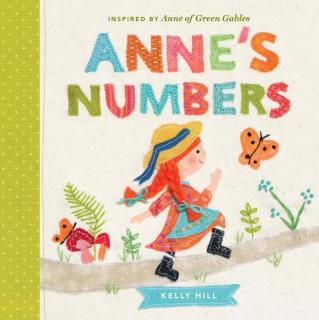
Anne’s Numbers: Inspired by Anne of Green Gables – Kelly Hill, Tundra Books, 2018
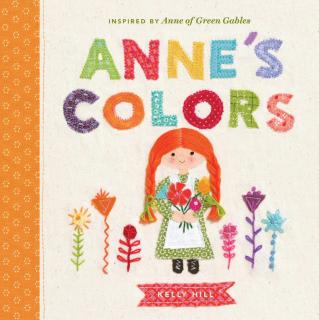
Anne’s Colors: Inspired by Anne of Green Gables – Kelly Hill, Tundra Books, 2018
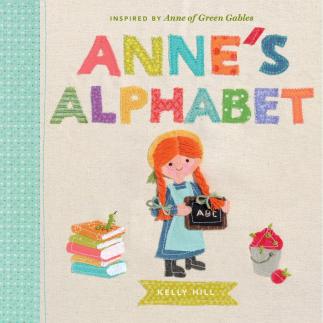
Anne’s Alphabet: Inspired by Anne of Green Gables – Kelly Hill, Tundra Books, 2019
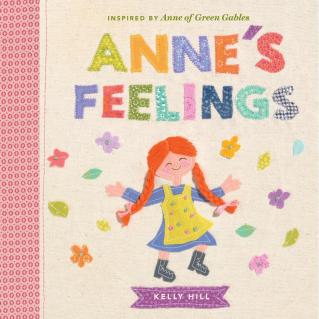
Anne’s Feelings: Inspired by Anne of Green Gables – Kelly Hill, Tundra Books, 2019

AlphabetCoverfeelingscover

ColorcoverNumbersCover

How young is too young for Anne of Green Gables? The answer to that question is found in Kelly Hill’s two board books for the youngest readers released last year, and two more that will be available on May 7. Children old enough to hold a sturdy board book or sit on a caregiver’s lap and look at pictures while listening to words, can easily enjoy the simple beauty of these books, with images created from Hill’s hand embroidery.  The next question might be, why introduce a child that young to a specific literary figure? Anne, the Prince Edward Island orphan who embodies both the deprivations and the joys of childhood, as well as the challenges and the proud triumphs of being a smart and sensitive girl, bookish and emotional, loyal and truthful to herself and others.  The answer is that Anne is not merely the heroine of one glorious childhood classic, but an evolving character whom we come to love from childhood to motherhood, from her arrival at Green Gables to the impact of World War I on her family. Anne changes and so do her readers.  These lovely books for toddlers and young children present images of the young Anne, her friends and guardians, the natural and domestic worlds.

depthsofdespair

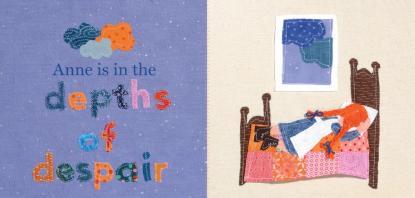
The first appeal of these books to children is that they are designed with bright colors, fabric cut-outs, sewing, and embroidery.  The pictures are easy to interpret, even as they must have been challenging to design and construct.  Some board books based on adult works of literature are clearly marketed to parents.  That’s fine, because they can still be enjoyed on two levels: that of the mom or dad finding the humor in Wuthering Heights or Anna Karenina, minus the tragedy, and also by children who like the pictures and can follow invented narratives by a grown-up reader, or make up ones themselves.  So those books are fun.  These are a bit different. Although there are specific phrases that keep them rooted in the original book, such “depth of despair” to describe one of Anne’s emotions, or “kindred spirit” to identify the letter “K.”  In every case, the clarity of the pictures gives a clear context for explaining to children.  They might not have heard of the beverage “raspberry cordial,” but one hand holds a white fabric cup partially filled with red while another hand pours from a similarly divided pitcher.  Everyone likes fruit juice!

slate

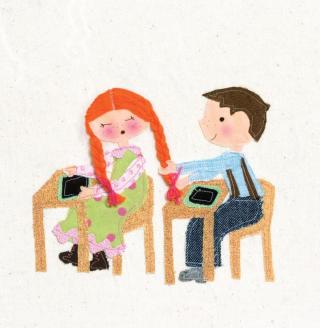
Kelly Hill has created a fabric Anne, three dimensional and fully accessorized.  Such iconic elements from the novel are here as Anne’s puffed sleeve dress, rendered in a rustic brown fabric, and Gilbert Blythe tugging at Anne’s orange yarn braids.  Some of the figures are sewn to a background and many use a variety of embroidery stitches.  Anne’s Alphabet illustrates “imagination” with Anne standing on a tree stump, her hair crowned with an embroidered garland of flowers, and a quilted cape indicating that her imagination is taking flight.

picnic

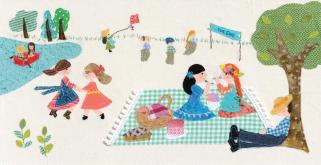
A community picnic layers burlap fabric over the participants in a sack race, while a red fabric rowboat travels on a blue sea.  There are unending carefully chosen details to explore with children, but they are not overwhelming; each page is a stand-alone scene to share and discuss. Characters and objects overlap in the four books.  The puffed sleeve dress from Anne’s Alphabet also appears in Anne’s Colors, where we can see its blue tulle underskirt as Anne joyfully pulls it out of its box.

There is an Anne for every age, as I have blogged on here and here and here and here; and, of course the original, irreplaceable Anne of L.M. Montgomery’s 1908 novel and later ­sequels.   When readers eventually meet her, they will find a familiar friend, maybe even a kindred spirit.


Knitting Together

A Scarf for Keiko – Ann Malaspina and Merrilee Liddiard, Kar-Ben Publishing, 2019

keikocover

Every once in a while a children’s book comes along which seems to fully and originally satisfy its intentions.  A Scarf for Keiko is one of those books.  It is the story of a friendship between a Jewish boy and a Japanese-American girl in World War II era Los Angeles, in the Boyle Heights neighborhood where their two communities shared a common home.  It’s about the tragedy of Roosevelt’s decision to enact Executive Order 9066, interning innocent people in relocation camps due to unjust suspicions of their loyalty.  It’s also the story of a child learning that passively going along with bullies is wrong, and that the values which his parents have taught him will strengthen his resolve to ignore the warnings of his egg-throwing racist neighbors.  It does all this without simply preaching to the inevitable choir of people who like progressive children’s books.  Merrilee Liddiard‘s graphic novel-style illustrations add a dimension of contemporary tastes to realistic settings of a now distant era.  This is a great book.

A Scarf for Keiko spread

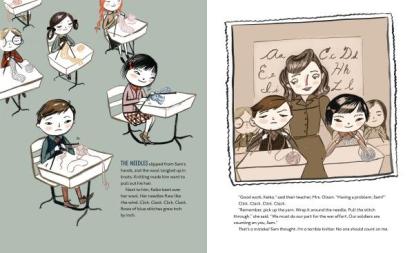
Sam’s older brother is away fighting in the War, putting a great deal of pressure on him just to emotionally survive. So when his well-meaning teacher promotes a school project of knitting for the soldiers, Sam’s apparent incompetence has his “stomach tied up in knots like the yarn on his desk.” His friend, Keiko, on the other hand, effortlessly creates rows of beautiful stitches.  Her skills and her patriotism are not rewarded by classmates who taunt and bully her. Sam’s friend Jack is convinced that Sam’s brother would not want him to even speak to Keiko, and Sam’s response, natural to a terrified child, is the morally meaningless, “ I didn’t talk to her…She talked to me.”

Sam soon witnesses senseless destruction of Japanese-American’s property, including at the Saito family’s shop where he is sent to buy flowers for Shabbos. Liddiard draws Mr. Saito, neatly dressed with period details of cuffed pants and plaid vest, as he sadly sweeps broken glass from the street, a terrible echo of the violence perpetrated against Europe’s Jews.  Worse, Sam learns that Keiko and her family are being sent to a camp in the desert. Simple language and expressive pictures combine to illustrate Sam’s mother’s gesture of solidarity: “How long will they be away? Sam asked. Mom sighed. No one knows.” The Saitos’ elegant tea set sits on the table, where Sam’s mother has promised to protect it while they are gone.

This is a book for young readers. It is not intended to detail life in the “relocation centers,” as they were euphemistically called, but Ann Malaspina’s detailed “Author’s Note “and photographs explain the destructive effects of the policy.  Sam and Keiko remain hopeful friends, and the knitting continues. Sam may not be as gifted in this area as Keiko, but it’s enough for him to follow his teacher’s instructions:

“Pick up the yarn.
Wrap it around the needle.
Pull the stitch through…

Come home safely.”