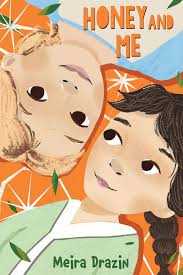
Honey and Me – Meira Drazin Scholastic Press, 2022
In a reversal of sorts, I would like to start my appreciation of Meira Drazin’s middle-grade (and older) novel with her thoughtful author’s note. She raises the somewhat contentious issue of identity in children’s books. Do we only relate to characters who duplicate, at least in some key ways, ourselves, or do works of literature transcend that type of categorization? Like Meira Drazin, I’m Jewish, and I grew up reading books in which Jewish characters rarely appeared. I loved those books—Little Women, Anne of Green Gables, Noel Streatfeild’s work—so I appreciated Ms. Drazin’s mention of them as touchstones.
However, I also loved and was greatly impacted by, Sydney Taylor’s All-of-a-Kind series, which I have written about in this blog, and for several other publications (see, for example, here and here and here and here). What Jewish girl did not? Actually, I bet there were some, and maybe now Taylor’s books, with their glow of nostalgia, seem too distant to some Jewish readers. Of course, Ella, Henny, Sarah, Charlotte, and Gertie, like Meg, Jo, Beth, and Amy, reach out to any reader, regardless of ethnicity, race, or gender. Honey and Me is a thoroughly original work, and also an homage to books about friendship, books about girls, books about imperfect families, and just…books.
Milla Bloom and Honey Wine are best friends. (Their names are among the best devised in modern children’s books.). They are both Orthodox Jews, but here is where identity creeps in. Some readers will bring to the book their knowledge of what it means to be Orthodox in the Jewish world today, but others will not, and Drazin lets them know without lengthy explanations. Milla’s family integrates more aspects of modernity into their practice, while the Wines approach Judaism more traditionally. There is virtually no judgment about this difference in the novel. Honey’s family is larger than Milla’s. Honey has a brother on the autism spectrum. Milla has an independent and creative aunt who needs the find the right guy. Honey’s mom seems almost perfect to Milla, a paragon of steadfastness and enveloping love. Milla’s own mom is complicated. She made sacrifices for her career and she had some difficulties with becoming a mother.
The exploration of friendship in the novel is deep. It’s not a mean-girls story, or one about competitiveness with a facile resolution. In fact, the girls in this book are really nice! Siblings are supportive, but also annoying. There are some wonderful teachers in the girls’ school. Feminism is an undercurrent, and it comes up against Jewish tradition but, at the same time, finds opportunities within that tradition. Anne Shirley came up against some implicit gender bias, right from the moment when Mathew and Marilla are disappointed that she is a girl. Remember when Charlie is born, and Papa finally has a son? Or when Aunt Lena and Uncle Hyman celebrate the birth of their first son with a pidyon ha-ben ceremony? (link to my article). (If you haven’t read the All-of-a-Kind books, this would be a good time to start.). To celebrate become Jewish adults with their bat mitzva, both girls engage with Jewish texts. Honey reads from the Megillah (Book of Esther) in front of other women. In the context of her own family, she is pushing boundaries. If readers expect that women should have no limits on public recitation of Torah, they may feel both pride, and disappointment at both the limits and expansion of women’s roles. Authors write books not principally to reassure, but to challenge.
The dysfunctional family seder scene is particularly terrific. Drazin acknowledges that holiday celebrations are not always moments of unmitigated joy. Sometimes children leave the table in tears and a mother “sits in stony silence.” Even if it is one moment in time, it may feel like an eternity. I recommend reading Honey and Me and returning to some of the fertile sources for Drazin’s unforgettable characters. This novel is not an homage to Sydney Taylor, nor is at an intellectual demonstration that Orthodox Jewish girls have inner lives. But within the richness of her book, Drazin has brought in those precedents and allowed them to take their own direction.
Once Upon a Sari – written by Zenia Wadhwani, illustrated by Avani Dwivedi Tundra Books, 2024
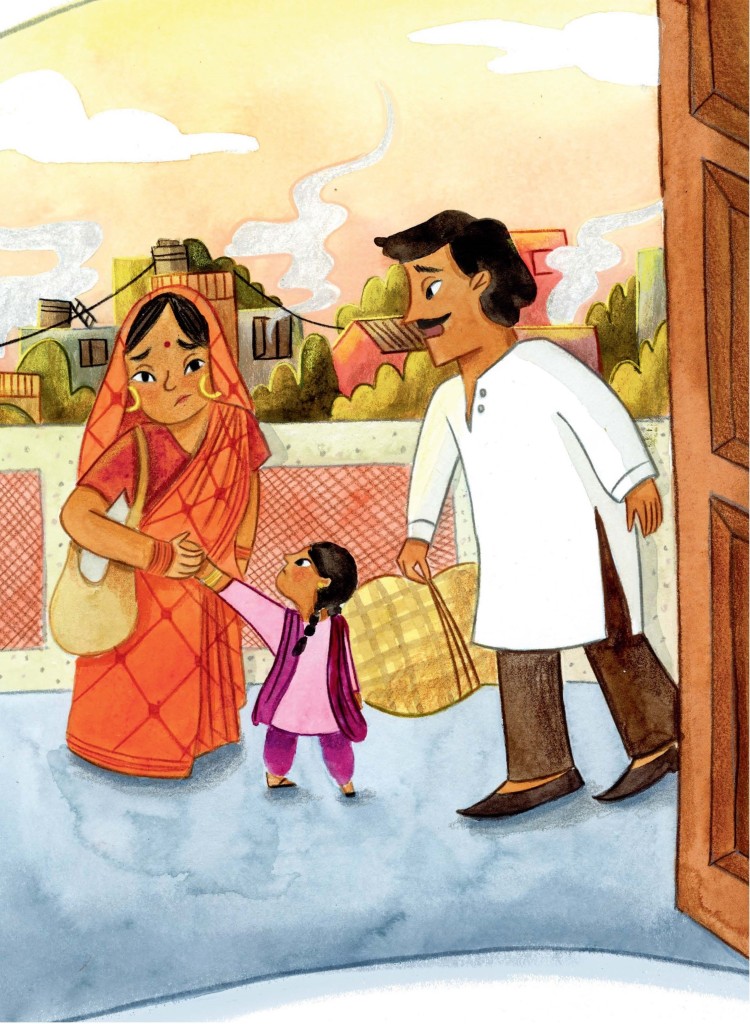
Once Upon a Sari is a gorgeous and profound book. It opens with a girl standing on a stepstool to reach a wardrobe. She opens it, and explores her mother’s collection of saris. The profusion of color and texture emerges in a description tinged with synesthesia: “…rivers of turquoise, pistachio, and mehndi greens…Hues of spicy turmeric, paprika and cinnamon browns.” The girl, Avani, is overwhelmed with beauty. The two-page spread is covered in the garments that remind her of “…a million shining stars…a bed of red and pink roses.” Beginning as a celebration of Indian culture, family, and the delights of lovely clothing to a child, it then expands to consider the impact of historical events on individual people. Zenia Wadhwani makes this transition seamlessly, as a mother teaching her child an important lesson while leaving some aspects unsaid.
First, the mother does not become upset at the mess her daughter has created. She empathizes with her curiosity, revealing that she had also been drawn to her mother’s saris and had created the same bit of temporary chaos. Although she is smiling, the mother’s comment, “Every sari has a story,” foreshadows how the stories may not all be as wonderful as her daughter anticipates. One sari is a gift from Avani’s grandfather to her mother, and another was worn at her uncle’s wedding. Seated at her vanity, Avani’s mother is dressed in gold, picking up the same gold of a glowing lamp. She mentions specific locations imbued with memories: Gujarat, Tamil Nadu, the city of Delhi.
Eventually, Avani’s mother picks up a sari that evokes a different kind of memory, one of fear and danger, as partition divided the Indian subcontinent. Her narrative of this time uses carefully chosen words. Life was not safe anymore. Avani’s grandmother, Nani, and her family, like so many refugees, had to “…leave their home and make a long and difficult journey.” Avani Dwivedi’s picture shows both suffering and dignity. The darkness of a night flight turns to the light of a new home, one that is safer, but also lonely for Nani. The colors in succeeding pictures alternate between ones where darkness or light predominates, along with earth and jewel tones.
Avani wants to learn about the sari itself. She asks her mother to return from her thoughts about the past, and her mother senses that Avani is both curious and anxious. The sari that had belonged to Nani on her flight has become a symbol of strength, and ways to “create joy” after experiencing tragedy. That responses exactly reflects the process of the book itself, where author and illustrator fold the difficult realities of one family’s history into a fabric of language and art.
I have decided to post about School Library Journal’s belated reference to Jewish American Heritage Month, which is shared with Asian American and Pacific Islander (AAPI) Heritage Month. SLJ posted three reviews of Holocaust-themed books, beginning on May 23. All appeared on the blog, Good Comics for Kids. The first review’s title does not connect it to Jewish American Heritage Month, but the review’s first sentence does. It appeared over Memorial Day Weekend with six days left in the month. These are some of recent the posts for Asian American Heritage Month, along with the date they first appeared:
Finally, on May 29, the same reviewer on the Good Comics for Kids blog posted this. The review opens with this surprising assertion: “It seemed like a bit of fate to find this book just as the month of May wraps up and AAPI Heritage and Jewish Heritage Month come to an end.”
I respect the reviewer’s choices of books to cover and I do not doubt the sincerity of her endorsement. It is not “a bit of fate” that she found the book. The book was published last September (when I reviewed it for Jewish Book Council). It is a distinguished work of graphic historical fiction, and also the third Holocaust-themed book reviewed on the Good Comics blog this month. Several posts about upcoming June holidayswere posted on SLJ before any of these reviews.
Not only did SLJ begin to celebrate Asian American Heritage Month at the end of April, but, as readers will see from the partial list above, the articles feature books on a variety of subjects. Some were featured on the front page as the main headline, with the Heritage Month connection as part of the title.
Meanwhile, as mentioned, there have been three recent book reviews, all about the Holocaust, all on the Good Comics for Kids blog, all graphic works. I am definitely not opposed to YA books about the Holocaust. I do not share the opinion that this subject has been overexposed or that attention to the Holocaust necessarily detracts from an emphasis on other, more uplifting, aspects of Jewish history. However, in the context of May’s Heritage Month, it is significant that Asian American literature is presented with an appropriate focus on many experiences, not all of them tragic. The choice of a Holocaust book may simply reflect the fact that SLJ did not begin coverage earlier in the month, and was then necessarily restricted to a narrow range of topics. The decision to feature them all on the Good Comics blog is less clear.
The custom of designating certain months for awareness of an ethnic group in the United States dates to 1926, when the eminent Black historian Carter G. Woodson chose one week in February (later expanded to the full month) to focus on the under-recognized past of Black Americans. Although there is no one official resource about this greatly expanded custom, it now includes many more groups and their achievements in different areas. Asian and Jewish Americans share the month of May, a fact widely acknowledged by many organizations and publications as well as the U.S. Government. (Other Americans, including women, LGBTQ people, and people with disabilities, also have months selected to raise awareness about their importance.) My concern here is specifically with children’s literature, within the larger context of Jewish American Heritage Month, specifically with the question of why a major source of information about children’s books would selectively endorse only one of the two groups in May. Here are some examples of institutions that did not commit this oversight and recognized May as both Jewish American heritage Month and AAPI Heritage Month, from journals in the same space as SLJ to public libraries to private publishers: The Horn Book; The New York Public Library; and Lerner Publishing Group.
One week into the month, when I noticed that several publications had not yet posted about Jewish Americans, but had honored Asian Americans, I contacted editors and corporate staff members. Publishers Weekly Children’s Bookshelf Newsletter had not yet posted any Jewish-themed material; they responded on May 20 that they intended to do so shortly. On May 23, a list of featured Jewish heritage-themed books appeared. (Kirkus Reviews had posted about Asian American, but not Jewish, heritage, and also still has not responded)
I contacted the Editor-in-Chief of School Library Journal on May 7, and I heard back on May 13; her one-sentence reply thanked me for my feedback. I contacted her again, asking when I could expect a post about Jewish American Heritage, but I did not hear back. Although it is still May, they have included several posts about Father’s Day, Caribbean Heritage, and the Muslim holiday of Eid al-Adha, all of which are observed in June (Eid al-Adha follows a lunar calendar, but coincides with June this solar year). As pointed out in the list above, articles in May have specifically referred to Asian-American Heritage Month. This is an important distinction. Recognizing their participation in this half of May’s Heritage Month program confers value on Asian American literature, while denying that value to its Jewish American counterpart.
Why does this matter? One could argue that “heritage months” are nothing but tokenism, and that they have been commercialized to the point of negating their original purpose. Perhaps they are now the equivalent of greeting card holidays, like Mother’s and Father’s Days. Do mothers need flowers one day a year, or better access to health and child care all the time? Yet no one could credibly argue that Father’s Day merits attention, but Mother’s Day does not. It is also valid to consider if overall coverage throughout the year is not more significant than a brief, if more publicized, focus. Again, that assumption would hold for other groups, not only Jews. Given that Asian and Jewish Americans share the month of May, it serves as a test case in marginalization. Clearly, it requires a conscious decision to honor one group but not the other during their assigned month, regardless of any coverage they may receive throughout the year. I prefer to avoid the terms “cancel” and “erasure,” both of which have been largely co-opted by the right, but sadly, they would seem to apply to this deliberate exclusion of Jewish heritage. As noted above, as of today, SLJ has featured severalpieces celebrating Asian American Heritage in 2024. If SLJ, or any other publication, had determined that “heritage months” had become irrelevant, that decision would logically apply to the general program.
What outlook is this pointed decision really expressing? As recently as 2022, SLJ did post about Jewish heritage in May. The title of that piece, which ran on May 12, 2022, was “29 Books that Celebrate All Aspects of Jewish Life/Jewish American Heritage Month.” The distinction between that all-encompassing tone and the last-minute addition of three book reviews, all about the Holocaust, all in one literary form, could not be more pronounced. If the current policy of ignoring Jewish Heritage Month is due to the horrific events in Israel and Gaza, that reaction would be unjustifiable. Heritage months are about American diversity. They do not imply approval of any country’s actions, nor do they place blame on Americans of diverse backgrounds for the suffering of innocent people. If that were true, SLJ and other publications would have to exclude any group whose origin can be traced to a nation with an illiberal government. Of course, this would include many Asian Americans, as well as Americans whose ancestry is rooted in Europe, Africa, the Americas, virtually everywhere on the globe. A tactical choice by a publication might be to avoid recommending Jewish-themed children’s books about Israel. I am notadvocating that policy, but merely mentioning it, because it would provide a clear way to signal respect for Jewish Americans without implying support for Israel, if an editor considered that message essential. (Of course, adopting that approach would potentially raise questions about current conditions and conflicts involving other nations and groups.) In any case, readers would reasonably expect an explanation for this recent development, not an abrupt departure from a more inclusive position.
Antisemitism is an ongoing reality. Like other forms of prejudice and hatred, it includes both overt and subconscious forms. In trying to confront these internalized biases, those against Jews are not granted an exemption. One month should offer enough time and space to equally celebrate the rich heritage of two different groups that have enhanced the cultural mosaic of America.
I’m Afraid, Said the Leaf – written by Danielle Daniel, illustrated by Matt James Tundra Books, 2024
This is a picture book about children feeling afraid, and finding support in the natural world. Animals and plants, even when they are not figuratively anthropomorphic, have implied human qualities, so the book is also about welcoming help from those around us. The text is poetic, the pictures deep and resonant. I’m Afraid, Said the Leaf is direct in its appeal to children, and also stunning visually.
Everyone experiences difficult emotions and sensations, including hunger, fear, boredom, and sadness. There are different ways of engaging children in confronting those states. Danielle Daniel and Matt James present a child and the natural world, unmediated by discussion or plot. A horse is cold; the sun offers him warmth. A squirrel is hungry, until a nut offers to feed her. The ubiquitous problem of worry finds a solution when tall blades of grass surround an anxious deer, enclosing the animal in a protective environment.
Some of the pictures include both the child and an animal, who share the comfort of a solicitous natural element. A thirsty skunk is offered a drink by a stream, while the child crouches over the water. He may be taking a drink, but also seeing his reflection, in a kind of reverse allusion to the myth of Narcissus. Instead of being consumed by his own reflection, he is sharing happiness with other creatures. What child has not complained of boredom? Here, a mushroom with expressive eyes finds simple pleasure in playing with a mouse.
James’ illustrations were created with acrylic paint on Masonite. The book’s paper is thick and glossy, and the colors appear as rich as paintings in a gallery. The use of background space and the careful composition of figures contribute to the sense that each picture is an individual work of art. The child smiles intently at a butterfly, which appears to be part of the human face as it covers one eye. Sleepy, the child rests his feet on a wolf, transformed from a predator to a pillow. A bear suffering from the heat is shown in profile without facial features. When he bathes in a creek, his eyes open and his claws emerge from the water. It’s easy to imagine sharing this book with a child by both talking about the message and interacting with the physical beauty of its images.
“Close your eyes,/said the moon” closes the story, and the child follows those instructions. Resting on his hair are dark silhouettes of animals, resembling the ancient beauty of cave paintings. I’m Afraid, Said the Leaf will offer new connections to the natural and human worlds each time you read it with a fortunate child.
Summer Is Here – written by Renée Watson, illustrated by Bea Jackson Bloomsbury Children’s Books, 2024
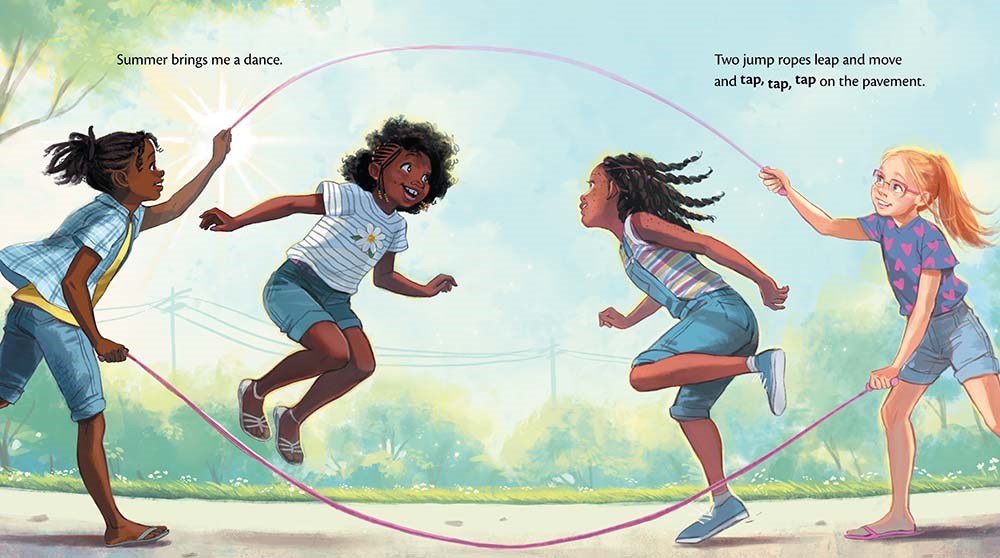
Summer Is Here approaches the arrival of the season exactly the way a child would, with excitement and joy. The text uses simple description, rhythmic language, and a bit of poetry (“Summer sings me a song,/serenading me from the ice-cream truck.”). Renée Watson gives voice to a young girl, allowing her to choose what is most significant: the ephemeral fun of blowing bubbles, swimming with friends (image), time spent with a loving family, and the tinge of regret that comes with knowing that it cannot last forever. Bea Jackson’s digitally created pictures, almost trompe l’oeil in their vividness, are as accessible as the text.
The book’s characters are realistic representations of diversity, of age, race, and body type. There are babies, children, and adults, with larger and slimmer bodies. One girl wears glasses, and style choices include a ruffly peasant blouse, overalls, and jeans. Perspectives change; one two-page spread of a family barbecue gives the father most of the space as he grills burgers, while the facing page shows the girl in the foreground watching him. Other family members sit at a picnic table in the background in a gauzier, less-defined image. Friends float in a pool. What matters most to a child can change from moment to moment.
The concluding scenes of nighttime are a shift in tone, as the lively momentum of summer draws to a close. Summer is personified as female: “I feel her breath blowing/through my open window.” Sitting on the bed in almost balletic pose, the girl looks out at the moon, and, in the next scene, whispers goodbye. The daytimes unique to the season are coming to their inevitable end. Children intuitively realize that some things they love are transient. The warm weather and freedom from structure come once a year, but the foundations of friendship, family, and imagination itself, are more lasting. Watson and Jackson do not need to state that message explicitly; it comes through as a deep sense of security in their words and images. The girl’s closing wish that “summer would stay” is accompanied by her smile and a scene of homes, with lights punctuating the darkness.
Afikotective – written and illustrated by Amalia Hoffman Kar-Ben Publishing, 2024
Every year there are new books about Passover/Pesach for children. Some have novel premises; others are contemporary versions of classics. Amalia Hoffman’s Afikotective features a family of mice ensconced in a cozy home. Mice have appeared in Passover books before (such as Matzah Belowstairs,Mouse in the Matzoh Factory, Pippa’s Passover Plate, orThe Passover Mouse), so Hoffman’s are in good company. The concept of hiding is intrinsic to the Passover seder. Customs vary among different Jewish communities, but often the middle matzah of three is hidden by an adult, to be found by a child, who will receive a reward. Only then can the seder be completed. Hoffman’s mice are rendered in sophisticated images that allude to fabric art, and they embody the home-based ritual which is central to the festival.
In this family the grandparents hide the afikoman. The grandfather wears a large, Sephardic style kippah/yarmulke, and the grandmother sports cat-eye glasses and bold dangling earrings. The bright orange of their outfits match! One of the children at the table wears a bowtie and a deerstalker hat, signaling the detective role he will play.
He employs some obvious tools, like a magnifying glass and binoculars, but also a toy elephant with a super sensitive trunk. The logic of his search technique will make perfect sense to young children, even when he encounters a few detours and needs to get out his toolbox.
Amalia explained her creative process to me. She sketched and colored each picture, and then cut out the shapes and composed them on a board, painting them and scratching the surface to add texture. Curving parts of the mice gives an allusion of animation. Finally the images are photographed. (The afikotective sniffer-leash and the word “YAY” were produced with yarn.) Images are textured and layered to appear three-dimensional. The ingenuity and precision behind these heimish (homey) scenes is the result of loving attention to detail.
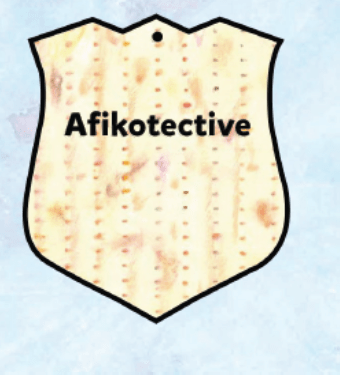
Children and mice are both small, but their stature does not minimize their important role in the celebration of Passover. In fact, adults are obligated to teach them the story of the Exodus, and for everyone to experience it as if he or she had actually been alive at the time. Young readers will undoubtedly feel affinity for the other species in this book. They can even make a copy of the “Afikotective” badge included. In her author’s note, Hoffman reveals the origin of this special identity in her own childhood.
A Garden Called Home – written by Jessica J. Lee, illustrated by Elaine Chen Tundra Books, 2024
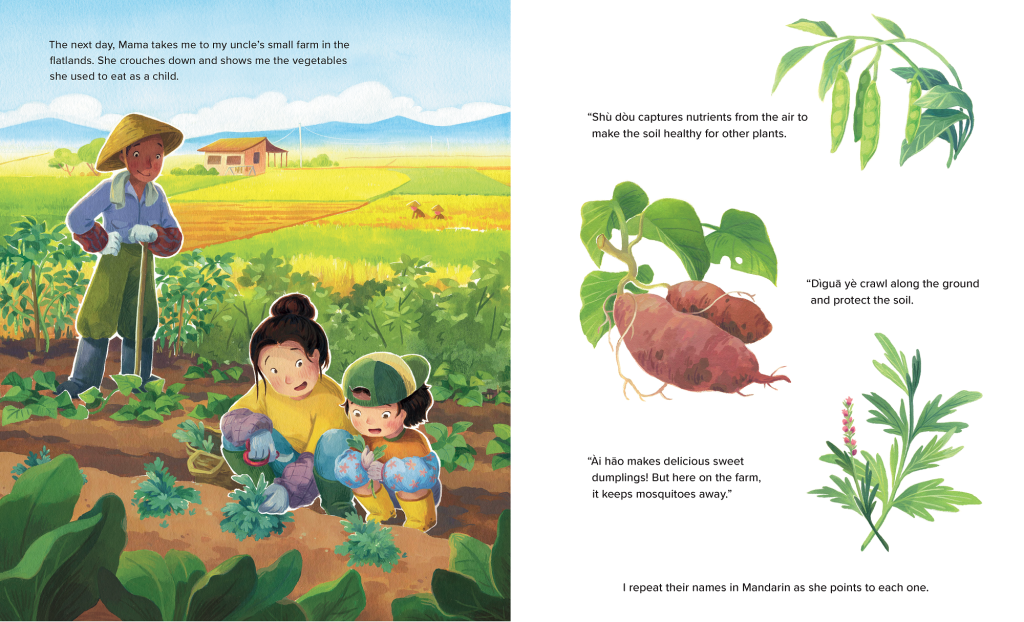
There is more than one layer to Jessica J. Lee and Elaine Chen’s new picture book. Narrated from the point of view of a young girl, it begins with a simple statement about the season: “Winter is arriving.” She looks out the window, her eyes full of expectation. But soon we learn that “Mama doesn’t like winter.” Her mother, from the much warmer, and to her more hospitable, climate of Taiwan, is living with her daughter in a much colder country, where even warm jackets and steaming congee cannot seem to elevate her mood. “She never wants to go outside.” The girl and her mother go to visit family in her mother’s homeland, but the consoling trip is a temporary solution to her mother’s sadness. The girl invents her own solution, immersing herself in the environment of both countries and encouraging her mother to experience joy.
The mom’s reunion with her family is wonderful for her. The girl observes how her mother is suddenly outgoing, talking constantly to make up for the infrequency of her contact with people who matter to her. A busy food court meal shows the mom with eyes uplifted and her hands gesturing, while the girl herself seems baffled by change. Much of the trip centers on the natural world, with the girl’s mother patiently explaining the unique plants and geographical features. One point of contact is becoming familiar with the vegetables that had been part of her mother’s diet as a child. That knowledge takes root in her mind. She learns the names of each plant in Mandarin and repeats them.
The trip ends and they return home, but the girl is able to transform the way in which her mother views the world. Perhaps a more accurate metaphor than layers for this story would be the growing concentric circles of ripples on a pond, or maybe the inside of a tree trunk. At first, the mom remains indoors, as she had before the trip.
Her daughter’s response is to pursue the study of nature they had begun abroad, and to bring her new knowledge home as a gift to her mother. Her forays into the outside are alone, but she conveys the excitement surrounding them to her mother. Fungi on maple trees, nutcracker birds living on whitebark pines, and seeds with thick shells waiting to sprout are all part of the same process. With careful observation and systematic study, she constructs a picture and shares it: “I show Mama that nature here can be wondrous, too.”
A Garden Called Home begins with a tough premise. The girl’s responsibility for her mother’s emotional renewal could have ended in sadness. Instead, her fascination with the environment, her persistence in expressing that experience, and her mother’s hidden strength, allow their life together to bloom.
Guts for Glory: The Story of Civil War Soldier Rosetta Wakeman – written and illustrated by Joanna Lapati Eerdmans Books for Young Readers, 2024
A young woman is determined to serve in the army during wartime. She disguises herself as a man and fulfills her dream. This story is the stuff of both history and folklore. In Joanna Lapati’s unusual picture book, the example of this choice is Rosetta Wakeman, who created the male identity of Lyons Wakeman, donned a uniform, passed a cursory physical, and became a soldier in the Union Army during the Civil War. What dream was she fulfilling? The book assumes the perspective of Rosetta herself; Lapati does not attempt to impose ideological commitments that may or may not have motivated the transformation. Instead, readers are immersed in Rosetta’s consciousness, as she joins the 153rd New York State Volunteers and confronts the enemy in battle.
The glimpses into Rosetta’s state of mind are brief. Third-person narration is interspersed with brief selections from her letters home. She assiduously avoids taking off her uniform. She sends her pay home to her family, directing them to use it for food and clothing. When her comrades in training become “a little rowdy,” Rosetta asserts in one letter: “I haven’t been punished Since I have been in service. I never got to fighting but once…” Lapati’s text reflects the terse and incomplete mode of expression that Rosetta adopts in her letters. Readers may imagine what that “but once,” represents, whether Rosetta is being honest, evasive, or just sticking to the minimal information she deems necessary. Her story is about the daily life of a soldier, not the larger vision behind the Civil War, nor the limitations of gender roles.
Lapati’s artwork is exceptional. As she explains in an afterword, she has recreated the style of 19th century wood engravings, using scratchboard. There is more detail about the process, which reinforces the sense of her commitment to accuracy and to designing a complete and immersive production. Rosetta is depicted sitting on the ground while writing a letter, her eyes covered by the brim of her military cap. We see her in a line of soldiers, ready to raise and aim her weapon. We observe her taking her oath of allegiance to the United States of America, where she is revealingly, but not too revealingly, the shortest man in the group. While the book does not glorify war, it certainly does not apologize for Rosetta’s chosen identity as a fighter.
A sense of ambiguity follows on this deliberate reticence. Was Rosetta’s life one of defiance of restrictions on women? Would she today have identified as transgender? Did she assume that slavery was the underlying reason for her enlistment, or was it secondary to some personal desire? Extensive backmatter gives more information about Rosetta’s life, which sadly ended when she died, not in combat, but of dysentery. Ultimately, readers learn about one woman’s unusual, but not unique, decision, but also consider the many intersecting ways in which she fit into history.
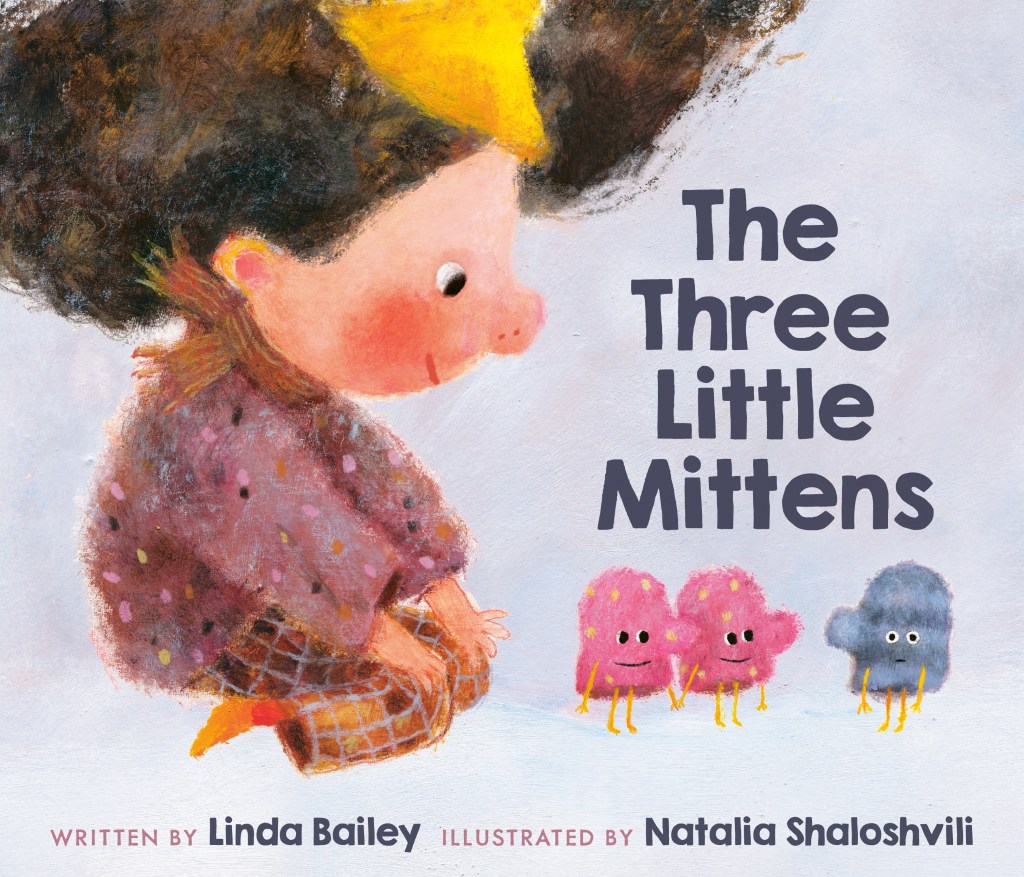
The Three Little Mittens – written by Linda Bailey, illustrated by Natalia Shaloshvili Tundra Books, 2023
The Three Little Mittens opens up several questions about being the odd one out. First, and most literally, “What’s the use of single mitten?” More generally, we’re asked to consider, “Why do you have to match?” Finally, can an assortment of mismatched items find a home together and even encourage others to do the same? Children’s picture books have always been a welcome location for exploring these issues, and for questioning rigid categories that separate people, animals, or other beings from one another. Humorous childlike thoughts and joyful pictures align the book with other classics, including Leo Lionni’s Little Blue and Little Yellow, Margaret and H.A. Rey’s Spotty, and both Antoinette and Gaston, by Kelly DiPucchio and Christian Robinson.
The connections are subtle. The mittens depicted here are not subject to the same type of prejudice. They judge each other, conforming to unreasonable outside standards of who has value. When Stripes gets detached from her partner, a common hazard for mittens, she suffers a kind of existential panic, but insisting “I know I’m just one…but there must be some reason why I’m here.” But instead of reassurance, she suffers rejection, as Dotty and Other Dotty hold hands and walk away from her. With just three squiggles per mitten, Natalia Shaloshvili captures the pink mittens haughtiness, and the bereft mood of one Stripes, matching Linda Bailey‘s playful text.
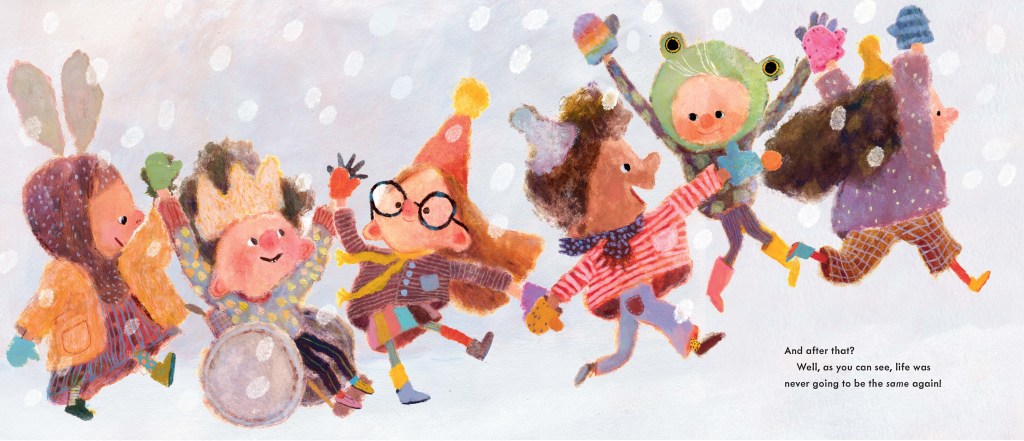
Just sticking with mittens would have made the story seem more of a parable. When a Little Girl appears, the mittens, and the reader, begin to experience other possibilities. Her features are formed of the same flexible line as those of the mittens, but she also has beautiful dark curls, a jaunty hat, and a playful dog. Most importantly, she in addition to her pink pair of mittens, a blue one peeks out of her pocket. Maybe there is hope for Stripes after all. When one mitten falls off the girl’s hand, a new relationship begins. It starts, from Dotty’s point of view, as a last resort, but soon the two single mittens tentatively form a partnership.
While Lionni’s green and yellow geometric forms effortlessly play together, Shaloshvili conveys a great deal of ambiguity in each simple picture. Their stick-like limbs swing in motion, and their bodies sometimes shed a bit of fuzz. The white space on each page is not only snow, but a spacious background for their drama. More characters appear when the Little Girl goes indoors and opens her cardboard box, full of highly individual mittens who are not abandoned, but given a new life. There are such unforgettably warm collectibles as Pom-Pom, Big Dino (only big compared to the other mittens), and the decorative Furry Cuffs. The Lost Mitten Box is, just by being placed in a container, a curated collection, but only minimally. The mittens all get to come out in play according to a fair system devised by the Little Girl: …over time, all of the mittens would get a turn.”
The finale is a range of possibilities, all representing “FREEDOM.” Children and mittens play together. Their lives are full of wonder. It was easy to resolve the questions about the potential uses of a single mitten, the necessity of matching, and the viability of existence.
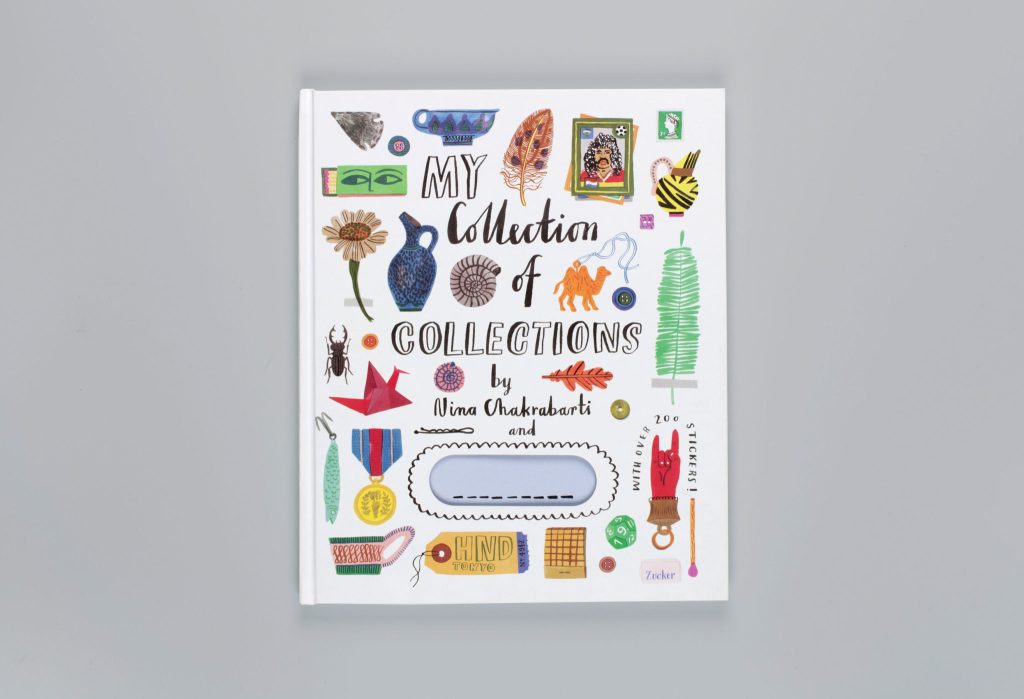
My Collection of Collections – written and illustrated by Nina Chakrabarti Laurence King Publishing, 2017
How many objects constitutes a collection? Do the collected items have to be objects, or can they be words, thoughts, or memories? Does the collection have to be assembled deliberately? Nina Chakrabarti more than answers these, and other, relevant questions in her picture book, My Collection of Collections. The authors credited on the cover are Chakrabati herself and, with a space provided for adding a name, the reader of this book.
Not only perfect for any child, or adult, contemplating starting a collection or curating one, it’s equally appealing on aesthetic grounds. The book is interactive, including stickers, and suggestions for expanding on existing drawings. Most important, it considers the universal urge to accumulate, categorize, and sometimes display whatever element is appealing to an individual. Some are well known: stamps, dinosaurs, mugs, shoes. Some are fading in popularity: stamps again. Maybe it’s time for a revival! Some are deliberate, others accidental. Unlike other hobbies, no special skills are absolutely necessary, although a particular collector might develop a great deal of knowledge and eventually build and arrange her collection with greater expertise.
The pictures are whimsical, affectionate, funny, and as carefully composed as the collections themselves. A page of sugar packets features graphic design in different languages, fonts, and styles. A white coffee cup releases red steam, a red bird flies under a flag proclaiming “ZUCCHERO,” and a cylinder of brown sugar is broken in the middle and spills sweet stuff. Chakrabarti provides helpful suggestions in the form of obvious qualities one may have missed, such as “COLLECTIONS can BE EDIBLE,” and “COLLECTIONS are a WAY of UNDERSTANDING THE WORLD we LIVE in…” Don’t forget that “COLLECTIONS CAN BE ECLECTIC,” such as one attributed to “RAFI, AGED 11-½ .” He has good taste, as evidence by his agate slice, origami crane, and ammonite fossil.
Learning the names of different collecting categories has always exercised some fascination. Philatelists collect stamps, while falerists favor medals. A Wunderkammer is a cabinet of assorted curiosities. In fact, the book itself fits this definition. Curiosity, in the broader sense, is the underlying message. In addition to objects, collections may gather dreams, words, and secrets. A two-page spread of the random evidence of life that turns up in a railway lost and found suggest an imaginative activity: “Invent a story using all the lost items.”
Whether you own a matchbook decorated with a hedgehog whose quills are matches, or a bunch of blue elements that might have something in common in addition to their color, My Collection of Collections should get you started. Space and time are the only limits.
















 Imaginary Elevators