Class Is Not Canceled Under the Sea

Narwhal’s School of Awesomeness – by Ben Clanton
Tundra Books, 2021
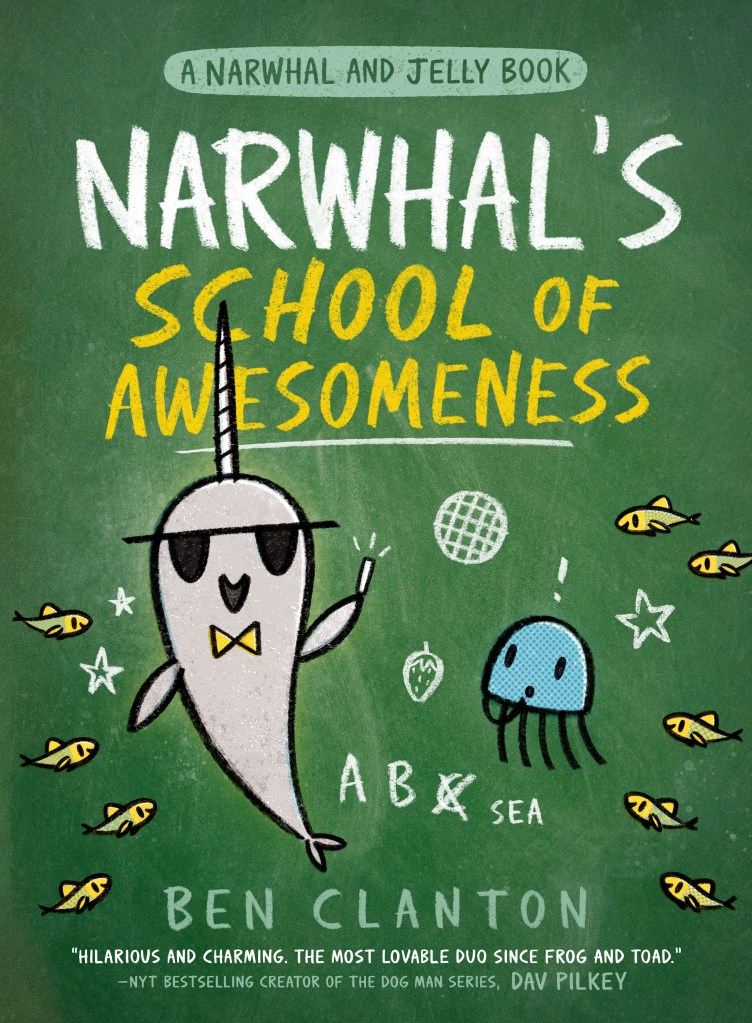
Narwhal and Jelly are back again, just in time to substitute teach for a school of fish with a teacher who is under the weather.  As always, Ben Clanton’s combination of one creature of almost mythic stature (narwhal), with another sometimes thought of as something of a pest (jellyfish), contradict most of their stereotypes.  Narwhal is bold and funny, Jelly a modest sidekick who plays along. They work together, using a high-energy and multidisciplinary approach, from math to recess.

While the plot is more or less linear, there are so many ingredients that the passage of time is not the main point. These include jokes, puns, alliteration, “Fun Facts,” “Science Squad,” ambitious vocabulary (“delectable, palatable, toothsome”), and more.  By the end of the book, (“fin, concluded, a wrap, fini), readers will have learned about seahorses, how to divide a waffle, and how to say goodbye to an irreplaceable substitute teacher in several languages.

Narwhal and Jelly’s students are all good-natured; there is no taunting of the dreaded substitute teachers.  Narwhal admits his complete lack of experience in the classroom to Jelly, but that doesn’t present much of an obstacle.  The fish students learn about science, math, comic book art, as well as the ethics of sending their sick teacher a warm and appreciative note. Finally, they have to regretfully tell Narwhal that the school day has ended.

The note to Mr. Blowfish, out with a bad cold, includes a copy of their full-color adventure, “Super Waffle and Strawberry Sidekick.” Readers familiar with earlier Narwhal and Jelly books will remember that these sequences appear in the middle of the story, with a brighter color palette from the “real world” of the main characters.  Adults will enjoy the wry comment on creating fiction; Super Waffle and Strawberry Sidekick on no more improbably than a narwhal novice teacher.  For kids, it’s just delightful to turn the page and find a waffle wearing a bright red superhero mask.

Narwhal’s School of Awesomeness has the right combination of frenetic pace and reassuring characters.  Narwhal and Jelly are kind and supportive to one another. When Narwhal gently taps Jelly for one more game of tag, we know that no one will get hurt, and everyone will learn something.  The wingspan of an albatross is useful information, and so is how to express gratitude to your teacher in four different languages.

American Girl Stands Up for Labor Rights

Samantha Helps a Friend (American Girl: Step Into Reading) – written by Rebecca Mallary, illustrated by Emma Gillette
Random House Children’s Books, 2021

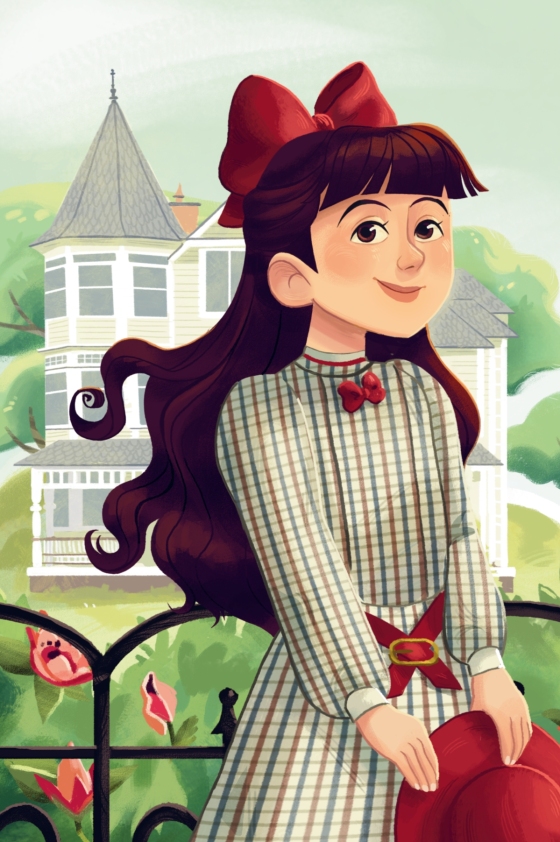
I haven’t given up on the American Girl books or dolls, in spite of Mattel’s relentless race to the bottom as they continue to downgrade the historical aspect of the project. As part of the company’s somewhat hypocritical celebration of their product’s thirty-fifth anniversary, they have reissued some of the original dolls and released some new books. The latter category includes beginning readers in the trademarked “Step into Reading” series.  For those of you who don’t remember every character and plot point, Samantha Parkington is a wealthy orphan who, in 1904, is living with her generous grandmother in New York State.  In spite of her incredible privilege, she befriends a poor Irish American girl, Nellie O’Malley, and winds up learning a thing or two about how the other half lives.  Samantha Helps a Friend, in addition to being a gateway book to the American Girl phenomenon, teaches young readers about standing up for the rights of working people.

Rebecca Mallary’s text is relatively simple, labeled “Level 3” in the series.  “Samantha always tells the truth, and she will do anything to help a friend,” is a typical sentence. Children will easily follow the plot and understand clearly who the good and bad guys are, although the worst bad guys are students who tease Nellie. Presumably, the factory owners who force children like Nellie to do adult work under dangerous conditions are much worse, but we don’t actually meet them in the book.  However, a picture of Nellie and a young boy laboring at heavy machinery is quite affecting and gets the point across about the injustices of the Gilded Age. 

The central message of the book, which is actually somewhat sophisticated, is that the definition of “progress” depends upon whom you ask.  When Samantha’s fancy private school decides to participate in a speech competition, on the subject of “progress in America,” she canvasses the adults in her life to learn their opinions. Telephones, automobiles, and factories are all suggestions, but Samantha is bright enough to think about the implications of who is manufacturing all these marvels.  In her bold address, she speaks truth to power. Since the book is part of the American Girl series, some people are shocked, but others are impressed.  There are many opportunities to talk to children about workers’ rights and other issues when you share this book with them.

Emma Gillette’s pictures are definitely kid-friendly; colorful and expressive, they help to fill out the story’s meaning, as beginning readers’ illustrations should.  (The original American Girl novels had beautiful pictures, but now these have been removed. This change was probably due to an ill-conceived theory about marketing the books to readers “too old” for illustrations.)

If you are incontrovertibly opposed to the alleged commercialism of American Girl, then you might not want to give a child Samantha Helps a Friend. That would be unfortunate, because this simple and appealing story delivers a strong message in a pleasant (no pun intended about Pleasant Company, the original home of American Girl) package.

Lunch with Nonna

Eat, Leo! Eat! – written by Caroline Adderson, Illustrated by Josée Bisaillon
Kids Can Press, 2015

Here is a lovely and inventive picture book about grandmothers, stories, food, and the specific appeal of pasta.  Just like the staple of Italian cuisine, which comes in many different shapes, Nonna’s stories for her grandson, Leo, are varied and delightful.  Believe it or not, Leo isn’t such an eager customer. Sometimes he’s just not hungry.  But his grandmother, Nonna, turns every type of pasta, from star-shaped stelline to the menacingly named occhi di lupo (wolf eyes), into a pretext for exciting narration.  Although the pretense of the book may seem elaborate, Caroline Adderson’s conversation tone and Josée Bisaillon’s friendly pictures (link to other blog post), make this family story as inviting as a bowl of zuppa.

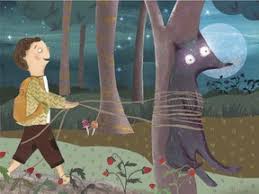
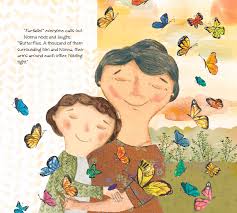
The book opens with a child’s eye view from the kitchen floor, as adult feet stand in place to socialize or walk swiftly to get the gathering started.  Nonna would like Leo to eat, but she isn’t pushy.  Her gray hair and big glasses and her resemblance to Leo’s mother make her seem comforting. She’s also smart and imaginative, ready to entice Leo with the first of a series of tales. Each week a young boy undertakes an adventure, its outcome unsure enough to be a bit scary.  Once he uses spaghetti to tie up a wolf, another time a thousand colorful farfalle, butterflies, appear in the sky.  Leo’s extended family, both children and adults, are equally absorbed in Nonna’s magic.

Bisaillon’s pictures are her inimitable blend of realism and exaggeration.  Bodies and faces are slightly stylized. Some scenes are viewed at an angle or from above.  Nonna’s kitchen is full of detail, from multicolored stacked bowls to dishtowels hanging from the oven’s handle.  Jewel tones and pastel colors alternate, as do dark and light scenes.  The tone is casual, preempting any sentimentality that might be expected in a story about an ethnic matriarch and her clan.  There’s even an afterword, “A bit about pasta,” explaining the amazing range of shapes available for this food, and a glossary of Italian words appropriately placed at the beginning of the book.  Eat, Leo! Eat! is a feast of words and pictures.

Imagination, Hard Work, and Some Friends

The Perfect Plan – written and illustrated by Leah Gilbert
Bloomsbury Children’s Books, 2021

Maya’s adventure in The Perfect Plan involves a determined and creative child who wants to build the best tree fort possible. While high standards sometimes lead to frustration, especially when children naturally lack the skills to match their vision, Maya gets some help.  Leah Gilbert’s picture book is composed of empathy, fantasy, and respect for the natural environment.  The proportions of all these components are as well-balanced as Maya’s feat of engineering.

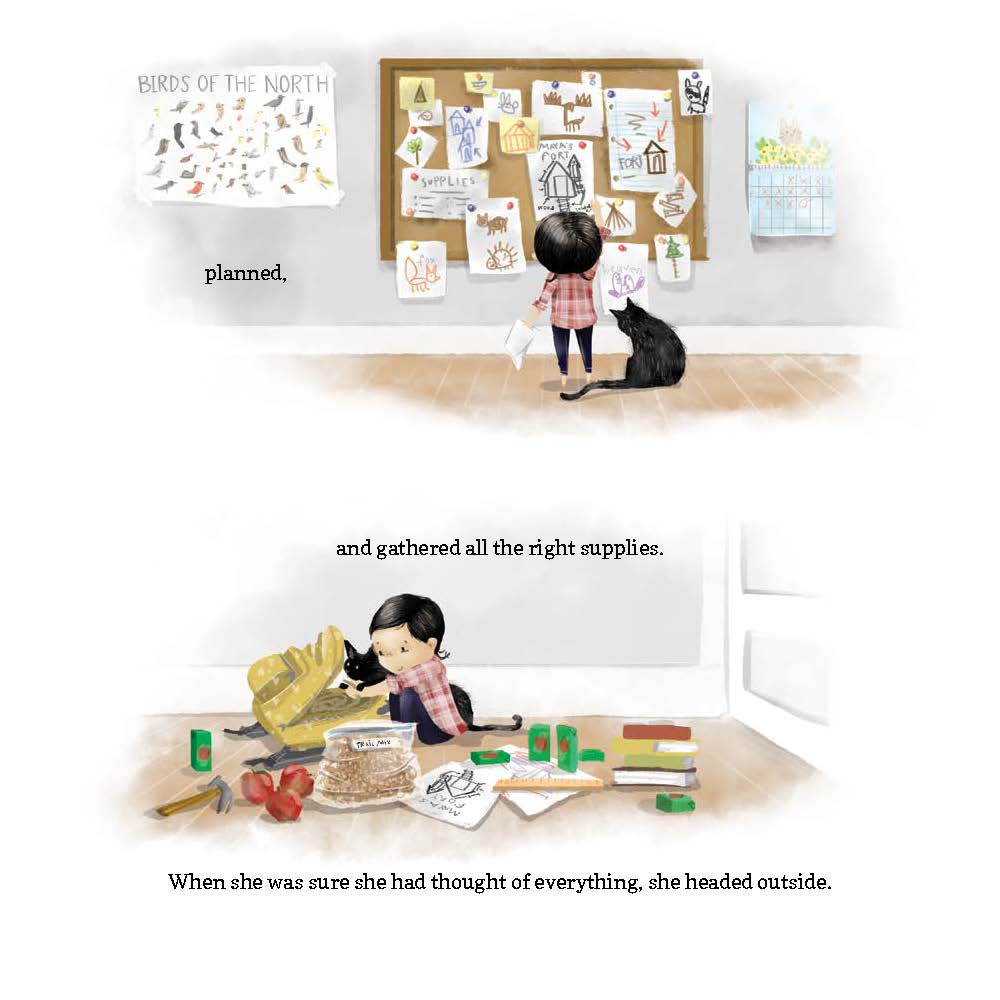
The entire point of the fort is to provide a special and secure place to dream, and Maya approaches her work as something of an individualist. Without preaching to children about cooperation and STEM teamwork, Gilbert reveals that Maya will need some assistance.  But every construction project begins with an idea some careful research; crumpled papers and multiple drawings reflect the young engineer’s intense focus. At this point, only her cat is helping, perhaps with some moral support. Maya plans and packs and goes outside in search of a location. But her efforts and lugging logs and consulting her sketches don’t bear fruit.

When Maya spots some beavers, known for their building skills, things pick up. Now Gilbert moves away from the strict limits of reality.  Everyone knows that beavers build dams, but soon Maya enlists the support of other animals not as well-known for building.  They are all residents of the natural world and they want to help someone who they sense is, like them, attuned to the special qualities of their home.

Soon there are birds, bears, and moose working together to create a fort that is both functional and a work of beauty.  There are no artificial divisions between the two qualities that Maya needs for her home-away-from home.  Ornamented with pastel-colored flowers and sparkling lights against a green background, the fort is a refuge.  Maya has found room for her friends, though.  The final image shows her engaged in the solitary pursuit of reading, but surrounded by all the creatures who helped her.  The Perfect Plan draws a parable about creativity, solitude, and persistence and places it securely in a child’s imaginary world.

Odd Couple Makes Friends

Wolfie & Fly – written by Cary Fagan, illustrated by Zoe Si
Tundra Books, 2017

If you’re looking for something different in a chapter book or middle-grade novel, Wolfie & Fly is it.  Written by versatile author Cary Fagan, with wonderful drawings by Zoe Si, it tells the story of two oddball kids, Renata Wolfman and Livingston Flott.  (I have also reviewed Fagan’s work here and here and here and here.) Given the sometimes cruel humor of children, Renata has become known among her classmates as Wolfie, because her introverted personality makes her seem a “lone wolf.”  Livingston’s nickname is “Fly,” because, as he readily admits, “I buzz around and annoy people.”  They’re not exactly Frog and Toad, but, by the end of the book, this unlikely duo has formed a friendship.  Every child who feels that she is too introverted, too extroverted, or too anything else, will identify with their bond.

Renata is uninterested in shopping for clothes except for overalls and white T-shirts. She prefers to curl up with a book, and disdains her parents’ suggestion that everyone needs friends.  Then, one day, Livingston stops by her house, just as she was about to convert a cardboard refrigerator carton into one of her creative construction projects.  A submarine seems like a great idea!  Fagan details Renata’s amazing collection of seemingly useless items, which she uses to engineer everything from a model of the Golden Gate Bridge to a peanut-tossing catapult. She reluctantly agrees to allow Livingston to help her.

Livingston plays the guitar and improvises song lyrics, narrating his life like a modern troubadour.  (“You opened the door and you/let me run in./’Cause I was being chased by one of/my kin.”). Soon the carton is a submarine complete with control panel and the two not-yet friends are navigating the deep sea.  Is their trip imaginary or real?  They pass everything along the way, from sharks and jellyfish to “an old DVD player, a sofa and even a toilet.”  Soon Wolfie and Fly are discussing environmental pollution, confronting pirates, and admiring the beauty of the ocean.  As in Dr. Seuss’s the Cat in the Hat, parents have to eventually return. Reality and fantasy sort themselves out.  Wolfie and Fly have come to like and respect one another.  Their adventure has all of the internal logic of childhood, full of contradictions and excitement.  This ode to unlikely friendships and unlimited imagination is a wonder.

She’s the Captain of Her Ship

Out Into the Big Wide Lake – written by Paul Harbridge, illustrated by Josée Bisaillon
Tundra Books, 2021

Out Into the Big Wide Lake is a wonderful picture book about a young girl learning to challenge herself. It’s also about a child with a disability who has a wonderful family to support her.  The book’s most salient qualities, evident in both its words and pictures, is its honest and unaffected tone, and the way in which it works on different levels simultaneously.  To say it is “just” a book about disability would be untrue, and yet that is not to diminish the subtlety with which Paul Harbridge and Josée Bisaillon take on that issue in their story.  A child who does not live with a disability will also relate to the ordinary courage of the young heroine, Kate, as she navigates a new environment and gains confidence.  The book is extraordinarily sensitive and beautiful, and Kate is an unforgettable character.

In a brief introduction accompanied by a photo, Harbridge explains that he based the story on his younger sister, an accomplished and brave young woman who has Down Syndrome.  The book itself never specifies that Kate lives with this challenge. Instead, the author allows her to describe, in thoroughly convincing words, her feelings, her daily routine, and her ambitions.  Bisaillon’s lovely and expressive pictures of Kate do imply that she has Down’s syndrome, yet she also is depicted with a clear family resemblance to her mother and, especially, her grandmother.  She is different from them, and yet linked to them as well, as we all are to our own relatives. 

When we first meet Kate, she is seated at her desk with colored pencils, but she is not drawing. (image) Rather, she is practicing writing her name by associating each letter with a different object: “A stick with an arm and a leg. That was a ‘K.’ ‘A’ was a tent…’T’ was a telephone pole and ‘E’ was a little comb.”  There is no need to explain her learning method, and her creativity is also evident.  When Kate’s grandmother suggests to her mother that Kate spend the summer at her grandparents’ lakeside home, Kate’s mother hesitates. She doesn’t need to articulate her fears, only to suggest them. Any parent might experience this same ambivalence, but, in Kate’s case, her concerns are a bit different.  But when Kate’s grandmother responds, “Give her a chance,” it is clear that everyone is on the same page.

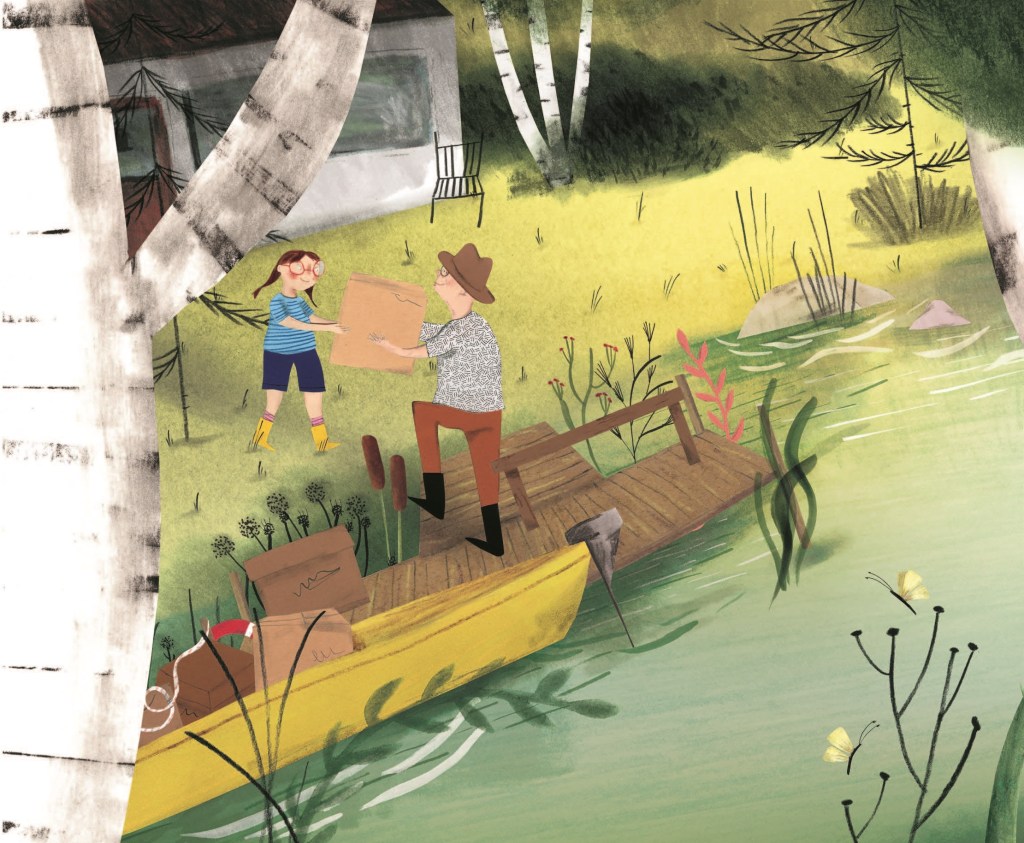
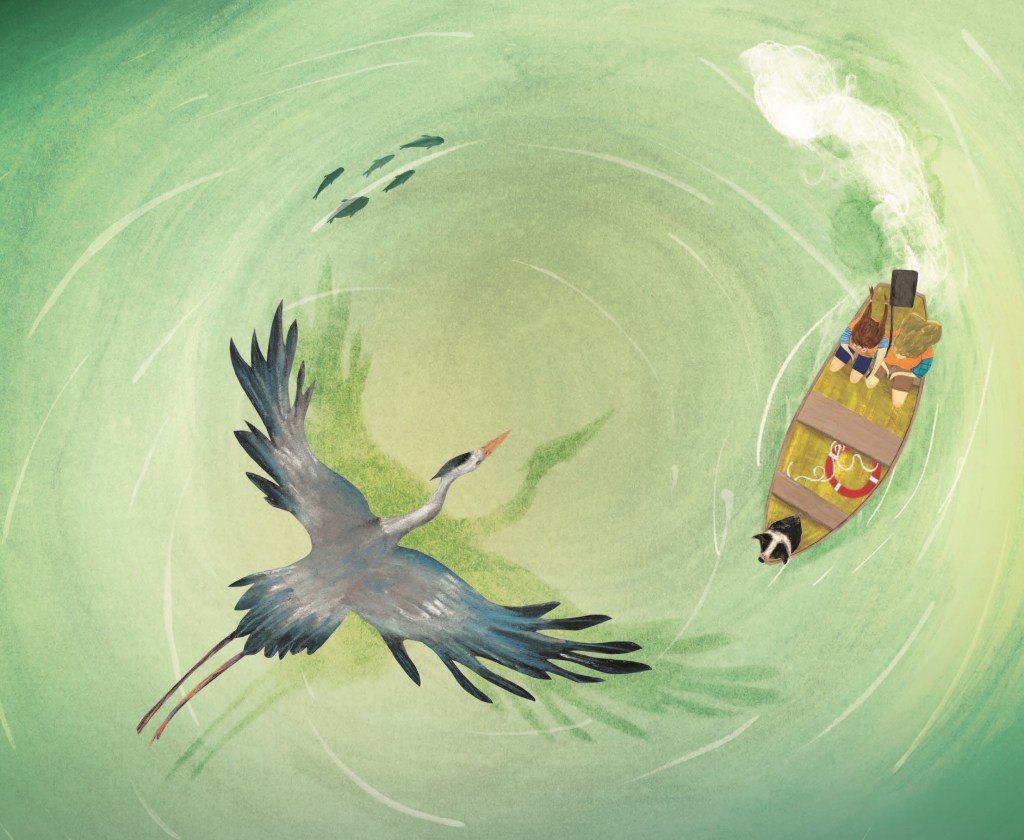
Kate’s grandparents own a store, and they deliver groceries by boat to the neighbors in their small community.  Kate takes an active role, happily helping her grandfather to load the boat with cartons. Her grandmother is loving and accepting of Kate, but she also knows exactly how to push her to succeed.  Again, in addition to the theme of normalizing life for a child with a disability, there is also the parallel ideal of caregivers, often grandparents, who dedicate themselves to helping children realize their own goals, rather than those imposed on them.  Bisaillon captures the excitement of learning to steer the boat from a bird’s eye view, while a crane circles overhead, as if admiring the scene.

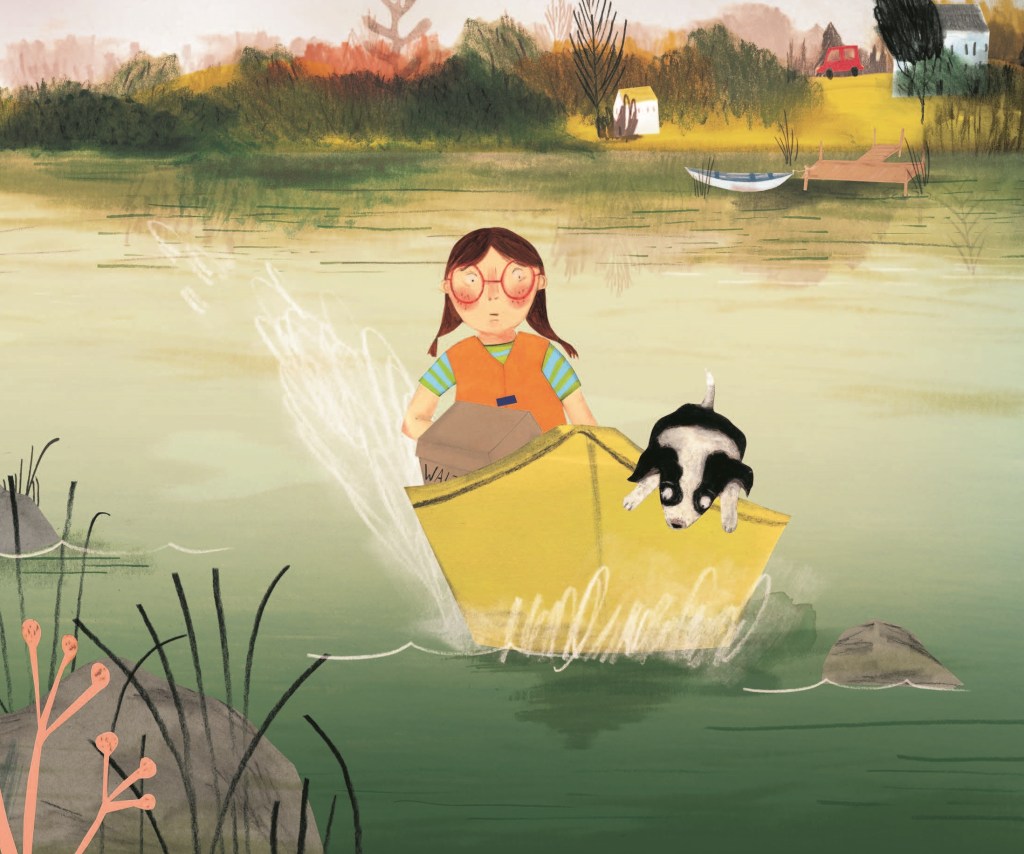
One day, circumstances leave Kate alone in the boat. She thinks carefully, and decides to take on the role which her grandparents’ support has made possible.  Empathy plays a part in her choice, as she thinks of one particular customer, “…the old man sitting there, waiting and waiting.” Kate is not absorbed in her own experience; she can reach out to others. The old man also becomes part of an interesting subplot about family tensions, ensuring that the relationships in the book are not overly idealized. 

When Kate’s mother arrives and embraces her, her simple statement about Kate’s summer experience, “Just like when I was a girl,” is full of implicit meaning.  Kate confronts some obstacles which her mother did not, but the two share a deep, common bond.  The final image sums up that connection.  Mother and daughter look out the window towards the world, and also appreciate Kate’s unique identity, in the form of a wooden miniature boat and girl framed in the center of their view.  Out Into the Big Wide Lake is a summer outing, or one for every season, to share with our children.

Snow Day

My Winter City – written by James Gladstone, illustrated by Gary Clement
Groundwood Books, House of Anansi Press, 2019

It’s July, which seems like a good time to enthuse about My Winter City, a beautiful tribute to a snowy day in a busy urban center.  This past winter in New York we had significant snow for the first time in several years which, for some young children, was the first time ever. I believe the book is set in Toronto (where author James Gladstone lives); one picture seems to be the Allan Gardens Conservatory. But the book is also a reflection on the way in which snowfall, an unpredictable gift, transforms even a place so otherwise full of action and possibility.

Gladstone’s text is poetic, full of images, rhythm, and metaphor. Whether Toronto, New York, or any metropolis, “My winter city is a soup of salty slushes, full of sliding buses…” where a boy dreams of all he shares in common with other residents. Footprints make him wonder “Who walked here before,” and “rows of locked bicycles, buried and waiting,” remind him of winter’s power, changing the normal speed of the city to “the sluggish speed of snow.”  While it may seem obvious, at least to adults, that natural events can produce inconvenience, or worse, to a child the sudden change of environment is a joy. 

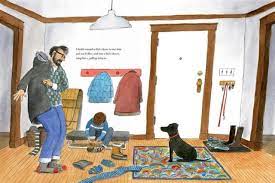
While many books about snow put young children at the center, this one focuses on a school-age child, as well as a father with the patience to enjoy the change along with him.  The child is old enough to articulate his feelings, and to understand that the bond between him and his father is an essential part of the wonder.  At the beginning of the day, the two prepare to go out together. At nighttime, his father carries him to bed, although the boy seems old enough that this ritual may no longer be a daily one.  Walking through the city, the boy’s visible breath in the cold is the counterpart to ice crystals in his father’s beard.

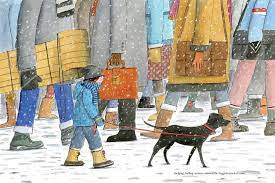
Snow in the city sometimes begins inside, when you first see it outside the window.  Illustrator Gary Clements (also a Toronto resident) balances all the perspectives from which snow appears. The beginning scene of father putting on coats and boots shows no snow at all, just the white door to their home ready to open.  We see snow from the eye level of the boy and his dog, with adult feet walking in boots, and snow viewed from the window of a bus, although some of the passengers are absorbed in their phones. 

There is snow while sledding down a hill in the park, and snow landing on a variety of storefronts.  There is an incredible bird’s eye view, or skyscraper window view, of cars moving through the storm, caught in slow motion.  Finally, there is a sleeping child under a blanket, dreaming of the blanket of snow which had enveloped his day.

My Winter City is a truly original take on the timeless, if transient, promise of snow.

Anne, Auburn, and Carrots

Anne’s School Days – Adapted by Kallie George, Pictures by Abigail Halpin
Tundra Books, 2021

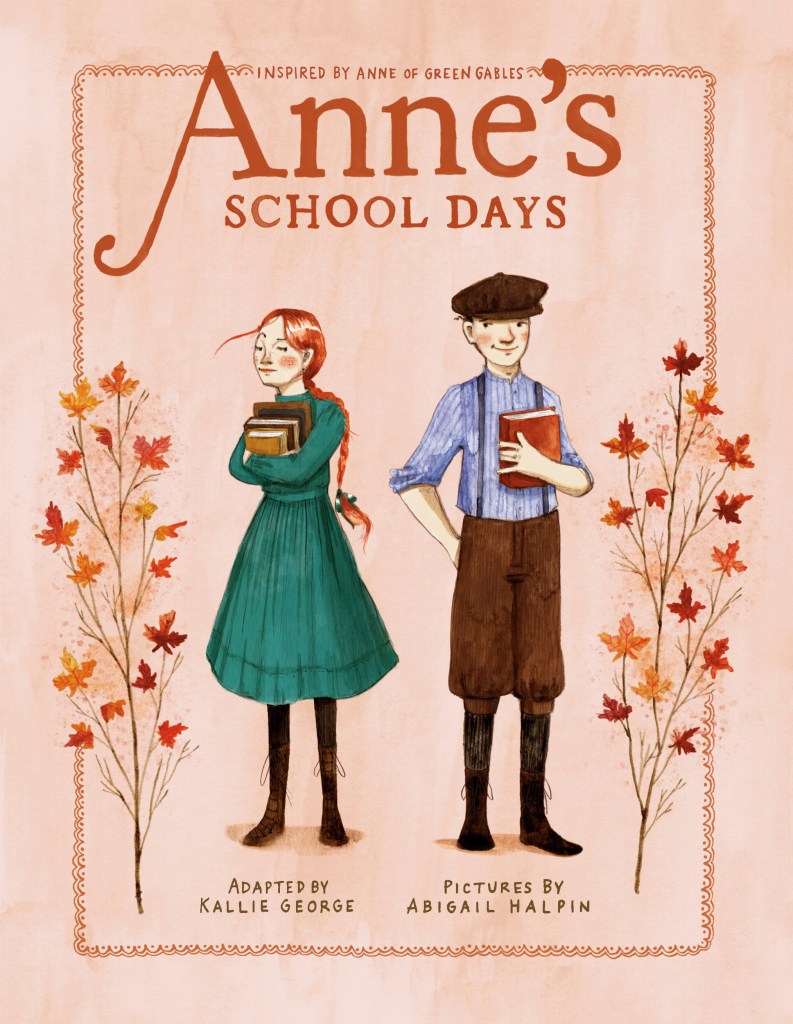
What reader of L.M. Montgomery’s Anne of Green Gables doesn’t remember the empowering moment when Anne smashes her school slate down on Gilbert Blythe’s head?  No, physical force should not be the response to teasing; we all want to be clear about that with our children and students.  But no harm comes to him, and generations of girls reading the book understood that mocking someone’s appearance, or anything else about her, merits an unmistakable response.  Once again, Kallie George and Abigail Halpin, in their illustrated chapter book series adapted from Anne’s original story (see earlier volumes here and here), have captured the impact of the classic without imitating it. (I’ve written about some of Halpin’s non-Anne work elsewhere.)

The book opens with Anne and her “bosom friend,” Diana Barry, off to school. It’s significant that George chooses when to preserve the antique language of the original, as in this phrase to define the intimate friendship between girls (also known as “kindred spirits.”).  The balance between writing in homage to L.M. Montgomery, and using language more suited to contemporary younger readers, is subtle.  Less subtle is Gilbert Blythe himself.  He has an advantage in Anne’s eyes. He’s good-looking, but “Anne didn’t care that he was handsome. But she was glad that he was smart.”  Anne is obviously discerning and confident.  But, cultural norms being what they were at the time, “Anne was very sensitive about her looks (especially her red hair).”

When Gilbert publicly humiliates Anne by yanking on her gorgeous red braid and whispering “Carrots,” she needs to defend herself. Halpin’s picture shows the perspective from the back of the classroom. Anne is facing the blackboard, seated next to Diana.  Gilbert’s obnoxious gesture reduces her to a visual joke, spoiling the symmetry of her appearance.  Yes, we all know that he will ultimately turn out to be the love of her life, but at this moment, he needs to learn a lesson, possibly a more valuable one than the rest of the curriculum in Mr. Phillips’s schoolroom.  Now the reader is at the front of the classroom, watching as an infuriated Anne stands up for herself, and for every girl who’s ever been the target of a socially inept boy.

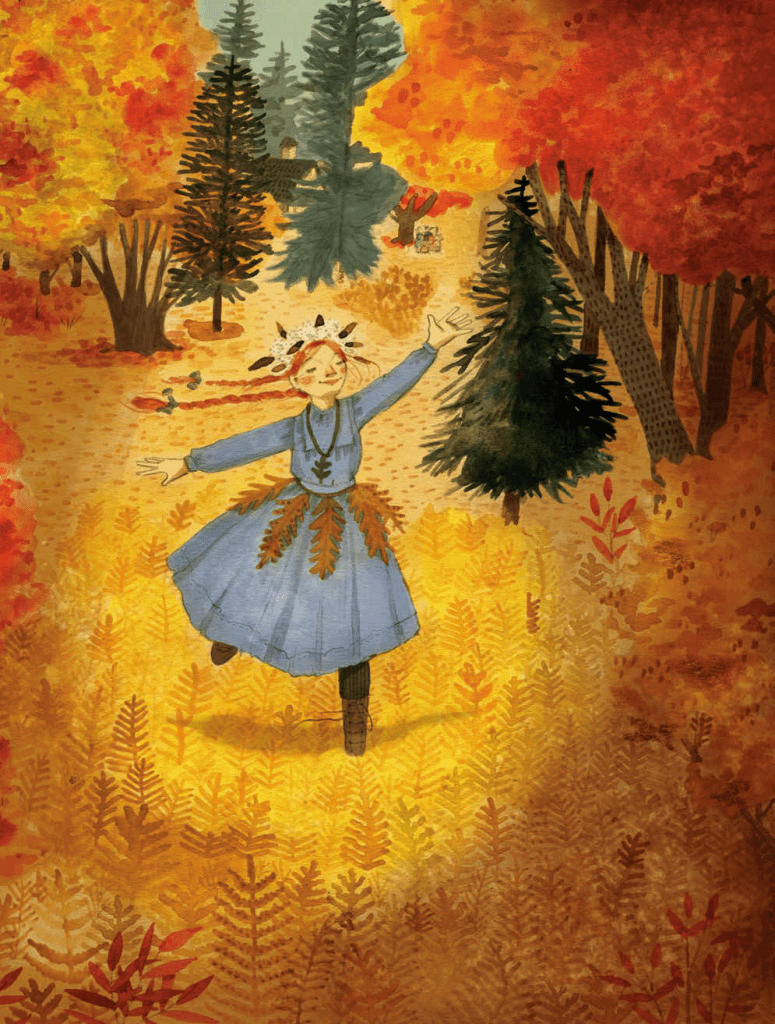
But don’t think that Anne’s days are consumed by anger. She has loving foster parents, Matthew and Marilla, even if Matthew is a bit more of the child empathizer than his sister.  Her friendship with Diana is also at the center of her life, and her unbridled imagination enriches everything. Halpin’s pictures are both realistic and stylized, offering, like the text, a distinct version of Anne and those around her. The red and gold foliage of Prince Edward Island becomes a theatrical setting for a poetry-reciting Anne, who becomes a self-created woodland creature with literary dreams. 

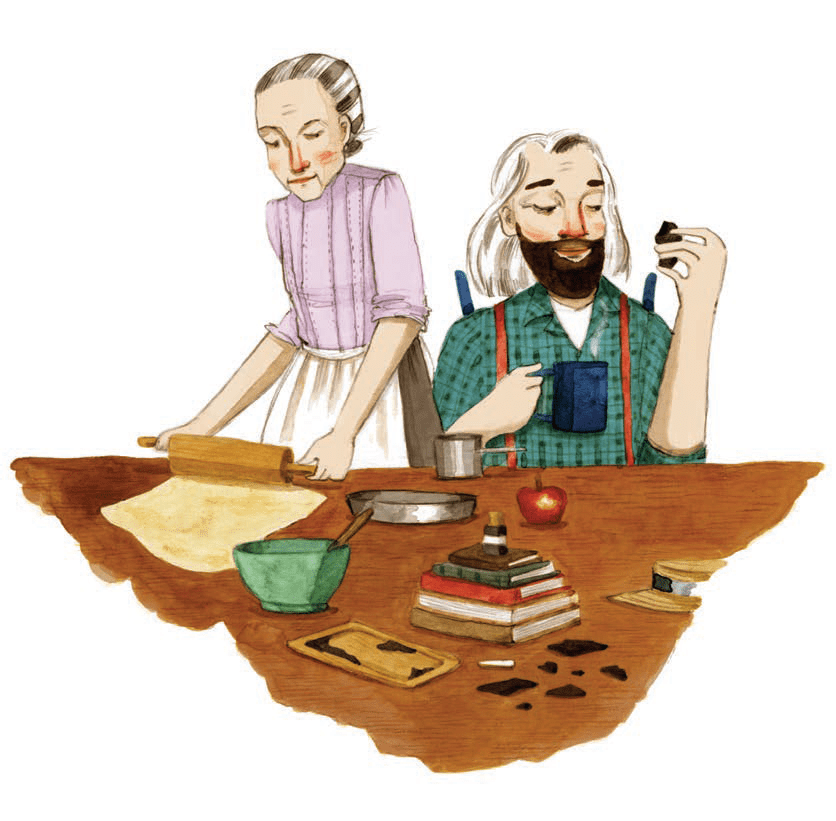
The contrasting personalities of Marilla and Matthew are another theme of Halpin’s images. Marilla needs to be involved in the productive of baking, while Matthew enjoys his tea, avoiding her direct gaze while they discuss Anne.  The pieces of Anne’s broken slate, evidence of her misdeed, sit on the table in front of them.

One of the features of Anne’s life is her orphanhood, which gradually ceases to define her in the original novel. In Anne’s School Days it is just as clear that Anne enjoys the closeness of a wonderful, if untraditional, family. Seated with her “parents,” and her beloved Diana, in a scene of domestic harmony, young readers will understand the meaning of what Anne has found.  Her hair may be red or auburn, but that’s not really important: “Maybe Anne had changed, just a little. But she’d always be Anne, with an e.”

Not Such a Sentimental Journey

War and Millie McGonigle – by Karen Cushman
Knopf Books for Young Readers, 2021

Millie McGonigle is a twelve-year-old girl living in San Diego, California in 1941.  She is dealing with many issues, including her family’s financial distress due to the Great Depression, her mother’s apparent favoritism for a younger sister, and the death of her beloved grandmother.  After the Japanese attack on Pearl Harbor and America’s entry into the war, an onslaught of changes challenges her further.  This novel is not particularly nostalgic about an era when unity against an external enemy gave many Americans a sense of purpose; Millie’s psychological state is dominated by grief and anger.  She carries a notebook with her everywhere, making notes and drawings in this “Book of Dead Things.”  Karen Cushman has created a character who is not initially easy to love: morbid, bitter, and self-centered, even for a pre-teen.  Because she is a wonderful writer, she allows readers to have a range of responses to her character, following Millie on her incomplete and not so sentimental journey towards change.

The McGonigle family is far from perfect.  Her father’s good-natured jokes sometimes veer into insensitivity.  Her mom, a frustrated poet submitting verse jingles to advertisers, seems momentarily jealous when Millie actually wins five dollars in a contest.  A middle-aged cousin, Edna, has come to live with them. She seems to have a mild psychiatric or neurological disability, but her insistence on using German phrases for no apparent reason as the war approaches was worse than irritating.  Millie describes Edna’s physical appearance, and particularly odors, in repulsive detail.  The sibling relationships in the novel are the most troubling.  While Millie is loving and tolerant towards her six-year-old brother, Pete, the middle child, Lily, is a source of outrage to her older sister. Lily suffers from an unspecific respiratory condition, making her vulnerable to frequent illnesses.  Cushman doesn’t merely imply that the attention this earns Lily makes Millie feel ambivalent towards her younger sister. Millie’s feelings are actively hostile.  (She is also a bookish child, and compares Lily to Colin in The Secret Garden: “Colin was a drip like Lily until he got healthy and nice.”

Cushman’s descriptions of the natural environment are beautiful and seamlessly related to Millie’s feelings about the world. Her seaside community is full of sailors about to be deployed, and expanding aircraft and shipping industries bring the impact of the war home.  Millie is introspective, and she also turns to different people in her life, from close to more superficial acquaintances. Eventually she finds some answers from their advice, and from observing how they cope with fear, disappointment, even grief.  War and Millie McGonigle is an unusual novel for middle-grade readers, with a main character who is aware of her sense of difference from those around her.  Cushman presents her with all her flaws, as well as her deep sensitivity as she finds a way to keep afloat for the duration.

Patricia Reilly Giff, 1935-2021

Lily’s Crossing – Patricia Reilly Giff
Delacorte Press, 1997

Patricia Reilly Giff, who died in June, left an unforgettable body of work for young readers.  Her funny and engaging series about the Polk Street School kids, her historical novels, many about Irish and Irish-American children, and a broad range of other works, are her legacy.  One of my favorite books by her, and, in fact, by any author of middle-grade fiction, remains Lily’s Crossing. This story of a motherless girl, Lily Mollahan, who befriends a Hungarian refugee boy, Albert Orban, takes place in Far Rockaway, New York, in 1944.  Lily, her father, and her grandmother live in St. Albans, Queens, but spend the summers in a seaside community where both year-round and summer residents make their homes.  Her best friend has moved to Detroit, and her father, an engineer, leaves to serve in the military.  Lily is devastated.  This beautiful, elegiac, look back at a specific time and place in American history is also a sensitive picture of childhood, relevant to anyone who has ever struggled with loss.

Life is hard during wartime.  Mrs. Sherman’s bakery has been affected by rationing, now selling mainly cookies which “would be hard by now, the juice drained out overnight.”  The local letter carrier is kept busy, but still has time to let Lily know when he has a letter from her father overseas.  Lily’s days are filled with swimming and rowing, practicing the piano, attending church, and feeling sad.  Giff captures both the nostalgia for an era when Americans were largely united in a feeling of sacrifice, but also lived with the daily anguish and anxiety of absent fathers, brothers, and husbands.  Many Americans, like Lily’s neighbors, the Orbans, had relatives in Europe whose fate was uncertain, or worse.  When Lily meets Albert, at first she projects her anger at him, finding his serious, almost adult, demeanor, to be irritating.  But gradually the two children form a bond based on their grief, as well as their need to be normal, rule-testing, kids.

Lily feels guilty because she sometimes tells lies. Imaginary accomplishments or famous distant relatives make her feel important, and creative untruths can sometimes keep her out of trouble. When she suggests an unrealistic plan to reunite with her father, Albert desperately tries to follow her lead.  Both Lily and Albert figure out that motives matter when people make mistakes, even nearly disastrous ones. They also learn that telling the truth is hard, but that they have built up a level of trust with one another where it is much better than the alternative.

Lily has a collection of paper stars which remind her of her mother. Each summer, she brings up with her from St. Albans to Far Rockaway. When she explains the practice to Albert, he understands:

“I bring one with me to Rockaway every year,” she said. “I counted. There are dozens of them left on my ceiling. I’ll be thirty or forty before they’re all used up,”…

She took a breath. It was nice to tell someone about the stars. It was so nice to talk about her mother as if she, Lily, were like everyone else, like everyone who had a mother…

Lily squinted a little, looking out at a curl of smoke from a freighter far away.”

Patricia Reilly Giff has so many books to share with children, but you might want to begin with this one. It will be so nice to tell someone about the stars.