Invisible Elf Leaves Tracks on the Table

The Blueberry Pie Elf – written by Jane Thayer, illustrated by Seymour Fleishman
Purple House Press, 2008 (reprint of original edition, 1959)

This is a review of an older book, the type that invites the description of “nostalgic,” as if that were a negative quality in children’s books.  Of course, there are plenty of older books, ranging from mediocre to offensive, which don’t need to be invited back into our libraries. This is not one of them.  Created by a prolific author Jane Thayer and the prolific illustrator Seymour Fleishman, it engages children in the story of a small and invisible creature who, because of his very nature, cannot communicate his needs to humans.  In the end, he gets his blueberry pie, after performing a number of domestic chores made difficult by his diminutive size.  He has good manners, even when frustrated.  Best of all, young readers accept the premise that he is real and that he only needs to devise the right method in order to be believed, even while he preserves his secrecy as an elf.

To put this terrific book in context, it used to be quite difficult to find, but was reprinted by Purple House Press, a small publisher in Kentucky dedicated to producing new editions of out-of-print books. Even the author’s and illustrator’s names are unfamiliar to you, a bit of research will reveal that they were incredibly prolific, if sadly less known today.  Thayer also wrote under the name of Catherine Woolley, and Fleishman, who illustrated over eighty books for children, does not even seem to have merited an obituary in the New York Times or Publishers Weekly when he died in 2012. 

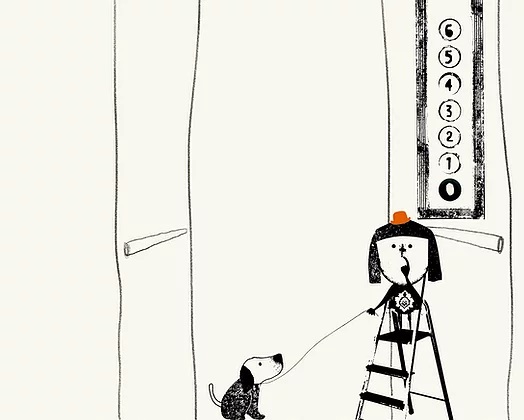
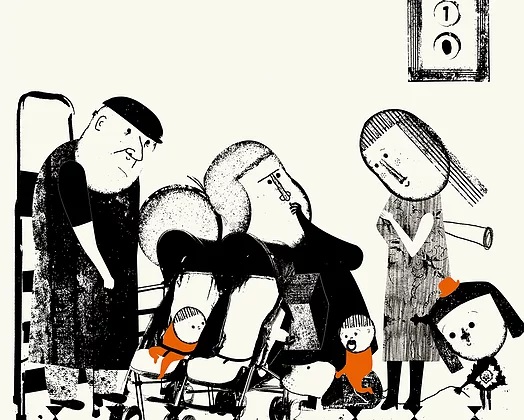
This is an illustrated book with a great deal of text relative to its pictures.  Reading this type of story expects a longer attention span than younger children might typically have, but try it! The story is exciting and the pictures combine relatively static images of the human family with ones of the persistent elf’s relentless activity.  When we first meet him, he is sitting on a girl’s shoulder while she reads a book. Right away, we are in a literate home, even though reading then disappears from the rest of the story, which emphasizes food and housework.  By establishing that the girl is a reader, the author and illustrator hint at a fairy tale world residing within a mid-twentieth century home.  Fleishman shows the elf’s size through scale in scenes where only a human hand holds a basket of blueberries or wields a rolling pin. Recollections of Mary Norton’s The Borrowers, illustrations by Beth and Joe Krush, surface in pictures of the elf sweeping the toy room, dwarfed by a toy car and only somewhat bigger in relation to a toy jack. 

Most of the illustrations are in black and white, with touches of purple giving prominence to the blueberries.  A well-stocked suburban refrigerator houses the elf prospecting for his favorite food; we also see him sleeping off his meal inside a teacup. Then the blueberry pies disappear and he gets a little desperate. Jumping up and down like Rumpelstiltskin accomplishes nothing; nor does tugging on the mother’s ear. No one can see him or hear him, nor, apparently, can they feel his touch.  He gets to work making himself useful. In one two-page spread he tugs on the quilt of a double bed with great fortitude; the family recognizes his work but remain baffled about the identity of their silent housekeeper.

Children’s fantasy has its own logic, and the book’s internal logic reflects this truth.  Apparently, invisible elves leave visible footprints once they have stepped in blueberry juice.  Also, cherry and apple pies are completely inadequate substitutes for the elf’s favorite. Finally, manners are important, even if you are invisible and have finally succeeded in revealing yourself as an important person and are rewarded with a blueberry pie.

Not So Reckless, But Pretty Glorious

Reckless, Glorious, Girlby Ellen Hagan
Bloomsbury Children’s Books, 2021

Beatrice Miller is unsure of herself.  She lives with her mother and her paternal grandmother in Kentucky and attends middle school. Her father died before she was born, and she has two supportive best friends.  Beatrice’s moments of rebellions and her ambivalence about moving from childhood to adolescence are hardly reckless, but they feel that way to her. Ellen Hagan’s novel in verse captures that exact sense of confusion and conviction so common to girls struggling to find their way forward without rejecting the past, although sometimes “it seems like distance/is something we need most.”

Mamaw is Beatrice’s tough and talented grandmother. She can bake or cook anything, and she tries to inculcate in Beatrice, her granddaughter and namesake, that pride and disregard to social conventions are keys to contentment.  Beatrice’s mother works long shifts as a nurse; she is often frustrated by her mother-in-law’s defiance and her indulgence for a young girl in need of guidance. Beatrice is caught in the middle of these two matriarchs.  She accurately sees herself as “The great copycat. Play it up/or down./Depending on who/I’m with, what’s expected of me.” 

The poems representing Beatrice’s consciousness are varied and beautiful. Some take the form of internal monologues, lists, or rational discussions with herself about what exactly she wants and needs. Others feature colorful and associative images, many involving food that is central both to her family’s routine and to Mamaw’s work in a bakery:

Olives & jalapeños, roasted tomatoes,
mushrooms & mozzarella, pineapple & pecorino,
fontina & feta, ham, salami & pepperoni, Parmesan,
paper-thin slices of onion, red peppers & oregano…

Mamaw does absolutely nothing halfway…

Beatrice struggles with her identity as a “hillbilly,” which she both flees and embraces, and compares herself to friends whose bodies seem more in line with the changes of puberty. She disdains the popular and rich girls, but also seeks their approval.  Girlhood and womanhood appear in many poetic images, from Beatrice’s sense of herself as skinny, pale, and unattractive, to her proudly ageing teacher, Ms. Harrison, who encourages the class to create metaphors about her advanced years:

Ms. Harrison is a fossil (she really howled at this one)
Ms. Harrison is a cool antique you find at a flea market
Ms. Harrison is a dusty old-fashioned book you find in
your attic.

The book’s poems begin as isolated sketches, but gradually build narrative momentum as compelling as prose.  Characters develop from initial sketches limited by Beatrice’s preliminary descriptions, to fully formed people who evolve through challenges.  Readers learn more about each one’s backstory, and eventually share Beatrice’s changing perceptions of those around her. Adults, friends, even enemies in school all have reasons for their behavior, even if not all escape the constraints of their environment to become someone new. Ultimately, that is Beatrice’s goal, to “See myself new/taking up space//being the girl/I was always/meant to be.” Hagan’s skills as a poet combine with her psychological insights into a young woman’s search for identity.  Reckless, Glorious, Girl uses specificities of time and place to ground bold statements about girls’ needs to claim their own lives.  It offers both plenty of questions and equal amounts of reassurance to young readers who are “Trying to pretend one moment/& trying to be real the next.”

Art: Something Humans Are Up To

Outside Art – written and illustrated by Madeline Kloepper
Tundra Books, 2020

It’s not exactly intuitive how we should explain art to young children.  There are some fine books on the subject, and the versatile Madeline Kloepper might be the perfect artist to take on this challenge in an original way.  In Outside Art, some curious but puzzled woodland animals try to solve the riddle of a seemingly useless process. Why would “Human,” a dedicated painter, sculptor, musician, and textile artist with a pre-Raphaelite halo of beautiful red hair, spend so much time doing something with no clear point?” (“No, today Human is putting colors on a board using a furry stick. Why?!”)

These animals are pretty smart, and they speculate about what this person, living in a “log nest in the woods,” is up to. She must be expecting a specific, practical, outcome from each of her projects.  A concerned Mouse assumes that Human must be storing up food for the winter, while Doe conjectures that she is actually leaving marks to help her keep track of where to find the food, although Pine Marten is skeptical of this explanation.  Just like actual human observers of art, each animal sees something of herself in the need to create.  Food, shelter, even playing, all seem plausible, depending upon who is observing the finished product. 

When Grouse complains that “THERE IS NO MEANING” to the works of art, the one domesticated animal, a large fluffy cat, offers an academic monologue on the subject. At this point, adult readers will laugh, and kids will realize that using big words doesn’t mean you are right. One of the most striking qualities of Kloepper as an artist is her versatility.  Although this book, as well as her wonderful earlier The Not-So Great Outdoors, focuses on the beauty of nature, she is just as adept at portraying the great indoors, both domestic interiors and people. 

There is nothing abstract about the artist’s joyful and serious vocation.  She lives in an identifiably real home. She wears overalls. She stops work to look fixedly at what she has painted so far.  Traditional crafts are as meaningful to her as the fine arts. She plays the guitar and spins her potter’s wheel while barefoot, and her sewing table is a lovely mess of straight pins, tape measure, and scissors, as well as a sewing machine.  The look on her face as she feeds the quilt through the presser foot and needle shows the rewards of being a creator immersed in a task.

Not only will kids learn that the true purpose of art is self-expression, intrinsically different for each artist, but they will also learn about learning itself. Each animal offers a plausible hypothesis, argues with his friends, and considers other possibilities and consequences to their conversation (“I’ll dig a den to show the poor Artist how to make a better shelter.”) Ultimately, they reach a consensus: “I think all of us were right about what Art can be…and every one of us is a great artist.” Human looks away from her easel to watch them outside in the snow, perhaps unaware that they have the system all figured out.    

Libraries are a Refuge and They Will Be Again

Lost in the Library: A Story of Patience &Fortitude – written by Josh Funk, illustrated by Stevie Lewis
Henry Holt and Company, 2018

Where Is Our Library?: A Story of Patience & Fortitude – written by Josh Funk, illustrated by Stevie Lewis
Henry Holt and Company, 2020

If you’re not already familiar with Patience and Fortitude, they are the two stone lions who guard the main branch of the New York Public Library, located at 42nd Street and Fifth Avenue, in Manhattan.  They were given their inspiring names by Mayor Fiorello LaGuardia during the Great Depression, when New Yorkers needed the boost provided by a great temple of public learning.  They are also characters who come to live in Josh Funk and Stevie Lewis’s two picture books dedicated to the wonders of the New York Library System, and specifically, to its children’s reading rooms.  The sleek and brave animals seem to move, animation-style, from picture to picture, where bold outlines, earth-tones, and selected brighter colors all advertise the beauty and friendliness of Patience and Fortitude’s home.

In Lost in the Library, Fortitude wakes up one morning to find Patience missing from his plinth.  Fortitude determines to find his friend, a task which involves search all the byzantine byways of the library, and asking for help from real-life landmarks, including portraits of early benefactors, a lion-head water fountain, and the lovely statue of Frolicsome Girl from 1873.

Fortitude also reminisces, and we get the backstory of his early meeting with Patience, who evolved from a silent statue to a loquacious companion, whose stories often alluded to the wonderful world of children’s books: “Patience told stories of ducklings and moons,/of wardrobes and buttons and fun.” When, to readers’ relief, they reunite in the children’s room, Patience is engrossed in several classics that are pictured together as a trio of Caps for Sale, Sylvester and the Magic Pebble, and Amelia Bedelia. If the child with whom you are sharing the book isn’t familiar with those stories yet, don’t worry.  Part of the purpose of this picture book is so promote the love of reading. An afterword includes information about the NYPL, but you can supply your own tribute to books and the wonderful institutions which make them available.

Before the pandemic struck, the NYPL had planned to open a new children’s center; this project has been completed, but is not yet open to the public because of the pandemic. In Where Is Our Library, Patience and Fortitude return; this time they are both anxious at the apparent loss of their favorite reading room.  When they enter the beloved space, which is now a hollow shell with furniture, but no books, Patience seems panicked but Fortitude has a plan.

Their nighttime journey through the city takes them from Times Square to Central Park, and involves encouraging conversations with some other statues as devoted as they are to literacy.  Again, if children have never met the Hans Christian Andersen or Alice in Wonderland statues which are New York landmarks, the book offers opportunities to explain their significance.  Similarly, the many wonderful works which appear in their children’s room search are listed in an afterword, and they represent a terrific opportunity to interest children in the content within their covers. There is even a fabulous Chinese dragon on the ceiling in Chinatown’s Chatham Square Library!

Of course, when they do find the exciting new children’s center, it’s clear that the picture was composed pre-pandemic when New York’s streets, and those of so many other communities, were full of activity. Here is one more, hopeful, conversation to have with your children. But even inside, we still have books. To help children have further access, please consider helping some wonderful resources to provide them with reading material, such as Reach Out and Read or First Book.

Charles Lindbergh, False and Corrupt Icon, Part II

This post is a follow-up to my earlier analysis of Candace Fleming’s The Rise and Fall of Charles Lindbergh. The book continues to receive accolades, and I continue to be profoundly disturbed by the way in which media coverage of this award front runner avoids the core of Lindbergh’s life and legacy.  As I wrote earlier, I understand that coverage of a book is not the same as the book itself. I do have issues with the book itself, a young adult biography of one of the most notorious antisemites in modern American history. I am also beginning to find it more difficult to artificially separate those reservations from the way in which both Fleming’s publicity and critics of children’s books are presenting her work.

Early in December, School Library Journal published their “Best Books” list for 2020. (There are several categories on the list: picture books, chapter books, middle-grade books, young adult books, nonfiction, graphic novels. There are 112 books listed; one of the graphic novels features Jewish themes, although this fact is not noted in the description.) Although there are no books about Jewish history, the Lindbergh book is, predictably, recommended. The brief description reflects the same refusal to confront Lindbergh’s disgraceful legacy that I noted earlier.  It is a “balanced biographical account,” of a man who led a “complicated life,” and had a “rather unusual childhood.”  It would be difficult to argue that his life and his childhood were notably more complicated or unusual than those of many other Americans.  Then we learn that he used “pro-Nazi and anti-immigrant rhetoric.” The bizarre exclusion of antisemitism is obvious. Lindbergh hated many people, but Jews were definitely at the top of the list.  He also engaged in actions in support of Nazi Germany and immigration restriction which went well beyond “rhetoric.” This characterization of the Lindbergh’s life is grossly misleading.

Today I read the nominations for the American Library Association’s YALSA (Young Adult Library Services Association) Nonfiction Award and, yes, the Lindbergh book is there again.

Lindbergh, according to the award committee, is a “deeply flawed hero.” Apparently, qualifying “hero” with “deeply flawed” is enough to justify the use of that term.  I can only repeat the thought exercise of imagining a contemporary book about such non-heroic Americans as Robert E. Lee, Jefferson Davis, Strom Thurmond, David Duke, and George Wallace which awarded them the title of “hero,” flawed or not.  The YALSA description is one of the most disturbing which I have read.  The hierarchy of attributes and events in Lindbergh’s life evokes sympathy for an odious antisemite and virtual traitor: “Celebrated aviator, dogged scientist, heartbroken father, Nazi sympathizer, unapologetic eugenicist…”  Well, he was a celebrated aviator. No one can dispute that.  He was not a scientist, “dogged” or otherwise. Lindbergh practiced only pseudoscience, a series of disgusting experiments without any value in order to “prove” the superiority of the Nordic “race.”  Again, there is no mention here of the baseless hatred of the Jewish people who were already the target of vicious attacks in Germany, and would soon be almost completely exterminated in Europe.

I understand that Fleming’s book is poised to possible receive some prestigious awards.  In spite of the useful and important information which it does contain, I find the uncritical reception of the book, and the obtuse attitude towards its subject, to be indicative of a refusal to engage with antisemitism. Perhaps if School Library Journal had included even one work of fiction or history about the people so hated by “Lucky Lindy,” the critics’ praise of this biography would be slightly less painful and less significant.

A Body in the Library at an Inconvenient Season

Aggie Morton Mystery Queen: Peril at Owl Park – written by Marthe Jocelyn, with illustrations by Isabelle Follath
Tundra Books, 2020

Aggie Morton is bright if somewhat unconventional girl living with her mother and grandmother on the coast of England during the Edwardian era. Readers of the first book in Marthe Jocelyn’s series, Aggie Morton Mystery Queen: The Body Under the Piano, will already be familiar with her preternatural talent for sleuthing and uncovering uncomfortable truths.  If you have not yet read the earlier mystery, this second entry in the series stands alone as a wonderful tribute to Agatha Christie, imagined here as a fictional version of what the great detective novelist might have been like as a child.  There is an outrageously entertaining cast of characters, a complex series of mysterious events, and a somewhat compromised Christmas setting in which finding a body takes the place of pulling gifts out of stockings. 

This holiday season will be different for Aggie.  Instead of staying home with her recently widowed mother, she will travel to visit her sister, Marjorie, at Owl Park, the country estate where the newly married Marjorie and her husband James are lady and lord of the manor.  As with the first book in the series, Isabelle Follath supplies a visual introduction to various people, good, bad, and in-between, before the text begins.  Follath’s small illustrations above the title of each chapter are an essential part of the Aggie’s story, wonderful period drawings which enhance the plot’s unfolding.  The decorative signature on a calling card placed on a tray calls attention to “A Disquieting Scene,” while a small writing desk on spindly legs stands above “A Worrisome Absence.” 

Jocelyn’s inventive approach involves recreating the mystery novels of an earlier time with authenticity and humor, not parody.  When Marjorie sharply reminds her younger sister of her good fortune with the admonition, “Count yourself lucky that James’ mother has agreed that you may be at table with the adults this evening and not up in the nursery eating buns and hot milk,” we are transported to a distant past. At the same time, Agatha’s frustration at the limits of childhood and the irrational social roles imposed by adults seem perfectly up-to-date. Readers will cheer for Agatha and her persistence at violating rules, but also appreciate her love for family, and for her special companion, aspiring detective Hector Perot. As in the first book of the series, the Belgian Hector’s endearing personality and astute but modest crime-solving abilities, (“A logical breakthrough!…But he should remain on the list until we can dismiss him logically.”) play a big role.

Young readers will not require experience with mysteries to enjoy this one, but even those who are fans of the genre will have a lot of fun unraveling this one.  Even as the story draws to a close, there are frequent surprises.  For those who pick up the book for its historical setting, or just to meet unforgettable characters, the plot may even be less important than watching Grannie Jane impose her ironic eye on the surrounding chaos, or wondering whom Anabelle Day will charm next with her acting skills.  There’s even a boundary-challenging journalist whose frequent updates appear as newspaper pages interspersed among the chapters, courtesy of Follath’s drawing skills.  As the label on Jeever’s Lavender Pocket Salts located by Aggie cautions, “Refuse Worthless Imitations” of this inventive book.

Mice Menorah

The Hanukkah Mice – written by Steven Kroll, illustrated by Michelle Shapiro
Marshall Cavendish Children, 2008 (Two Lions, Amazon Publishing)

There are too many children’s books featuring mice to mention in one post.  Within that category are quite a few in which mice inhabit their own parallel universe adjacent to a human one. Eventually, the two species interact. Some of these books feature dollhouses, perhaps most famously in Beatrix Potter’s The Tale of Two Bad Mice. This week Hanukkah begins, so it’s a good time to revisit one example of this popular theme, Hanukkah Mice, by the late Steven Kroll, illustrated by Michelle Shapiro. I like the playful pictures, the understated tone, (“I wonder where that tablecloth came from,” said Mama.”), and the nostalgic sense of a mid-twentieth century American Jewish celebration of the Festival of Lights.

The human family in this book is named Silman, a choice that definitely evokes a kind of identifiable Ashkenazic (Jews originally from Central and Eastern Europe) world.  If you analyze the name, maybe it could be a combination of “still” and “sill”. They certainly are quiet and calm, but removing the letter “t” in the more common last name suggests the part of a window that will feature in the story.  Their daughter, Rachel, receives a beautiful doll house on the first night of Hanukkah, represented by a chanukiya (Hanukkah menorah) with one candle and the shammes (helper candle) lit. The house is beautiful, but simple, not of the extremely expensive and elaborate variety.  Rachel is both excited and grateful to receive it.

At the same time, a mouse family living in their typical home of a mousehole aspire for more. They see the house and they are really delighted.  There is no suggestion here of arrogance or pride going before a fall; they just would like to live in this attractive new setting, and who could blame them? We see Rachel sleeping in her bed, the dollhouse on the floor close by, and the mouse family quietly approaching their new potential home.  The scale of the objects in the room captures the story in one image: a human child in her bed, a small nightstand, a dollhouse bigger than the nightstand but smaller than the bed, and a diminutive mouse family.

As the eight-day holiday progresses, Rachel receives an article of furniture each night for her new dollhouse.  Her parents’ choice to give her one “big” gift and then modest additions for it is nice in itself; today one might see it as a refreshing choice to avoid materialist excess, especially since gift-giving is not in itself the core of Hanukkah celebrations.  There is a lovely wing chair with footrest, a comfy couch where Mindy Mouse bounces, but not enough to get hurt, and, the best part, small plates with miniature latkes (potato pancakes).  Rachel observes the family setting up their new furniture, a proportionally huge face peering through the window of their house. On the eight night, Rachel receives a miniature dollhouse menorah; this is as good as it gets for the mouse family! In a cutaway scene of the dollhouse, each room appears still and quiet, with only a few pieces of unoccupied furniture, while the mouse family celebrates the holiday with a feast on their new dining set. 

Papa Mouse recites the Hanukkah candle blessing, (not printed here), on their small electric menorah.  This small detail raises both a minor an and a bigger issue.  Electric menorahs are a modern convenience, not meant to replace one using candles or oil.  One of the mitzvot (commandments) of Hanukkah is to publicize observance of the festival by placing the chanukiya/menorah in a place which is visible to all.  While many families do place their chanukiya in the window, the obvious issue of safety has made the electric lamp, used as a symbol only, a substitute.  One would not recite blessings over the electric bulbs. If this error bothers you, you might just explain the discrepancy when reading to children.  Or, you could assume that the characters are mice, so there is not an expectation of the same realism as humans would evoke.  It also reminds me that, if this choice is indeed a mistake based on lack of knowledge, any author or illustrator might be vulnerable to making one. None of us is perfectly informed about our own heritage, any more than an “outsider” writing about a different group.  I prefer to think of the electric menorah blessing in The Hanukkah Mice as a charming quirk of apparently Jewish mice joyfully celebrating the holiday in their new home.  Chag Chanukah Sameach/Happy Hanukkah.

A Girl in Her World

Little Big Girl – written and illustrated by Claire Keane
Dial Books for Young Readers, 2016

There are many books about a family welcoming a new baby and the effect of this wonderful event on an older sibling. Some of these books are bland and didactic, although even those serve a purpose. Claire Keane’s Little Big Girl is not in this category.  It is a witty and realistic description of the transition in one little girl’s life from small to big, as she gradually exchanges one role for another.  Keane’s inimitable style of portraying people, captures the perspective of a child on how own size and importance relative to both the contained world of her own family and of the outside urban environment.  Keane convinces young readers that becoming an older sister may seem to happen overnight, but that the arrival of a new baby is the beginning of a longer, and delightful, process.

When we meet Matisse, she is “a little girl in a big world,” lying peacefully on an almost empty vast beach.  The outdoor terrain emphasizes how small she is, while her busy apartment and her family car are much more easily controlled. Yet she still perceives herself as small in both environments. Keane depicts Matisse as secure in her self-image, whether putting on “little shoes,” or brushing her “little teeth,” or traveling through a southern California city beneath tall buildings and palm trees. 

A two-page spread shows her shopping for baby stuff with her pregnant mother, who has filled her cart with a double stroller, implying that Matisse is still a baby, but soon not to be the only one in her family. The story’s overwhelming display of baby essentials foreshadows the challenging nature of parenthood. Right before the new baby’s arrival, a sleepy Matisse rests on her bed, an image of the changes to come. She wears a toy stethoscope and holds a magic wand, as if both practical skills and fantasy will be part of her new status.  Opened next to her is a useful copy of a “Big Sister Book,” but it is likely that this volume doesn’t yet hold much meaning.

The book skips the almost inevitable sibling rivalry that even an enthusiastic older sibling experiences. Little Big Girl is as sunny as its location, focused on the incredible excitement of becoming someone new, an older sister.  Everything about her adorable new brother thrills her. When she leans over his cradle to kiss him while he sleeps, a ray of white light shines into the blue pastel background of the nursery like a Renaissance painting.  There is nothing cloying about this scene, because Keane’s approach is to deliberately present the positive aspect of change.  Matisse grows older in a parallel way with her brother, each of them making progress. 

Matisse’s “big job” entails reading to her brother from an extensive library, helping her tired and informally dressed father to change the baby while she herself is in the process of getting dressed, accompanying him to the same beach which had appeared in the beginning of the book. Now she views everyday activities, as well as the unlimited world of clouds and sand, with a completely different perspective. As in all her books, Keane’s characters express the velocity of childhood, their faces reflecting changes and their bodies moving gracefully from one moment to the next.  The bond between an older and younger sibling in the early years of life has probably never been painted with such elegance and affection as in Little Big Girl.

A Child on the Home Front

Love You, Soldier – written by Amy Hest, illustrated by Sonja Lamut
Candlewick Press, 2000, reprint of original 1991 edition

Amy Hest has contributed so many meaningful children’s books to the modern canon, including her most recent, The Summer We Found the Baby, in which Hest returns to the World War II home front setting of this earlier classic.  Not only the setting, but the central device of seeing the war through the eyes of a child, unite these books, which encourage young readers to understand both a specific historical era and the personal tribulations of one girl as inextricably tied together.  Hest is an expert at using simple and authentic language without ever patronizing children.  Love You, Soldier is a work of artful innocence. There are no extraneous elements, no anachronistic attempts to the characters more like contemporary individuals, no grand statements about the meaning of love and loss.  This is a wonderful and poignant story about a girl and her mother living in New York City during the war, waiting for a father who will never return.

Seven-year-old Katie Roberts lives in a New York City apartment building with her mother.  The building is a hive of activity, where neighbors share one another’s lives.  A widow named Mrs. Leitstein is a surrogate grandmother to Katie, the kind of older person who intuitively empathizes with her young friends.  Then Katie’s life abruptly changes: The war came and my father left in a uniform. It was olive green.”  Katie mentally arranges each physical item associated with her father: his notebook, his socks, his fountain pen. She draws a picture for him; “he wrapped that picture like he was wrapping diamonds. He slipped it in his duffel and zipped the fat brown zipper.” Each detail of object and emotion which Katie records becomes a tangible way for her to keep her father alive and with her.

The book is full of New York references, presented in the matter-of-fact way that only a child who had always lived there would use.  In the taxi to Pennsylvania Station, her parents hold hands “all the way from 109th Street to 33rd.” The menu at the Automat, where diners put coins in a slot and retrieve their food from a glass door, includes “egg salad on rye. A glass of milk. And, of course, lemon meringue pie.” Katie’s mother and her friend, Louise, reminisce about the time when they skipped school, sneaking off to a concert at Radio City Music Hall, where they watched a performance by “a singer with blue eyes.”  Readers familiar with New York may or may not remember some of these settings and recognize the allusions, but even if they don’t, they will recognize the sense of attachment of a child to her home.

 When Louise, pregnant with her first child, needs support while her own husband is in the service, she comes to stay with Katie and her mother, forming the kind of supportive ad-hoc family which war sometimes imposes.  The Jewish holiday of Passover is different this year. Instead of mother, father, and daughter, Katie celebrates with her mother, Louise, Louise’s brother Sam Gold, who is a solider on leave, and Mrs. Leitstein.   This new formation doesn’t negate old traditions, the “silver candlesticks…last minute trips to the butcher…small glasses with wine for the grownups and grape juice for me.”  The appearance of Sam subtly foreshadows the way in which temporary arrangements may become lasting when distant events dictate the structures of personal lives.

The novel has new life as well as loss. When Louise goes into labor during a massive blizzard, it is Katie who takes on the adult role of getting her to the hospital. With no taxis available, Katie is surprised and confused to find her own sense of resolve giving her the strength to take charge: “’We will walk.’ I said it in a strange, strong voice.’” When Louise is reluctant, Katie reasons with her, “You cannot have the baby out here in a blizzard, Louise.” There’s no arguing with that logic, even though it would be expected from an adult, not a little girl.  Katie, like the rest of the country, has to adapt.  But when a telegram arrives with “a stranger in a uniform and black leggings,” Katie and her mother know that life has they had known it is over.

Grief has different contexts.  So many families lost fathers, sons, and brothers during the war that the aura of collective dignity might seem to mitigate some of their pain. Of course, it didn’t. Katie is heartbroken, and resentful when, after the war, Sam Gold persistently writes to Katie’s mother, renewing their friendship and hoping for a lasting relationship.  When Katie confesses to Mrs. Leitstein that “I have a problem,” the older woman advice about coping with loss and giving the future a chance is far from a panacea.  Still, she gently articulates her philosophy to Katie, that “Love is risky…but you know something…It’s worth it,” as the unobtrusive core of Love You, Soldier.

(Hest continued Katie’s story in two sequels, The Private Notebook of Katie Roberts, Age 11, and The Great Green Notebook of Katie Roberts, Who Just Turned 12 on Monday, which I will cover in a future post.)

Portrait of Audrey as a Young Girl

Little Audrey’s Daydream: The Life of Audrey Hepburn – written by Sean Hepburn Ferrer and Karin Hepburn Ferrer, illustrated by Dominique Corbasson and François Avril.
Princeton Architectural Press, 2020.

Kirkus Reviews deemed this lovely picture book bio of actress and humanitarian Audrey Hepburn (1929-1993) as appropriate for “Audrey Hepburn completists.” Since I am one of those readers, I can only welcome this book (see my reviews here and here).

Written by Hepburn’s son and daughter-in-law, and illustrated by two wonderful French artists, Little Audrey’s Daydream is as unusual as the all-black outfit and white socks worn by Hepburn in Stanley Donen’s movie, Funny Face. The central premise of the book is that the young Audrey as narrator is looking forward into the future, dreaming of a life based on her love of performance, her yearning to have a family, and her desire to help humanity.  Dominique Corbasson (who passed away shortly after completing the pictures) and her husband, François Avril, have not attempted to duplicate in color pastels childhood photos of the real Audrey, but rather to create wholly original visions of a young girl’s visions.  Of course, these visions turn out to correspond to the accomplished and compassionate life of the adult Hepburn.

When I started to read this book, I was reminded of David Copperfield’s famous opening lines: “Whether I shall turn out to be the hero of my own life, or whether that station will be held by anyone else, these pages must show.”  In Audrey’s case, she remembers her mother saving her life during a bout with whooping cough. From there, there are both joys and obstacles in her journey.  Her idyllic childhood in Holland, captured in a picture of her ice skating past a Don Quixote-like windmill. Then an odious dictator, identified in the language of a child as “a horrible little man with a tiny mustache who screamed all the time,” invaded, and everything changed. To convey the scenes of occupation, Corbasson and Avril punctuate black and grey images of goose-stepping soldiers with the bright red of Audrey’s coat and hat, but also the threatening red of bombs exploding over her city.

Audrey’s home is a refuge, where she dreams of returning to her former life and of becoming a ballerina. Then her dreams become quite specific, each one predicting one of her performing triumphs. Instead of naming the as-yet unreal productions in which she will star, Audrey imagines interpreting “a princess who escapes from her castle, a poor flower girl who becomes a lady…a fashion model, and a regular country girl who moves to a big city and becomes quite a stylish dresser.” (That last reference is the most imaginative description of Holly Golightly which I have ever read!)

Corbasson and Avril’s drawings are so vibrant that you can image them selecting the color pastels from a box as they deliver Audrey as Eliza Doolittle, Audrey as the bookish bookstore clerk in Funny Face, and Audrey as Holly Golightly accompanying herself on the guitar as she sings “Moon River” on a New York City fire escape.  But there are many other fulfilling aspects of Hepburn’s life. The young Audrey imagines motherhood as “taking my boys to school and shopping for books and socks,” as she pushes a baby carriage, followed by a whimsical line of her dolls and stuffed animals come-to-life.”  Yet she never erases the memory of war, and promises herself that she will bring consolation and aid to children unfortunate enough to experience the same cruel reality, because “I know what it’s like to be hungry.”

Little Audrey’s Daydream uses a different approach to presenting an icon to young readers.  Just like them, she was once a child enclosed in a harsh reality. In her case, the dreams of escape and achievement became a reality.