One Child, One Cat, One Bath

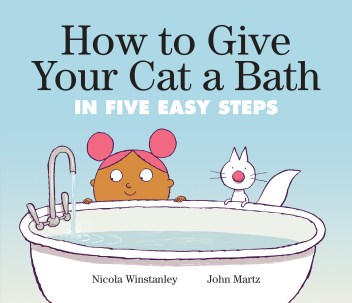
How to Give Your Cat a Bath in Five Easy Steps – Nicola Winstanley and John Martz, Tundra Books, 2019
how to give your cat a bath 0 (cover)

Very young children like routines, as long as they can control them. However, it something upsets a familiar process, such as a cat who refuses to take a bath, the results may be frustrating.  Yet they also adapt, as Nicola Winstanley and John Martz chronicle in their sweetly empathic collaboration, How to Give Your Cat a Bath in Five Easy Steps. A persistent little girl is determined to bathe her cat, appropriately named Mr. Flea. She has it all planned out.  When her five easy steps don’t produce the desired result, she needs to reevaluate without giving up on her goal.  Children reading this book will probably laugh both at her and with her, because kids can do that. Adults will enjoy the poetry of the simple language and the visual rendering of child-produced chaos.
how to give your cat a bath 1

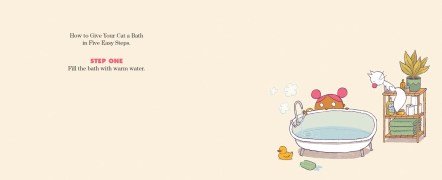
No one has any reason to suspect potential problems on the first page: “STEP ONE: Fill the bathtub with warm water.” A little girl with a round brown face and equally round red pigtails peers over the edge of the tub while turning the faucet.  Her cat, whose red ball of a nose matches the girl’s hair, looks down from a shelf with no sign of anxiety.  By the second page, things start to go awry.  The tub overflows and the girl starts over, this time with “a little warm water.” Winstanley’s words reflect a child’s mindset, as the girl adjust her expectations in a way that adults would not. Maybe the water should reach the cat’s knees. Maybe the problem is lack of energy, requiring cookies and milk.

how to give your cat a bath 2

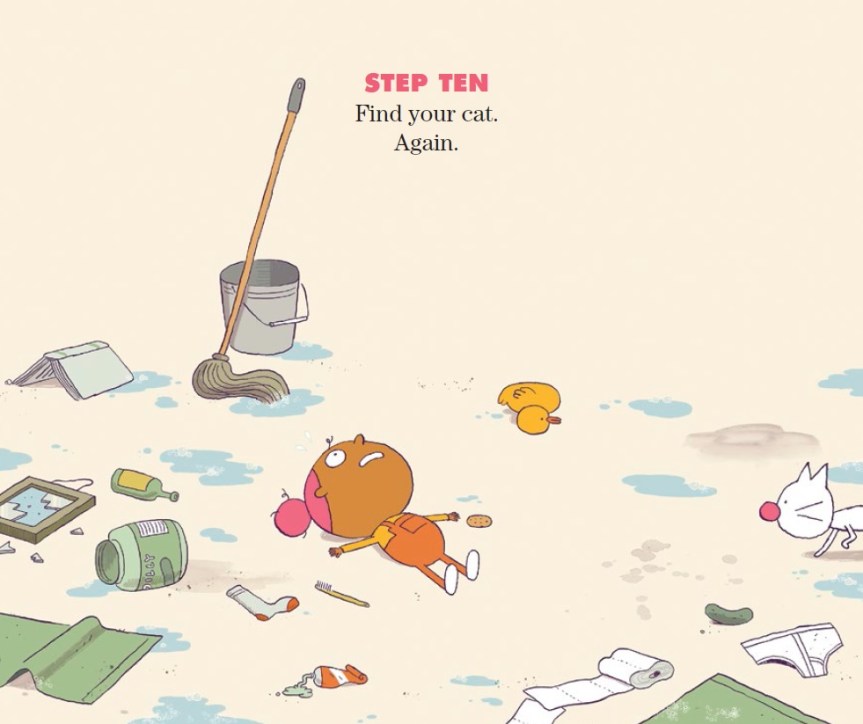
In each of Martz’s pictures, the girl changes expression, from confidence to concern, and finally to anger, as she is forced to admit that cats have a different idea of a bath from humans.  The small objects on each page help to tell the story and even to build a backstory.  When she starts over after two failed steps, the girl stands on a stool to reach into the refrigerator. A broken egg and open jar of pickles litter the kitchen floor.  The cat, perched atop the refrigerator, looks down at the process.  Meanwhile, the refrigerator door is decorated with twin images of cat and girl, emphasizing their friendship, and even their equality.  They are each invested in their own ideas about taking a bath.  Step Ten is an image of defeat, the girl flat on her back, and the mop and pail in the background useless in cleaning up from her struggle with the cat.
how to give your cat a bath 3

The final two-page spread shows that the girl’s enterprise of bathing her cat was doomed from the start, as she has learned reluctantly to “Sit quietly while your cat licks himself clean.”  If fact, the most interesting part of this story is the lack of a tidy resolution. There is no embrace of cat and girl, and her plucky persistence just doesn’t work.  Toilet paper, an apple core, banana peel, and fish skeleton, as well as the more elevated accessories of books, a newspaper, and a cute stuffed koala, attest to the truth that, sometimes, you just have to admit your mistake.  Children know this, and will find the book both funny and comforting. Adults certainly know that multi-step attempts to accomplish a goal often end up with the equivalent of banana peels on the floor.  Everyone will appreciate this delightful book.

The Good Life, with Cats

Miss Mink: Life Lessons for a Cat Countess – Janet Hill, Tundra Books, 2019

missmink cover

Already experienced at enlisting pets to guide readers towards a better life, Janet Hill, author and illustrator of Miss Moon: Wise Words from a Dog Governess, is back, this time with felines. In a series of twenty terse lessons, Miss Mink, a successful entrepreneur with her own cruise company, found that she needed the example of her own cats to step back and enjoy life.  Whether brushing her hair in front of an elaborate vanity, exercising in a flapper dress, or sipping tea while listening to an art deco radio, Miss Mink offers advice to young and old readers on complementary levels.  Adults who need a reminder of what matters and kids who see the appeal of cats dressed in human clothes can enjoy Miss Mink together.

Hill’s jazz age settings and gauzy colors are the setting for her brief and clear messages.  “Show kindness, even to your enemies,” features Miss Mink seated at a sidewalk café, where a large white poodle on its hind legs eats from her table without disturbing the cats sipping milk through a straw or eating pastries from her delicate hand.

miss mink lion desk

Another lesson encourages readers to nap, and what better way to be assured of a good rest than by wearing an eye mask, even if you are a lion?  Large cats and small are shown deep in slumber in Miss Mink’s office, while she puts her feet up on her stately desk and shuts out the world.

Her ship itself, christened “The Cat’s Meow,” highlights her cat friends on deck watching a giant octopus, along with the message to “Let your curiosity lead you to exciting new places,” an idea which Miss Mink endorses with her parasol in one hand and her spyglass in the other.

miss mink octopus

So what makes this a book for children?  Admittedly, the clever references to nineteen twenties style seem more aimed at adults. Miss Mink visits the Mona Lisa to understand a sense of mystery, and poses on a steamer trunk in front of a closet full of shoes as an example of “daily exercise.”   Yet in each picture, the cats are doing something antic and silly, whether hiding in a cookie jar, swinging from a chandelier, or dancing to Miss Mink’s accompaniment on the accordion. The final two-page spread of Miss Mink and her cats waving “Bon Voyage” from their ship is followed by a complete cast of characters, including Butterscotch Ripple, Mean Marcia, Sargent Smooshface, and Snowshoe.  Don’t underestimate your child’s sense of humor, or her interest in pictures that place the familiar figures of cats in unfamiliar settings. And who doesn’t need a lovely reminder to “Express yourself in creative ways, or to “Chase your dreams,” even with a cat on your shoulder?

Jasmine Toguchi: “What Was A Talent Anyway?”

Jasmine Toguchi, Drummer Girl – Debbi Michiko Florence and Elizabet Vuković, Farrar Straus Giroux, 2018

drummercover

If you have read the other books in the Jasmine Toguchi series (which I have reviewed here and here and here), then you know that Jasmine is a generally confident and capable third grader. She has supportive parents, an affectionate, if controlling, older sister, and Mrs. Reese, a lovely older neighbor who provides her with space to unwind and contemplate the problems that inevitably arise in even so anchored a young life. When her teacher, Ms. Sánchez, announces a school-wide talent show, Jasmine is forced to confront some big questions.  Most of her talents, including making collages and climbing trees, don’t lend themselves to performance.  Even worse, a new classmate, Maggie Milsap, is so supremely convinced of skills as a violinist, and of her general superiority to everyone around her, that Jasmine Toguchi briefly confronts despair.  But that is not the Jasmine we know.  After admitting that she is at a loss, Jasmine is ready to move forward: “I needed to figure it out, and fast!”

Jasmine’s mother is not perfect, but she is wonderful.  Not only is she a great role model as a successful editor, but she listens to her children and empathizes with their dilemmas with impressive consistency, considering that she is constantly multitasking in a way which young readers may not appreciate but parents enjoying the books with them certainly will.  She is able to elicit her daughter’s real feelings about the talent show, and also comes up with a brilliant and yet totally feasible plan, involving getting her college friend Kat to teach her to play the traditional Japanese taiko drums.  In fact, Kat doesn’t only teach her friend’s daughter some routinized movements so that she can parrot them in front of her friends and their parents, but, acting as a kind of surrogate mother, she imbues in Jasmine both respect for tradition and an overwhelming feeling of physical confidence and joy.  And she does this without minimizing the hard part: there are rules.

There are many small details, which set Jasmine Toguchi apart from some of her counterparts in series fiction chapter books.  Two funny and touching allusions to other works of literature pop up in Jasmine Toguchi, Drummer Girl, one intentional, and one, maybe not. Jasmine’s favorite book is E.B. White’s Charlotte’s Web. She compares her friendship with Linnie Green to the bond between Charlotte the spider and Wilbur the pig, an indirect analogy since Charlotte is dedicated to saving the life of an animal meant to be turned into food from the day of his birth.  Linnie, on the other hand, is loyal and compassionate. Through her consistent sensitivity and support, she will save her friend from self-doubt and anxiety about the talent show.  Children don’t necessarily read books or relate to characters exactly the same way that adults do; Jasmine’s association of her favorite book and her beloved friend make that point.

drummerinside.jpg

Of course, the range of readers’ responses is not limited to the spectrum of age.  When I read the scene where Jasmine and her classmates lunch together in the school cafeteria, I immediately thought of another children’s book where differences in lunch box contents reflect the characters’ unique qualities.  Jasmine opens her unicorn lunchbox and enumerates its contents, and also relates the exchange of items with her friends: “She handed me her yogurt and I gave her my banana.”  To me, this scene echoed Russell and Lillian Hoban’s Bread and Jam for Frances. (If you have forgotten about the strong-willed little female badger, go back to that wonderful series of picture books and easy readers.) Caught in a picky eating cycle that seems it will never end, Frances reluctantly admires her friend Albert’s elegantly simply fare:

“I have a cream cheese-cucumber-and-tomato sandwich on rye bread…And a pickle to go with it…And a hard-boiled egg and a little cardboard shaker of salt to go with that. And a thermos  bottle of milk. And a bunch of grapes and a tangerine.  And a cup custard and spoon to eat it with.”

Jasmine is not a picky eater and Michiko Florence is not imitating Hoban’s work.  But the significance of what children eat, centered on both their own choices and those of their parents, turns up with a new twist. Jasmine is Japanese-American and her stories all integrate the intertwining richness of her family heritage and her American life:

“I used to bring sandwiches every day, but when my grandma visited from Japan, she made omusubi.  I loved eating the rice balls wrapped in nori, or seaweed….Sometimes Mom puts a treat in the middle of my rice ball, like pickled radish or a piece of roast chicken.”

Jasmine’s friends’ lunches are also individualized.  Tommy has his turkey sandwich and chips, while Daisy, whose mother is a baker, brings “star-shaped cookies dusted with powdered sugar.” Jasmine’s world is full of the unprejudiced diversity of childhood.

As always, Elizabet Vuković’s black, white, and shaded drawings capture perfectly the ups and downs of Jasmine’s daily life.  We see Jasmine practicing her drumming on a gomi-kan, or trashcan, her parents and sister cheering her on. Her father, eyes closed in complete immersion in the performances, raises, his arms over his head, making them the highest point of the picture. His support is as crucial as Jasmine’s mom’s understanding.  On the other end of the parenting scale, we see a deflated Maggie Milsap holding her violin case while her father clutches a brief case and checks his cell phone.  Vuković’s drawings are as natural and understated as Michiko Florence’s language.

Now I have to wait for Debbi Michiko Florence to add more books to Jasmine’s saga.  I hope that will happen soon.

Don’t Hide Those Tines!

Spork – Kyo Maclear and Isabelle Arsenault, Kids Can Press, 2010

spork cover

Have you ever felt that you just don’t fit in?  Perhaps each of your parents are different and you live in a society where “Mixing was uncommon.”  Although you know some proud individuals who defy convention, you are unable to comfortably negotiate your own unique identity. The little utensil of Kyo Maclear and Isabelle Arsenault’s affecting and unpretentious tale learns a lesson that may apply to you, even if you are not the resident of a flatware drawer.

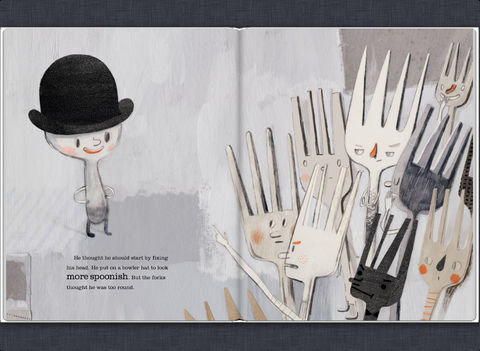
We meet Spork and learn about his parentage on the opening pages. He has a wide and innocent round face like a spoon, but his fork ancestry shows as three short tines extending from his forehead. His mother, dressed, or rather engraved, somewhat like a 1920s flapper, adores him, as does his dapper tie-wearing fork father.  But other members of the kitchen look down on him.  Spork looks sadly on his odd reflection on the side of a toaster and resolves to be what he is not: one thing only.  Wearing a natty bowler hat to conceal his fork features doesn’t work, and nor does a pointy paper crown cover up his spoon DNA.  Arsenault’s pictures feature juicers, corkscrews, and egg timers with comic features, looking a bit like Miró’s biomorphic figures floating in space. Spork’s quirky face manages to evoke a range of emotions, from desolation to joy.

spork inside

Then a bright splotch of action painting arrives to save Spork’s grey and white world.  This “messy thing” is too young and unprejudiced to care about fine distinctions when it just needs a way to feed itself.  A giant infant with a big smile and a jar of baby food finds Spork the greatest thing since sliced bread.  All of a sudden, someone appreciates the very qualities that had isolated him from his peers:

“Something that could do all sorts of things at once./Something flexible and easy to hold.” Children listening to or reading the book will be relieved, although older or more inquisitive ones, as well as adults, may wish for a sequel to this charming book.  Have all Spork’s problems really been resolved? What happens when the baby grows older and is pressured to choose correctly at the table? Maybe, as in Thomas Disch’s The Brave Little Toaster, Maclear and Arsenault could collaborate on a continuation where the utensils interact and their prejudices clash, but ultimately resolve. In the meantime, Spork is a sweet and simple story of for children about acceptance from an unexpected friend.


Nutcracker History

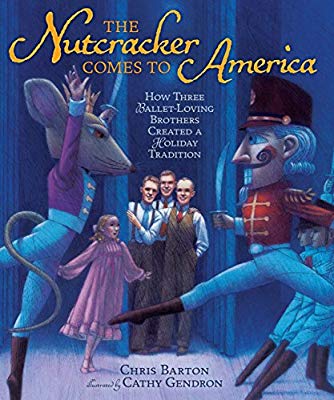
The Nutcracker Comes to America: How Three Ballet-Loving Brothers Created a Holiday Tradition, Chris Barton and Cathy Gendron, Millbrook Press, 2015

nutcracker cover

The Nutcracker Comes to America isn’t principally about fairies and the land of sweets, or a brother who deliberately breaks his sister’s beloved doll.  It’s a picture book history with engaging and detailed text about three brothers from Utah who staged the first full-length Nutcracker ballet in the U.S. You won’t read about Clara (or Marie in some versions) bravely defeating the Mouse King by hitting him with her slipper.  You will reverse some preconceptions about this ballet, which was not always popular or guaranteed to bring in audiences every December.  Chris Barton is the author of many picture books, including one of my favorite informational books for young readers, The Day-Glo Brothers: The True Story of Bob and Joe Switzer’s Bright Ideas and Brand-New Colors. Having brought the invention of fluorescent paint to life, he has no trouble creating, along with artist Cathy Gendron, a compelling story out of the birth of Tchaikovsky’s classic.

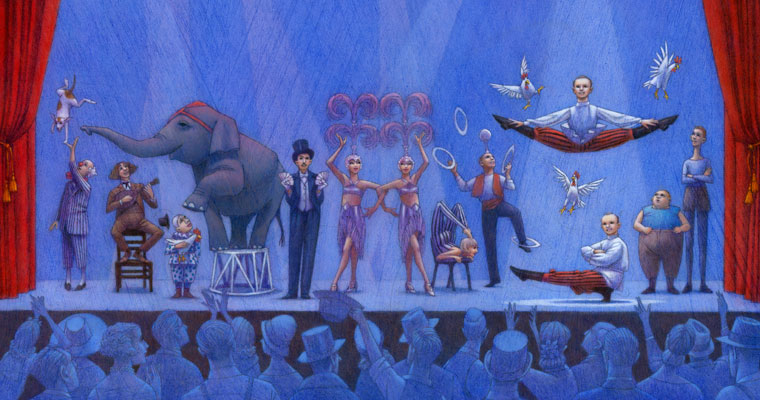
Readers may not be aware that the original performance of the Russian composer’s work in 1892 was far from a hit, or that American audiences did not always throng to theaters every holiday season to see a production of the work based on stories by German Romantic author E.T.A. Hoffman.  Barton grounds the book in the American melting pot success story of William, Harold, and Lew Christensen, three grandsons of a Danish immigrant to Utah. Their family had a dancing school and two of the brothers joined the vaudeville circuit, which Barton explains as a world where the “competed for applause with jugglers, clowns, magicians, and dancing elephants.”  Through a series of acquaintances and opportunities, William choreographed some dances to Tchaikovsky’s score for a ballet company in Portland, Oregon.  Later, after World War II during which Lew served in the military, the brothers consulted with Russian dancers and concocted an early version of the marvel that would take root in American culture in many different forms.

Vaudeville_for_port

Gendron’s pictures accompany Barton’s words on their journey, from the Christensens’ love of show business to their commitment to collaborate in producing a professionally excellent ballet in San Francisco.  She shows us the excitement of preparation “on as small a budget as possible, because small was all they had.”  A ballerina places the hem of the tutu she is wearing under a sewing machine operated by an intent designer.  Another artist carefully applies makeup to a cast member’s cheeks, while painters on ladders finish the backdrop.  The last two-page spread shows programs for the successors to the brothers’ dream, from the Pacific Northwest Ballet Nutcracker, (that one has sets designed by Maurice Sendak) to “American Ballet Theater’s with Baryshnikov as star, to Harlem Nutcracker arranged by Duke Ellington and Billy Strayhorn (also the subject of a children’s book).

If you don’t need a break from The Nutcracker and Nutcracker kid lit, but would like a complementary history of its origins, The Nutcracker Comes to America will not disappoint you!


Jasmine Toguchi, Girl Detective

Jasmine Toguchi, Super Sleuth – Debbi Michiko Florence and Elizabet Vuković, Farrar Straus Giroux, 2017

jasminecover

In this installment of Debbi Michiko Florence’s Jasmine Toguchi series (previously entries reviewed here and here), Jasmine struggles with the friendship issues that can decimate the lives of middle grade readers. She learns about empathy, and renews her joy in celebrating Hina Matsuri, the annual Japanese doll festival, with her loving mother and her reluctant older sister. All the Jasmine Toguchi books are really about empathy.  Jasmine’s family relationships, her lovely affection for neighbor Mrs. Reese, and her ongoing understanding of how Japanese traditions fit into her life, are hallmarks of this warmly appealing and realistic saga. So what’s new for Jasmine here?

Jasmine is looking forward to March 3, when every year Japanese people celebrate girlhood, as well as the imperial family, by assembling an elaborate and hierarchical display of dolls. These are not play dolls, but fragile pieces which embody tradition and attention to aesthetic values.  Display dolls or not, Jasmine’s older sister Sophie isn’t having any of it.  One of the most subtle touches in the story is the moment when Jasmine relates to her mother’s sadness at the thought that her older daughter is growing up and struggling to break away:

“’You know it’s not only about dolls, Sophie,’ Mom said. ‘It’s about celebrating girls. I love celebrating with my daughters.’
Sophie shook her head. ‘I really don’t want to, Mom.
Mom’s eyes looked sad, but Sophie didn’t seem to notice. I felt sad, too.”

Jasmine is an artist, always busy making collages.  Her imaginative nature extends to the way she views the world. Exploring her neighbor Mrs. Reese’s garage, Jasmine notes that the carefully arranged plastic storage boxes resemble “trees in a forest,” while a big dresser “sat like a castle.” There to play dress –up with her best friend Linnie Green, Jasmine becomes determined to find out the meaning of the mysterious objects they find there, including piles of old flyers with the puzzling titles Annie Get Your Gun and Fiddler on the Roof.  Jasmine is creative, but she also proud when her teacher or other adults praise her rational approach to problem solving.

Jasmine’s friendship with the shy and less fearless Linnie, her friend who celebrates Hanukkah and not Christmas, (thanks, Debbi!), teaches her that friends need not be people with whom you share every personality trait or interest.  Unlike Sophie, Linnie is thrilled to be invited to participate in Girl’s Day with the Toguchi family, but first she and Jasmine needs to take responsibility for their own actions and to relate to each other’sfeelings.

JT_MochiQueen_chapter08_3-1024x463

As always, Elizabeth Vuković’s black and white drawings capture Jasmine’s emotions. When she opens a letter from her formerly best friend, Jasmine is wide-eyed with remorse at Linnie’s kindness. The numbered images of Jasmine and Linnie dressing in their kimonos according to the proper, complex order, portrays their excitement through outstretched arms and happy faces.  One of my favorite images shows kimono-clad Linnie, her back to the reader, observing the doll display, as a somewhat self-important Sophie points out the identities of each doll.  The doll display is a shadowy grey, while the girls are drawn in darker lines, making their interaction the center of the picture.

Debbi Michiko Florence includes an “Author’s Note,” providing brief and pertinent information about Japanese customs.  She chooses to explain exactly those aspects of Hina Matsuri that would be most intriguing to young readers, including the structure of the doll display and the details of traditional dress.  There are also instructions for making an origami doll.  Each book in the Jasmine Toguchi series sparks conversation and encourages readers to learn more.


Happy Birthday, Alice B. Toklas, A Little Early…

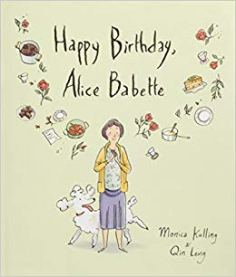
Happy Birthday, Alice Babette – Monica Kulling and Qin Leng, Groundwood Books, 2016

alice cover

It’s actually a little early to be wishing Gertrude Stein’s companion a happy birthday; she was born on April 20, 1877.  Gertrude, however, was born on February 3, 1874, so the day to celebrate the actual author of The Autobiography of Alice B. Toklas (Stein herself) is coming up soon. It’s neither too early nor too late to celebrate a children’s picture book about the warm and caring relationship between these two independent women who enjoyed, in the words of a famous book about the era, “being geniuses together.”

Young readers who are unfamiliar with Stein’s inimitable cubist-inspired poems, or her mentoring friendships with Hemingway, Fitzgerald, and Picasso, will learn about Stein and Toklas’s devotion to one another, including Stein’s successful creation of a poem, and failed attempt at pineapple upside-down cake.

alice interior

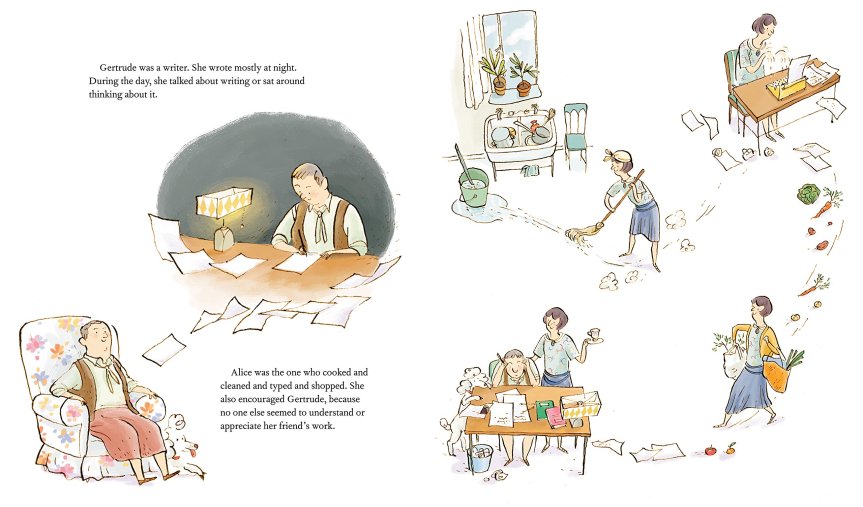
Monica Kulling (I’ve written about other books by her here and here and here) describes the traditional elements of Stein and Toklas’s partnership: “Alice was the one who cooked and cleaned and typed and shopped.” Qin Leng’s image of Gertrude hunched over her work at a cluttered table, Alice placing one encouraging hand on the poet’s back while holding a cup of tea in the other, reinforces their division of labor. “Gertrude was a writer. She wrote mostly at night. During the day, she talked about writing or sat around thinking about it.”  Kulling has managed to allude to Stein’s writing style in her own words, without simply imitating it.  Yet Alice is not a downtrodden housewife.  She leaves Gertrude to celebrate her birthday by riding a carousel in the Luxembourg Gardens, enjoying a children’s puppet show, and having the chutzpah to apprehend a jewel thief by hitting him with her pocketbook.  When she returns home to find the wreckage of Gertrude’s cooking disaster, she is unperturbed, confident that everything her companion does will become Continue reading “Happy Birthday, Alice B. Toklas, A Little Early…”

Cowboy Boots, Aliens, and Juggling Pickles: All in Eight Nights

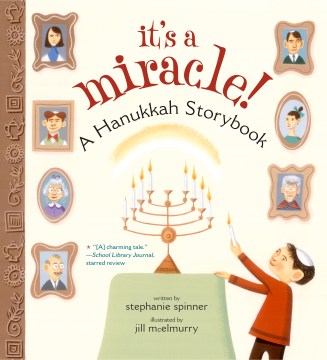
It’s a Miracle! A Hanukkah Storybook – Stephanie Spinner and Jill McElmurry, Atheneum Books for Young Readers, 2003

miraclecover.jpg

When I began my blog, one year ago just this past Thanksgiving, I wrote about Sharing the Bread: An Old-Fashioned Thanksgiving Story by Pat Zietlow Miller, with pictures by Jill McElmurry. At the time, I learned that McElmurry, perhaps best known as the illustrator of Alice Schertle’s highly popular Little Blue Truck series, had recently died.  I went back to two of McElmurry’s earlier books, Mad About Plaid and It’s a Miracle! Both feature her signature use of caricature and humor, along with a joyous enthusiasm perfect for capturing the Festival of Lights.  This is a Hanukkah story with a grandma wearing cowboy boots, a dentist with a parrot named Dreidel who distracts fearful patients with his constant talking, and Owen Block, a little boy who is thrilled to earn the title of O.C.L. (Official Candle Lighter). Grandma’s stories of the past alternate with Owen’s celebration of the eight nights of Hanukkah in the present.

The book, written by Stephanie Spinner, has a significant amount of text for a read-aloud picture book, but it also could serve as an entertaining story for elementary school age readers.  Just like Owen, they will wait with excitement for each one of Grandma’s improbable tales. A World War II era account of Uncle Ralph’s miraculous project to save his wife’s life involves a search through the phone book: “…whenever he saw a Jewish name, he called the number. He told each person about his wife and asked them to pray for her…The very next day she started to get better.” We see a young soldier in uniform holding the hand of his post-partum wife as a twisted telephone wire links together portraits of the sympathetic Jews across two pages.  Then there were the aliens who come to earth and see menorahs in the windows. One alien is disoriented, but the holiday lights of the town restore his memory and lead him home. “’Did you make that story up,’ asked Owen.  ‘Maybe I did,’ said Grandma Karen. ‘And maybe I didn’t.’”  A child with gloomy parents is admonished by his teacher not to be the class clown. So he restricts his outlandish behavior to home, entertaining Mom and Dad by juggling “a sour tomato, three pickles, and a knish.”

Where’s the Hanukkah? Owen and his cousin Molly spin dreidels. Owen’s mother’s latkes, which usually “tasted like fried cardboard,” turn out delicious. Owen’s friend Buster, who is African American, visits him for Hanukkah and stands on a tall pile of books to reach the menorah, which Owen is lighting all by himself (looks dangerous!). Every zany tall tale, as well as the warmth and comfort of Owen’s home, are all “miracles.” An afterword explains the history of Hanukkah, and there is also a page of Hanukkah blessings in both Hebrew and English, as well as a glossary of Hebrew and Yiddish words.  I was touched by Jill McElmurry’s explanation on the inside back flap of the jacket:

“I’m not Jewish and I grew up in a nonreligious family, but as a child I remember being attracted to religious ritual and ceremony. Working on It’s a Miracle! gave me the chance to step for the moment into the warm light of Hanukkah in a fun way.”

Reading this quirky take on the fun of Hanukkah and the nature of miracles is a way to appreciate both Stephanie Spinner’s weaving of tales, and the lovely legacy of McElmurry’s work.


Otterly Inventive and Fun

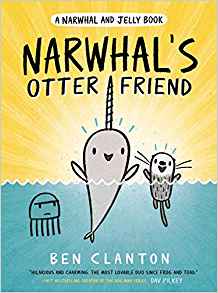
Narwhal’s Otter Friend – Ben Clanton, Tundra Books, 2019

narwhal cover

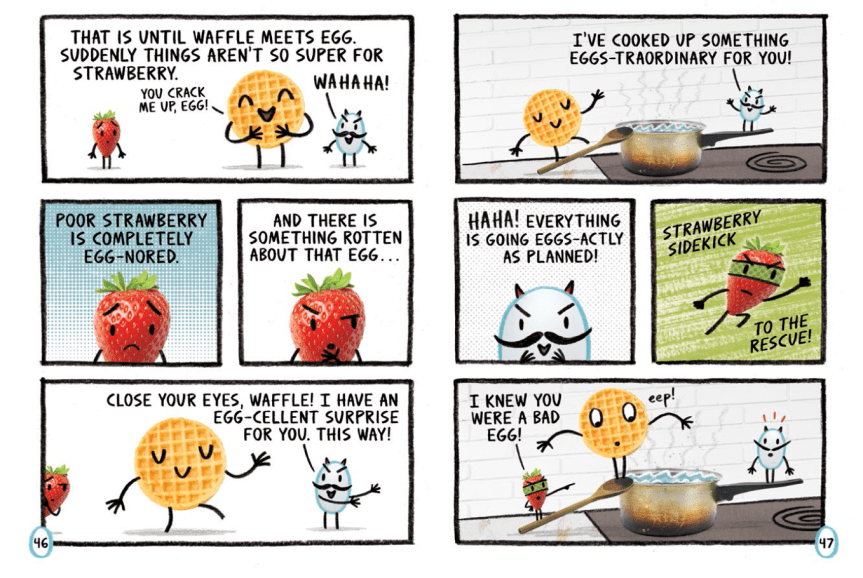
If you are a narwhal, you’re lucky enough to have the evolutionary fluke of a single tusk, making you look like an aquatic unicorn, maybe friends with a mermaid or a dragon.  In fact, your best friend is sensitive jellyfish, who, in this latest Narwhal adventure from Ben Clanton, is friended by a clever little otter.  Maybe the otter is sincere in his excitement about meeting a narwhal: “Wowee Wow! I’ve always wanted to meet a Narwhal!” but Jelly is skeptical.  He raises an eyebrow and asks, “Seriously?”  Readers learn, along with Narwhal, Otter, and Jelly, that they can share friendship and have a “funtastic time,” even surfing down a rainbow. They also learn factual information about otters, and take a wild detour to meet the superheroes Super Waffle and Strawberry Sidekick. Ben Clanton has both written and illustrated this inventive and zany trip through the sea, and has produced an entertaining tale that manages to replicate the way young children associate events and feelings.

narwhal's otter friend 1-1.png

Clanton’s characters are simple and childlike with antic expressions. He uses black, white, gray, and blue. Comic strip formats alternates with full-page pictures and two-page spreads. Then, when you least expect it, an informational section of “Otterly Aww-some Facts” appears. Kid may be surprised and pleased to learn that otters “trap bubbles in their fur creating a ‘blanket’ of air,” and that jellyfish actually glow in the dark.

narwhal's otter friend 5.png

Later, as when Dorothy leaves Kansas in The Wizard of Oz, there is a segment about the superhero foods in bright colors, combining photographs with the colored pencil, watercolor, and ink of the other images.  For all its seeming digressions, Narwhal’s Otter Friend relates a consistent story about Jelly’s distress and being displaced by Otter. At one point, Jelly determines that he will approach other friends to make up for his threatened loss. A turtle, shark, even a rock, seem like alternatives to being cast aside in favor of the adventurous and manic Otter.  Children will relate to Jelly’s frustration, and we feel reassured along with him when Narwhal tells Jelly that no adventure is complete without their friendship.

The most unusual aspect of Narwhal is the way that Clanton crams so many different elements into the book while maintaining a clear and consistent story line, suffused with high energy and wild imagination.  Children and adult readers will agree with Jelly that it “does sound like an amazing adventure.” And it is.


Old, But Good, Hanukkah Beginning Reader

Hanukkah Lights, Hanukkah Nights – Leslie Kimmelman and John Himmelman, HarperCollins, 1992

leslie-cover

It’s not that old, not as old as All-of-a-Kind Family and its sequels, What the Moon Brought, or K’ton Ton, but pre-PJ LibraryLeslie Kimmelman has gone on to write many more wonderful books, on both Jewish and non-Jewish themes (link to her website), and John Himmelman has both written and illustrated others, but I am still fond of this one. The recommended ages listed on the dust jacket are three to five, but when I recently found it on my bookshelf I noted that my daughter’s name was written on the inside cover, meaning she had taken it to school, probably for independent reading in first grade.


The text is simple. Each page has two lines in large bold print. It doesn’t rhyme, (although the author’s and illustrator’s names do!), but the second line is repeated throughout the book, with only the number of the Hanukkah night changing. So although it is a perfect picture book to read to a young child, it is also great for beginning readers who are ready to be challenged with words like “blessings,” “brightly,” and “Maccabees.”

dreidel

An extended family is celebrating Hanukkah in a warm and lovely home. Relatives arrive “from far and wide.” Unrestrained fun ensues, with kids spinning dreidels on the kitchen floor, and others acting out the Maccabees’ rebellion in the yard with colanders and saucepans as helmets. There are kittens everywhere. Guys cook, wearing aprons and flipping latkes with skill.  One two-page spread shows two grandmothers, one cooking soup and tasting it, the other seated at the table and sipping it out of a bowl. (Some grandmothers tell you not to do that.) In the bottom-right of every other page is a small brass menorah with an increasing number of pastel candles, which readers can count as they go along. Clothing styles are attractively eclectic. A little girl in a pink dress with a big pink bow tied in the back, sort of like Clara in The Nutcracker. Some of the dads wear white shirts, others striped, and one portly member of the latke squad sports a brightly flowered shirt, red polka dot tie, and frilled apron. Something for everybody.

The book concludes with an informational section, “Hanukkah, The Festival of Lights.” It provides a brief summary of the holiday’s roots and significance, the background for all the eating and revelry. You really cannot go wrong with this joyfully sincere celebration of the Festival of Lights, readily available from secondary sellers through Amazon and other sources.