
The Inside Scouts Help the Strong Cheetah – written by Mitali Banerjee Ruths, illustrated by Francesca Mahaney
Scholastic, 2024

The format of this early readers graphic novel matches the content. A compact 7×5 1/2 inches, it easily fits the hands of a young child. The Inside Scouts series, by Mitali Banerjee Ruths and Francesca Mahaney, features the veterinary adventures of Sanjay and Viv, who shrink to fit the inside of animal in need of medical attention. (It may make you think of The Magic School Bus Inside the Human Body by Joanna Cole and Bruce Degen.) The title is intriguing. If the cheetah is strong, why does he need help? With minimal text and bright graphics, young readers learn about the causes of muscle cramps and how much they can hurt. Don’t worry; Sanjay and Viv are on the job.
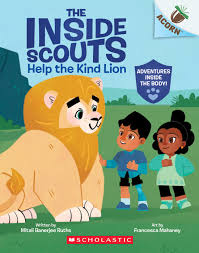

The heroes of the story exchange their everyday clothes for uniforms with robotic arms and legs, tool packs, and shrink suits. When Zora the cheetah pops up on their computer screen, they locate her and spring into action. Even with their high level of motivation, they are still kids. Sanjay briefly complains about the heaviness of this tool pack, but Viv reminds him that the cheetah needs help. There’s a Doctor Doolittle element to the story; the cheetah talks to them and explains his problem. They take him to the care lab, a doctor’s office with reassuring pictures of animals on the walls.

Fact and fantasy combine in the story. Navigating inside the cheetah’s body in their jump rocket, Sanjay and Viv use power tools to access the animal’s muscle, described as “bunched up ropes” that “look stuck.” At the end of the book, “Fun Facts About Muscles” provides some more specific information about the musculoskeletal system. (The author is a pediatrician.) The book’s best feature is its matter-of-fact approach to learning about science. The superhero approach is minimally elaborated. There is no back story about how Sanjay and Viv met or when they discovered their power to help animals. Instead, their special identity is presented as a given, as is the underlying message about using one’s abilities to help others (even when a heavy backpack seems a burden). Educators and caregivers can certainly use the book as a starting point for learning more about the topic, but it also stands alone as an attractive and engaging story that blends fact and fiction. On the penultimate page, Sanjay and Viv plan to rest, in anticipation of their next adventure. Zora will not be the last animal who needs their help.

 Imaginary Elevators