
Not So Fragile

Broken – written and illustrated by X. Fang
Tundra Books, 2025
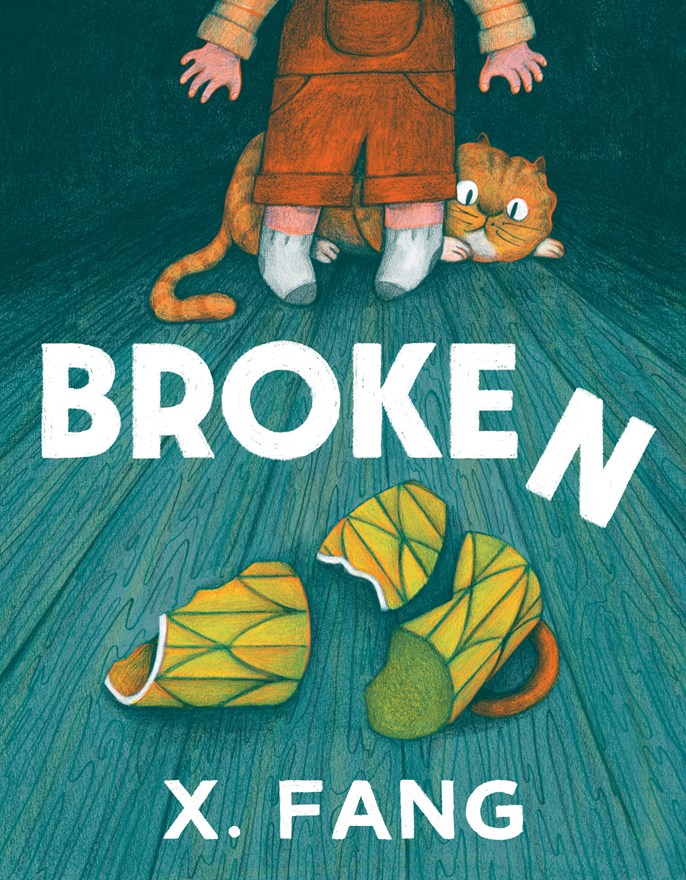
A picture book by X. Fang has an unmistakable identity (see my reviews here and here). The actual species of the mysterious visitors in We Are Definitely Human may be ambiguous, and the vivid dream imagery of Dim Sum Palace seamlessly transforms to the warmth of a family restaurant. Broken is about the unbreakable bond between a grandmother and her grandchild, and also the reassuring truth that many things that are broken can be repaired (grandparents being a constant presence in children’s books, as seen in my list at the beginning of this review). Maybe the new object will appear identical to the old one, or perhaps some small difference will be evidence that its importance is not compromised by a beautiful, jagged crack and some glue. The sturdy, rounded characters who populate Fang’s earlier books are back, but they are not repetitive. She has a specific visual interpretation of humanity and it is inimitable.

A little girl, Mei Mei, introduces the story with an invitation and an outright confession: “Let me tell you the story of the day I broke Ama’s cup.” A day at Ama’s house is full of unspoken comfort, but sometimes boredom. Thick dashes connect the girl’s activities, like a familiar board game.
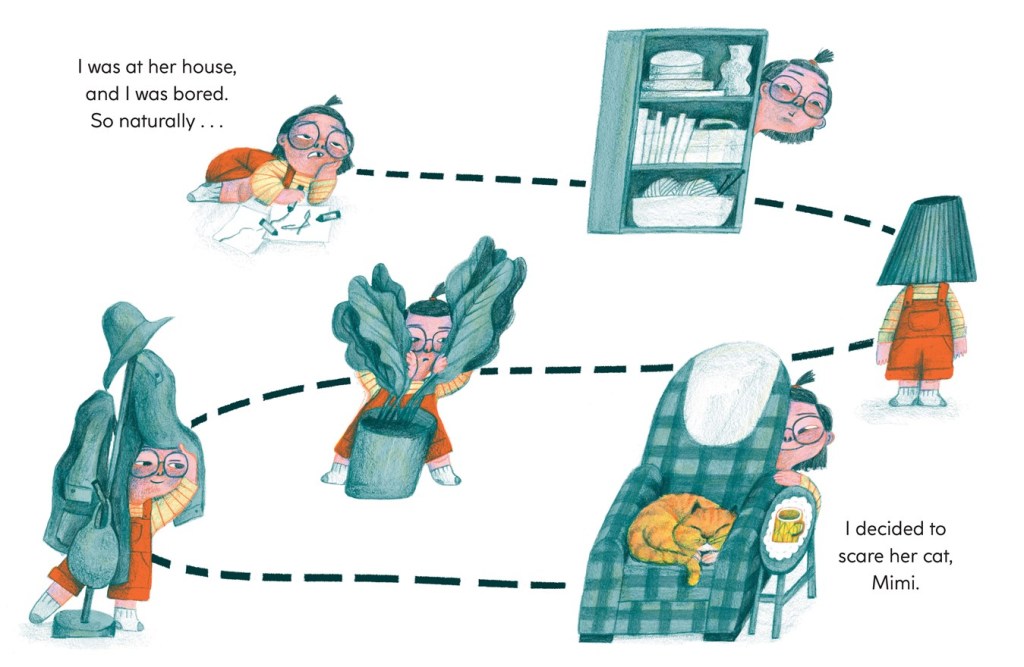
Then it happens. Having made the conscious decision to frighten Ama’s cate, the girl bumps into a table and hurls the cup towards its trajectory. Not only does it break, but the damage results in three pieces. Appealing to young readers with a direct statement of her guilt, the girl futilely tries to escape her own fears. What if Ama’s unconditional love has conditions attached?
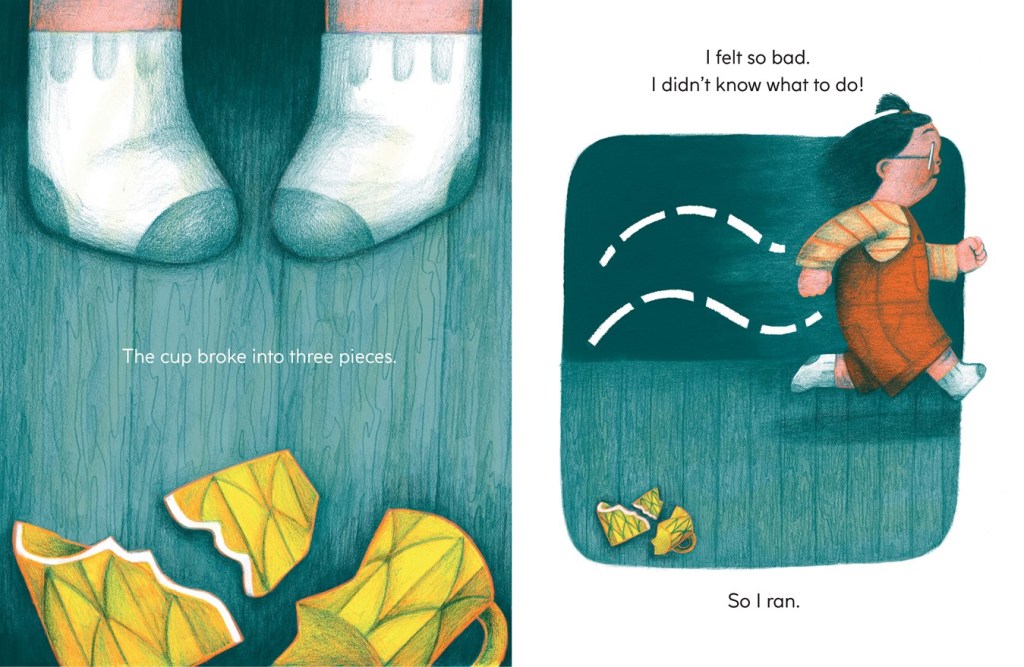
The girl’s senses become exaggerated. Her grandmother calls to her, maybe in anger. That may seem unlikely to an adult reader, but only her warm smile convinces Mei Mei that nothing fundamental has changed. Ama brings her some cake. Mei Mei has the opportunity to blame the broken cup on the hapless cat, but she can’t bring herself to be dishonest. A full page picture of the cat’s accusatory stare is the counterpoint to Mei Mei’s closed eyes behind her oversized glasses.

Overcome with anxiety, she hides in the closet, obviously a temporary solution. Fang even includes a helpful graphic of Mei Mei in silhouette profile, the truth emerging from her insides in arrows that turn into words of apology.

Mei does not only forgive her; she offers an explanation. Repairs make meaningful objects stronger. Each one tells a story. Ama takes on a new identity, as a “fixer,” in a series of portraits framed with old-fashioned photo corners. She is a super competent, and also compassionate, role model to her beloved and unique granddaughter.

Picking Out Plants and Turning Bad Moods Around

Everyday Bean (Tiny Bean’s Big Adventures, Book #1) – written and illustrated by Stephanie Graegin
Tundra Books, 2025

There are many book series chronicling the adventures of best friends, some human and some animals. Frog and Toad, Ivy and Bean, Stella and Marigold, Mouse and Mole, Elephant and Piggie, are only some of the best-known and loved. The relationship between grandparents and their grandchildren also constitutes the core of picture and chapter books, as well as middle-grade novels (see a list of examples at the opening of this review). In Everyday Bean, Stephanie Graegin has given a little hedgehog and her grandma the same kind of symmetry as peer friendships, but simultaneously the unique empathy and protectiveness of a grandparent, and the loving trust of a grandchild. There is continuity with other books celebrating both friendship and family (such as the books by Lore Segal) but Graegin also offers a new verbal and visual picture of a unique connection.

A key element of Everyday Bean is balance. Each short chapter is an independent story, linking together in a thematic whole. Bean is tiny. Grandma is bigger, from Bean’s perspective, but still small from the viewpoint of the reader. We meet each one of them against a background of white space, emphasizing the scale of these personified animals. As they toast marshmallows together, Bean invents a story about “tiny ghosts,’ while Grandma prefers one about “giant marshmallows.” Bean reminisces about the blanket her grandmother had created for her when she was a baby. Somewhat mysteriously, the blanket kept shrinking, and ultimately became a bandana (another common kidlit theme). The reduction in size is not translated into reduced importance. While in Goldilocks and the Three Bears, each diminishing bowl of porridge, chair, or bed, is fraught with tension, the disparities in size between Bean and her grandma, blanket and bandana, all give a sense of security.

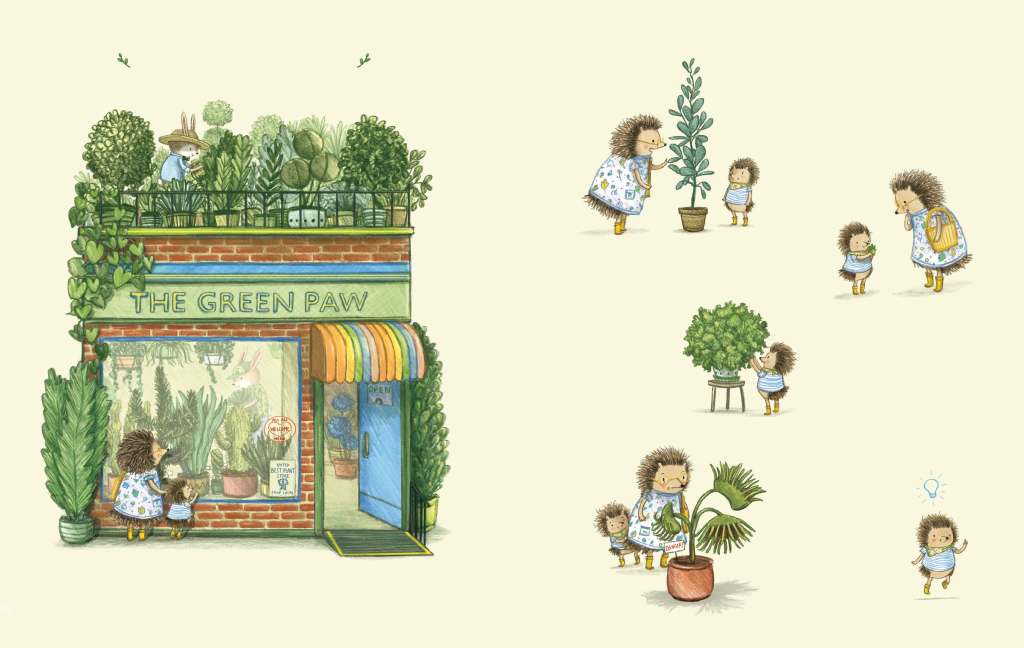
A visit to the plant nursery is one example of Graegin’s understated method. Mr. Green, the store owner, is a rabbit who is carefully attending his lush assortment of plants in the store window. The balcony of his brick shop is also densely filled with plants, in contrast to the following page, where white space allows Bean and Grandma to examine each possible plant without distraction. The exchange between the two is brief; they can intuit each other’s thoughts in this situation. The round, prickly cactus that Bean selects is perfect, because it embodies the qualities of both Bean and Grandma in each other’s eyes.

In “A Box for Bean,” Graegin revisits the cliché about a child preferring to play with an empty box to an elaborate toy. Grandma helps Bean construct a house out of the box, but then respects the child’s imagination, as Bean experiments with the box as a spaceship, pirate ship, and ice cream truck. There is a quiet image of parallel enjoyment, as Bean colors in the box while Grandma sits outside, in her own space, reading. This picture gives further evidence of the pair’s smallness, as flowers dwarf the box and Grandma’s teacup rests on a mushroom.

“Bean’s Bad Mood,” presents the difficult test of how a parent or grandparent responds to a child’s intense emotions. I was reminded of Little Bear, where the mother’s tenderness serves as a gentle test of reality, as in an imagined trip to the moon. Sophie’s patient grandma in Rosemary Wells’s Time Out for Sophie also came to mind. As Bean lies prone on the floor, enclosed in her “dramatic moping mood,” Grandma calmly assures her that bad moods are inevitable. In fact, she has anticipated this event: “I knew this would happen someday…Just be back by next Thursday. I’ll make you a sandwich.” Unhappiness cannot be avoided, but something simple to eat might mitigate its effects. Her well-stocked kitchen is neat and orderly. A portrait of Bean hangs on the wall. Grandmother and granddaughter wear matching boots, with only the older hedgehog using eyeglasses. Bean’s posture of mild defiance, with hand on hip, faces Grandma’s slight stoop, and her use of both hands to hold a cup. Each note in Everyday Bean resonates.