
Lumber Jills: The Unsung Heroines of World War II – written by Alexandra Davis, illustrated by Katie Hickey
Albert Whitman & Company, 2019
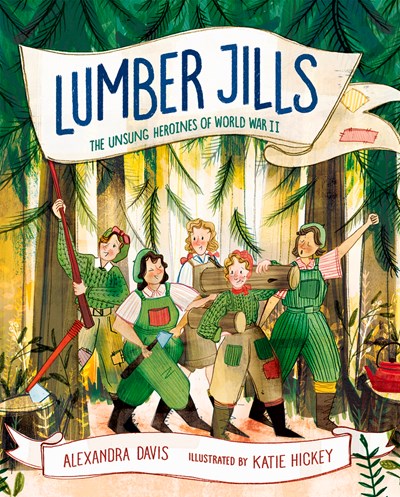
Today I’m writing about the relatively unsung contribution of many brave women during World War II. They were 8,500 female “lumberjacks,” who joined Britain’s Timber Corps, cutting trees, driving trucks, and operating sawmills. With so many men serving in the military, the contribution of the Lumber Jills was absolutely essential. (According to the author’s detailed afterword, women in Canada and the United States had also long worked in the timber industry.) Alexandra Davis and Katie Hickey’s picture book is a thrilling ode to women’s strength. (I reviewed another Katie Hickey book about a woman pioneer here.)
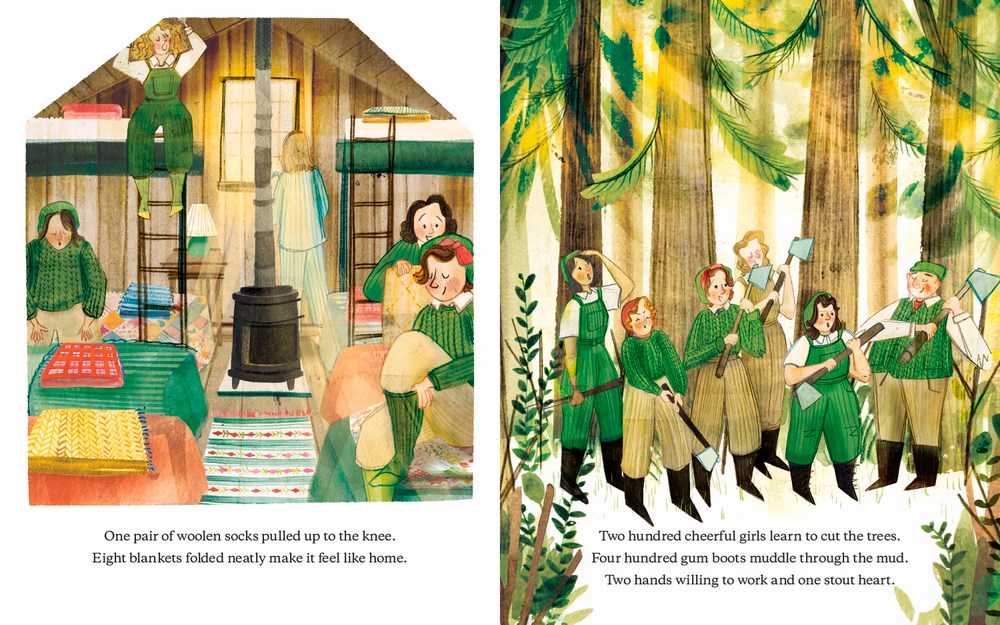
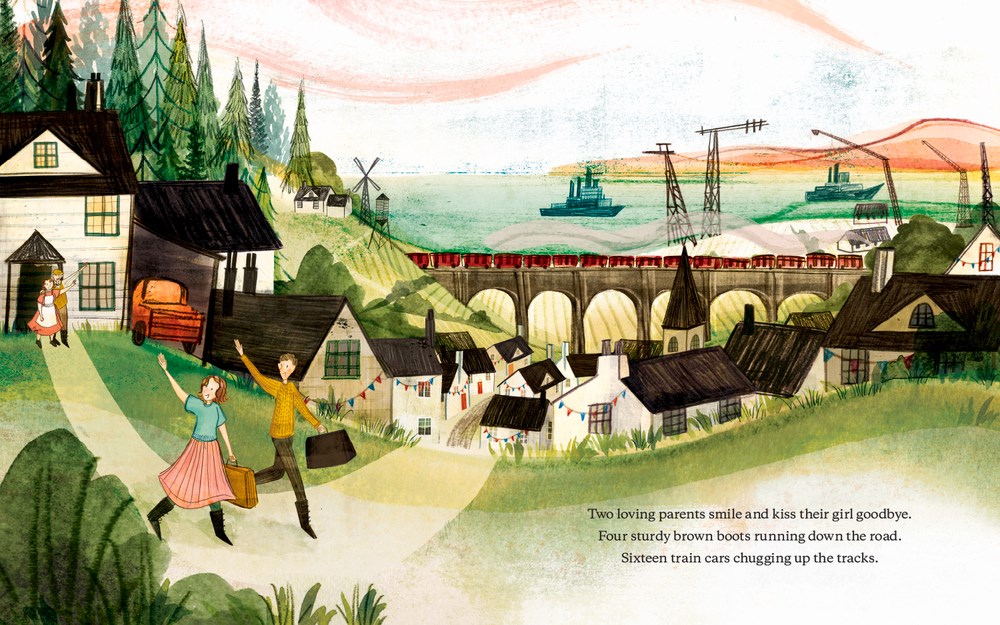
An inventive use of repetition and counting characterizes the text, and allows it to bridge a broad span of ages. The story begins with “one pair of woolen socks pulled up to the knee.” Evading the male gaze, these young women do not dress in conformance with male beauty standards. They wear study, tough overalls, gum boots and, as stated, socks pulled up to the knee. That pair of socks reappears several times in the book, reiterating that the women’s role does not prioritize physical attractiveness. The pleated skirt and short-sleeved sweater of their previous lives transforms into a new uniform.
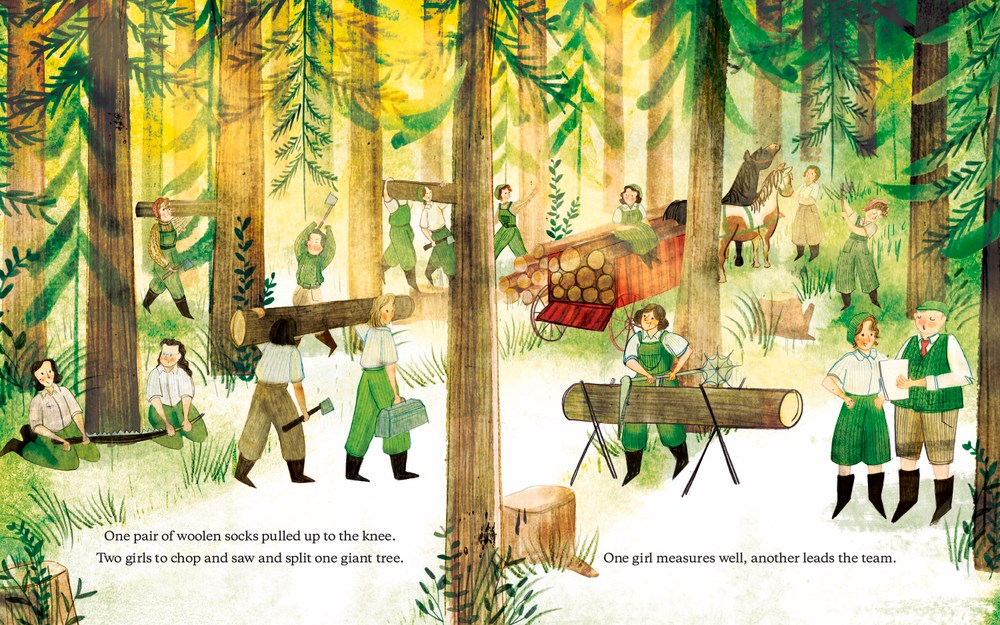
Companionship among women is also a key to their success. Smiling and forward-looking, this corps of workers learns new skills without becoming discouraged. At times their facial expressions convey that the work is tough, but the mutual support they come to expect, combined with their implied patriotism, ensures success. Domestic life has not disappeared, but it is centered on their community rather than on individual homes: “Three girls burn the brush, as well as warm the tea.”
Large numbers alternate with smaller ones, emphasizing the different scales involved in their goals. “Five nights are spent indoors, writing letters home,” while “four hundred girls sing while they walk to camp.” Accomplishing their purpose, “ten million” trees are provided for the defense of the realm. Yes, there is also a dance with soldiers, where colorful dresses and the pleated skirts return, and the girls even wear “ten shades of lipstick.” (They must have access to quite a choice of make-up. All are shades of red.).
At the end of the book, and of either the war or of her term of service, we see one Lumber Jill who has returned home. She sits on her bed, wearing pants and a bulky sweater, as she assembles an album. It includes pictures of trees, commemorating her unforgettable role. Even if you have shared other books about women’s strength with your children, this one is different and memorable in many ways, woolen socks included.
 Imaginary Elevators