
One Present from Flekman’s – written by Alan Arkin, illustrated by Richard Egielski
HarperCollins, 1999

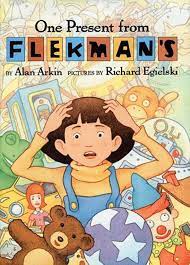
Yes, the great American actor, Alan Arkin wrote several children’s books. While he was best known for his wonderful stage and screen performances, he was also the author of, among others, One Present from Flekman’s, a picture book from 1999 about a girl, Molly, and her grandfather, who visit an overwhelmingly sized toy store in New York City. The store is a thinly disguised version of the legendary F.A.O. Schwarz, before it declared bankruptcy and was eventually reintroduced as a very pale imitation of its original self. Arkin’s grace and humor as an actor comes through in this gentle story of how materialism affects childhood fun.
The book is illustrated by the prolific Richard Egielski, winner of the 1987 Caldecott Medal. I’m a literary award skeptic, but I think it’s relevant that Arkin’s book was paired with so well-known and respected an artist. From the title page, where a grandpa in a checked coat and sweater vest addresses a little girl in cowboy boots, Egielski captures Arkin’s tone perfectly. Molly and her grandpa take the train into the city to visit Flekman’s. A condition of their trip involves the number of presents the girl can choose: one. In a store filled with life-sized stuffed animals, a Ferris wheel, costumed employees and a distracting marionette performance, that condition seems impossible. Why do adults expect children to conform to their optimistic expectations?
I’m intrigued by one picture that reflects the year of the book’s publication. There is a shelf covered with dolls of every variety, “Raggedy Ann and Andys. Barbie dolls. Humpty Dumpty dolls. Rumpelstiltskin dolls. Pinocchio dolls. Dolls who drank from a bottle and burped.” Aside from the references to classic folklore and literature, and to dated technologies, there is another cultural reference. Non-trademarked version of both Babar and Madeline occupy two of the shelves. From 1988-2001, a popular series of Madeline shows were broadcast on television, and a Babar series debuted in 1989. At that time, tie-in toys based on the characters were widely available, only to sadly disappear later. They were high-quality toys, faithful to the original characters.
The toys are not the only dated element in the book. Of the many distracting items in the store, none are based on screens. A frenetic sales pitch for a game called Upsy Downzy Inzy Outzy entices kids with “dice and balloons and lights.” Players “had to pick cards and answer questions in a loud voice, then blow a whistle and run around like a crazy person.” Arkin is satirizing what he sees as the ultimate challenge to a child’s attention span. He couldn’t possible have known the future, virtual play would subsume so much of a child’s time.
The desperate grandpa calls the Carnegie Deli and orders pastrami sandwiches and egg creams, affectionately alluding to Arkin’s early childhood in New York, as well as his Jewish identity. But it has become too late for the grandpa to retrieve Molly from the dilemma of limiting herself to one toy. Egielski depicts her lying prone under a pile of bicycles, dolls, and teddy bears. Eventually, he calls in medical help, in the person of Dr. Brower, who diagnoses “Flekman’s fever,” prescribing warm milk and distance from any toys. (In an interesting example of sensitivity to representation in children’s book, both Dr. Brower and the store manager are Black.) The resolution to the story is double-edged, with Molly calmed down, but also identified by Flekman’s manager as a potential entrepreneur. Her marketable idea, however, is a simple washcloth transformed through imagination into a multipurpose toy. Over the long span of his life, Alan Arkin brought joy to many in his varied roles on stage and in the movies and on television. As a parent and grandparent, he couldn’t have predicted the way complex financial and social forces would conspire against an active little girl trapped in a toy store.
 Imaginary Elevators