
Uri Shulevitz died on February 15. The breadth of his artistic vision was outstanding, demonstrated both in books which he wrote and illustrated, and in others that he illustrated in collaboration with another author. Many were deep explorations of Jewish themes, while others were more universal in scope. Chance was a masterpiece, integrating his entire life’s work in both words and pictures (I have also written about him here and here). The title indicates his conviction that his survival as a refugee from the Nazis, and, therefore, his entire career as an artist, was fundamentally a result of random events. The book earned many distinctions; unfortunately, a Sydney Taylor award was not among them.

I would like to call attention to one long out-of-print work by Mr. Shulevitz, his quirky, and even disturbing, Toddlecreek Post Office. (Farrar, Straus and Giroux, 1990). Like several of his other books, it adopts a tone from folklore. The small village of Toddlecreek has a small post office. It resembles an ordinary house, with tall windows, flower boxes, and an American flag indicating its purpose. The name of the postmaster is Vernon Stamps, reinforcing the idea that the story is something of a parable. (Some of his neighbors are named Mrs. Woolsox; Charlie Ax the logger; and the garrulous and nostalgic Dexter Shuffles.) Mr. Stamps is busy and efficient, but also compassionate, helping everyone in the community and even welcoming animals to his overcrowded enterprise.
Into this paradise, one unfortunate day, the postal inspector intrudes. Her presence is immediately disturbing, and the animals react before she even sets about her task. “Birds’ songs diminished…Bees’ buzzing ceased, or so it seemed. The small dogs stopped barking, and stared.” The inspector examines the post office’s records, as well as the evidence that unofficial, but humane, activities are also promoted there. There are books to read, and announcements for barn dances on the bulletin board. She announces that the post office will be closed. Vernon is stunned, but he senses that resistance to this decision is futile. He locks up and leaves.
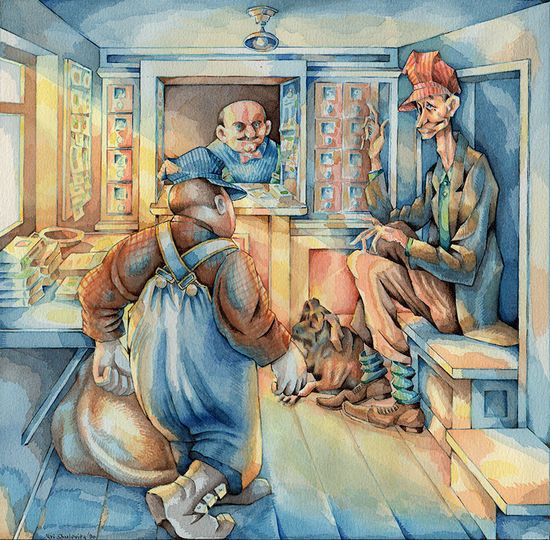
If readers are not already saddened by this point, Shulevitz makes clear that the post office’s closure leaves a terrible gap in the life of the community. There is a sense of shock in the rumors about Silken, Vernon’s part wolf and part sled dog companion. The animal has disappeared. “Some say she went north to join the wolves. Others say she was killed by a hunter.”
What motivated Shulevitz to end the book on an unambiguous note of sadness? He was a great artist and humanist who had lived through the worst conditions imposed by tyranny. Toddlecreek has been ruined. “It is not on any map, it is bypassed by travelers and forgotten by time. And now, like any other small village, Toddlecreek has no post office.” Yet, unlike the residents of this unfortunate town, he did survive to produce an unforgettable body literature and artwork for both children and adults.
 Imaginary Elevators
One thought on “Uri Shulevitz 1935-2025”