A Universe of Rainbows – poems selected by Matt Forrest Esenwine, illustrated by Jamey Christoph
Eerdmans Books for Young Readers, 2025

To paraphrase Mark Twain oft quoted remark about the weather, everybody talks about STEAM (science, technology, engineering, arts, and mathematics), but nobody does anything about it. A Universe of Rainbows is a picture book that fulfills the ideal of combining education about these seemingly disparate fields. An anthology of poems rooted in rainbows and color, it includes works by well-known authors and others whose work may be less familiar. Each poem is accompanied by a boldly colored illustrated, and by a column of informational text. The breadth and range of the content and styles is amazing.
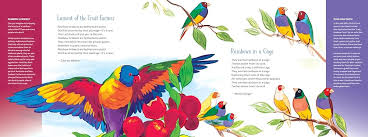
Virtually any selection gives a sense of the book’s approach. A poem by prolific author Marilyn Singer, “Rainbows in a Cage,” warns of the dangers of extinction caused by the voracious pursuit of rainbow finches: “They wanted rainbows in a cage:/finches stolen from the wild./A different time, a different age.” Singer uses the poetic form of the triolet, while other poems in the collection are composed in free verse. This compact form, using only two different rhymes, is perfect for conveying her message. The birds’ beauty does not excuse their exhaustion by selfish collectors. At the same time, she contextualizes the events by noting that different standards have applied in the past. Jamey Christoph’s picture of the sought-after birds sitting on branches shows the bright and pastel colors that attracted collectors. The explanatory text gives historical background and summarizes the results of the birds’ popularity: “the demand for Gouldian flinches became so great they were nearly trapped and caged out of existence.”

Lee Wardlaw points out the unfairness of judging a species only by its obvious beauty in “The Fruit Fly’s Secret.” Yes, butterflies are lovely, but “just because/they flit and flirt/on wings of rainbow hues” they have deflected attention from the equally significant fruit fly. Viewed under a microscope, the colors of these insects are revealed, elevating them from their lowly habitats in “drains and sinks and mops” or rotting fruit. The text box describes how photomicroscopy documents how they refract light, and also interacts with the poem itself. Wardlaw includes quotes from different authors extolling the beauty of butterflies; the text refers back to the poem by attributing each quote (Victor Hugo, Oscar Wilde, Bashō, and more).
Editor Matt Forrest Esenwine’s own poetry is also part of the book. “Alien Fountain” responds with awe to the unexpected phenomenon of the Fly Geyser, a “peculiar/accident/that could/only have/been created/by human ignorance/and Nature’s/resilient/soul.” This result of an energy company’s drilling for geothermal water in the 1960s produced a strangely stunning appearance, captured in Christoph’s illustration. The algae growing on mounds of limestone caused an explosion of color, “giving the geyser its otherworldly appearance.” As in all the explanations, concise presentation of facts works in parallel with literary language.
I cannot recommend this book highly enough. It sets a high bar for authors and artists aspiring to link science and the arts without sacrificing aesthetic and linguistic distinction.
 Imaginary Elevators