
Ramon Fellini the Dog Detective – written and illustrated by Guilherme Karsten
Eerdmans Books for Young Readers, 2025
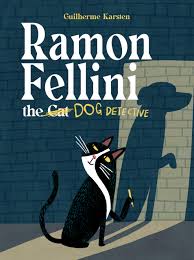
Sometimes people believe what they want to believe, in spite of evidence to the contrary. Children have their own frame of reference for viewing the world. Whether you choose to call it innocence, or just a still untested belief that no one would lie to them, sometimes they interpret events differently than an adult would. The endearing boy who narrates Ramon Fellini the Dog Detective needs to determine who overturned his fishbowl, leaving one fish missing and the remaining one “terrified.” When a self-proclaimed Dog Detective shows up at his door, offering to help, he is relieved, if momentarily confused. This dog looks just like a cat.
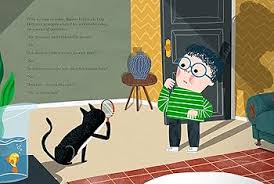
Guilherme Karsten has created a believable character. In his striped shirt, curly dark hair, and oversized glasses, the boy is an image of curiosity combined with trust. The dog resembles a cat because his costume is “impeccable.” The questions posed by this detective are searching, and, if his methods seemed “strange,” the boy still has confidence that he will find the culprit. One might think that a close up revealing the dog’s interrogation of the remaining fish would invite skepticism. The fish “looked like it had just seen a ghost,” and the detective extends his very feline tongue towards the fishbowl. But the boy has suspended his disbelief. (Suspension of belief is a theme in Karsten’s work.)

Every picture conveys character. The dog detective mirrors the black and white of the venetian blinds, as he lifts one of the slates to peer outside. One of his eyes half closes exactly like the aperture. But while the blinds are just an object, the dog looks notably sly. Meanwhile, the boy looks on in appreciation of the detective’s skills. Even after this supposedly canine Sherlock insists on taking a walk with the fish in its bowl to search for clues, the boy is only worried that his pet will be cold.

Will children think of the boy as foolish? No; just look at the abundant evidence and expertise the dog detective shows, even using a pointer to indicate his deduction about the fish’s escape. When Fellini hands him a post card from the fish’s destination, the boy has even more support for his faith in good deeds. The dog detective is “AMAZING,” “a legend,” and even “a boy’s best friend.” (images). The price of the boy’s happiness is not clear. After all, the fish is gone, and the boy is left with the deep satisfaction of having benefited by the detective’s incredible skills and dedication. What has he really lost?

 Imaginary Elevators