
Together We Are Family – written and illustrated by Emily Hamilton
Bloomsbury Children’s Books, 2025

Wonderful children’s books each have their own outstanding qualities. There is no one formula for producing the authenticity and beauty inherent in a distinctive picture book. Emily Hamilton’s Together We Are Family features a tone of empathy with kids, simplicity that is not patronizing, and pictures that are reminiscent of children’s artwork without mere imitation.

In the opening picture, the mother lowers her body slightly to speak with her daughter, a young girl using a walker. The mother’s words are enclosed in a speech bubble bordered by unconnected dashes rather than a continuous curved line. “You are you and I am me. Together, we are family.” There is nothing trite about those words to a child. The facing page shows family portraits framed and posted in their home. Each scene captures a moment: a bird carrying off part of a girl’s ice cream cone, a father holding one daughter and an older daughter’s face peering over the bottom of the photo, sisters on the beach with their back to the viewer.
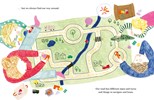
Hamilton’s illustrations are rendered in watercolor and pencil, along with Photoshop. Simply using media that children might also prefer, including colored pencils and paint, does not necessarily convince readers that the illustrator identifies with their point of view. The primary colors and naïve brushstrokes need to be accompanied by a sense of identification. In a terrific two-page spread, Hamilton presents a bird’s eye view of a family that embodies the metaphor of finding their way together. Sitting around a floor mat designed as a town with roads connecting the community, each family member chooses a different activity, but they are working in harmony. The father “drives” a red car in a traffic circle, while one child drives a similar vehicle on her mother’s pants leg. The mother builds a structure with blocks. The younger girl, who is moving a toy alligator, which seems more fanciful and less related to the overall purpose of the game, is just as integrated into the scene.
Frustration is also part of a child’s life, as Hamilton visualizes without judgment. Putting on her shoes is a challenge for the young girl, as is climbing stairs without the aid of her walker. As with all children, whether or not they have special needs, anger can erupt unpredictably, as “the moods that catch you unawares.” While her older sister calmly picks up a piece of fruit at their picnic, the younger girl, frowning, tosses a sandwich into the air. The chaotic merriment of a party is off putting to the child, who stays close to her mother watching the scene with some discomfort. Anyone, young or old, who has ever experienced frenetic social activity as less than an unalloyed joy will relate to this scene.

In a sensitive author’s note, Hamilton explains how her daughter’s disability has influenced their life as a family in specific ways, but she emphasizes how all families inevitably cope with difficulties through support and love. Together We Are Family resonates with that truth for all readers.
 Imaginary Elevators