
Our Corner Grocery Store – written by Joanne Schwartz, illustrated by Laura Beingessner
Tundra Books, 2025
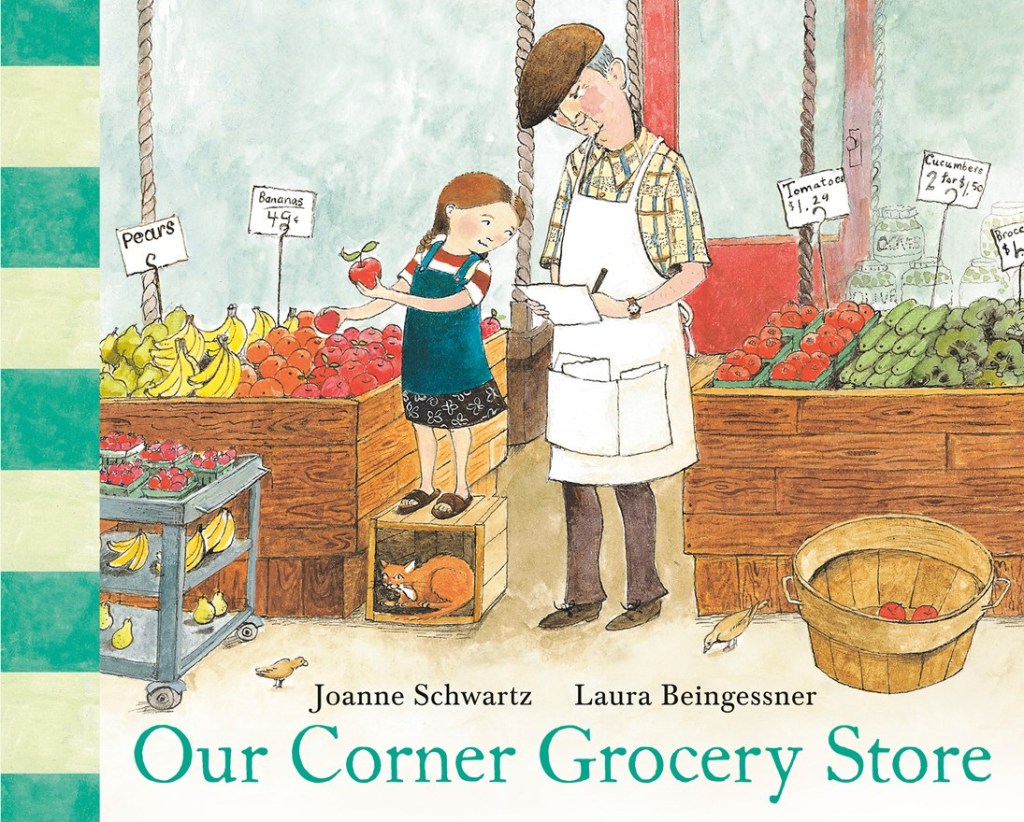
Tundra Books has reissued Joanne Schwartz’s and Laura Beingessner’s classic picture book, about family and community. Originally published in 2009, this ode from a child’s perspective to her loving grandparents and their unpretentious shop seems instantly familiar. Anna Maria describes her Nonno Domenico and Nonna Rosa’s corner establishment, where the provide every food needed by residents of the town. At the same time, Schwartz’s words and Beingessner’s images almost startle with their simplicity. The place where Anna Maria helps out is practical and magical.
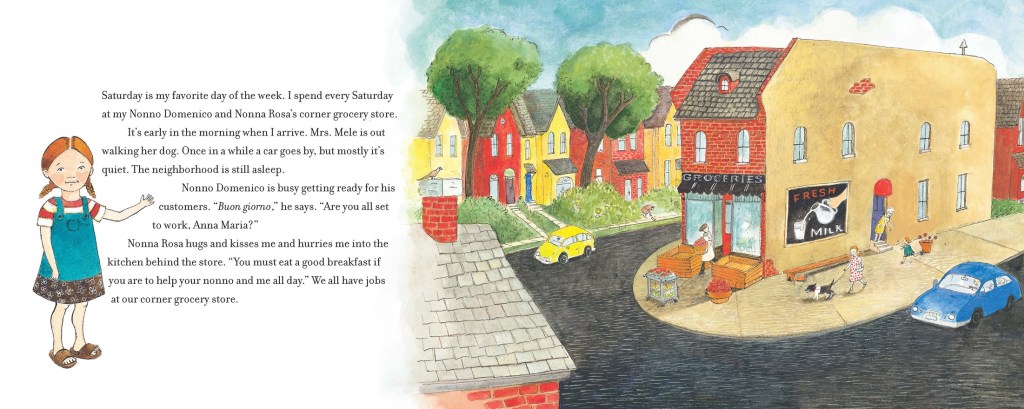

Even Anna Maria’s inventory has a poetic sound: “On one side we have the apples, oranges, pears, bananas and strawberries. On the other side are tomatoes and cucumbers, broccoli and green beans.” (image) Clear organization and aesthetically pleasing display are a testament to the store’s importance. Anna Maria and Nonno Domenico collaborate on ensuring that everything is in order. Even standing on a crate, Anna Maria does not reach her grandfather’s height, but they are coequal partners in quality control.

Detail defines Beingessner’s illustrations, along with careful composition and bright colors. Anna Maria is precise in her descriptions. She traces her steps: “There are only two short aisles in our corner grocery store. When I come inside, I have to close the boor before I can get to the counter.” An adult might minimize the need to establish scale this way, but to a child it matters. The bottom of the page with text sets out several small items, including a box of paints and a slice of pizza. On the facing page, the store becomes a cutaway doll house, with each room individually constructed. You will want to look at this page for a long time, noticing the floral upholstery on the armchair, Nonna in her green dress making coffee, and the incredible array of miniature products juxtaposed on their shelf.

Children use metaphor without self-consciousness. To Anna Maria, baguettes resemble swords and cornbread “looks like big, flat stones.” When her friend Charlie visits, both children become artists, drawing with chalk on the sidewalk in a kind of meta reference to the illustrator’s work. (image). A pirate and a girl seem to be self-portraits, proudly signed by the painters. Of course, the neighborhood children are valued customers, treated with respect by the proprietors.

They order their sandwiches with specific requests, “’Provolone, please,’ someone calls. ‘Mortadella and Havarti for me,’ somebody else says.” Observing the cold cuts and cheese passing through the slicing machine is part of the process. Soon, separate components are transformed by Nonno into an unforgettable sandwich. It’s almost a theatrical production, and even the cat is intrigued.
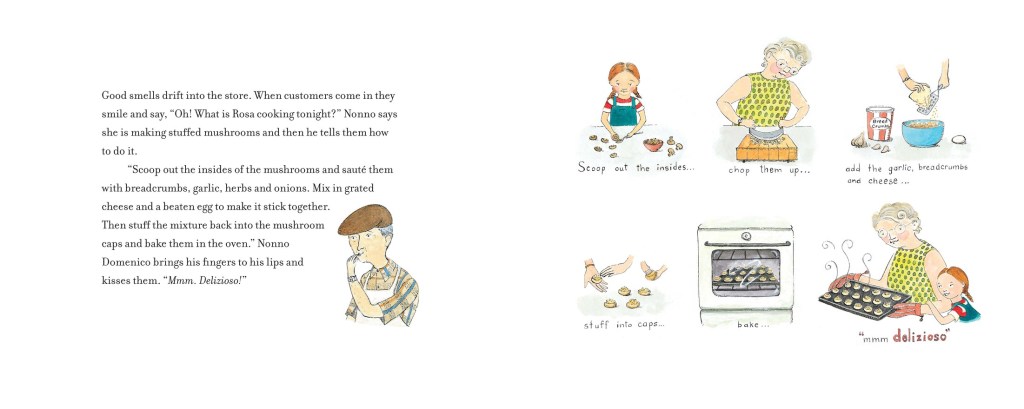
Every picture in the book stands alone as a work of art, and also advances the building of characters. The delicious smells filling the store attract customers, who ask Nonno what dish Nonna is cooking. He recites the recipe, and then completes his expression of love, raising his fingers to his lips and kissing them. A visual timeline of the stuffed mushrooms’ creation appears on the facing page. The entire book is delizioso.
 Imaginary Elevators