Emily Schneider is a writer and educator living in New York City. She has published on children's literature, feminism, and politics in Tablet, The Foward, Jewcy, and Family Reading at The Horn Book. She is a regular reviewer for The Jewish Book Council.
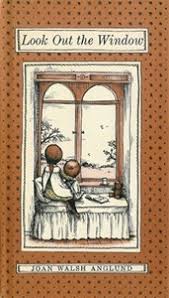
Look Out the Window – written and illustrated by Joan Walsh Anglund Harcourt, Brace & World, 1959
Joan Walsh Anglund has died at the age of ninety-five. She has been widely known and read for more than sixty years, as the author of many children’s books, some of which inspired cards, dolls, and other products. Perhaps her best- known books are A Friend is Someone Who Likes You and Love is a Special Way of Feeling. The sentiments expressed in her works are simple, easy to understand, and easy to characterize as overly sweet, even cloying. I would disagree with that evaluation. My favorite one of her books as a child was Look Out the Window, a book whose message can be boiled down to the following: each child and each person is unique. Simple it may be, but there are still numerous children’s books dedicated to reassuring readers of the same basic idea.
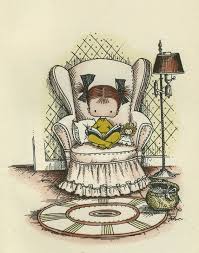
Anglund was both an author and illustrator. Her children have wide faces; two black dots for eyes are generally their only feature. Everything else in the pictures is highly detailed, including the characters’ limbs, hands, clothes, and all the objects surrounding them. Most of the settings are rural and idealized, but the core of the text may be applied to children living anywhere. The book begins, “Look out the window…/What do you see?” A girl in a sailor suit, which I certainly never wore or saw any of my peers wear, kneels on a window seat and looks outwards. We see her from the back. There is an open book next to her, a box of crayons on the windowsill, a doll in a rocking chair, and a cupcake and plate on the floor. Many of the pictures have a static quality. In fact, even when the children are playing, there is a sense of quiet and stillness, which drew me to the books.
Every item or person in a child’s life is uniquely suited to her: cats, dogs, houses, people, parents. Two people who are not like anyone else are “your very own mommie and daddy.” Yes, I know that even in 1959 there were children who did not have two parents. But there they are, sitting with their child in a rowboat, fishing, an activity in which I never, ever, engaged, and neither did my parents. Nonetheless, the picture seemed convincing to me. In fact, it was quite low-key, compared to other more modern picture books which pointedly remind children how wonderful and special they are. Here we just learn that no one else is “quite like” one’s parents.
The words do not rhyme but they have rhythm: “children planting seeds…/or sailing boats…/or selling lemonade…/or chasing cats…/or even children sitting very still.” The last activity shows a girl with her hair in a braid sitting on a stool, holding a single flower. Contemporary books might suggest she is meditating, but not here! She’s just a quiet person, who doesn’t choose to engage in the previously mentioned fun activities, which is fine. No purposeful exercise of mindfulness required.
I hope that children will still enjoy this book, and the rest of Anglund’s work. Love is a special way of thinking, a friend is someone who likes you, and looking out the window is a subjective and rewarding way of viewing a child’s particular world.
A Most Clever Girl: How Jane Austen Discovered Her Voice – written by Jasmine A. Stirling, illustrated by Vesper Stamped Bloomsbury Children’s Books, 2021
What better way could there be to introduce children to Jane Austen, the creator of Elizabeth Bennet, Anne Elliot, and Emma Woodhouse, than by using her own words? The answer might be Jasmine A. Stirling and Vesper Stamper’s heartfelt and insightful homage to the author who embodies female intelligence and wit? Austen’s words provide the central structure of this picture book biography, but Stirling has woven them into explanations of the novelist’s life which are simply stated but not simplistic. Stamper’s lovely pictures combine accurate period detail and individually expressive faces on the people in Austen’s life. The book focuses on one specific question about Austen’s genius: how did one woman of modest means and enormous talent manage to defy social expectations and discover her voice.
Authors of picture book biographies face a challenge: how to interest children and make the subject of the book relevant if her connection to their lives is not obvious. A Most Clever Girl approaches Austen as someone who “…loved stories —-long ones, short ones, worn and new.” She is the image of a child excited by reading, lugging a tall pile of girls into a room already overwhelmed with volumes. A teacup resting on another stack of books, one open, suggests that Jane’s love of the written word is inseparable from the rest of her daily life. Pointless stories governed by artificial, and sexist, convention are not for her. Jane’s busy family life in the Steventon rectory is the opposite of fainting couches and gothic drama. Instead, her parents and siblings worked hard, entertained and educated, and loved literature.
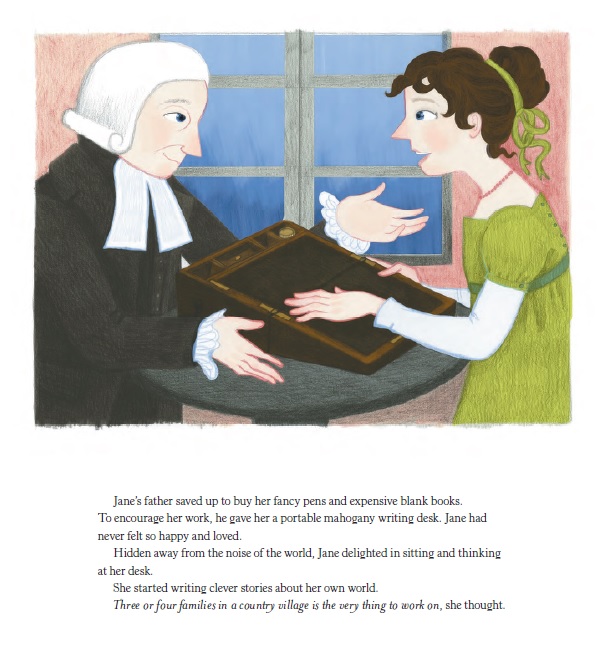
Stamper’s cutaway view of the Austen household captures the level of activity, with piano playing, reading by the fire, and children climbing and jumping in defiance of routine. One woman reads from a sheaf of papers, so engaged that she is unaware an ink bottle dripping its contents onto the carpet. Throughout the book, Stirling integrates quotes from Austen into the text, with Stamper’s pictures as the perfect visual accompaniment. Sitting barefoot with papers and a quill pen on her lap, Jane writes in the study which her understanding father has provided, going against the grain of a society which deems women’s intellectual work to be worthless. In addition to a room of her own, Jane’s father presents her with the latest technology in writing, “fancy pens and expensive blank books,” as well as “a portable mahogany writing desk.” Adults sharing this book with a child should not miss the chance to comment on this detail! Jane realizes that she must write about what she knows, and that “Three or four families in a country village is the very thing to work on.”
As in most stories which end in success, the heroine suffers a setback. Her family’s financial difficulties led to their move to the spa city of Bath, where, as she adjusted to her changed life, her writing almost ended. The death of her father added grief to Jane’s strained circumstances; Stirling vividly describes the poverty and violence of “unsurpassably stinky streets, filled with rough men, “ which threatened to silence her forever. Eventually, she found the strength to write again, this time with the added perspective of adversity. Seated again at her desk, watching and recording the world outside her window, she resumes writing, this time inviting readers to see “…the world through the eyes of complicated women.” A Most Clever Girl cleverly resolves the dilemma of presenting Austen to young readers. Make her a gifted girl with a persistent temperament and a supportive parent, describe the obstacles in her path as nearly impossible to overcome, and celebrate the power of the written word. Add beautiful and lively images of a colorful and the result is an accessible entrance to the world of Austen and her novels. Extensive backmatter includes additional sources, notes from the author and illustrator, and a list of quotes included in the book.
I Do Not Like Yolanda – written and illustrated by Zoey Abbott Tundra Books, 2021
It’s always exciting to encounter a children’s book that is truly original. Zoey Abbott’s new picture book, I Do Not Like Yolanda, did not arrive out of nowhere. Of course, it has precedents in other books that deal with children’s baseless, yet still very real, fears about different people or phenomena. It’s not the first children’s book to feature postage stamps in many of the pictures; the great author and illustrator Rosemary Wells has a used these miniature works of art in many of her stories. But Bianca, the young heroine of Abbott’s book, and Yolanda, her mistaken source of anxiety, are one hundred percent individuals. Here is a child living in a contemporary, diverse, San Francisco neighborhood, as we can see both on the return address of her envelopes and the vibrant urban neighborhood of the pictures. She is also an avid philatelist (stamp collector), and an all-around artistic spirit. Yolanda is a devoted employee of the local post office, but Bianca, as children will, has developed a frightening fantasy about this kind woman who sells her stamps. Children will absolutely relate to the way Bianca’s mind works.
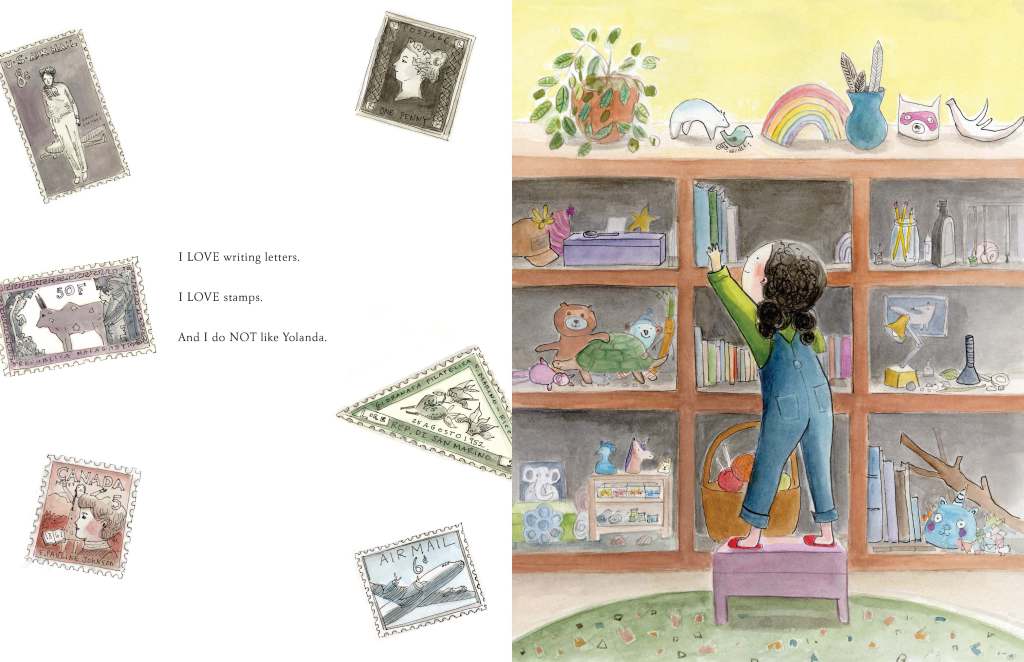
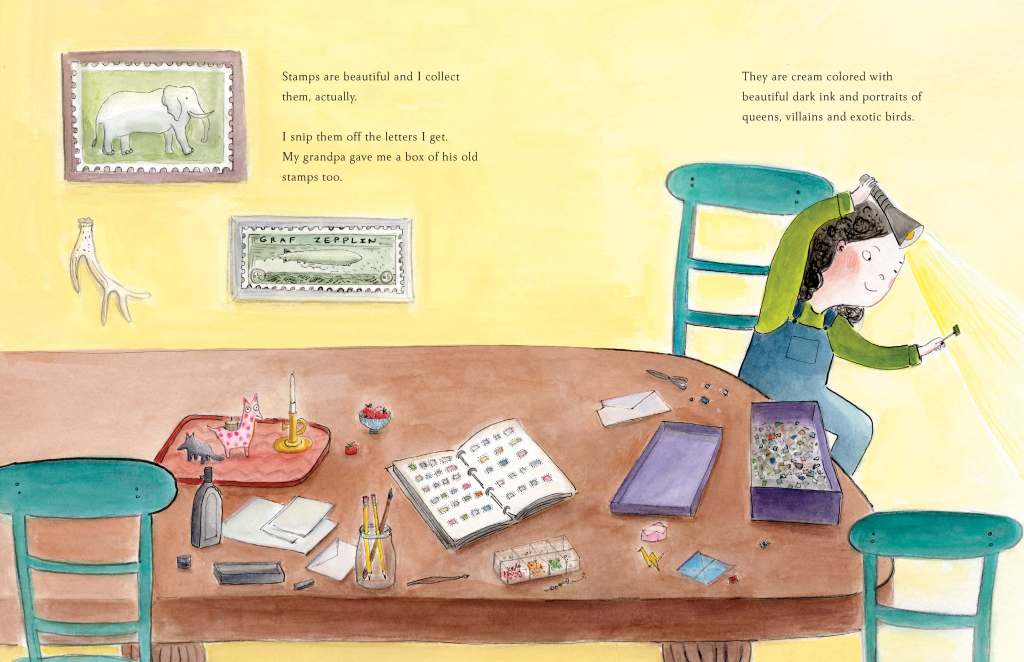
The book’s title is a straightforward declaration, and it presents a mystery: why? Bianca knows exactly what she likes, even loves: writing letters and collecting stamps. Why is the lady behind the post office counter so terrifying? Abbott doesn’t attempt to invent a logical answer to this question. We meet Bianca in a two-page spread featuring postage stamps one side, including a U.S. airmail commemorative honoring Amelia Earhart and the famous Penny Black, the first British prepaid stamp for mailing letters. Bianca stands on a small stepstool to reach the stamp album on a crowded set of shelves; she is obviously determined and purposeful. She’s not singularly obsessed with one activity, though, as we can see from both the other items on the shelves and those on her table: a polka-dotted llama candle holder, some origami in progress, compartments of colored beads. Bianca is an artist as much as a collector. Her stamps represent not only objects to acquire; “They are cream colored with beautiful dark ink and portraits of queens, villains and exotic birds.”
Bianca writes many letters, carefully addressing and decorating the envelopes with drawings. Then comes the hard part: completing her transaction with Yolanda. The lady weighs her heavier letters with suspicious diligence, and her fingernails are really long and brightly polished. (That last attribute is the link to reality; the nails do look a bit over-the-top.) Even children’s most irrational fears usually have some identifiable basis. It’s a shame to ruin what should be a lovely experience because the post office seems really friendly, with customers of every age and background socializing and helping one another. Too bad that Yolanda is an ogre, who “has probably eaten up dozens of people by now.”
Every picture in the book works perfectly. The ink, gouache, and colored pencil pictures are rendered in earth-tones, with white background and shadows helping to tell the story. (In the front matter, Abbott thanks Olive Wagner for providing “whittled stick-pens used in the book.). Objects are drawn with loving detail. Facial features are simple, but Bianca’s wide eyes and small mouth express a great deal. The suspected villain, Yolanda, finally escapes from Bianca’s wrong impression of her with a wide smile as she holds up a copy of Babette’s Feast, the novel by Isak Dinesen which becomes a link of friendship between her and her young customer. It’s obviously true that few children will have heard of the Danish author, her novel, or the movie it inspired, but that doesn’t matter. Abbott includes it as a personal homage, and adults reading the book might be fans of Dinesen. The point of including this reference is that it is both personal and accessible. Two people, an adult and a child, form a bond of friendship after a long period of misunderstanding. Yolanda shows Bianca and book and explains how much fun she had preparing a meal based on the one described there. Like Bianca, Yolanda has a creative side to her personality. I Do Not Like Yolanda is stamped with quirky details within recognizable experiences. It’s a true original.
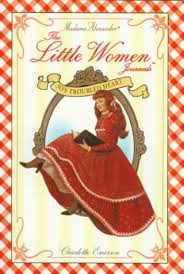
There are four books in this series from the Madame Alexander Doll Company, published to accompany a short-lived series of “play dolls” marketed in the late 1990s. They were 16-inch dolls designed to be played with by children, as opposed to be acquired by collectors, and they were one of many ill-fated attempts to make inroads into the American Girl doll and book market. Each book corresponds to one of the four March sisters, and they are intended to reflect the characters and plots of Louisa May Alcott’s Little Women without actually replicating them. Good luck with that, you may be thinking. But the books are nicely written stories for middle-grade readers and the characters do pretty much conform to the personalities developed in much richer detail in Alcott’s novel. If that sounds like damning them with faint praise, these books do what they were meant to do. If they serve as a gateway to the real literary work of Alcott, so much the better.
The plot here is somewhat parallel to one of the anguished moments in the original, when an angry Amy, frustrated that she has been excluded by a trip to the theater, deliberately burns her sister Jo’s manuscript. Jo’s Troubled Heart has a mild, but still poignant, commentary on the idea of family revenge. Convinced that her sisters have conspired to play a joke at her expense because of a series of bad but coincidental events, Jo decides on a writer’s revenge. She will alter the gothic tale she is planning to send to a magazine by making each villain correspond to one of her sisters. The plot suggests a bit of paranoia and Edgar Allan Poe-like fears. When the story is published, in spite of Jo’s attempts, with Laurie’s help, to have it withdrawn, her sisters are unperturbed. Nora Ephron’s famous saying that “everything is copy” operates here, but no one is angry.
For middle-grade readers, the plot about family anger offers a sense that sibling rivalry can get out of hand. Emerson also includes Marmee’s kind admonitions to Jo about learning to control her anger, an element of their mother-daughter relationship which is present in Alcott’s novel. Women have been warned to control their anger, or to interpret it through a religious lens of acceptance, for centuries, and Alcott definitely confronted this in her own life. Jo’s Troubled Heart offers a milder interpretation of family dynamics: “Your sisters are doing the best they can to keep their own tempers in the face of yours. Don’t harbor a bitter heart, darling Jo. Can’t you take your sisters back into your confidence and trust?” This sounds fair, if a bit less dramatic than the original novel.
I, for one, was relieved that the story appeared. I was really worried that Jo’s literary career would be stopped before it began by her feelings of remorse for vindictiveness. There were no terrible revelations in her story. Of course, Little Women itself presents a sanitized version of the complex Alcott family. The Little Women Journals are pleasant doll fiction, not a replacement for reading a nineteenth-century novel about female independence, the literary ambitions of women, and finding a spouse worthy of Jo March.
I have been following with great interest and some frustration the controversy regarding the decision by Dr. Seuss Enterprises to end the publication rights to six of the author’s books. I thought that I had possibly exhausted what I had to say about the matter, but then I read an interview with Professor Philip Nel in Esquire. Here is my response to Professor Nel, adding to my previous posts about Dr. Seuss (here and here and in my very first blog post).
First, I agree with Professor Nel that the right-wing ideologues of Fox News and their followers have no moral legitimacy in attacking the so-called process of “cancel culture” because they themselves constantly try to “cancel” opponents of their views. This seems to me to be beyond dispute. The problem is in using the utter hypocrisy of the right wing as an excuse to not engage in discussion about the serious issues of censorship and intellectual freedom.
Professor Nel dismisses the entire idea of censorship by using the term only in its narrowest sense: an actual government prohibition against publishing or reading certain works. Obviously, we do not have this type of censorship in our country, or at least not yet. For a while there, we were coming perilously close to it. There is another widely accepted use of the term, which is making a book inaccessible through putting the pressure of market forces on authors, publishers, and outlets for literary works. Professor Nel approaches the discrepancy between these two uses of “censorship” by mocking it: “No one’s setting these on fire. No one’s saying you cannot read them. No one’s saying they must be removed from libraries. No one’s saying they must be removed from your home.”
In fact, many people are saying that these, and other books, must be removed from libraries. Historically, most of those people have been on the right. “Banned Book Week” is an awareness campaign promoted by the American Library Association and other groups, urging the public to be aware of the threat of censorship. It is dishonest to claim that censorship and book-banning are not operative terms in the case of Dr. Seuss because Seuss Enterprises made the decision to render the books inaccessible. It’s also a little ironic to see a progressive scholar like Philip Nel championing the right of free market capitalism to control whether a book should be published. Local libraries or school districts that remove books about progressive social issues, LGBTQ stories, or children’s novels containing “witchcraft” usually claim that they are protecting community standards. In neither case is actual legal censorship taking place. It would also be reasonable for Seuss Enterprises to specify the “panel of experts” cited as key to their decision.
Against all the facts as we know them at this moment, Professor Nel also belittles the idea that the six books are now virtually inaccessible. Has he checked the major used book sites lately? Unscrupulous sellers are getting hundreds of dollars for them, and for other Dr. Seuss books, which they anticipate might be next on the chopping block, to use a Dr. Seuss metaphor from The 500 Hats of Bartholomew Cubbins. Perhaps his optimism is justified, and the sellers will not be able to command these high prices. However, right now, for him to refer to “the imagined scarcity of the marketplace” is as fantastic as one of Dr. Seuss’s creatures. Again, belittling concerns with intellectual freedom by referring to book burning or by denying the reality of outrageous prices for the books is an easy way to dismiss the real questions raised.
I will also credit Professor Nel’s acknowledgement that “the most egregious” racist images are those in If I Ran the Zoo. Some reporting on the subject groups all the books and their pictures together, when, in fact, the pictures and their respective contexts are quite different. I’m not going to analyze individual ones here. If, as Professor Nel insists, the books are widely available, perhaps readers might look and judge for themselves if the offensive depiction of an Asian man in And To Think That I Saw it On Mulberry Street, and some of the other inflammatory images, may all be considered equivalent. As Nel points out, the picture in Mulberry Street has already been altered in later editions of the 1937 book, but his response to the possibility of editing picture books is that bowdlerization is ineffective because “the offensive bits are coded into the narrative of the story.” In the case of some works of literature, that is true. It seems unclear, however, why a book which shows the exercise of a child’s vivid imagination through depicting fantastic creatures would remain ineradicably offensive after removing the one picture in question.
I would also agree with Nel’s conclusion that Dr. Seuss Enterprises may or may not have had purely ethical motives in withdrawing these books: “I don’t know if it’s a brand issue. Maybe they realized racism is bad for the brand, and so to sustain the brand, they need to address it.” My opinion is that Dr. Seuss Enterprises did choose to make this statement in order to protect their brand. These are not books that sell many copies, nor is there currently merchandise based on them. They could also have simply let the books go out-of-print without fanfare; the prices on the secondary market would then not have climbed outrageously. I think that they tried to get ahead of the ongoing controversy over Dr. Seuss’s legacy by sacrificing his now obscure early books, hoping to prove their organization’s antiracist credentials. But in doing so, they may have miscalculated, because those committed to the argument that Dr. Seuss’s whole body of work is compromised by racism will likely not be assuaged.
Nel contributes to that possibility by suggesting flaws in other works by Dr. Seuss, including sexism in The Cat in the Hat. (He cites the late distinguished critic of children’s literature Alison Lurie in making this case.) Of course, there is a dearth of female characters in Dr. Seuss’s work. I am a committed feminist and I consider myself to be acutely sensitive to sexism and misogyny in children’s books. I also use historical context when judging works of literature, and I know that there are many, many books to complement, question, or mitigate the effect of one particular work. Rejecting any children’s book which does not include an empowering vision of women and girls will automatically exclude hundreds of books with outstanding literary value, as well as many forgettable ones. Parents and educators need to read critically with children in all cases. Children also use their imagination in interpreting books.
Since Professor Nel insists that readers must be willing to have difficult and uncomfortable conversations about racism, a proposition with which I agree, I would like to suggest that he seems to be incapable of having such a conversation about Dr. Seuss’s legacy as a premature anti-fascist, and specifically as a champion of Europe’s Jews. The cartoonist spoke out loudly and persistently in his work, particularly for the leftist magazine PM, about the Jewish people who were on the brink of genocide. Although Nel has briefly alluded to these cartoons in his work, he always and deliberately underestimates their value, because it would compromise his view of the author as an unregenerate racist. In this interview, he again refers to “World War II cartoons that have grotesque caricatures of Japanese Americans and of the Japanese.” If Nel is referring to Dr. Seuss’s awful defense of the incarceration of Japanese Americans during the war, that was indefensible. Support for one beleaguered group of people does not excuse oppression of another group. However, many Americans are barely aware of Dr. Seuss’s interwar cartoons published in leftist magazines. It is important to be intellectually honest about the author’s contradictions. Nel’s reference to Japanese, as opposed to Japanese Americans, is ambiguous. The author drew numerous cartoons in leftist publications attacking Tojo, Hitler, and other fascist leaders and their followers. Those are completely different from his disgraceful attacks on Japanese Americans. I hope that Nel does not consider caricatures of Tojo to be any more unacceptable than those of Hitler or Mussolini. Where are his detailed references to the Dr. Seuss cartoons lambasting the America First movement, Lindbergh, Hitler, and other fascists?
Finally, Professor Nel’s conclusion is that anyone who questions the repercussions of Seuss Enterprises’ decision refuses to engage in discussions of racism. It is difficult to refute this argument because it becomes circular. If someone believes that scholars, educators, and ordinary readers have a legitimate interest in having access to all of Dr. Seuss’s work, that person is merely avoiding discussions of racism. But effectively removing the books only negates any possibility of analysis or discussion. Any library or book collection contains hundreds of books which I personally find offensive, and a subset of books which I would consider appropriate for adults, but not for children. Here is a link to the Library Bill of Rights.
Nel applauds the decision, whatever Seuss Enterprises’ motives, to issue this “product recall,” of “defective” works. “First, you need books that offer positive examples.” No, that is only one very small part of literature’s role. You can watch Paw Patrol on t.v. with your children for practical moral lessons. It is an enjoyable show full of nice role models and no pretense to artistic quality. “You need books that do not caricature people.” In that case, Dr. Seuss is out, since almost his entire body of work employs caricature, both verbally and visually. (I can’t help wondering what Maurice Sendak might have to say about these criteria.) Finally, “You need books to tell the truth.” Some of us are slightly less confident than Professor Nel that we can so easily determine what constitutes truth for each and every reader in every book.
Audacity – by Melanie Crowder Philomel Books, 2015
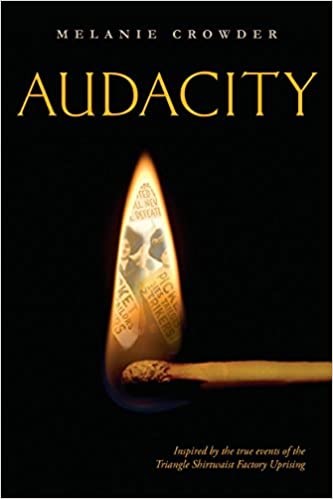
This is a novel in verse about the life of pioneering labor activist Clara Lemlich (1886-1982). She may not be a household name, unless you grew up in a household imbued with pride in the leaders, many of them Jewish, of the struggle for workers’ rights in turn-of-the-twentieth century America. In that case, she was there in the pantheon along with Sydney Hillman, Rose Schneiderman, David Dubinsky, and so many others. Readers of Audacity will learn about the deplorable working conditions in sweatshops and the indifference of many Americans to the conditions under which their clothing was made. The will also come to understand the seemingly ineradicable sexism which women labor leaders like Lemlich had to confront, not only in the workplace, but in male-dominated unions and even their own families. Each chapter in the book is a monologue in verse chronicling Lemlich’s emotional and political progress from victimhood to fierce determination. Powerful and poignant metaphors, along with rhythmic language and insightful reflections into her own motivations, bring Clara Lemlich and her cause to life.
Lemlich’s story begins when she is a child living in Ukraine, then part of the Russian empire. (The story was previously told in a picture book.) She and her family experiences violent antisemitism, and eventually decide to emigrate. Clara describes the constant anxiety, even hopelessness, of their lives. She also paints a picture of herself as a strong and intellectual girl trapped within a family and culture that denies girls and women the right to study or to pursue careers. Melanie Crowder does not idealize Eastern European Jewish culture, which shared the patriarchal structure of the other communities. (She does not, however, imply that the Lemlich family is representative of all Jewish families.) While this part of the book was moving, I found some of the poems to lack strong metaphors or rhythm, reading more like journal entries than fully realized poems. (“How can I ever be more/than just someone’s daughter/wife/mother?”)
When the Lemlichs emigrate, first to England and later to New York City, the poems become more polished and Clara’s conflicts more vivid. Working in an unregulated garment factory, or “sweatshop,” Clara’s life is a prison: physically, emotionally, and financially. Desperate young women, mostly Jewish and Italian, produce pieces of garments to make shirtwaists, a women’s blouse popular at the time. The words of the poems echo Clara’s frustration and anger and capture the sheer repetitive torment of the workers’ daily lives:
Locked inside a brick box bile rises lungs pump
workers shuffle to their stations. Stools creak heads bow
needles stabbing bobbins banging thread marching in
straight
steady
seams.
Clara attends night school and struggles between pursuing her dream of a career in medicine and choosing to dedicate herself completely to a struggle to free herself and her fellow women workers from exploitation. The answer becomes clear to her: joining a union and enlisting others to join is the only answer. The double nature of women’s oppression, by ruthless bosses and also by male union leaders who denigrate their ability and their right to participate, only reinforces her convictions:
From the drapers’ table I hear a new word whispered with a hard edge furtive eyes darting to the foreman’s desk
union
I think this is a word I need to understand.
Fortunately, when she meets Joe, a printer and fellow labor activist, she begins to see male role models who, unlike her father, respect women and see them as partners in every sense. Crowder presents this relationship with subtlety, as an enriching part of Clara’s life, but not the only focus of her existence.
Economic exploitation is the sweatshop’s core model. Rather than merely alluding to suffering, Crowder makes immoral principles central to the book, and the workers’ response to them through collective action the only possible solution.
The links in the chain that connect
the consumer looking to purchase a clean white shirtwaist demanding a lower price from
the clerk in the storefront looking to move his family to a better part of town demanding a lower price from
the owner of the garment shop looking to put food on the table demanding a lower price from
the cotton farmer.
The chain of words mimics the chain of complicity in creating inhuman working conditions.
Clara Lemlich suffered, struggled, and stood up for her beliefs. She did not work along, and knew that without convincing others that their cause was legitimate and their drive to organize a realistic goal, nothing would have changed. Even repeated acts of violence and time in jail did not dissuade her. Yet Audacity is not a didactic book, but a compelling novel in verse telling one woman’s life story and the story of her moment in history. At the end of the novel, the author provides a glossary of terms divided into useful categories. (Many readers surely don’t know the difference between a draper and a presser in the garment industry.) There is also a detailed section of historical background and an interview with members of Clara Lemlich’s family. The author has really done her homework, and her book reflects a commitment to thorough and meticulous research.
I wrote this article before the latest controversy about Dr. Seuss, and was wondering where to pitch it. However, because Dr. Seuss is in the news again, I decided to publish it immediately on my own blog. No, children should not read books with grotesque racist caricatures. Here I call attention to specific problems in an article that broadly attacks Dr. Seuss for his racism, and specifically lacks context concerning his antifascism and defense of Europe’s Jews. Most authors find that much of their work quickly goes out of print. The early works by Dr. Seuss with offensive images might well have taken that route. Instead, by announcing their decision, Dr. Seuss Enterprises was able to prove they had taken a stand against racism. Now the books are virtually inaccessible to scholars, librarians, or anyone else who would like to study and analyze them, because they cost hundreds of dollars on the secondary market. Readers might not be aware that, for one example, the original edition of Mary Poppins had a chapter called “Bad Tuesday” full of abhorrent racist terms. It has been removed from later editions of the book, with a note indicating that the book has been edited. This might have been a possibility with early Dr. Seuss books. Dr. Seuss’s legacy as someone who truly revolutionized teaching reading to children has not changed. Kids still read The Cat in the Hat, Yertle the Turtle, and the Horton books, while McElligot’s Pool has long faded from view. Nonetheless, it is important to have access to these books in order to assess Dr. Seuss’s full legacy: good, bad, and indifferent.
***********
Historian Deborah Lipstadt has used the term “soft-core Holocaust denial” to describe an insidious trend in modern anti-Semitism. Practitioners of this deception do not outright deny that the Holocaust took place. Rather, they minimize it, trivialize it, and deny it any current relevance. Most Americans don’t think of Holocaust denial and children’s author Dr. Seuss as intersecting at any point. Yet the recent outcry against racism in the author’s work, including the decision to distance his brand from the Read Across America events founded to coincide with his birthday, are granted legitimacy partly by denying a central fact about Dr. Seuss: he was a vehemently outspoken critic of xenophobia, isolationism, and anti-Semitism in the interwar era, when Jews in Europe faced imminent annihilation, and American Jews felt powerless to intervene in the impending tragedy. A recent academic paper, “The Cat is Out of the Bag: Orientalism, anti-Blackness, and White Supremacy in Dr. Seuss’s Children’s Books,” by Katie Ishizuka and Ramón Stephens, has become a prooftext in the push to topple Dr. Seuss, like Yertle the Turtle, from his lofty status in children’s literature. Cited widely, from National Public Radio to School Library Journal, and even People Magazine, the paper’s apparent power to convince is largely due to its dramatic distortions of Dr. Seuss’s part in the fight against Nazi race hatred. As in Lipstadt’s description of thinly concealed Holocaust denial, the paper’s authors exploit a declining base of historical awareness to convince readers that Dr. Seuss’s advocacy for Jews was worthless.
The same ignorance of history, which provides a fertile ground for questioning the truth of the Holocaust, has allowed a segment of critics claiming to promote racial and cultural diversity in children’s books to redefine Seuss’s long career. Without a doubt, that career included repugnant racial caricatures of both African and Asian people in his early cartoons for the puerile Dartmouth College humor magazine. Some of his early picture books, including If I Ran the Zoo, reveal similar racist tropes, as do several of his advertisements for products from bug spray to beer. We look at these today and recognize them for what they are: offensive, even disgusting. Yes, this is the same Dr. Seuss who later went on to promote environmentalism in The Lorax and peaceful coexistence in The Sneetches. Long before those popular books reached young readers, Dr. Seuss drew more than 400 cartoons for the leftist New York publication, P.M. This grandson of German immigrants dedicated much of his work to warning Americans about the senseless cruelty of denying refuge to immigrants, and of turning our backs on Britain as that country begged for an end to the outdated Neutrality Acts of the 1930s. In his Fireside Chat of December 17, 1940, President Franklin Roosevelt, addressed Americans reluctant to become involved in another European conflict, arguing that their refusal to allow aid to Britain was like denying a neighbor the use of your garden hose because the fire had not yet spread to your own backyard.
Not surprisingly, Dr. Seuss was funnier than F.D.R. In a rich collection of his political cartoons on two University of California at San Diego websites (viewable here and here), readers can find an artist whom some would not recognize as the same figure currently vilified as a primitive hate-monger. Here are just a few which have earned Dr. Seuss gratitude and respect from Jews:
This cartoon uses a familiar Seuss technique of mixing human and animal qualities, as a sad looking bird with an Uncle Sam hat and beard, sits locked in the stocks associated with punishment in early America. His crime is declared on a sign hanging from his beak: “I am part Jewish,” and his tormenters are named specifically as C.A. Lindbergh and Gerald P. Nye. Lindbergh, the target of Seuss’s contempt in several other cartoons, was the revered American aviator, a heroic symbol of rugged individualism. This same Lindbergh was also the most famous spokesman for the America First Movement, dedicated to promoting isolationism by insisting, as Lindbergh did in his infamous Des Moines speech of Sept. 11, 1941, only eleven days before this cartoon was published, that U.S. involvement in the War was being promoted by Jews. As he warned this disloyal segment of Americans:
Instead of agitating for war, the Jewish groups in this country should be opposing it…for they will be among the first to feel its consequences…The greatest danger to this country lies in their large ownership and influence in our motion pictures, our press, our radio and our government.
In a much more graphic cartoon registering Seuss’s revulsion at Nazi persecution, Jews hang lifeless from trees, their identity prominently pinned to their corpses. Below them, Hitler and French collaborator Pierre Laval, head of the puppet government of Vichy, are singing joyfully about the ‘sport” of killing Jews. In case anyone missed the point, a noose is casually draped over Hitler’s arm. The dictators are singing a parody of Joyce Kilmer’s poem, “Trees,” a sentimental fixture in American culture at the time.
Pearl Harbor brought the end of American isolationism, but Dr. Seuss had no illusions about the potential for defeatism or for the very racism that Americans were fighting in Europe to damage the war effort:
Here, a racist employer, instead of promoting the full use of the American workforce, defends Jim Crow laws and dangerous prejudices against black and Jewish laborers.
Dr. Seuss also dramatically inverted the age-old stereotype of Jews as disloyal “rootless cosmopolitans,” never committed to any country where they lived:
Here it is “U.S. Nazis,” those Americans still reluctant to view fascism in Europe and Asia as threats to American democracy, who are the real traitors. (See Roger Cohen’s poignant look back at the German American Bund’s anti-Semitic attacks.) One of the tools was American anti-Semitism which, if not as historically violent as its European equivalent, was just one step away from a hooded executioner inflicting the same bloody end on both American Jews and Uncle Sam himself.
Where do these courageous documents fit into “The Cat is Out of the Bag,” and its authors’ firm conviction that Dr. Seuss’s role in American history is one of unmitigated evil? It seems that Ishizuka and Stephens realized the need to at least raise opposing arguments in their paper; they claim to have “analyzed Seuss’s early political cartoons…that scholars assert are examples of his anti-racist work.” They then mention three anti-racist cartoons in which Dr. Seuss argued for encouraging the full use of both white and black labor during the war. According to Ishizuka and Stephens, these cartoons, rather than crying out for racial equality, are actually “political propaganda geared toward exploiting Black bodies for the purpose of the war effort.” To strengthen their argument, they grossly distort the work of other Seuss scholars. Charles Cohen, in his 2004 biography, The Seuss, the Whole Seuss, and Nothing But the Seuss,” offers many details about Seuss’s advocacy of a racially integrated workforce. Ishizuka and Stephens cite Cohen’s book as testifying to Seuss’s real motive, “boosting the capacity of the war industry.” If fact, Cohen describes Seuss’s pre-War obsession with convincing Americans to empathize with foreigners, as well as his transition, during the War, to promoting American values of equality along with the practical motive of defeating the Axis. By summarizing this method as “boosting the…war industry,” they are, ironically, echoing the logic of the Nye Committee on Investigation of the Munitions Industry, the notoriously isolationist Senate group which warned of the role of war profiteers in promoting intervention in Europe’s conflicts.
In addition to omitting any references to Seuss’s many other cartoons promoting the values of democracy, the dangers of defeatism, and the selfishness of indifference to refugees, they deliberately ignore any of Seuss’s advocacy for Jews and his stubborn persistence in equating the American brand of anti-Semitism with Nazi hatred. Yet, earlier in the article, they do mention Jews. In analyzing material from Seuss’s work for the thoroughly racist Jack-o-Lantern, Dartmouth College’s humor magazine, they describe in detail cartoons with crude anti-Semitic references, such as Jewish football players ransoming a ball for money. Clearly, Seuss’s political beliefs and emotional maturity had both evolved since his college days. Ishizuka and Stephens have consciously chosen to exclusively present evidence of Seuss’s early prejudices, and to omit his much more extensive and influential defense of embattled Jews later. In order to negate any value in Seuss’s life and work, they need to deny the validity of the Holocaust within the history of racial atrocities which form the basis of their argument.
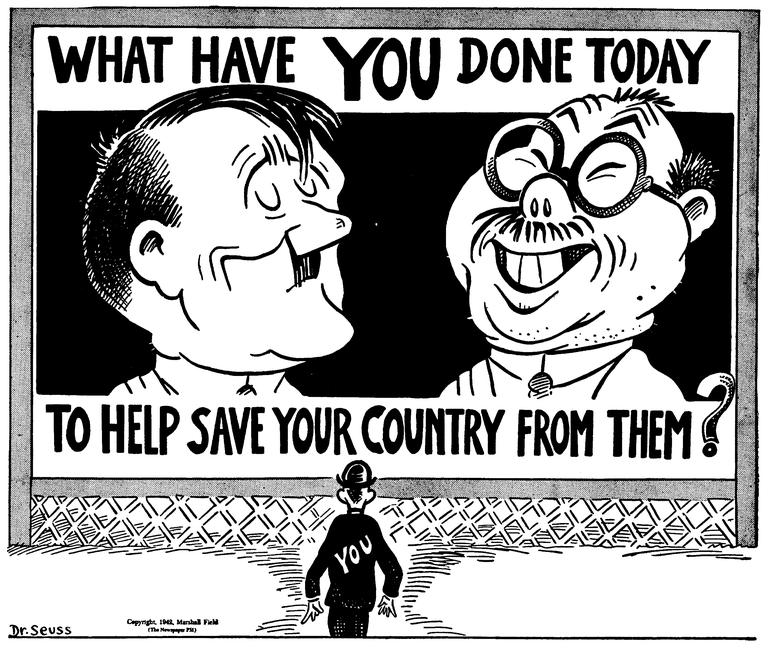
One of the most serious charges against Dr. Seuss was his indefensible support for Roosevelt’s Executive Order 9066, implementing the notorious policy of imprisoning innocent Japanese Americans because of unsupported allegations of potential espionage. Although a majority of Americans did not question this policy, the very nature of Seuss’s progressive stands on other issues makes his failure to show empathy and courage in this case even more disappointing. However, Seuss’s critics, in order to denigrate his full career, have conflated his racist attitudes against Japanese Americans with his tenacious warnings about the Japanese government and military. After American entry into the War, Seuss continued to draw caustic and bold caricatures of the Axis powers, including the Japanese and the Germans. Granted that the line between racial and individual caricature can be dangerously blurred, is this March 5, 1942 cartoon, showing Hitler and Tojo as a double menace, racist?
Only by thoroughly distorting history can Ishizuka and Stephens hold Seuss guilty for aiding the U.S. war effort. Incredibly, they characterize Seuss’s propaganda on behalf of the U.S. and its allies as examples of “white savior” narrative. Many scholars and readers have interpreted Seuss’s Horton Hears a Who (1954) a fable about the value of even the smallest and most insignificant beings, as an implicit response to the devastation caused by the atomic bombing of Hiroshima and Nagasaki. Ishizuka and Stephens dismiss this approach, complaining that “…Seuss never issued an actual, explicit, or direct apology or recantation of his anti-Japanese propaganda…” The expectation that Seuss would have “recanted” his support for an Allied victory in World War II is absurd, but it succeeds in building the argument that the War itself was immoral. Therefore, any motivation for fighting which was rooted in protecting victims of Nazism and Japanese fascism, was worthless. This would include Dr. Seuss’s attempts to warn of the impending genocide against Jews. The article’s authors neatly reduce any reading of Horton Hears a Who as a defense of the vulnerable to the equivalent of contemporary racism, where “people of color are forced to prove their right to life and that their lives ‘matter.’”
Each reader and educator will have to make an individual decision about Dr. Seuss, as well as about any artist whose ideas evolved over time, even as early prejudices left inevitably ugly stains on his work. How much evidence do we need of compassion and bravery in Dr. Seuss’s political cartoons to ignore the grotesque caricatures of African and Asian people which lurk in some of his picture books and cartoons? There is no simple answer to that question. However, Ishizuka’s and Stephens’ recent article, as well as other attempts to banish Dr. Seuss from the American imagination, do not engage with that paradox. Instead, by carefully excluding a major segment of Dr. Seuss’s long career, his dedication to the cause of protecting Europe’s Jews from annihilation, they provide a textbook example of Deborah Lipstadt’s “soft-core Holocaust denial.” A recent piece recommending Ishizuka and Stephens’ viewpoint, at Teaching Tolerance (a project of the Southern Poverty Law Center), sternly warns us that “It’s Time to Talk About Dr. Seuss.” Indeed it is. Jewish readers might well consider the motives for constructing so unbalanced an image of the author and artist. Without turning away from honest discussions of his work, we can continue to call attention to an unforgettable part of his legacy.
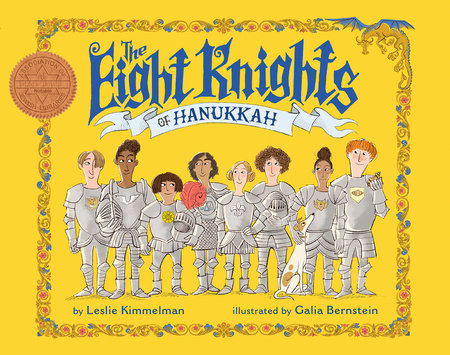
The Eight Knights of Hanukkah – written by Leslie Kimmelman, illustrated by Galia Bernstein Holiday House, 2020
Yes, I know it’s not Hanukkah anymore, or perhaps it would be better to think of the timeline as not Hanukkah yet. Purim has just ended and Pesach (Passover) is around the corner. But it’s a good time to think about inviting the Eight Knights of Hanukkah to your home. Their names are a mix of Anglo and Jewish tradition: Sir Alex, Sir Gabriel, Sir Margaret, Sir Julian, Sir Lily, Sir Henry, Sir Isabella, Sir Rugelach, and their memorable mother, Lady Sadie. Leslie Kimmelman’s humor is welcome, and so is her clear statement that gender roles restricting knighthood and heroism to males are just ridiculous. Galia Bernstein’s inventive illustrations bring medieval manuscripts up to date and make them ready to celebrate the Festival of Lights.
Like so many literary classics for children, the book opens with a map, introducing the village where our story takes place. This not a metropolis; the landmarks listed include little more than a vegetable patch, a bakery, and some lettering indicating that “Here Be Dragon,” and “Hot Soup.” When Lady Sadie sends her eight adult children on a quest to save the last night of Hanukkah from “a dastardly dragon named Dreadful,” they are ready to succeed. Said Dragon has wrought havoc, everything from damaging a child’s dreidel to leaving a woman alone with a huge pile of potatoes ready to be peeled for latkes (potato pancakes), but no helpers available. Each person’s dilemma requires a solution which fits the category of mitzvah, a commandment, in this case, a good deed. Some villagers are sick. Naturally, “Sir Julian, the fourth knight, performed the mitzvah of bringing chicken soup to the sick and keeping company with the lonely.” Throughout the book, there is a careful balance between humor and practical lessons about the obligations of the holiday and of Jewish life in general.
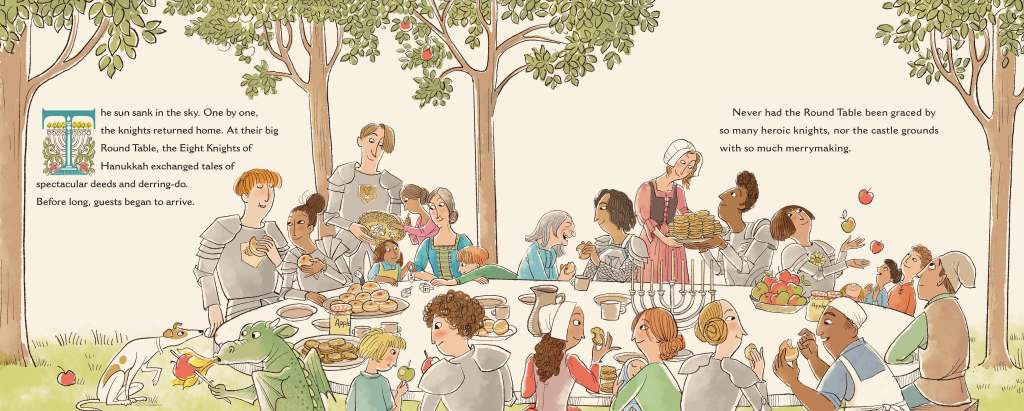
The pictures are just perfect for this story of a group of loyal Jewish knights and a dragon who turns out to be somewhat less terrifying that they would have predicted. Each knight is an individual, with carefully delineated features. Bernstein’s palette recalls a box of recently sharpened color pencils. Piles of sufganiyot (jelly doughnuts) are the same light brown as Sir Lily’s hair, while their red filling matches the roses climbing the trellis to Lady Sadie’s window in the castle. Each illuminated initial beginning a page contains an intricately drawn object: a rolling pin, a cat and dog, and, finally, a beautiful chanukiya (Hanukkah menorah). The book’s culminating feast, where the knights “exchanged tales of spectacular deeds and derring-do” is a truly communal event; multigenerational, multicultural, juggling and dreidel-spinning fun. There is even a young dragon trying out his skills. A note at the end about “The Traditions of Hanukkah” points out that fulfilling mitzvot is a year-round process, so you can definitely start reading and sharing The Eight Knights of Hanukkah now.
The Smile Shop – written and illustrated by Satoshi Kitamura Peachtree Publishing, 2020
A young boy in a bustling city is excited, because he has saved enough money to buy himself “something for the very first time.” The reason for his happiness may be the desired purchase, or perhaps the experience of independence itself, but he is going to savor his trip through the street market before deciding how to spend his money. Satoshi Kitamura evokes the sense of a child’s new freedom, his disappointment when an accident occurs, and the realization that, sometimes, the best things in life are not an expensive toy boat. The Smile Shop gives the sense of both a classic fable and a modern tale of endless choices in urban life. At the end, readers understand that, while the boy’s wish for something new was not trivial, his ability to adjust to circumstances was more meaningful and fulfilling.
There’s a timeless quality to the book. The multicultural city residents wear contemporary clothes. As the boy walks among them, his dark blue sweater and matching boots, and his bright red scarf, cause him to stand out from their gray, brown, and pastel forms. He might be a boy in a fairy tale, or Harold among the creations of his purple crayons. Kitamura’s unmistakable choices for the market’s wonders are not disposable. Instead, the boy is attracted to such serious items as a wonderful-smelling soup , an analog clock, and a finely crafted musical instrument. Young readers may recognize that there are no video games or even sports equipment among his possible choices.
Once his money falls down a street grating, we are in the territory of easily identified disappointment. How did that happen? Was he distracted by too many possibilities? The book then slips from reality to possible fantasy, as the boy enters a shop labeled “Smile.” There are portraits of smiling people on the wall, but the owner at first appears quite serious. In fact, the element of caricature in Satoshi’s drawings, as well as his three-piece suit and bowtie, gives him an intimidating demeanor. After the non-monetary exchange takes place, the boy has been enlightened. Even the economy of the street is transformed, as the search for ordinary goods and services becomes a celebration, with music, dance, and conversation. There is no heavy-handed moralizing about materialism or greed, just an appealing and subtle illustration of ideas. Disappointment is part of life, distraction can lead to mistakes, and people need more than a fancy toy boat or a gourmet meal to be happy.
Little Women Next Door – by Sheila Solomon Klass Holiday House, 2000
Louisa May Alcott’s Little Women (1868-69) has influenced authors, readers, and bookish girls for more than one hundred and-fifty years. The original novel has been reimagined and recreated in film, opera, and theater, and has also inspired numerous works of literature, from biography to graphic novel. I would like to begin looking at some of the novels which respond to the original classic; some of these have become relatively well-known, while others remain obscure. In the latter category is an unusual middle-grade novel by Sheila Solomon Klass, the author of several works focused on female characters. Sadly, there is not even a Wikipedia entry dedicated to her. (Klass is the mother of pediatrician, author, and New York Times health columnist Perri Klass. Dr. Klass is a founder of the children’s literacy charitable program, Reach Out and Read.). Little Women Next Door is based on an unusual premise. Set in the Massachusetts community where Louisa’s father, Bronson Alcott, along with other “consociates,” attempted an experiment in communal living at Fruitlands, it is told through the perspective of a next-door neighbor, Susan, who befriends Louisa and the odd assortment of Fruitlands residents. The narrative makes clear that Transcendentalist philosophy was more of a burden than a liberating experience for women and children.
Susan lives on the adjacent farm with her stern, traditionally Christian father, and her empathetic Aunt Nell. Her mother has died, and Susan is acutely aware of the loss. Her father’s standards are exacting and she has few opportunities to socialize outside of her family. When the non-conformist newcomers show up next door, the first key to their unusual way of life is a man with a long beard. Klass is adept at presenting the perspective of an intelligent child who questions adult behavior while still lacking the confidence to fully trust her own judgments. Soon Louisa becomes her friend and confidante, and her father, who turns out to be more flexible than he had first seemed, actually allows Susan to become a student in their unorthodox school, where experiential learning is the norm. Susan also has a stutter; rendering her speech in the text seems awkward, yet probably as close to accurate as possible. As she gains confidence studying with Louisa’s father and her friends, her speech improves. Klass shows this as an incremental process, not a miracle.
One of the strongest and most compelling characters is Louisa’s mother, Abigail. Her patience with the philosophy of Fruitlands’ male founders is not infinite. Not only is veganism enforced, but other less palatable prohibitions also make everyone’s life difficult, even dangerous. Without a lamp using whale oil, Mrs. Alcott can barely see well enough to read, nor, for that matter, to perform the countless domestic tasks which the supposedly radical men cannot envision as anything but women’s work.
The villain of the story is based, as are most of the characters apart from Susan and her family, on an actual person. Charles Lane was a British philosopher whose rigid adherence to abstract ideals, as well as his overall incompetence, reduced life at Fruitlands to a daily struggle for survival. Yes, they are abolitionists and committed to progressive education and other causes, but Lane’s insensitivity borders on cruelty. When he attempts to force the Alcott’s to join him, and his motherless son, at a Shaker community, Abigail refuses. Enforced celibacy and its destruction of her family relationships are beyond her ability to compromise.
Susan sees adults and their shortcomings clearly. Klass’s creation of this fictional character exposes their hypocrisy and Bronson’s weaknesses, but also his tenderness and Abigail’s strength. Most importantly, it brings out Louisa’s wild imagination as she invents the stories that will become the beginning of her career, eventually chronicling the lives of girls and women. Sheila Solomon Klass has offered a different angle on Little Women’s creator, elaborating on her challenging childhood and her fierce support for the people around her.












 Imaginary Elevators