
Whistling in the Dark – Shirley Hughes, Candlewick Press, 2017
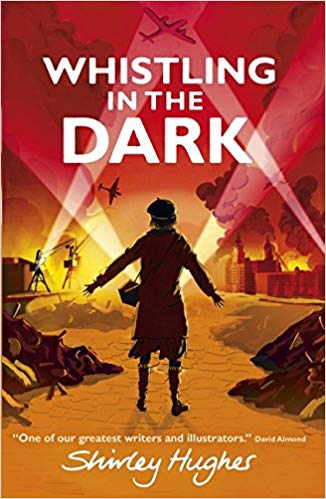
There are some English language authors better known on one side of the pond than the other. One of these is Shirley Hughes, born in North West England in 1927. The author of more than fifty books, Hughes is best known for stories for young readers, which she both writes and illustrates. Her culturally and generationally diverse world of mums and dads caring for young children is appealing and realistic, even comforting. Hughes’s series about the siblings Alfie and Annie Rose , and her enchanting rhymes and pictures of everyday life in other books for the youngest readers, have won her many awards in her native Great Britain. Only two years ago, this talented octogenarian decided to try something new, and wrote two middle grade novels set during World War II.
Whistling in the Dark describes the challenges facing Joan, a fourteen -year-old girl growing up, as Hughes herself did, near Liverpool during the years when German bombers threatened the lives and security of her community, as well as that of all the Allied nations. The value of this compelling story is immeasurable, both for its historical setting and for its examination of an adolescent’s resilience under intense pressures. The book is dedicated to “those brave men who served in the British Merchant Navy during the Second World War,” a large number of whom lost their lives when the Germans sunk ships that were bringing crucial supplies of food, armaments, and other necessities to their country.

In the novel, Joan’s father had been killed before the War, when the ship on which he served caught fire. Joan’s loss, therefore, is a sort of warning of the catastrophic losses which would affect many more families in the coming months and years. After his death, Joan’s mum had temporarily become “too ill with sadness to manage,” while Joan herself gradually began to remember her father as a distant image, one which she compares to the British painter J.M.W. Turner’s famous painting of a burning ship.
I found it dissonant to read Joan’s admission that “If she was being really honest, she didn’t miss Dad so much now,” not because I found the idea to be implausible, but because the rest of the book does not support her claim. Continue reading “Keep Relatively Calm, and Carry On”












 Imaginary Elevators