Flying Over the Truth: a Sadly Misleading Story of World War II

Thirty Minutes Over Oregon: A Japanese Pilot’s World War II Story – Marc Tyler Nobleman and Melissa Iwai, Clarion Books, 2018

30 cover

People seem drawn to children’s books about reconciliation. After all, even adults feel comforted by the idea, however illusory, that every terrible event has a valuable lesson or conclusion.  When reading with children, we want to be even more careful to emphasize redeeming moments within even the worst events whenever it is possible to do so.  However, this inclination shouldn’t lead to disrespect for the truth. Marc Tyler Nobleman and Melissa Iwai’s Thirty Minutes Over Oregon is a profoundly disturbing, if compellingly narrated and gorgeously illustrated, story.  Nobleman purports to tell the story of a sensitive and contrite Japanese bomber pilot and the Americans who forgive him for his unsuccessful attempt to destroy a community in Oregon in 1942.  The book completely whitewashes the context of this terrible event; it is more the story of an American author wanting to find the good in an overwhelmingly dark period of history than it is the story of a failed Japanese bomber.

Japanese aggression in the cause of consolidating economic and political hegemony in Asia led to their alliance with Nazi Germany and their attack on Pearl Harbor.  In China, Korea, and other parts of Asia, millions of people suffered and died because of Japanese fascism and militarism. Allied soldiers died in the Pacific Theater of War, and many more returned with life-long injuries, both physical and psychological.  Of course, the Japanese people themselves suffered tremendous losses, culminating in the atomic bombs dropped on Hiroshima and Nagasaki by the United States in order to end the War. While Nobleman chooses to focus his story on the personal experience of pilot Nobuo Fujita, he fails to provide the context of this man’s personal near-tragedy and search for forgiveness.  In a book for elementary school-aged readers, this omission is serious, as is Nobleman’s rather manipulative choices in describing historical events.

First, the design and the illustrations of the book are outstanding.  Melissa Iwai is a gifted artist whose pictures capture both the human actors and the epic proportions of the story, including the first two- page spread where Fujita approaches the submarine that will transport him to his mission.  He appears quite small in relation to his airplane and even smaller in comparison to the massive sub.  Nobleman presents Fujita, not as the loyal servant of a dictatorial regime, but as a somewhat positive example of Japanese culture, as he “strode across the slippery deck,” and “gripped the 400-year-old samurai sword that had been in his family for generations.” While family symbols and deeply rooted customs may be either good or bad, there is nothing here to indicate any problem with Fujita’s modern application of an ancient code of war (for a counterpoint, see here).

Nobleman does describe Fujita’s mission as one of destruction, as his bombs will aim to ignite and destroy Oregon communities.  Yet the picture of him in his bombing gear looks heroic, and we learn that he left  his wife “strands of hair and fingernail clippings” to be buried if he did not return.  Everything about his failed mission is described from the pilot’s point of view, with little commentary. After both his first and second attempts fail, Fujita vows to die “with honor” by deliberately crashing his plane.  Only confusion about the actual failure of his mission allows him to avoid suicide. He returns home; as his ship lands, Fujita “gazed through binoculars to mask his tears.”  No child reading or listening to this story will feel anything but empathy for the pilot, who was only one of many who served a tyrannical regime, whether willingly or reluctantly.

Fast forward to 1962, when the residents of Brookings, Oregon, or at least some of them, decide to invite Fujita to a Memorial Day celebration.  Nobleman and Iwai depict those residents opposing this choice as hard-hearted fanatics. We see a frowning picketer bearing a sign that says “NO to Nobuo Fujita.” This is only seventeen years after the end of a war that cost millions of lives.  “Despite the pressure to cancel the visit,” the town would host Fujita, as a “symbol of reconciliation not just between individuals but between nations.”  Residents of the town he nearly destroyed joke with their former enemy that he is “one of the worst fire-setters in the world.” Again, it seems doubtful that children will understand enough about the Cold War and the eagerness to avoid Soviet influence that contributed to encouragement of reconciliation with former Axis powers. Support for Fujita’s visit appears completely as a spontaneous outpouring of forgiveness. In a telling indication that Fujita’s remorse is tinged with the very obedience to authority that he upheld during the War, he brings his samurai sword to Oregon because, if his apology is not accepted, “he would use the sword to commit seppuku, traditional Japanese suicide by a person overcome with shame.” This book has received positive reviews. Am I the only reader to find it strange and alarming that a book for young children uncritically describes suicide as a response to shame? Is Nobleman blinded by the fact that seppuku is part of a foreign culture, and therefore somehow not subject to moral judgement?

When Nobuo Fujita again returns to Oregon in 1990, by which time World War II is a distant memory, he is greeted at another celebration, where he is served “a large submarine sandwich topped with a plane made of sliced pickles and a half-olive helmet.” It’s difficult to comment on this stunningly inappropriate joke, except to point out, again, that children reading this book will not see it as evidence of historical ignorance or insensitivity.

Nobleman’s “Author’s Note,” which might have provided some clarification, is disappointing.  He refers in it to the internment of Japanese Americans after Pearl Harbor. This unforgiveable and unconstitutional infringement on the civil rights of loyal Americans should never be forgotten, but Nobleman fails to include other relevant facts about the War and Fujita’s mission.  He briefly mentions one episode that really transforms the presentation of Fujita’s story from a pathetic failure to an ominous precursor. In 1945, a Japanese balloon bomb did explode, again, in Oregon, this time killing six people. Nobleman fails to mention that they were members of a Sunday school class on an outing; the dead included both students and the minister’s pregnant wife. Finally, Nobleman refers to Fujita as a “noble figure.” No, he was not. He was, like many soldiers in wartime, a cog in a machine. He may indeed have felt sincere remorse and suffered emotionally for his deeds, but I don’t believe that we should present his life to children as an example of nobility. Were Nazi soldiers noble? Were Southerners who died fighting for the Confederacy?  Even when people have limited choices and we feel reluctant to judge, glorifying their deeds to children is a terrible idea. If you would like to read a true example of noble behavior by a Japanese dissident, I recommend Passage to Freedom: the Sugihara Story, by Ken Mochizuki and Dom Lee.



Swimmy: We’re All in This Together

Swimmy – Leo Lionni, Knopf Books for Young Readers, 1963

swimmy

When a tiny black fish realizes that he can swim faster than the rest of his school, he needs to get serious about solidarity and self-preservation. All the other fish are red, and the lack Swimmy’s sharp eye and sense of purpose. Although Swimmy was “…scared, lonely, and very sad,” he learns that panic in the face of existential terror just won’t work. He loves his home, the sea, which is full of wonderful and strange creatures. There is a lobster “who walked about like a water-moving machine,’ and some bigger fish moving together, as if “pulled by invisible thread.” When his fellow little fish warn him that, if he tries to enjoy his life, a bigger fish will eat them all, Swimmy concludes, “We must THINK of something.”

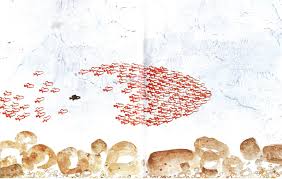
Next year marks the twentieth anniversary of Leo Lionni’s death.  He had a well-established career as a graphic designer before beginning his life as a children’s book author and illustrator.  Lionni was from the Netherlands. His father was Jewish, and his family fled the Nazis, settling in the United States.  If you want to learn more about the circumstances and gifts that led him to create Little Green and Little Yellow, Frederick, Fish is Fish, and many other beautiful and contemplative works for children, read his autobiography for grown-ups, Between Worlds (Knopf, 1997). Swimmy is a fable set in the water and in the consciousness of a child.  The little black fish is pragmatic and visually defined; his surrounding red friends are mere outlines moving aimlessly among the soft grey water and plants, about to be menaced by a huge predator.

index

These fish need to work together, and they also need a strong but unassuming leader.  Lionni ingeniously transforms the small fish into one big one, in a formation designed to deceive the big fish who threatens them.  Once they understand the need to band together, Swimmy assures them that he will do his job: “…and when they had learned to swim like one giant fish, he said, ‘I’ll be the eye.’” Some of the characters in Lionni’s stories are dreamers, like Frederick the poet mouse, or the minnow of Fish is Fish, who needs to learn his place in the world.  Swimmy is more of a community organizer, an optimist but also a realist, who learns that his fear is rather useless in confronting a big, scary, bully.  He restores harmony to the sea, as the lacy outline of little red fish against blue watercolor waves moves steadily onwards, “and chased the big fish away.”

Snow, Not Sugar

Waiting for Snow – Marsha Diane Arnold and Renata Liwska, Houghton Mifflin Harcourt, 2016

snow cover

Many of us have begun waiting for snow, at least in some parts of the world. Of course, the nuisance of driving and cleaning up is meaningless to children, and also, as it turns out, to badgers, rabbits, and voles. Marsha Diane Arnold’s text and Renata Liwska’s pictures capture the ways in which impatience leads us to make improbable gestures, like throwing pebbles at clouds or shaking sugar from a roof.  Fortunately, these uninhibited and anxious friends have a hedgehog to assure them that “It will snow in snow’s time…All we have to do is wait.”  He doesn’t condescend to his friends or lecture them about magical thinking.  Hedgehog is full of wisdom and empathy, and children will learn from this book that silliness, even if it doesn’t make anything important happen, is its own reward.

The repetition of Hedgehog’s reassuring refrain, with slight variations, is accompanied by delicate and fanciful creatures engaged in everyday activities.  In one two-page spread, Hedgehog is teaching a class (Math? Botany? Philosophy?). He draws plants and the sun on an old-fashioned blackboard, while his students watch with varying degrees of interest. Vole has fallen asleep, while Bear attempts to add some numbers on a small slate.  Rabbit is the eager front row kid with his hand raised, while Badger turns in his chair and grips a pencil, although he has no writing surface.  Discussing the predictability of natural events such as sunrise and the blooming of crocuses, Hedgehog intones, “Sometimes they come late and sometimes early, but they always come in their time.”

wait1

Badger figures out that he just has to wait, but the fact that this is true doesn’t reduce his frustration. He sits with his legs pulled up and his face burrowed in his arms, as all his friends register concern. Possum reaches gentle to touch Badger with his fingertips, and Hedgehog, as practical as he is knowledgeable, offers Badger a sandwich, which he stubbornly refuses.  The next two pages show many ways to pass the time, and even Badger joins in, playing with tangled yo-yos, and even peeling potatoes. The other animals read, play dominos, skip rope, and sleep.  Even Hedgehog, who knows how everything will turn out, knits a cap, conveniently storing the pastel colored balls of yarn on his prickles.  Children don’t always need explanations as much as distractions; Arnold and Liwska let readers know that sometimes anticipation leads to…snow.  The steady and measured pace of the story and the resonant images of childhood give this book tremendous appeal.

Apparently, putting on one’s pajamas backwards is a sure way to invite snow.  I’m not sure what the source of this detail was for the author and illustrator, but I was told by my grandmother that putting on an article of clothing backwards or inside out, if you did it inadvertently, brought good luck.  Kids may want to try this out.

Being Jewish: A to Z

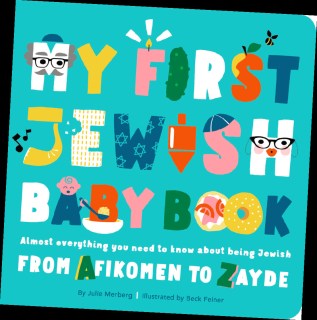
My First Jewish Baby Book: Almost everything you need to know about being Jewish – Julie Merberg and Beck Feiner, Downtown Bookworks, 2018

My First Jewish Baby Book cover.jpg

“Welcome to the tribe,” the back of this charming board book announces.  My First Jewish Baby Book promises to introduce new Jewish little ones to holidays, rituals, and the “expressive language of their people.” To quote Tevye, “Sounds crazy, no?” Julie Merberg and Beck Feiner have actually created a funny and eclectic summary of Jewish life that is not only, or even mainly, for babies.  Brightly colored pictures and playful text rapidly associate different holidays and customs for the sake of rhyme. The result is a quirky and humorous ride through the Jewish life cycle, along with a warm and sincere salute to the Jewish values that a new baby will come to know, from his bris to her first Purim party, and beyond.

If you are look for an introduction to the alef-bet (Jewish alphabet), this is not it.  The book is in English, beginning with the afikomen (matzo) hidden by parents and found by kids at the Passover seder, and ends with zayde, Yiddish for grandfather.  Some of the choices seem the result of free association, such as the combination of two different holidays, Hanukkah and Purim, for “G” and “H,” in order to include gelt (chocolate coins) and hamantaschen (pastries shaped like a three-cornered hat to commemorate Queen Esther’s heroic victory over the wicked villain of the Purim story.) This method may make less sense as a teaching tool, but quite a bit of sense in reflecting the way kids think about the world, in this, case, through the connection between different but delicious foods.

Speaking of food, my second-favorite two pages in the book are “K is for Kosher,” where the author enthuses about kugel, knishes, and kasha, (potato or noodle pudding; pastries with meat, potato, or other fillings; and buckwheat often served with egg bow pasta). The grown-up in the room, shown from only her mouth down to emphasize the importance of eating, is wearing a lobster bib with the treif (non-kosher) seafood marked off-limits with the circle/backslash symbol.  A little boy stands in front of the table, but his mouth doesn’t reach the surface. Hopefully, he reaches his hand towards the kugel…

Continue reading “Being Jewish: A to Z”

Dr. Jo: Information and Inspiration

Dr. Jo: How Sara Josephine Baker Saved the Lives of America’s Children – Monica Kulling and Julianna Swaney, Tundra Books, 2018

drjo

We are fortunate to live at a time when children’s books about women who serve as role models for girls are appearing every day. Monica Kulling, the author of several outstanding informational books for children (see my previous posts here and here), and Julianna Swaney, a gifted and versatile artist and illustrator, have given us a new biography of pioneering woman physician and social activist Sara Josephine Baker.  While there have been many books about Elizabeth Blackwell, America’s first woman doctor, Jane Addams, birth control advocate Margaret Sanger, and the courageous and persistent African-American women mathematicians at NASA, the subject of Dr. Jo is less well known.  Sara Josephine Baker was a doctor who, at the turn of the twentieth century, made the commitment to dedicate her life to improving the desperately poor and underserved residents of New York City’s Hell’s Kitchen neighborhood.  Central to her crusade was faith in the ability of women, doctors, midwives, mothers, to improve lives.

This book is an incredible achievement.  The text is rich in information, carefully selected and presented to elementary and middle grade readers.  Children with little background information will learn that “Diseases such as smallpox and typhoid fever spread like wildfire, especially among the young…Dr. Jo was saddened to think of the many children who died there every week. She was determined to help.”  Both the facts causing the tragedy, and Dr. Jo’s motivation, are clear.  Kulling explains the difficulties of immigrant life in this diverse community, and the realities of home births attended by untrained midwives, women whose important role Dr. Jo does not dismiss; she plans to license them.  Kulling describes other specific health challenges: poor swaddling methods, dirty eye drop containers, and simple hunger.

drjointerior

One of the most memorable features Dr. Jo is its perfect match between words and pictures.  Swaney’s people have simple but expressive faces, round with dots for eyes and a line for a mouth. Subtle differences in these features convey actions and feelings.  In one picture, Dr. Jo looks into a microscope. Her intense focus shows in her one closed eye and one hand delicately moving the slide.  Her desk is covered with carefully placed significant objects, each one meaningful to the story: her eyeglasses, a fountain pen, a Bunsen burner.  She has determined the solution to the problem of contaminated bottles: “The midwife could be confident that the drops were clean and perfectly measured.”  Each word and each element in the picture reflect one another. On the facing page, Dr. Jo is sitting on a bench in Manhattan’s Bowling Green Park, making careful notes in a small book.  Kulling tells us that Dr. Jo “put her mind to the problem of the flawed eye-drop containers…while sitting in Bowling Green Park, she watched bees at work…” Children playing in the background and the bright pink of a circular flower bed emphasize how the doctor is working in the real world, but not distracted when she needs to focus.

Dr. Jo is a book to read and reread with children, and still relevant today.   It will immerse them in a time and place where the immigrant poor were ignored and disadvantaged and where a stubborn, intelligent, and improbably successful women refused to accept the circumstances of their, and her, lives.

Grief and Anger After Pittsburgh


431041

I am writing today, in the aftermath of the slaughter in Pittsburgh, to recommend a few articles..with a focus on children’s literature…about the terrifying rise of anti-Semitism in our country and the world, and also about the need to remain unified in the face of overwhelming threats to human life and to freedom.

1) HIAS, the Hebrew Immigrant Aid Society, teaches children about refugees.

2) There have been several good articles about HIAS and its role in the lives of Jewish, and other, immigrants.

3) The New York Times is running a series of obituaries of previously overlooked women.  Rose Zar, a Holocaust survivor who died in 2001, co-authored a memoir for adults and young adults with well-known children’s author Eric Kimmel.

4) The Atlantic Monthly has a thoughtful and courageous piece about how and why a reassuring statement by the late Mr. Rogers..a genius in communicating with children… has been misapplied to the adult world.

5) The Forward has several short profiles of those killed in the synagogue, commemorating their lives and ensuring that they are not remembered only as statistics.


Corduroy is Back!

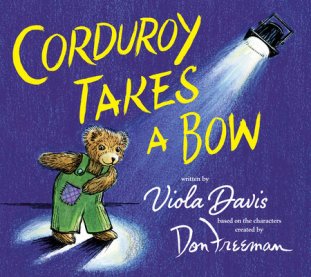
Corduroy Takes a Bow – Viola Davis and Jody Wheeler, based on characters created by Don Freeman,      Viking, Penguin Random House, 2018

corduroycover

In his fifty years, Corduroy the Bear has had a couple of close calls. Nearly ignored in a toy store, left behind in a laundromat, he has always been reunited with his friend, Lisa, reassuring children that people will look out for them and reward them with the affection they need and deserve.  In actress and author Viola Davis’ new book, Corduroy goes to the theater, where he is accidentally transformed from a spectator to an actor. He is acclaimed in his new, if brief, career, but is happiest returning home to Lisa’s apartment and her homemade doll stage, where two carefully aimed flashlights illuminate her original play.

Don Freeman, the original creator of Corduroy, will be the subject of an upcoming show at the Museum of the City of New York, (link below). Viewers will be fascinated to learn about the multifaceted artist’s work, including his brilliant depictions of the New York City theater and jazz worlds, as well as everyday street scenes of the adopted home.  Freeman was immersed not only in the world of teddy bears, but of guys and dolls as well…. Continue reading “Corduroy is Back!”

A Long and Winding Road

The Ghost Road – Charis Cotter, Tundra Books, 2018

ghost road

What is a curse?  Who is your real family?  Does the place you were born determine who you are? These are some of the questions brought to light in Charis Cotter’s The Ghost Road, a young adult novel for readers who don’t necessarily like ghost stories. Set in the Newfoundland of the 1970s, and rich with the particulars of that place, The Ghost Road follows the long and winding journey of cousins Ruth and Ruby as they try to unravel the real nature of the “curse” which plagues their family and their community.  There are sets of twins with Shakespearean qualities, and historical elements which ground this tale and make it sophisticated and engaging on different levels.  There are also two young girls who are mixed-up about who are the most important and trustworthy people in their lives.  So whether you are just looking for a chilling tale of adventure or more interested in identifying with appealing and serious characters, The Ghost Road will not disappoint.

The novel impressively combines dramatic tension with philosophical exploration.  Ruth and Ruby are intelligent and literate. They are aware of history, both of their own families and of Newfoundland, but they are motivated to learn more and to ultimately discover if the curse on their clans is a figment of everyone’s imagination and a self-fulfilling prophecy.  I found myself anxious about the outcome of their quest, as if could somehow influence its conclusion.  The author meets the challenge she has set herself in weaving this unusual story, which, without revealing any spoilers, doesn’t end as a shout-out to fans of the paranormal.  Instead, young adult, and older adult, readers will find much common ground and room for empathy as Ruth and Ruby seek to stop history and turn it around going forward.

The book is beautifully designed, with a spectral figure on the cover, and white lettering against the background of Newfoundland foliage.  There is a family tree, as well as ongoing attempts by the main characters to, literally, sketch their own as they attack the mystery in real time.  Chapter titles are short and enigmatic: “The Shipwreck,” “The Candle,” The Root Cellar,” and the author doesn’t waste words or leave loose ends as her characters painstakingly untangle their personal mystery. Just when it seems that a character is predictably two-dimensional, more a symbol than a person, changes happen and surprises ensue.

“My heart nearly stopped…So maybe this is it, I thought.  This is how the curse ends.” Not only is it unclear initially how the curse will end, but Charis leaves the reader with unanswered questions about what will come next for Ruth and Ruby.  The Ghost Road is a human story where people live in both the present and the past, trying to change their future.


When You Wish Upon a Daruma Doll

Jasmine Toguchi, Flamingo KeeperDebbi Michiko Florence and Elizabet Vuković, Farrar, Straus and Giroux, 2018

flamingocoverx

In the most recent release in the Jasmine Toguchi saga, Jasmine’s dilemma involves wanting a pet, which is typical. The pet is a flamingo, which is not typical.  One of the most attractive qualities of the series and its heroine are the familiarity of the little girl’s challenges and the distinctly individual feeling of her responses to them. Along the way towards understanding herself and her family, Jasmine introduces Japanese customs to young readers in a natural and delightful way.  In Jasmine Toguchi, Mochi Queen we rooted for Jasmine’s persistence in assuming a new role for girls within the Japanese New Year’s custom of preparing special rice treats. In Jasmine Toguchi, Flamingo Keeper, Florence embeds the traditional practice of using daruma dolls to make and fulfill wishes within the recognizable story of a child who longs for an unrealistic outcome. (The book includes instructions for a daruma doll craft project.)  I really didn’t know how this one would turn out! A flamingo seemed an unlikely pet, but then again, so did the idea of a tough little girl pounding rice into mochi flour in defiance of male authority.

Jasmine’s beloved Obaachan (grandmother) sends both Jasmine and her older sister, Sophie, paper daruma dolls. Their parents explain that they will need to fill in one eye on the traditional doll as they make a wish, and wait to complete the other eye until the wish is fulfilled.  No problem! Now Jasmine will get the pet flamingo she has always wanted.  (Jasmine’s mom, an editor, tells her that she had used the doll to wish for a dictionary when she was a child. I love her!) Later, in a video chat, Obaachan explains to the girls that they will need to make their wishes come true: “Nothing come free. You work hard. You make goal.” Well, that’s a little deflating, but Jasmine learns a powerful lesson, with the help of her parents, and even her sometimes mean but often loving older sister.

Vuković’s pictures are expressive and kid-friendly portraits of situations and emotions, but also draw on traditional Asian brushstrokes.  The book is beautifully designed, with Jasmine on the cover, arms crossed in triumph, with her fantasy-flamingo, complete with collar and leash.  The picture of the video chat with their grandmother centers on the older woman’s kindly face on their computer, and the back of Sophie and Jasmine’s heads, as we imagine the skeptical but respectful expressions as they listen to Obaachan’s instructions.

There are many middle grade novels, fortunately, about strong little girls making their mark in the world; it isn’t easy to create a heroine who stands out for her fortitude and imagination, as well as her ability to navigate two cultures.  Debbi Michiko Florence and Elizabet Vuković have succeeded. I look forward to more of Jasmine’s realistic conflicts and touchingly imperfect resolutions.


Goodnight Stars, Goodnight Air, Goodnight Anne Readers, Everywhere

Goodnight, Anne – Kallie George and Geneviève Godbout, Tundra Books, 2018

anne cover

The cover of Kallie George and Geneviève Godbout’s new introduction to Anne of Green Gables for the youngest readers seems a beautiful and lulling invitation to sleep. If you are too young to have even heard of Anne Shirley, the little girl asleep on a tree limb, wrapped in a floral fringed blanket, is calm and soothing. Her red braids are as still as the rest of her. Her eyes are closed and smile is evidence of a lovely dream.  Actually, children are about to meet Anne Shirley, the irrepressible heroine of L.M. Montgomery’s Anne of Green Gables series.  When awake, she is a dynamic and exciting dreamer, even in her waking dreams.  Young readers could not have a better introduction to Anne.

 Goodnight, Anne is appealing to adults, as well, but is not the kind of almost-parody of, for example, the BabyLit series, whose charming pictures are appealing to toddlers while reminding grown-ups of books which they may not have read in a while. George and Godbout have created an absolutely sincere and unaffected homage to Anne, with simple text that suggest the spirit of the original without attempting to summarize.  In fact, the book begins with a short conversation between Anne and her guardian, Marilla, without any explanation of who these characters are.

Goodnight+Anne+1

On the following two pages, we meet Marilla’s kind and generous brother, Matthew: “Goodnight, Matthew, shy and sweet./Thank you so much for the dress/with real puffed sleeves.” This immersion in Anne’s life without formal introductions is an unusual approach to reframing a classic. It works. A child enjoying the book with an adult can ask questions; they usually do! However, since Godbout’s pictures eloquently express the love and care of the adults in Anne’s life, children may simply understand without words the role that these people play.

Goodnight, Anne is the second book by Kallie George to extend L.M. Montgomery’s audience.  Anne Arrives, reached middle grade readers.  George shows the same fidelity to the spirit of the original Anne series in this picture book, an even more challenging task.  Readers of Anne of Green Gables know that Marilla, although ultimately revealed to be a deeply caring maternal figure, is initially strict, even harsh. Here is George’s brief and poetic admission of this fact:

“Yes, Marilla, sensible and strict.
Sometimes, oh, how much you miss!
But goodnight, Marilla.
I love you so.” Continue reading “Goodnight Stars, Goodnight Air, Goodnight Anne Readers, Everywhere”