Lights in Autumn

Garland of Lights: A Diwali Story – written by Chitra Soundar, illustrated by Amberin Huq
Bloomsbury Children’s Books, 2024

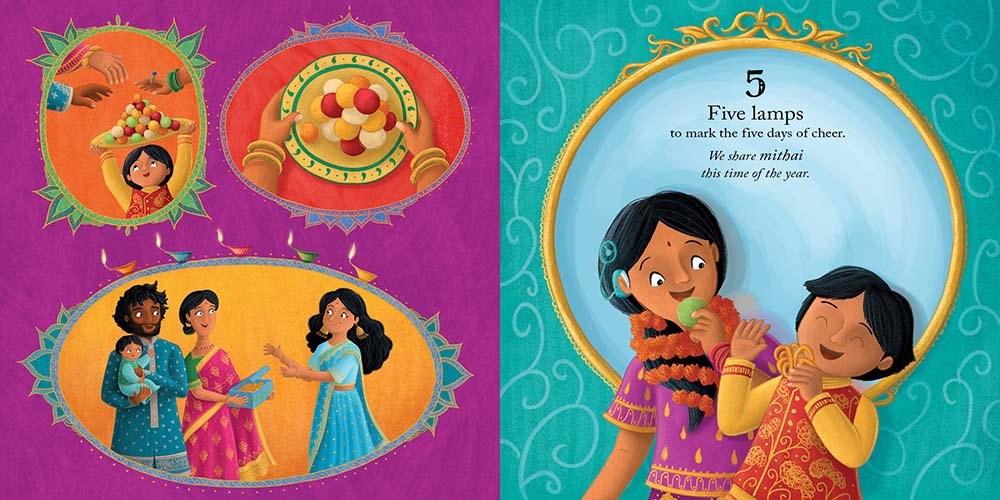
Garland of Lights using a counting book format to inform readers about the essentials of Diwali, the Hindu celebration, shared by some other Asian religions, that commemorates the end of the summer harvest and the transition to a new season.  The intergenerational emphasis, lush colors by Amberin Huq, and enthusiastic text by Chitra Soundar, will resonate with young readers, whether they are already familiar with the festival or come to the book with little knowledge of Hindu observance.

Each two-page spread begins with a numeral and a number of lamps associated with one aspect of Diwali.  Italicized text emphasis an important concept in terms accessible to children.  The first lamp represents the goddess of wealth, and her significance in offering blessings of wisdom and health. Three lamps signal a personal and communal obligation to heal conflicts. Seven lamps remind readers of hospitality, and eight lamps correspond to the festive fireworks display lighting up the night.  The book’s backmatter includes and essential explanation of the festival and a glossary; adults might choose to share this with children before beginning to read the book.

Light is the central concept of the book, and the illustrations reflect this in bright jewel tones. Different skin and hair colors of the holiday’s celebrants, as well as the broad span of ages, make an appealing package. The overall effect of turning the pages, reading the words, and enjoying the images, adds up to immersion in the festival’s multifaceted practices.
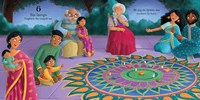
In the scene for six lamps, the rangoli, floor decoration, crosses the book’s gutter, and displays the lamps. Each lamp is separated from the others by enough space to emphasize its difference.  Babies, children, and young and old adults span the picture in a semi-circle; like the lamps, each person’s clothing is a different bright color. The grandmother’s deep red dress is surrounded by emerald-green, sky blue, and magenta outfits of her family members.

The holiday of Diwali encompasses a number of seasonal, religious, and historical events and beliefs.  A Garland of Lights strings together and illuminates several of them with graceful words and pictures.
Sisters vs. Goblins

Into the Goblin Market – written by Vikki VanSickle, illustrated by Jensine Eckwall
Tundra Books, 2024

Into the Goblin Market is not a young reader’s version of Christina Rosetti’s (1830-1894) provocative poem, but the picture book is an imaginative response to that work. Even if you knew nothing else about this fantastic, in both senses of the word, work, you would have to be impressed at the choice of this literary homage.  But Into the Goblin Market stands out all on its own.  Two sisters, Mina and Millie, use the strength of their unbreakable bond when Mina disappears, perhaps to be consumed by malign forces.  Millie, confronting the supernatural terrors of classic fairy tales with an undertone of Rosetti’s feminist poem, rescues her beloved sibling and they return home. The poetry is hypnotic, the pictures are stunning, and the sisters are undefeated through their love.

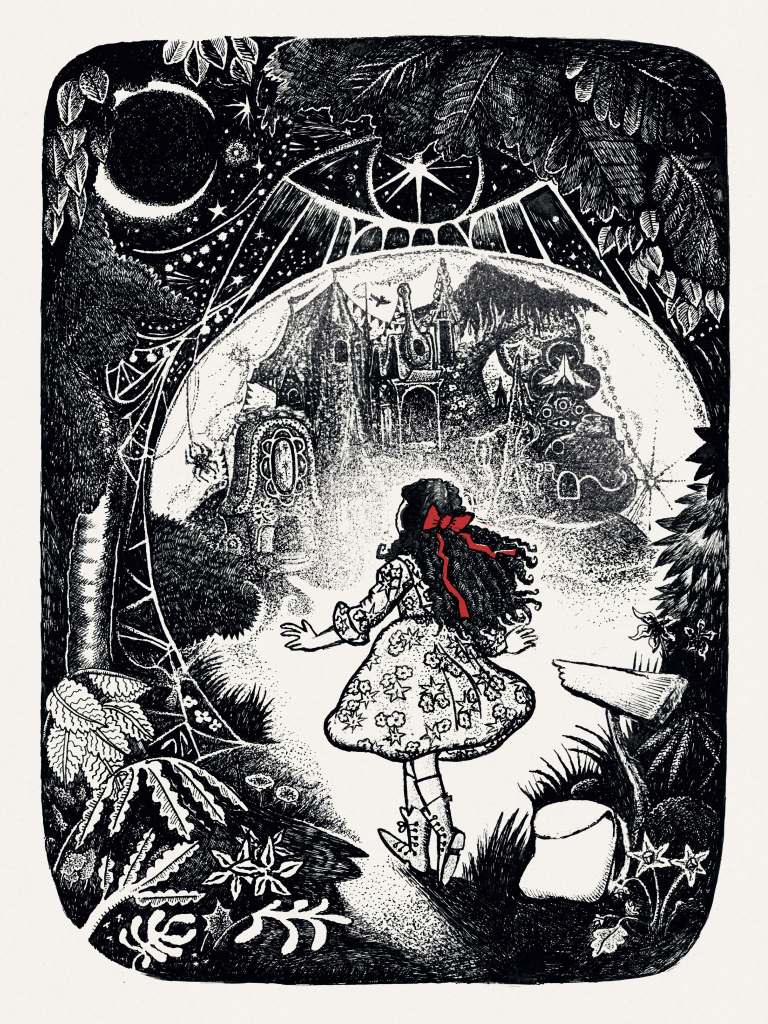
On the cover, (link to image) in Jensine Eckwall’s ink-drawn and digitally edited, illustration, Millie is seated in an alcove reading a book, while Millie looks down on the scene, as if thinking of ways to escape.  As Vikki VanSickle writes with concision and humor, “Millie’s manner was reserved/but Mina had a lot of nerve.” Those qualities set the scene for their adventure.  While her sister is sleeping, Mina leaves the safety of their farm, and stumbles on the land of the goblins, where she will disappear. Their tempting sales pitch works on a girl eager for change, but their high-stakes words contain an implicit warning: “Make a choice and make it quick!/Make it while the magic’s thick.”

Meanwhile, back in their home, Millie is awakened by a dream that communicates her sister’s flight.  With visions of goblins making her uneasy, she looks for Mina but does not find her.  The interior of their house, like every scene in the book, is rendered in black with deep red touches highlighting elements of importance.  Millie looks through a window from one bedroom to another, her face and upper body surrounded by a jagged red halo. Downstairs, a red cloak, alluding to familiar fairy tales, hangs on a hook. A bookish girl, she naturally turns to her books, searching through them for resources on how to rescue her sister.  Finally, it is time to take action and she assembles the tools for her journey: “She took some wool, a crust of bread/and donned her cloak of crimson red.” 

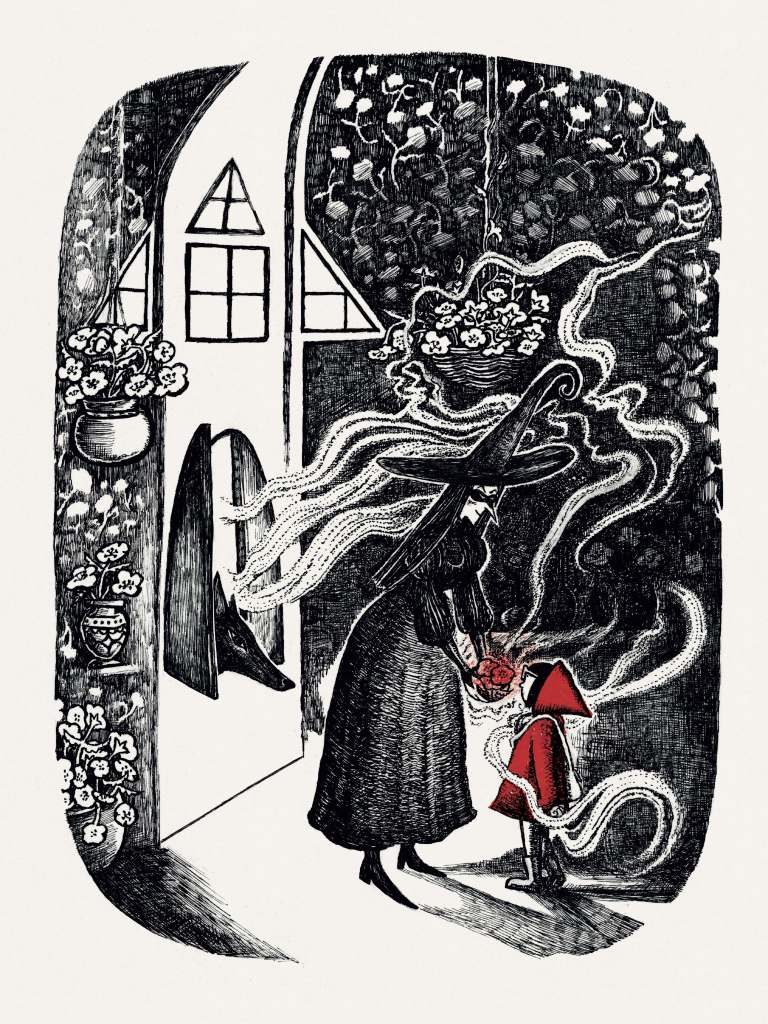
VanSickle employs the language of classic folklore without resorting to overt imitation. Her images, too, recall this literature, but take the form of eclectic blends.  A tall witch-like figure hands a bouquet of red poppies to Millie, wearing her red cloak.  Emerging from the figure’s home is the elongated face of a wolf.  Those poppies are as potent as a poison apple, and soon Millie’s “consciousness began to drift.” 

Finally, the sisters are reunited. They sit together in a bed of flowers, surrounded by the comforts of nature and the knowledge of Millie’s bravery has saved their lives and relegated goblins to the past. But without Mina’s urge to challenge boundaries, there would not have been a book.

Enjoying Coffee Together

It Is Okay – written and illustrated by Ye Guo
Eerdmans Books for Young Readers, 2024

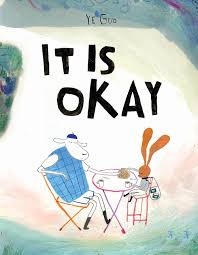
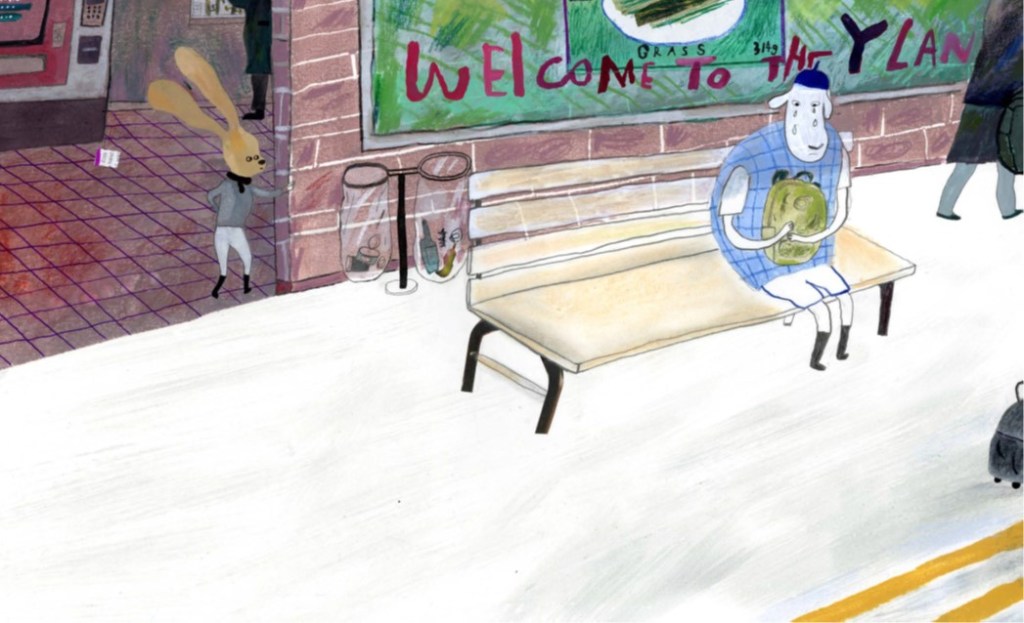
Goat and Bunny, who are simply named but hardly generic characters, enjoy more than just coffee. They are best friends, although their personalities are different.  They complement one another, accept the ways they are not the same, and understand that changing each other is definitely not a good goal. It is okay to be who they are.  Ye Guo’s words are reassuring in their simplicity, and her pictures, composed in pencil, colored pencil, wax pastel, watercolor pen, ink, and collage, are perfectly balanced and exquisitely detailed.  From the plaid endpapers to the relaxing meal together surrounded by books, sweetened coffee, and grass on toast, their friendship is one for both children and adults to admire.

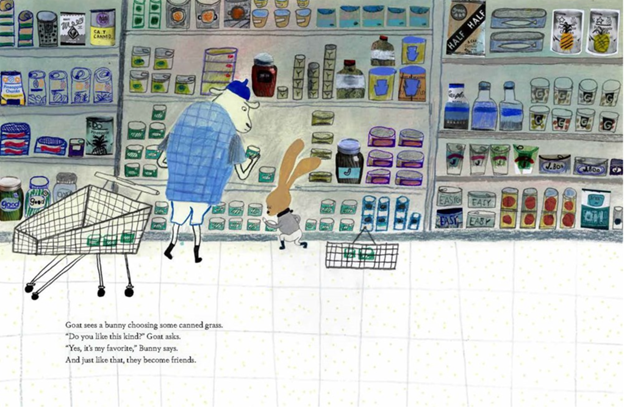
They meet in the supermarket, a visit prompted by Goat’s realization that he is out of canned grass, which he always eats on toast. We meet him with his back turned, crouching into the cabinet from which he has pulled out a number of foods, none of them canned grass.  The two-page spread of the spacious room is a delight, with perspective provided by the angles of the furniture, and each item carefully drawn, colored, and set against either white space or an appropriate surface.  Subdued greens and browns are punctuated by the bright red on a label. Goat’s outfit is deep blue windowpane plaid. Children will focus on the intricately rendered objects: a slice of bread with a slash of dark green for the grass topping, a picnic blanket with a long loaf crossing the book’s gutter, Rabbit happily carrying a tray with two coffee cups to share with Goat.

At the supermarket, the foods are neatly laid out on shelves.  Goat asks Bunny for advice about canned grass, and “from that day onwards,” that food becomes a connection between them.  They also like the same coffee shop.  But in so many ways that seem more fundamental than food brands, they would not seem like kindred spirits.  Guo keeps explanations to a minimum.  Disagreeing about how much sugar to put in coffee, they still both find it “delicious.”  Bunny has trouble navigating the outdoors, and Goat becomes anxious when they miss their train.  Sitting in the station, he is terrified, and clutches his backpack. Bunny waits patiently, standing off to the side to avoid embarrassing his friend.  “But it is okay, because they can always catch the next train.” The Zen-like repetition of the words in the title confirms that idea, without unnecessary elaboration.

The final words of the book are its essence. “But it is okay.” The sentence isn’t followed by a “because;” by this point, children know why it is okay to be friends with someone different.  No because is needed. 

Audrey

Audrey Hepburn – written by Emily Easton, illustrated by Ellen Surrey
Golden Books (Penguin Random House), 2024

As you may know, while Golden Books still publish their classics (such as Daddies, or The Seven Little Postmen), they have added many other different subjects, which appear at an astounding rate (for example, here). Tony Bennett, Taylor Swift, Carol Burnett, Dolly Parton, Simone Biles, and Ruth Bader Ginsburg all have their own gold-spined mini-biographies. I used to think I was a Golden Book completist, but I can no longer say that is true. I’m limiting myself to books whose subject attracts or inspires, and those with decent to good illustrations. (I may have to compromise when those two qualities are in conflict. Since I love Audrey Hepburn, I had to write about this one. (Some other examples are here and here and here).

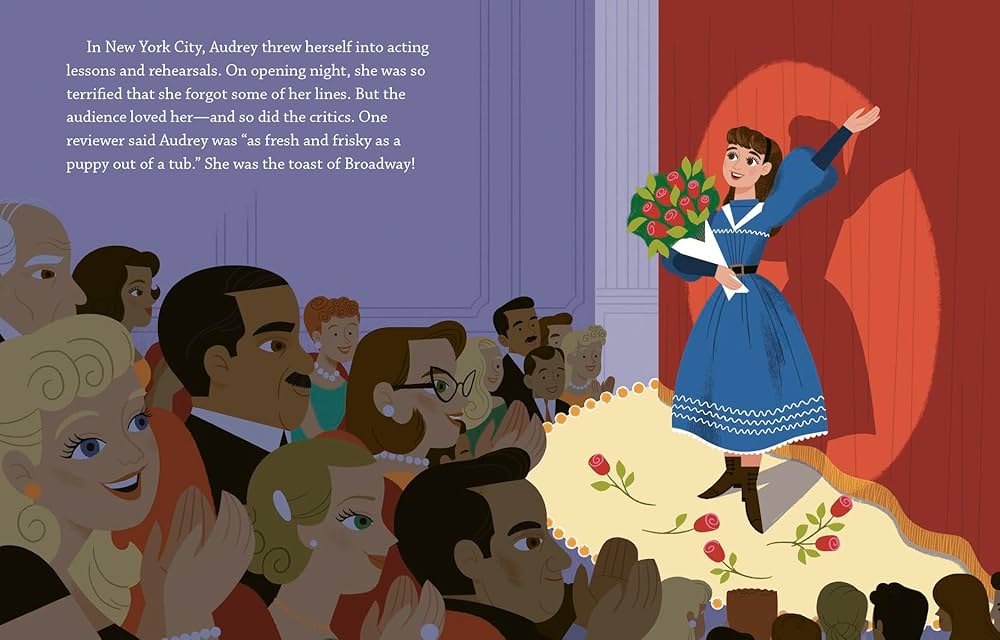
It’s impressive how much biographical information these slim books include. Readers learn about her ancestry. Did you know that her father claimed a distant connection to Mary, Queen of Scots? The book, written by Emily Easton and illustrated by Ellen Surrey, details Audrey’s abandonment by her father, her training as a dancer, and her family’s deprivation during World War II. Although she is best known as a film actress, there is a scene where she meets Colette, who personally insisted that Audrey be casted in the original stage production of “Gigi.” Even her Tony Award for “Ondine” finds its way into the book! The text is punchy, with a tone of excitement when Audrey works for the Dutch Resistance, becomes “the toast of Broadway,” and becomes a fashion icon. “Women wanted to dress just like Audrey! And her style is still beloved today.” So true.

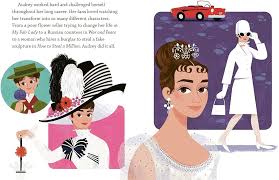
Of course, her cinematic fame follows, including “My Fair Lady,” “How to Steal a Million,” and “Breakfast at Tiffany’s.” After retiring from her acting career, Hepburn dedicated the rest of life to working on behalf of the world’s children, principally with UNICEF. If you assume that the book’s expected audience are adults, you’re probably right. There is definitely a nostalgia component of grownups who remember reading The Poky Little Puppy and would love any story that comes in this container. Nevertheless, Golden Books do offer an opportunity to introduce children to unfamiliar figures and cultural products that are not Disney. (Many of the Disney Golden Books are, by this time, classics.)

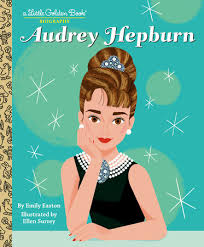
Audrey is on the cover in her little black dress and pearls from Breakfast at Tiffany’s. In the World War II section, she wears a plaid dress and a lavender scarf as she gladly accepts chocolates from an American G.I. He is down on one knee as he presents them, as if proposing marriage. Well, she is Audrey! Scenes from Funny Face show case both her gorgeous Givenchy gown, and the classic black turtleneck and cigarette pants with white socks worn for her Beatnik-inflected dance number. It will be fun to explain the cultural significance of these to the children sharing the book with you.

As the book tells reader, Audrey had two sons, although “her marriages to their fathers didn’t last.” But the author’s upbeat interpretation links her devoted care for her own children with her activism in children’s causes: “Audrey used her star power to draw attention to their needs.” That sunny sentence is consistent with the whole idea of Golden Books, but it’s also true.

Everything is Different

A Star Shines Through – written and illustrated by Anna Desnitskaya
Eerdmans Books for Young Readers, 2024

Anna Desnitskaya, an accomplished author and illustrator (see my earlier review here), became a refugee when Russia invaded Ukraine.  She has written an important book, a work of great beauty and simplicity about what it means to be uprooted from one’s home.  Even if the book were not illuminated by beautifully minimalist words and images, it would still matter. It would still succeed as a human document. However, its outstanding effect is inseparable from its haunting tone and careful composition.   A Star Shines Through is worth your time, and a space on your own bookshelf and that of your school and library.

In her author’s note at the end of the book, Desnitskaya explains its origins. She and her family were on vacation in Cyprus when they learned of the brutal attack on their country.  Their home in Moscow, epitomized by the large star-shaped lamp that hung in their apartment’s window, would no longer be their lives’ anchor, as they fled to different places of, perhaps temporary, refuge.  Standing within a beam of white light on a dark street, mother and daughter shelter under an umbrella.  The residents of a foreign city speak a different language; the word bubbles above their hands are filled with incomprehensible white swirls.

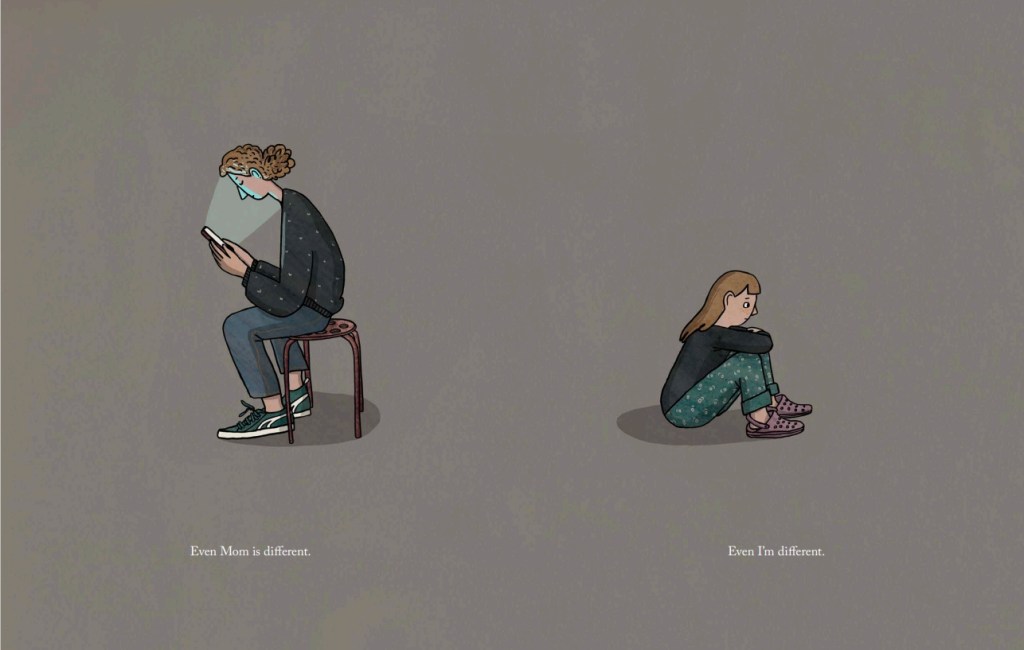
Each picture is a portrait of disconnection.  The girl sits on a windowsill looking out at the darkness while holding a book. The smiling family who, after all, still have one another, eats around a table, but the text reveals a great deal in the one phrase, “Different food.” Even people themselves are not the same.  On facing pages, the mother and daughter look in opposite directions as the adult stares at a cellphone and the girl sits alone, contemplating the fact that “Even I’m different.”  Desnitskaya does not attempt to elaborate on these thoughts, which convey both sadness and dignity.

Then they make a star.  A similar star appeared in earlier scenes, but perhaps it is a ghostly memory of the one in Moscow. Now they create a new one; when they display it in the window, it transforms everything.  Although their star cannot replace their old life, it partly restores what seemed to have been lost completely. An ice cream truck on the street and its string of bright lights indicate that their new home is welcoming. The foreign language that surrounds them begins to make sense.  Mother and daughter sit under the star together, accepting that nothing is the same, but everything is better.  Shades of blue contrast a busy apartment building against the darker night sky, but the gold star in the upper window holds our attention.  Even if you have shared other books about the refugee experience with the children in your life, this one fills its own niche.  Communal support, gradual acceptance of change, and acknowledgement of sadness coexist in this honest portrayal of one family’s upended life.

Questions and Answers

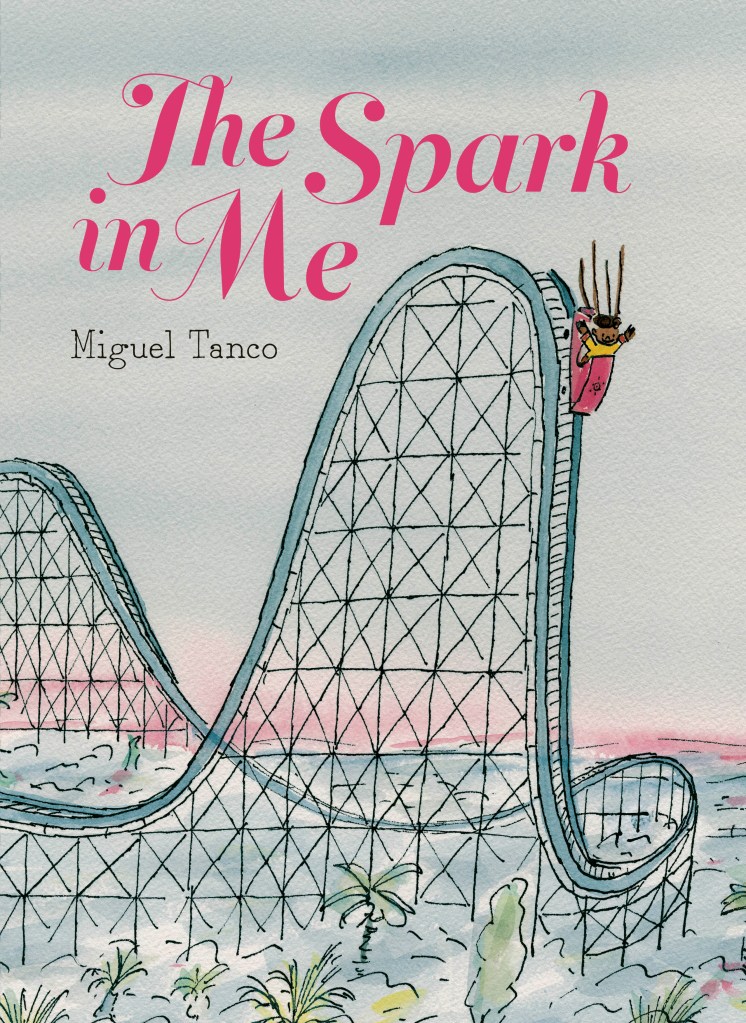
The Spark in Me – written and illustrated by Miguel Tanco
Tundra Books, 2024

Miguel Tanco is one of my favorite children’s book authors and illustrators (see other my reviews here and here and here). Allusions to classic styles of illustrations, along with contemporary settings, fanciful images rooted in realism, and respect for children’s imagination, all contribute to his unique works of picture book art.  The Spark in Me is not a sequel, but it is a companion volume to Count on Me. While you could characterize both books as STEM-themed, I would not want to reduce them to a didactic category.  The girl in Spark is full of questions about how the world works. The answer, or at least, one answer, is rooted in concepts of physics.  The book is rooted in her inquiring nature, but that nature also takes flight.

In Tanco’s work, people dream, but also use concrete objects to achieve their visions. The girl’s mother “is a dreamer,” who composes music for her guitar on multiple sheets of paper that cover the rug where she sits.  The dad is so different; “he’s a very practical guy.” Maybe he is not so different after all, with his elaborate collection of tools arranged to fix a bicycle. The wrenches, nails, and screwdrivers are laid out in a more linear pattern than Mom’s music scores, but both parents are working out a vision.

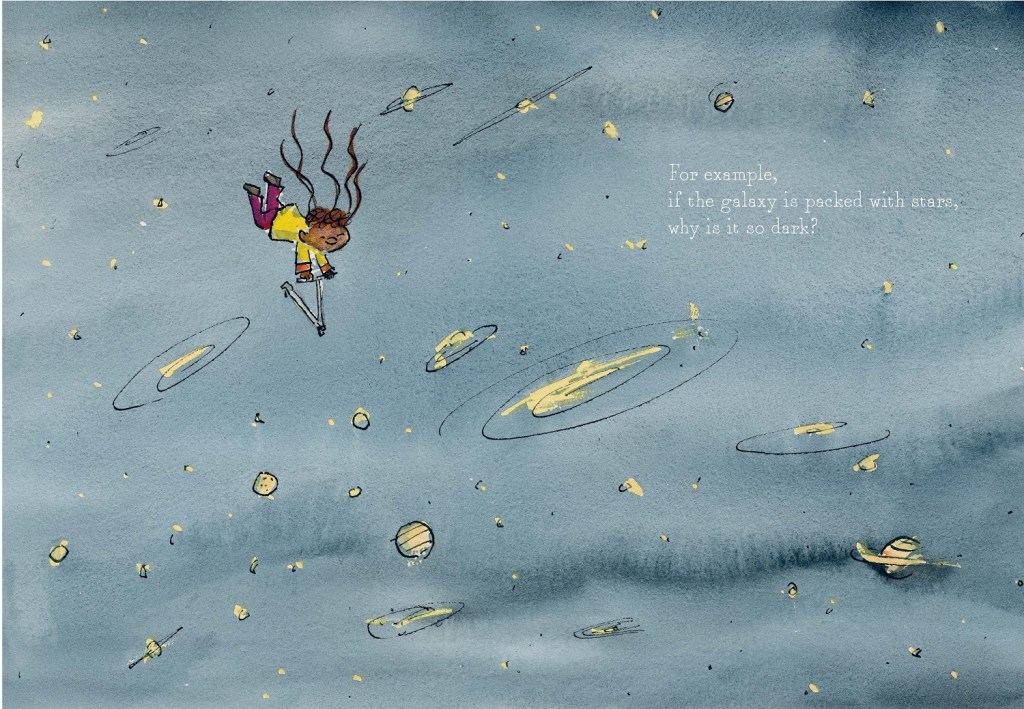
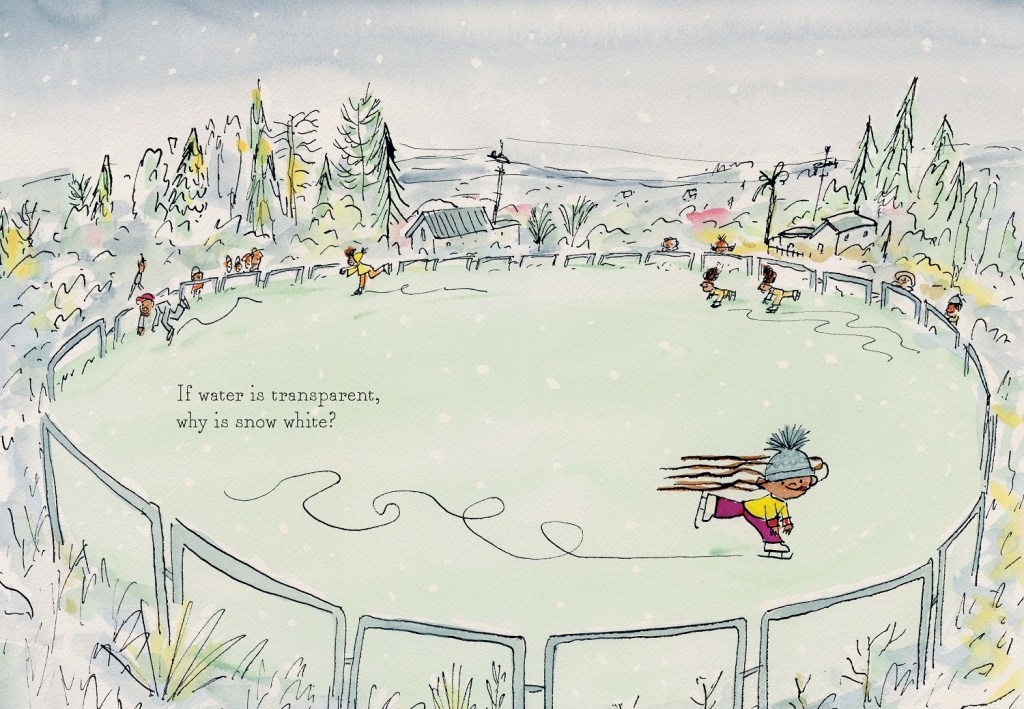
The girl, meanwhile, rides her scooter on earth, and soaring through the galaxy, as if she could build enough velocity to encounter all possible answers to her questions about how the world functions. Gravity does not stop her, nor is she discouraged by the lack of an immediate response.  “If water is transparent, why is snow white?” is a thought that crosses her mind without preventing her joy in the moment.  Skating apart from everyone else, she seems to be on her own.

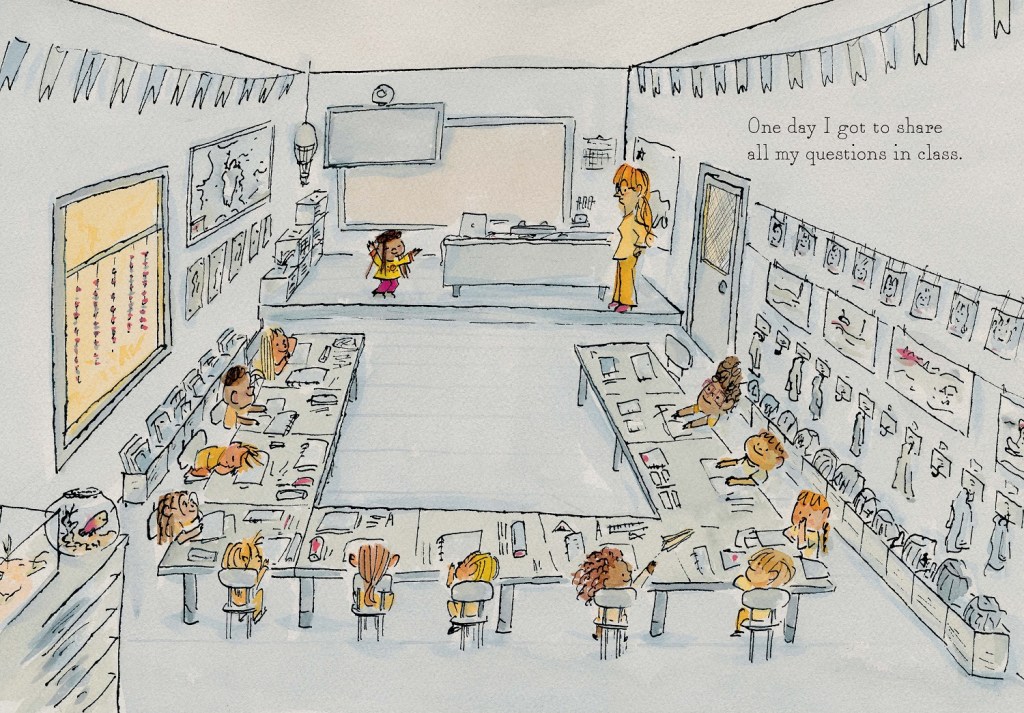
No one learns without cooperation.  The natural world inspires the spark within her, but interaction with other inquisitive and encouraging people, young and older, begins to set her on a path.  The excitement implicit in her statement, “One day I got to share all my questions in class,” is tangible. Every word in Tanco’s text seems deliberately chosen.  She “shares,” rather than “asks,” and the parameters of “all my questions” is broad enough to prove that the teacher is receptive to listening.  The interior of the classroom, unlike the outdoor scenes, is defined by squares and rectangles. These are not rigid or confining, just another setting for her ideas. Some kids are listening, others are throwing paper planes or falling asleep.  The fish in the bowl is smiling.

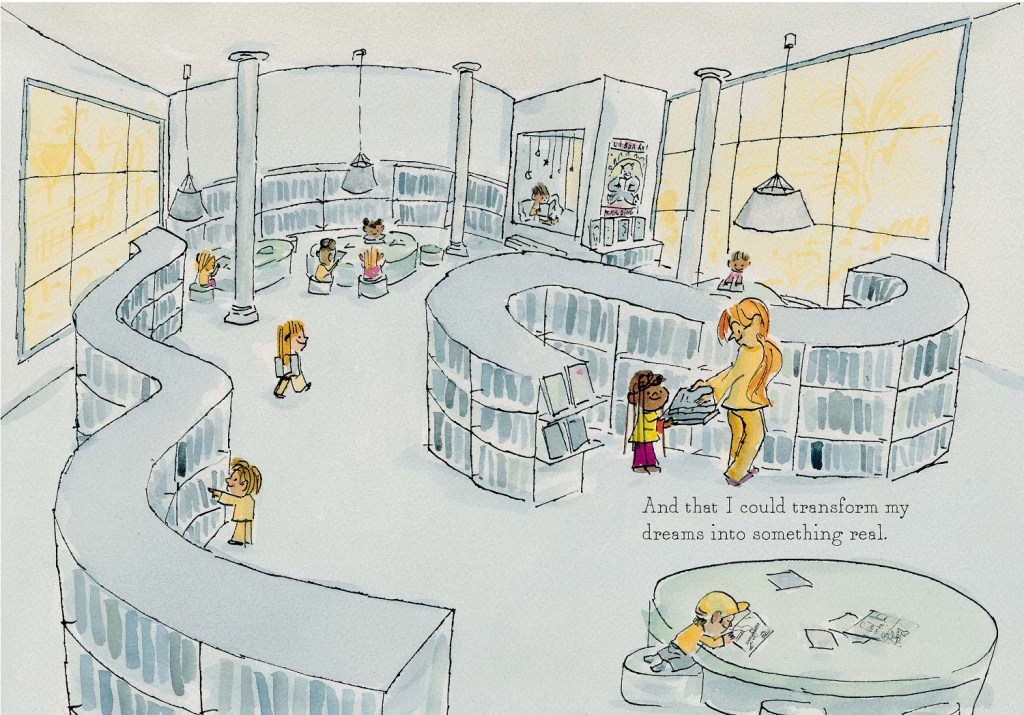
Who doesn’t love the library? This interior scene represents a different, more independent, kind of learning.  The bookshelves are curved, differentiating them from the desks in the classroom.  The librarian hands the girl a stack of books, proof that “I could transform my dreams into something real.”  Soon she begins to construct her plans and make them concrete.  The concluding section of the book, as in Count on Me, is a portfolio, here entitled “My Physics,” (note the possessive). Each page provides questions, definitions, and sketches.  One entry on light even incorporates an error, in the form of a crossed out “though,” which is corrected to “through.” Miguel Tanco inhabits the world of children, consumed with both excitement and their sense of initiative, as they steer a course towards knowledge of the world.

Biscuits, Sandwiches, and Beauty

Night Lunch – written by Eric Fan, illustrated by Dena Seiferling
Tundra Books, 2022

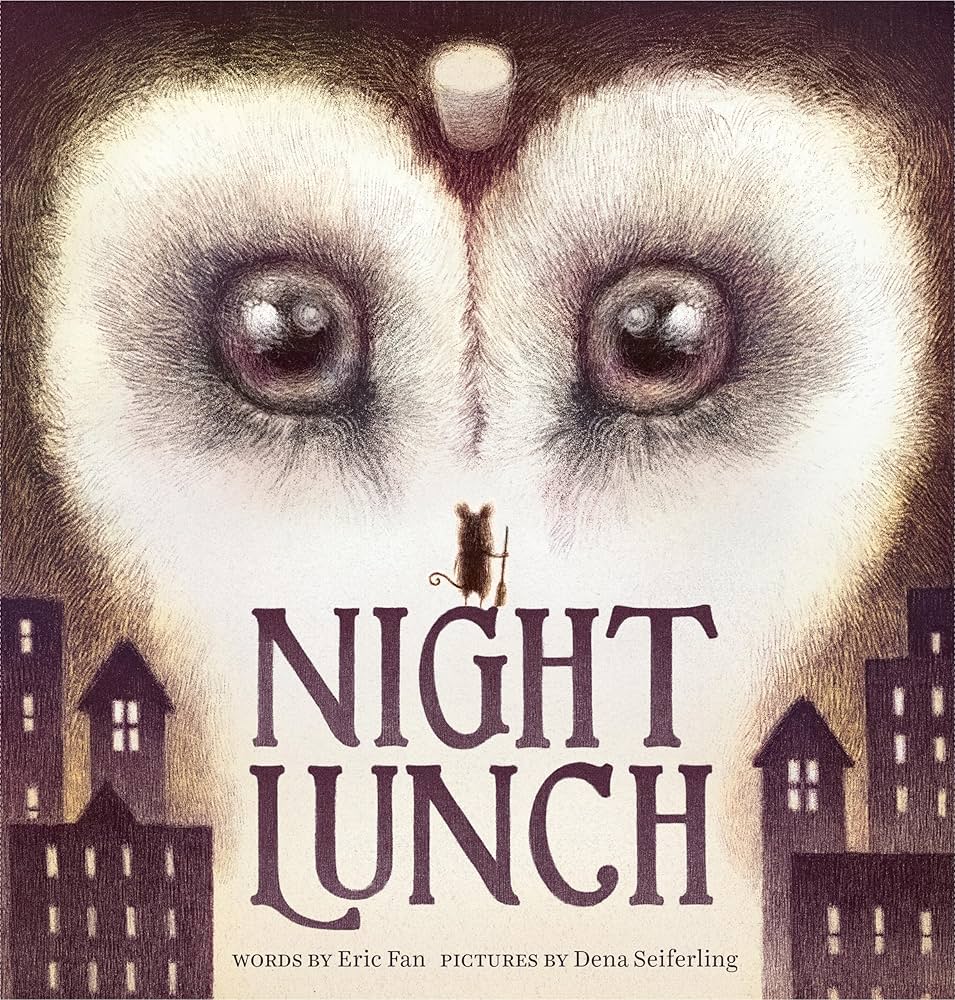
A mysterious atmosphere, gauzy sepia pictures, and only slightly anthropomorphic animal characters grace Night Lunch, an unusual book about some after-hours dining in a local eatery.  Eric Fan’s (of the Fan Brothers) brief text accompanies Dena Seiferling’s images of owls, horses, badgers, and mice who emerge after dark and quietly take over the scene (mice are a specialty of Seiferling).

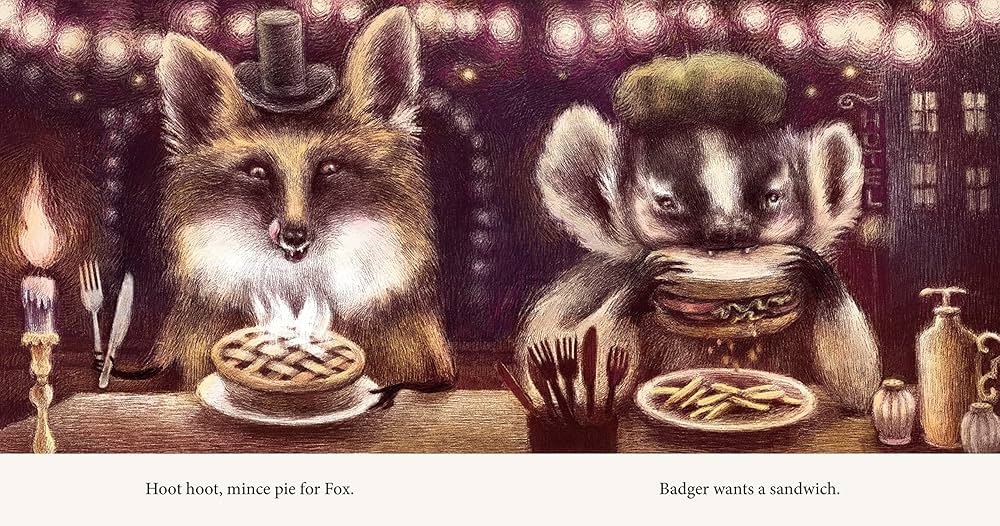
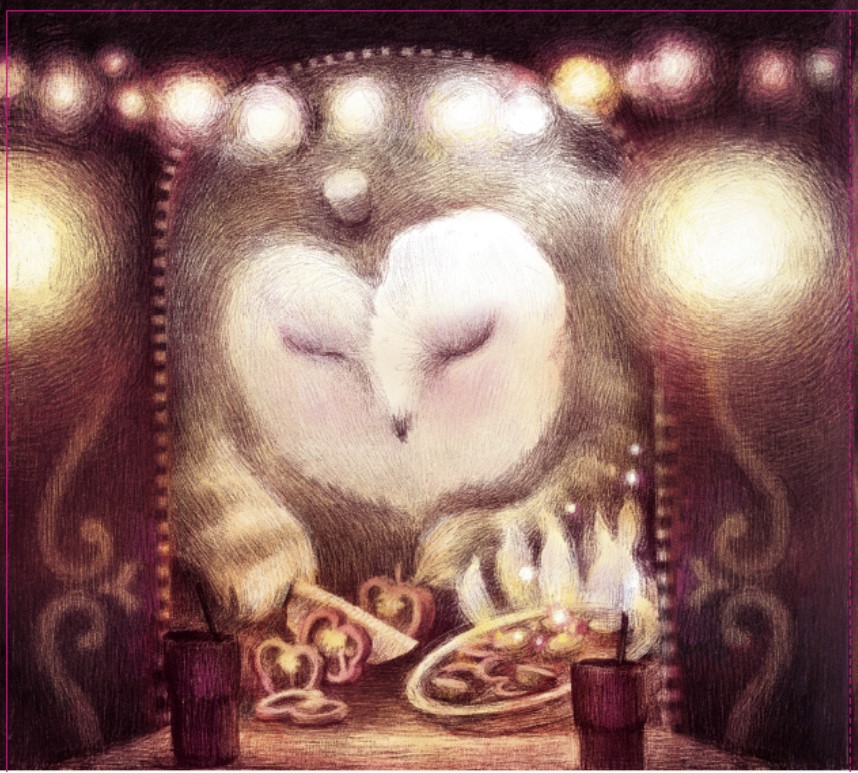
Each picture focuses on one or more creatures, settings, and implicit action to create a total atmosphere.  “Badger wants a sandwich,” and we can see how much from the look of satisfaction on his face as he bites into it, suspended over a plate of fries.  To the left, a canister of forks and knives, and to the right, bottles of condiments frame this segment of the story.  Buildings with lights in the windows form the background. In a two-page spread, a busy owl carefully packs “puddings for little possums,” whose parent carries them on her back and reaches out for their treat-to-go. Consuming food is only part of the story and images. Another picture shows the owl-chef intently slicing peppers for one of his creations.

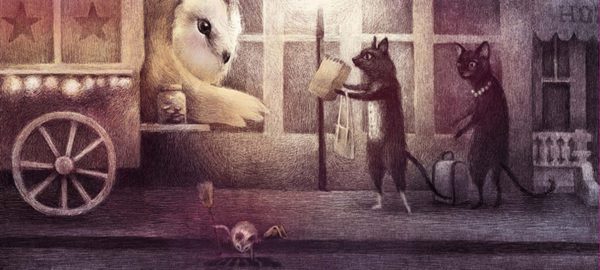
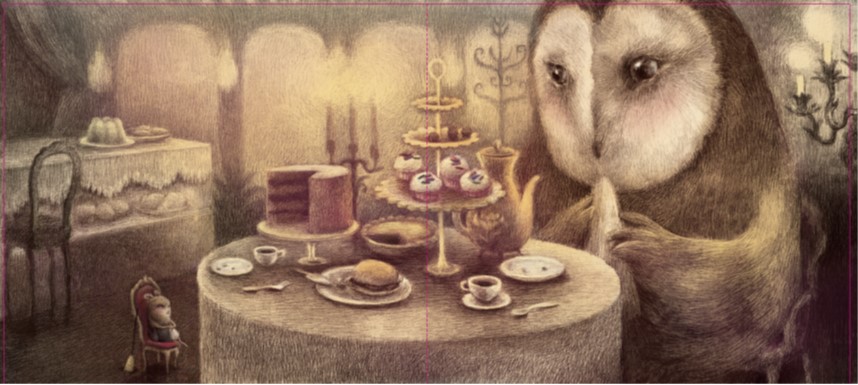
There is a bit of drama involving the mouse, probably the most vulnerable of the animals. While he sweeps the street for crumbs, two cats, one whose fur imitates a tuxedo and the other wearing pearls, confidently approach the food truck for their order.  Later, the mouse trembles in fear, and the owl extends a mouse-sized portion to him.  When the table is set with tiered cakes, candlesticks, and an elegant teapot, chef and worker enjoy it together. The disparity between their sizes is no obstacle.

There is so much information deliberately omitted, that children will inevitably fill it in with their own imagination.  The time period and location, the relationship between characters, the fantastic nature of a world where animals inhabit a human-scaled city, all invite speculation.  However many times you share Night Lunch with a child, the possibilities will not be exhausted.

Mice Love Art

Marcel’s Mouse Museum – written and illustrated by Hannah Abbo
Familius, 2023

There are so many children’s books designed to promote a love of the visual arts. This one definitely inspires some ambivalence, but, overall, I credit Hannah Abbo’s offbeat approach. Framing her book as a visit to a museum, she offers information about several different artists, as well as suggestions for projects that children can undertake to learn about different styles and movements. Gentle satire is a key element; if your child is unfamiliar with Frida Kahlo, then she might miss the humor of the painter’s mouse incarnation as Gouda Kahlo.

The same will be true for Edward Hopping-Mouse, Parmesan Picasso, and the Furrealists. Fortunately, a section with brief biographies of the artists as humans, as well as a glossary, appear at the end of the book. You might want to start there.

The museum is quite inviting. Beautiful endpapers with inspired and offbeat versions of artworks open the book. Marcel himself, working at the museum entrance, encourages enthusiasm about the “hundreds of paintings and sculptures by the most famous mice of the past 100 years.” Here, and throughout the book, his words appear in large font enclosed in speech bubbles against an orange background. A map and guide follow.

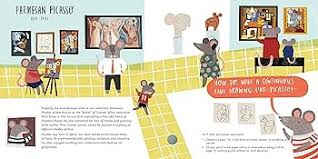
Parmesan Picasso opens the tour, since he is “probably the most famous artist in our collection” It would be hard to argue with that assessment. Actual birth and death dates accompany each mouse artist’s name. Picasso’s Blue Period is easily transformed into “Blue Cheese,” and his alleged enjoyment of “sneaking into restaurants” is probably not far from the truth. The accompanying project instructions seem simple and feasible; children are asked to try a pencil drawing without lifting the point from the page. Results may vary.

Henri Mousetisse is appealing to children through his paper cutouts, and his rivalry and friendship with Picasso are noted, as well, adding a bit of depth. The Furrealists, as an artistic movement encompassing many practitioners, gets four pages, including “Méret Hop-penheim’s Luncheon in Fur” (1936). The child sharing the book with you probably has not seen Oppenheim’s famous teacup, but I would guess that the entire idea is appealing to kids. Edward Hopper’s visions of loneliness certainly show “real life as it happens,” and so do the painting of his mouse equivalent. The mouse inhabitants of the diner look pretty sad, even if one’s bright red shirt is a cheerier shade than in the original.

You will decide whether the book is aimed over children’s heads, directly at their parents and caregivers, or if reading it is a wonderful, shared experience. I would vote to try it with some background information, and a brief explanation of the premise. The visitors in the last picture, a cutaway view of the galleries, are obviously having a lot of fun, particularly the two young mice kicking a soccer ball in front of American Gothic.

A Boy Like Us, Almost

Boy Here, Boy There – written and illustrated by Chuck Groenink
Tundra Books, 2024

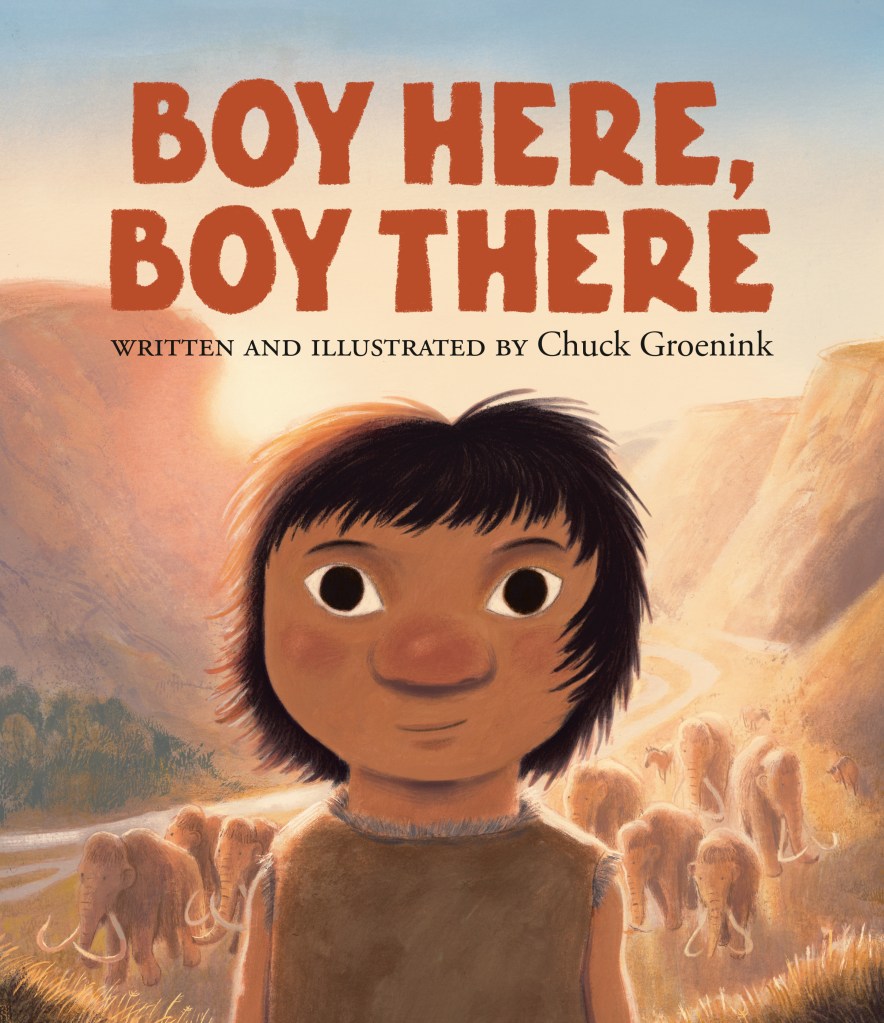
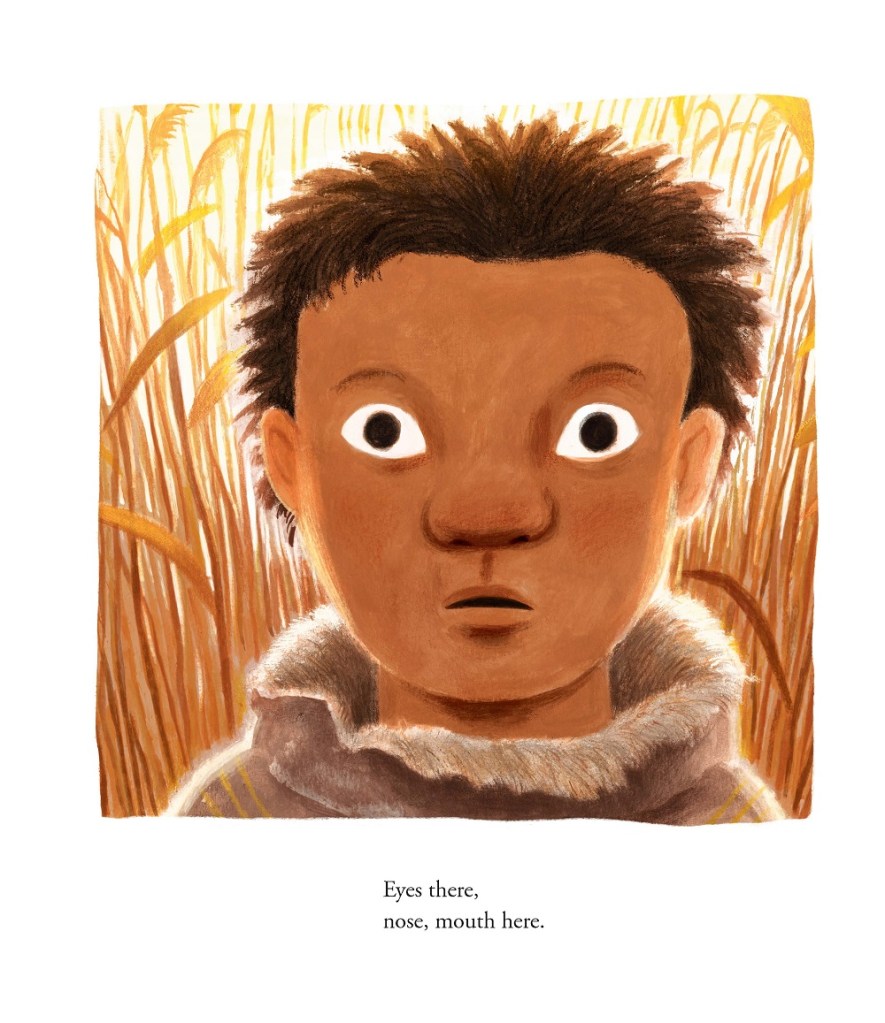
The premise of this wonderful new picture book is the chance encounter between a Neanderthal child and his Homo sapiens counterpart. Not only young readers, but many adults, may not realize that archaic humans and their counterpart overlapped in time from when the two groups diverged, between three and four hundred thousand years ago, and when the Neanderthals went extinct some 40,000 years ago. (The overlap in space, however, may have been brief; an author’s note carefully explains this part of evolutionary history.). Boy Here, Boy There is not a work of fantasy, but an imaginative exploration of early human society, undergirded by fact. The stunning pictures and poetic text recreate the plausible story of one curious boy as he interacts with the natural world, and eventually, with a kind of mirror image of himself.

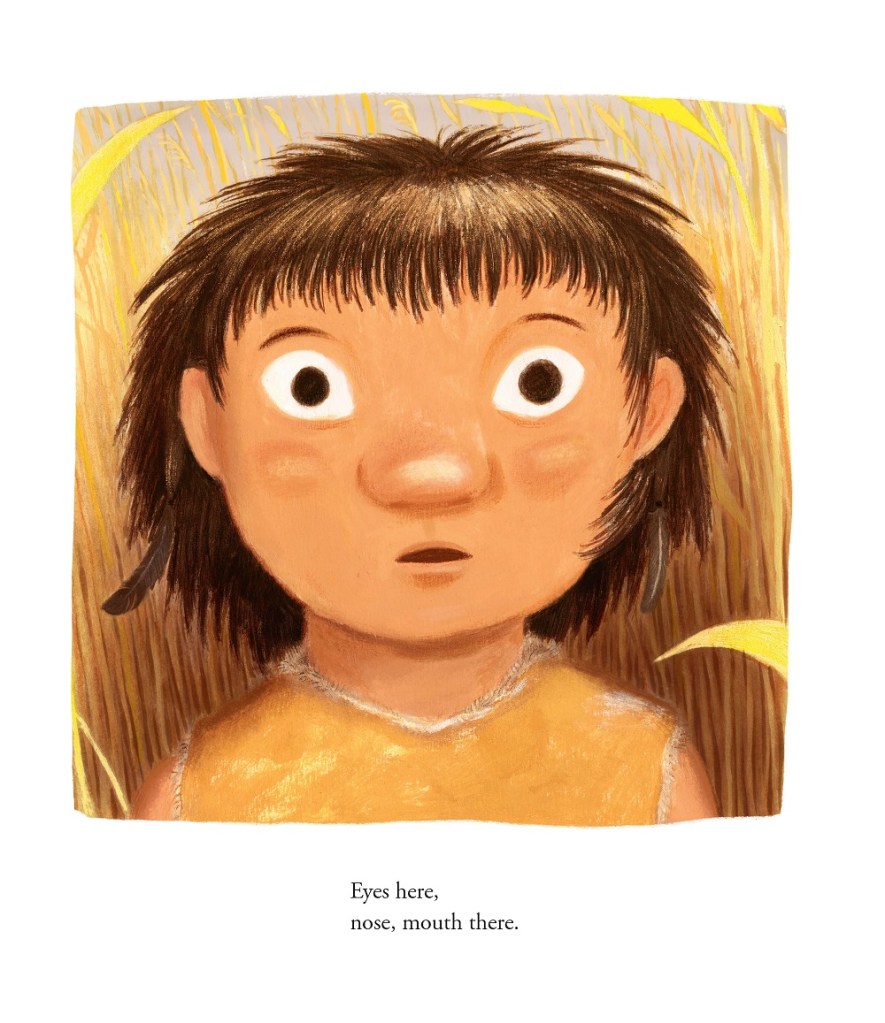
Presenting prehistory to children may take the form of nonfiction narrative, infographics, or historical fiction. Chuck Groenink instead builds character through accurate pictures rendered in soft earth colors, and in words that open a window into the boy’s consciousness (I previously reviewed a wonderful book he illustrated for another author). Popular depictions of prehistoric humankind are sometimes intentionally comic. Parallels to modern people may be noted ironically, patronizingly, or just as a type of ridicule. Groenink is well-aware of this model and purposefully avoids its temptations. We have limited information about Neanderthal speech, but anthropologists have offered insights about its level of complexity. On the other hand, children’s way of thinking and speaking is well-documented. As Wordsworth famously understood, “The Child is Father of the Man,” while scientist and philosopher Ernst Haeckel coined the memorable phrase, “ontogeny recapitulates phylogeny.” In other words, human development on the micro level parallels the development of the species. Groenink succeeds in distilling that truth in a remarkable way.

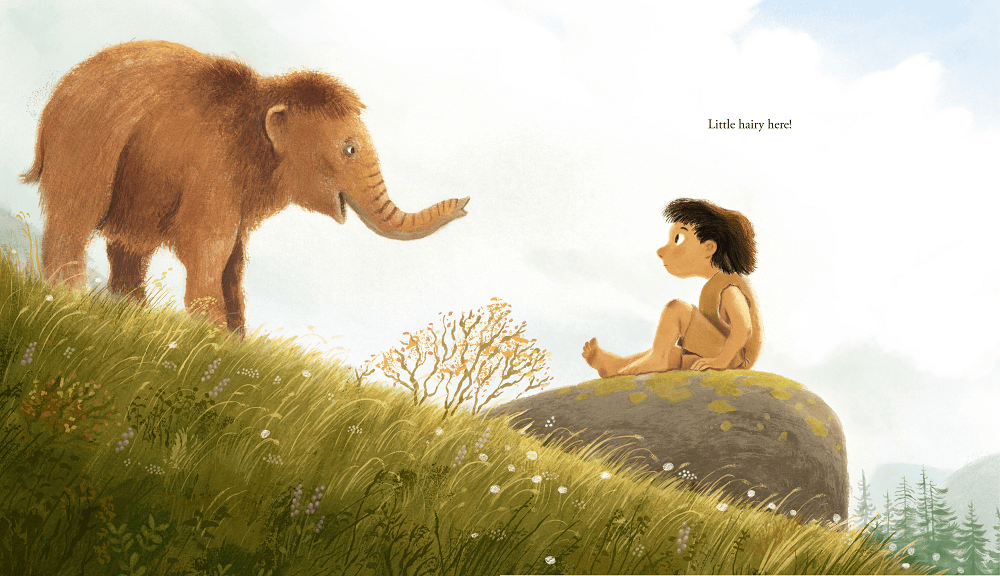
Whatever the Neanderthal boy observes in nature, he names descriptively. Owls, birds, rabbits, and deer are translated into “Runners, jumpers, fliers and pouncers everywhere.” The actual feathers of a bird and the soft grass on which he lies down are two variations on the same substance: “Feathers in sky. Feathers in hair.”  The artistry that Groenink uses to capture a child’s thoughts, and the language of humankind in its childhood, elevates his book. Readers expecting a wooly mammoth will not be disappointed. The boy faces the cheerful looking animal, again finding a similarity between himself and the “Little hairy,” the child of the huge “big hairies” of the herd.

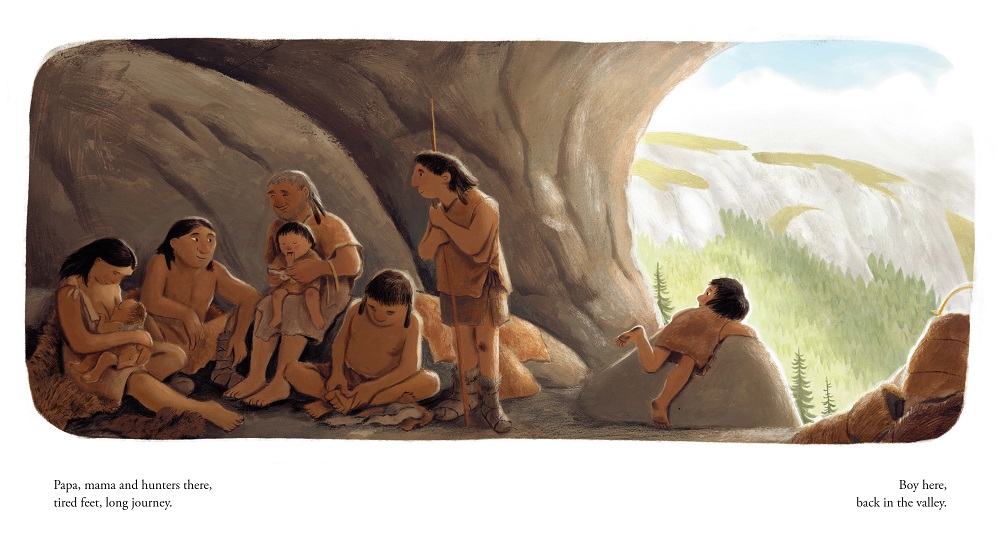
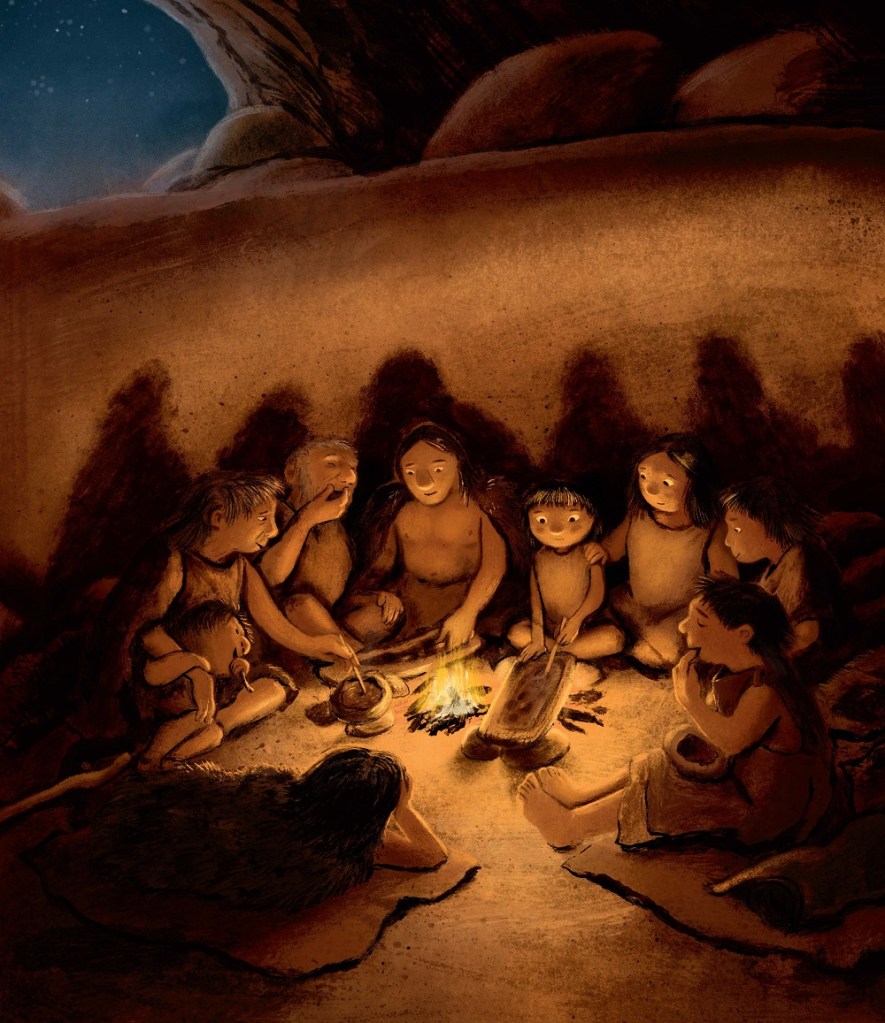
Neanderthals lived in communities where adults contributed to finding sustenance and caring for children. Their work is tiring, as the boy notes. The hunters sit for a brief rest, with one woman breastfeeding her baby. At night, they gather for a tender family scene in a cave dwelling. There are different generations represented; one older man appears to cover a yawn. A child reclines on a parent, and everyone watches food cooking on a fire with great interest. After his day exploring, the boy is content to be “Boy here, home again.”  Without forcing an emotional connection to contemporary life, one just emerges from the pictures and text: “Fire there, food bubbling, a full belly, family together.”  Neanderthals created works of art. There are none of the familiar cave paintings here, but the boy makes a series of handprints from the ash coating of his family’s fire.

Boy Here, Boy There is full of contrast. There are pictures full of light and others bathed in darkness. Humans work hard and rest. The boy integrates his surroundings into his vision of the world. Finally,  and accidentally, he encounters a glimpse of the future.

A Different Toy Story

Barnaby Unboxed! – written and illustrated by Terry, Eric, and Devin Fan (the Fan Brothers)
Tundra Books, 2024

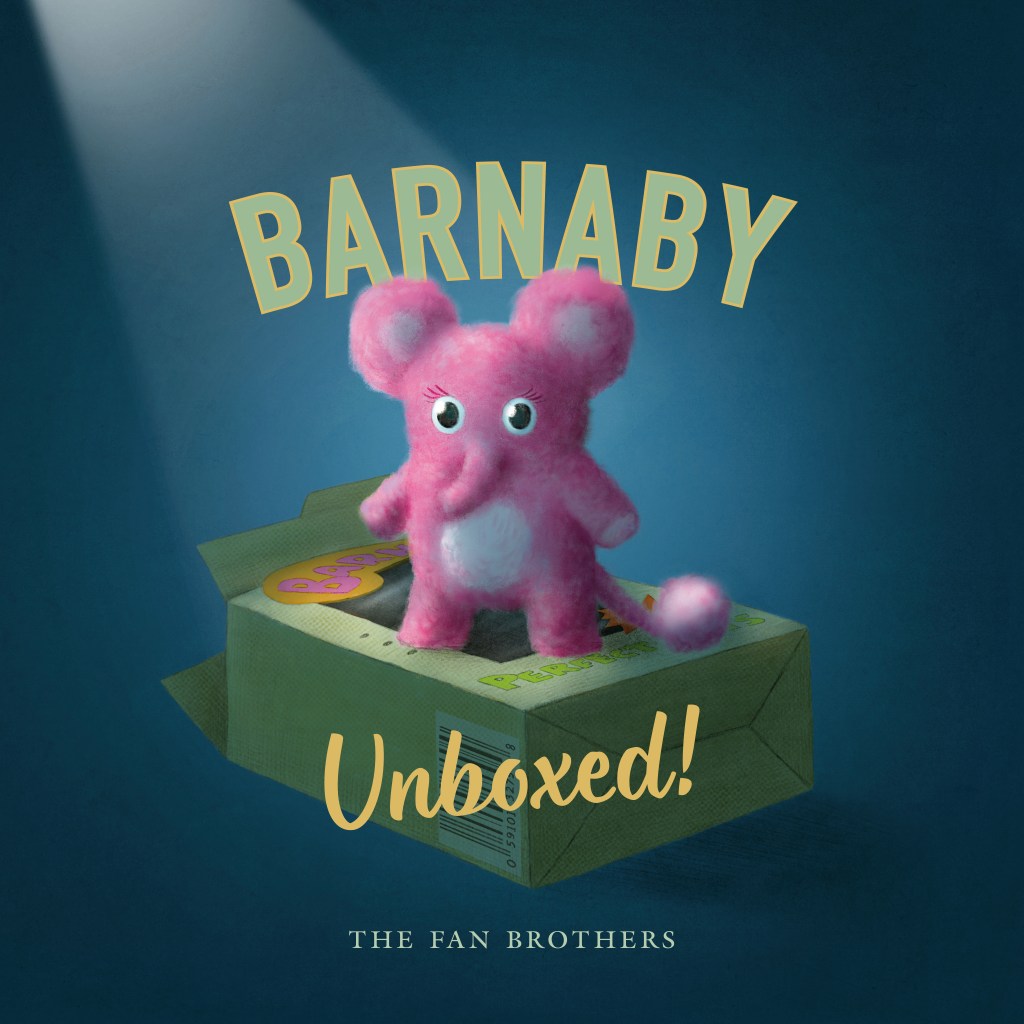
Barnaby Unboxed! Is not a sequel to The Barnabus Project (2020) but it takes place in the same universe of Perfect Pets. Readers (fans!) of the first book may recall that not all pets are perfect, and this difference makes them vulnerable to destruction. Here the potential danger is obsolescence. After all, once children gain access to a new-and-improved toy, why should they remain attached to, in this case, plain old Barnaby?

The Fan Brothers capture the essence of toy marketing, including the cheery names assigned to personified animals and other creatures. Some are obvious: “Jelly” resembles a jello mold, and “Cacti” is just the prickly plant with a plural, or perhaps, diminutive, ending attached. Barnaby is a furry pink elephant, the color of cotton candy. The little girl who picks him out of the lineup is absolutely sure he is the one. She joins other committed children in books, from Lisa in Don Freeman’s Corduroy to Betsy in Rebecca Caudill’s The Best Loved Doll and Kitty in Dorothy Kunhardt’s Kitty’s New Doll (re-illustrated by Hiroe Nakata in 2004). (Kitty is actually a toy herself.).
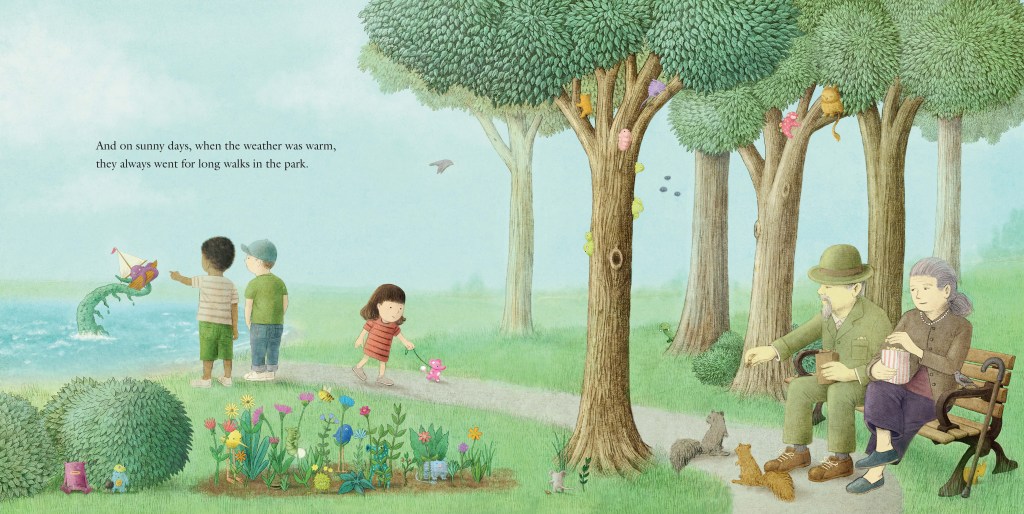
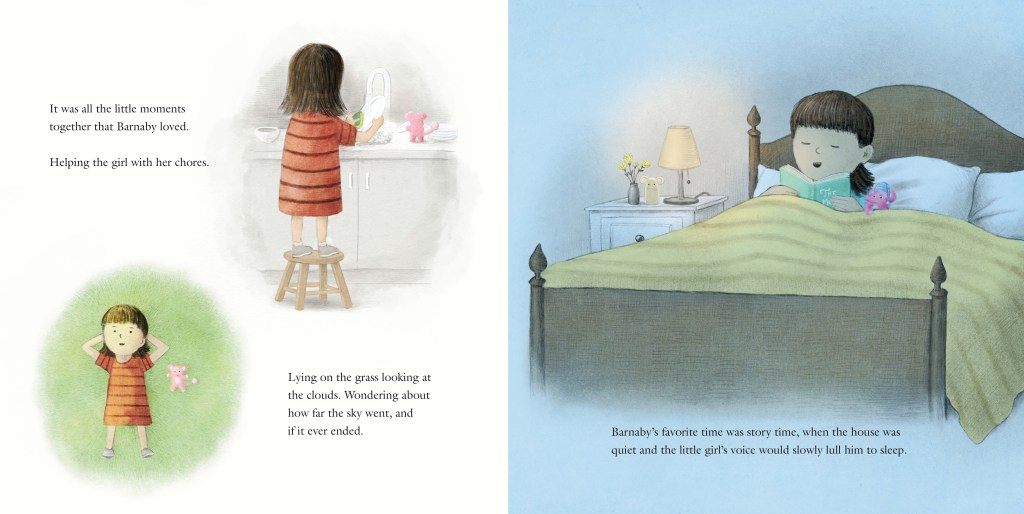
Barnaby is transformed from an insecure toy on a shelf to a beloved friend. He and the girl do everything together, including, of course, reading a story at bedtime. They take leisurely walks in the park, unfazed by the “paparazzi,” otherwise known as squirrels. Then, “everything changed,” as Rainbow Barney debuts on the latest children’s t.v. show. The little girl had seemed loyal, but suddenly she is asking for an elephant with stripes. She ignores Barney, even delegating the task of walking with him to her father, who is so inattentive that he barely notices threatening cats. It’s a toy’s nightmare.
Eventually, Barney finds a dumpster full of other displaced, now imperfect, pets. They eat leftovers, but at least they have one another’s company. One day, he even meets his nemesis, Rainbow Barney, out for a walk. This puffed-up mirror image of himself points out to the original Barney that his once candy-pink fur is now dirty and gray. Can Barney’s self-image survive this assault?

It turns out that the little girl is not fickle. She was just temporarily distracted by the commercial interests whose job it is to pry children from their favorite toys in favor of new ones. Soon they are back together, taking spa baths and eating favorite foods. Of course, they return to the park, full of welcoming nature and fantastic beings. There is even a kind older couple to keep the paparazzi content.