Bookish Girls

The Little Books of the Little Brontës – written by Sara O’Leary, illustrated by Briony May Smith
Tundra Books, 2023

You probably hope that the children in your life will grow up to read the Brontë sisters’ novels and poetry.  In the meantime, here is a book that offers the perfect introduction to their very early formation as authors. Sara O’Leary (I’ve reviewed other work by her here and here and here) and Briony May Smith don’t take the path of presenting their subjects as young people and then following the main steps of their lives as leading up to accomplishment and fame. Instead, the find one attractive and significant element that predicted Jane Eyre, Villette, Wuthering Heights, and The Tenant of Wildfell Hall. The young Brontës miniaturized their limitless imagination in the form of tiny books, which they wrote and bound themselves.  The scale of this endeavor is so appealing to children that it allows them to enter the distant world of 19th century Yorkshire as if it were a familiar and comforting place. The pictures are stunningly delicate and dramatic; the text speaks directly to young readers with elegant simplicity.

First, lift the dust cover to see a kind of facsimile of a book that would have found its way to the hands a child long ago.  Inside, O’Leary invites readers to look through a window and meet Charlotte and Anne seated at a table. Charlotte is creating a small volume while her little sister looks on with anticipation. Anne’s face reflects her response to an artist at work, as Charlotte writes, paints, and stitches. She has created an alternative life for his sister, one with a mother to replace the one who has died, as well as a visit to London and a voyage at sea.  Every object in the pictures is carefully composed and arranged in its relation to others, but, to children, the linking of words and items is invisible.  They are reading and viewing a story about dreaming of a different life.

O’Leary segues to “the real world,” where Charlotte, Emily, Anne, and their brother, Branwell, sit at dinner with their father. Smith’s  picture is a bird’s-eye view of a silent meal tinged with a sense of loss. Still, there is plenty of food and even a dog to feed under the table.  Every gesture and image in the book signals to readers that the Brontës’ world is not their own, but nor is it out of reach.  The children’s lives are both wild and domestic, with the lessons and visitors indoors, and the natural world as an unlimited space. 

The Brontë children never stop reading.  O’Leary enumerates the books they devour: novels, poetry, history, dictionaries, the Bible. Everyone knows that adults who write usually started as children who read, but this picture book doesn’t belabor the logic of that point.  We see the children peeling potatoes and reading, acting out stories in the dark, and using the ordinary props of childhood as a theater for their invented world. Dolls, toy soldiers, and blocks are integrated into the words that they string together on the page, both literally and figuratively. They grow up to be creators. Although the dimensions of their work have enlarged, the original seed of their visions has not changed.

The book concludes with an illustrated guide to making miniature books, a thoughtful author’s note in which O’Leary admits that she has “long been obsessed with miniature things,” a graphically beautiful timeline, and a list of sources.  (The small picture of the Haworth parsonage caused me to look twice, because it so resembles Madeline’s old house in Paris in Ludwig Bemelmans’s books. Even if the homage is inadvertent, it reiterates Briony May Smith’s undeniable place in a long chain of classic illustrators.). The Little Books of the Little Brontës is both artistically exceptional and completely accessible.  Its vivid picture of a bookish childhood demands multiple readings with your children.

Architecture Scaled Down to Size

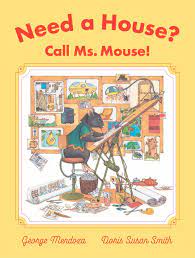
Need a House? Call Ms. Mouse! -written by George Mendoza, illustrated by Doris Susan Smith
The New York Review Children’s Collection, 2023 (reprint of original edition, 1981)

The cover of Need a House? Call Ms. Mouse! features Henriette, a female mouse architect hard at work on her drawing board.  The floor around her is littered with drawings, tape, scissors, trash, and other items associated with her work, including coffee.  Her bulletin board displays many of the homes she has designed, from treehouse to spaceship.  Anyone in need of a home would call her. Fantastic imagination meets incredible fidelity to detail in this introduction for children to a fascinating profession.

I have always found picture books with illustrated houses or dollhouses, including cutaway scenes, to be particularly appealing.  (see, for example, books by Marianne Dubuc or Rumer Godden). The idea of both viewing and imaginatively inhabiting a miniature universe is well-represented in children’s books. George Mendoza and Doris Susan Smith enhanced it, or perhaps professionalized it, in this “portfolio.:  Owls requesting a tower, otters a lodge, moles a tunnel, and bears a cave, are all enumerated on the opening page.  If you don’t see a species represented, maybe you should call Ms. Mouse and inquire.

Ms. Mouse is not the only person responsible for the work you will meet in this book. There are decorators, designers, and builders, according to her signboard.  On the endpapers, a rabbit and mouse unfurl a sheet of paper, a weasel helps to sort and fold fabric, a hedgehog is busy landscaping the garden, and a gopher smoking a cigarette hoists a big bag of tools.  For those who are unaccustomed to seeing characters smoking in children’s books, many of the classics do include them, but they are often fathers smoking pipes. The difference between pipe and cigarette here is one of class. The gopher is not identified as a father or father surrogate, but a laborer. 

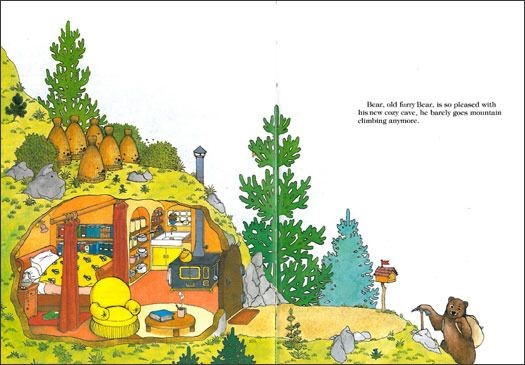
Each one of the pictures bears sustained attention! The cat’s “modern villa” has a minimalist, Japanese-inspired design with an open roof, bonsai trees and futons for sleeping. The rabbit’s warren is cozy, as expected, with rustic wood furniture and an attic stuffed with produce. The bear’s lair is neatly stocked with kitchenware, a woodstove, and a duvet cover with bumblebees.  Although the description may sound ironic, the book really does not have that tone.  Ms. Mouse, along with her team, has custom-designed a home, not just a house, for each customer.  “Bear…is so pleased with her new cozy cave that she barely goes mountain climbing anymore.” Why would she? Spider loves music; Henrietta has included a recording studio for his work-from-home days. Owl’s wisdom-infused dwelling has a globe and a telescope mounted on the deck, so he stargaze to his heart’s content.

Children are small, and they are often drawn to the miniaturized scale of dollhouses, trains, or any other reproductions of real life that allow imaginative play.  For adults who have not lost that part of childhood, or for anyone who appreciates the artistry of detail, this book is a delight.

More Than a Dreidel

The Extraordinary Dreidel: A Hanukkah Story from Israel -written by Devorah Omer, illustrated by Aviel Basil, translated from the Hebrew by Shira Atik
Green Bean Books, 2023

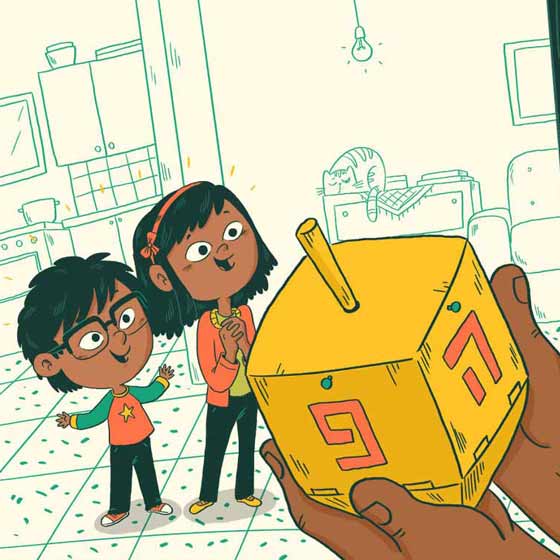
The dreidel in this delightful picture book is not actually magical; it is the incredible skill of Gil and Nurit’s Uncle Chaim that confers its extraordinary qualities.  Oversized and impractical for spinning in the traditional game, it contains a secret compartment, large enough to contain a stamp collection, doll clothes, or any number of other items potentially treasured by children.  The outsized dreidel and the miniaturized scene of family attachment at the story’s end are like charming bookends.  In between is the excitement of children embracing a familiar experience with a significant difference.

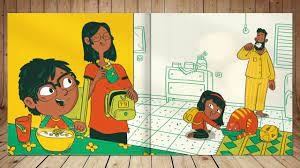
Devorah Omer’s text uses minimal words to convey the core of the story.  The dreidel is “as big as a soccer ball” and Nurit expresses admiration for her brother’s crowdsourcing plans with “I bet your friends will have some great ideas.” Aviel Basil’s images of family are both comforting and funny.  Ima (mom) packs Gil’s lunch while Abba (dad) absentmindedly brushes his teeth, toothpaste foaming over his dark beard.

Each scene features complementary earth tones: ochre, green, black and gold, but drawings in blue and white outline form the background. There are some whimsical touches, like a boy with green hair and a bunch of toys tossed into flight with incredible momentum.  Basil’s technique highlights the way children may experience events: a colorful picture of family and friends around a deep gold chanukiyah (Hanukkah menorah) with green candles and orange flames takes precedence over the lightly sketched floor, window, and bureau in the background.

The final scene of the dreidel with its multipurpose compartment uses surprisingly different characters to express the love of family associated with the Festival of Lights. You won’t even miss spinning the dreidel when you seem what’s inside. 

In the Batter and Out

Dim Sum Palace – written and illustrated by X. Fang
Tundra Books, 2023

There is a difference between an homage and an imitation. Even a book that celebrates a great author and artist, there may be an almost infinite number of ways to reinterpret the work of an icon.  In X. Fang’s Dim Sum Palace, a little girl looks forward to a meal at the eponymous restaurant, and can hardly fall asleep.  When her mother wishes goodnight to her “little dumpling,” readers are warned; we are in the territory of wishes and dreams, fears and delight. Liddy has one foot in a batter of Chinese dumplings, and the other (figuratively speaking), in the cake whipped up by bakers in Maurice Sendak’s In the Night Kitchen.

Fang was this year’s Dilys Edwards Founder’s Award winner at the Society of Illustrators’ Original Art Exhibition.  The award honors “the most promising new talent” in the field of children’s book illustration.  There are several qualities that must have drawn the jury’s attention to Fang’s work.  Her mix of ingredients from traditional Chinese techniques to Sendak’s edgy humor, give the book a distinctive appeal.  Sendak refused to romanticize the terrors of childhood; Fang also captures a child’s apprehensions, but adds some tenderness to the mix. 

Before entering Liddy’s world, don‘t forget to lift the dust jacket for a step aside into the more grounded world of restaurants and their inviting menus, complete with bilingual lettering and a pretend phone number.  The endpapers are a delicately composed assembly of many different dishes. The world of dream imagery begins in specific daily experience, such as pan-fried bun, sticky rice wrapped in lotus leaf, and radish cake. 

Liddy’s dream leads her to the night kitchen, where a male and female chef, in contrast to Sendak’s Three Stooges culinary artists, are making dim sum and an array of other sweets. While Sendak’s bakers seem frenetic in their preparation of a “Mickey-cake,” Fang’s counterparts are calm and focused, carefully folding dough with a sense of pride.  In Sendak’s book, the process of baking becomes an act of aggression. Fang’s chefs are completely unaware that Liddy, in her eagerness to taste the dumplings, has fallen into a bowl. Nevertheless, Liddy also becomes potentially edible.

When a maternal empress is served a dumpling stuffed with Liddy, the regal figure may be hungry, but she is obviously concerned with the little girl who has ended up on her plate.  Cradling Liddy in her palm like a tiny doll, she replaces the girl in her bed. The story begins with one mother expressing love for her child, and approaches its conclusion with another one also caring for a curious and impatient little girl who can’t wait for dim sum.  Liddy’s eventual feast in a busy and diverse family restaurant is worth the wait, for her and for the reader.

Grand Theft

The Mona Lisa Vanishes: A Legendary Painter, a Shocking Heist, and the Birth of a Global Celebrity – written by Nicholas Day with art by Brett Helquist
Random House Studio, 2023

This is one of the most intelligent books for middle-grade readers that I have read recently.  (It is equally appropriate for young adults and grownups.) When have you last found even a passing reference to the poet Guillaume Apollinaire (1880-1918) in a children’s book?  He happens to be one of my favorite of the modernists, and he also played an indirect but important role in one of the most important art thefts in history.  In fact, according to the mixed perspective of Cubism, where a painter can present an image from several different angles simultaneously, Apollinaire may have been front-and-center or off on the sidelines. 

It’s far more likely that young readers have encountered Picasso, as well as Leonardo da Vinci, or at least a reproduction or a parody or an animated version of one of their most famous images.  In The Mona Lisa Vanishes, Nicholas Day narrates the true story of an outrageous and puzzling crime.  Da Vinci’s now most famous painting, but much less iconic at the time, was stolen from the Louvre in August of 1911. The crime remained unsolved until 1913, on the eve of the World War that would forever change everything.  In parallel chapters, Day introduces Da Vinci himself, and describes the improbable circumstances under which he agreed to paint a young woman named Lisa Gherardini, the wife of Florentine merchant Francesco del Giocondo.  No one, including the great Renaissance man himself, is romanticized in the book, but nor are they used as sources of easy humor. There is plenty of humor in the story, but it is all rooted in human gifts and foibles and in the sometimes random events that affect people’s lives.

Not only does The Mona Lisa Vanishes tell a detective story, it also delivers a sophisticated yet accessible discussion of how fake news becomes more believable to the public than confusing facts.  Day also illuminates Renaissance and modern art, changes in the nature of museums in over time, the economically marginal existence of artists, and the development of modern forensics.  If the book sounds too ambitious, it is not.  Readers, young and older, will not be able to put it down!  Brett Helquist’s art depicts the main characters with gentle caricature. Chapters open with graphics in repeating patterns, while some sections of the story are preceded by black-and-white signage resembling the titles in silent movies.

It’s wonderful to contemplate how Day developed his idea, as well as the conviction that others would share his enthusiasm.  The book is not a dystopian fantasy, a traditional biography of a well-known figure, or a straightforward investigation of one historical event. All of those subjects are wonderful possibilities for children’s books. This one is different.  The concept may seem as enigmatic as the Mona Lisa’s smile, but the resulting work is a richly rewarding tour.

Looking Outward

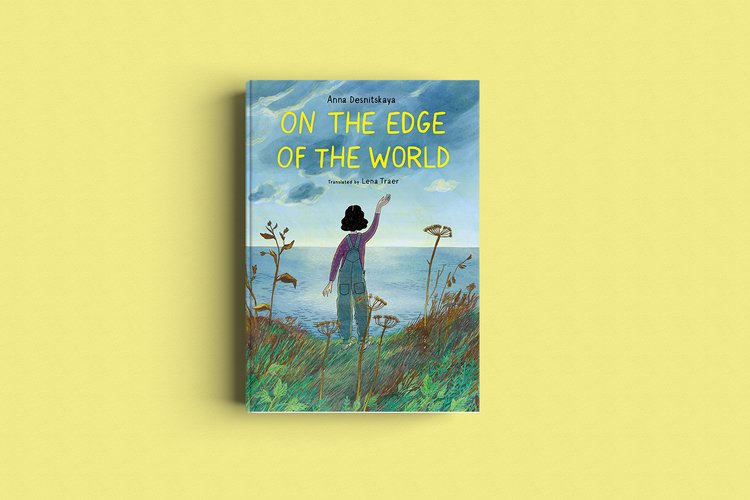
On the Edge of the World – written and illustrated by Anna Desnitskaya,
translated from the Russian by Lena Traer
Eerdmans Books for Young Readers, 2023

On the Edge of the World is a dual portrait of two lonely young people living on opposite sides of the world.  Vera’s home is on the Kamchatka Peninsula in Russia; Lucas lives on the coast of Chile.  In order to meet them, you will need to turn the book upside down.  Their stories meet at the center.  Each half of the story is a brief but deep insight into a child with a loving family who needs to find a friend.  Their similarities and differences bounce off one another like the signals each one hopes to send out in their search for companionship.  Both a realistic picture of childhood and a poetic exploration of distance—physical and emotional—On the Edge of the World is an exceptional work of picture book art.

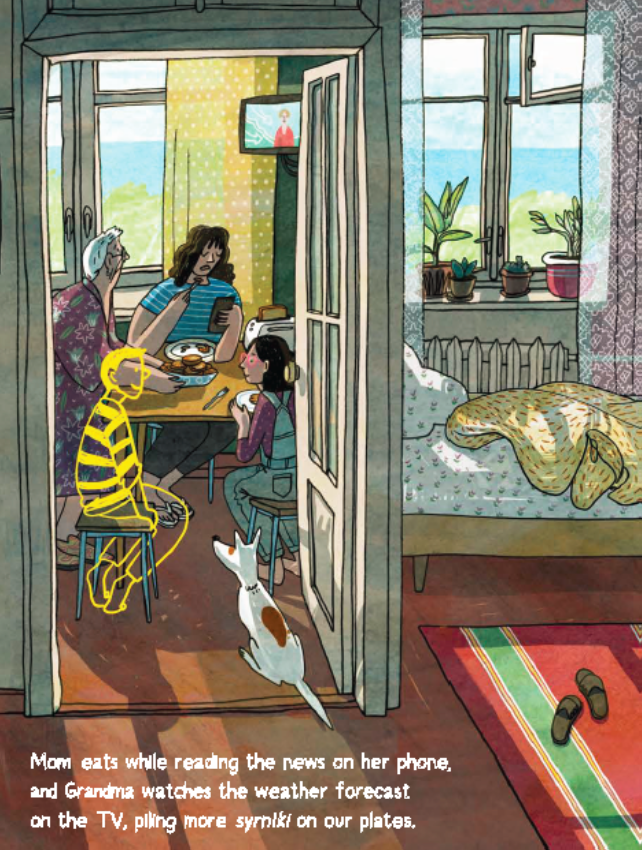
The endpapers open a chart of Morse Code, a language that bridges the divisions of nationality.  There is a map of the Kamchatka Peninsula, and an image of Vera.  Like all the characters in the book, her physical features are keys to a distinct personality.  Oversized glasses perched low on her hose, a self-conscious smile, and a pair of overalls over her purple shirt introduce a particular child in a remote place.  To expand on her portrait, Anna Desnitskaya presents a group of artifacts that form a kind of museum of Vera’s life.  She uses a flashlight on her searches, keeps a collection of feathers, and reads C.S. Lewis.  She is not alone, as evidenced by her grandmother’s delicious cottage cheese pancakes, and the support of a mother who is “smart and funny,” clearly two essential qualities.

Every child needs a friend, and Vera’s community provides few choices of companionship.  Small as her home is, Vera imagines that there would be room for one more inhabitant and this idealized figure appears as a ghostly but cheerful sketch in bright yellow outline.  If her indoor environment is compact, the outside is vast. Desnitskaya convincingly draws both the snug kitchen, where her solidly built grandmother presides over a small stove, and the mountainous outdoors, where Vera plays ball with her imaginary friend. 

Each picture combines stillness and motion, with earth colors both inside and outdoors, and carefully composed series of images against white space.  Vera’s mother’s instructions for producing a sekretik, a whole full of personal treasures, appears next to an image of Vera and her friend in the woods, examining the collection together. She will not give up on her hopes for a companion. 

Suddenly, the book transforms itself with three dramatic two-page spreads of wordless nature scenes, and then arrives in Chile, where Lucas is an uprooted urban child also coping with his abruptly new home. He also treasures valued objects, from ammonite fossils to a delicious hamburger.  He also loves to read, and has a strong grandmother, although her encouragement comes via video call. Lucas conjures a magical outline of a friend, who, remarkably, is the outline of Vera. He also alternates indoor activities in shadowy interiors with climbing trees and visiting the beach with his father.

When both children defy the laws of physics by reaching across the world, their persistent hopes are rewarded. While it is a virtual cliché do describe a book as bridging the gap between young and adult readers, On the Edge of World embodies that quality with visionary power. Everyone was a child once, and Desnitskaya’s book conveys that combination of intense solitude and the conviction that someone is out there who will understand you and embrace you for who you are.

Being President in Tough Times

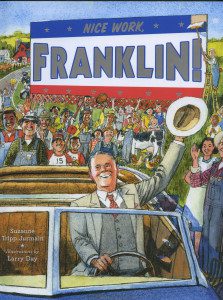
Nice Work, Franklin – written by Suzanne Tripp Jurmain, illustrated by Larry Day
Dial Books for Young Readers, 2016

Franklin Delano Roosevelt, as Suzanne Tripp Jurmain points on the first page of this picture book biography, was a lucky man. He was born into wealth, and his personal qualities were a further asset to his inherent privilege.  Jurmain begins Roosevelt’s story by suggesting he was driven by rivalry with is distant cousin, Theodore.  Yet Franklin’s attempts to imitate Teddy’s more colorful characteristics eventually became the least relevant part of Franklin’s drive.  Now, when we so recently had a president who finds humor in mocking immigrants, people with disabilities, and women, FDR’s story of ambition melded with a deep sense of duty is especially inspiring reading for children. Nice Work, Franklin, is informative, engaging, and artistically distinguished.  It also conveys the message that disability is not an obstacle to great accomplishments.

There is quite a bit of text in the book, accompanied by Larry Day‘s kinetic and busy images that reflect immersion in American history, as well as in Franklin’s life.  Readers learn that he is stricken with polio; a series of images depict him learning to move with the aid of crutches.  The two-page spread gives the impression of separate animation cels cohering into movement.  Several scenes focus on a collective America, including a crowded line of unemployed workers seeking help on a bread line. The ironic contrast between a billboard’s heartless admonition, “JOBLESS MEN KEEP GOING WE CAN’T TAKE CARE OF OUR OWN,” and their desperate persistence, links Franklin’s struggle to their own.

The scene of his first inauguration, in the midst of the Great Depression, shows a sea of diverse faces, all confronted with the same problem and in need of leadership.  “Franklin stood up on his paralyzed legs and Americans saw that both sick people and sick nations could get better.” Of course, Roosevelt did not actually stand. He supported himself on the podium with his hands, offering an illusion at a time when disability carried an implacable stigma. Although the book simplifies many facts, it still expresses an essential truth about FDR’s presidency and the vast improvements his New Deal brought to the nation he served.

Wonderful period details encourage discussion with children.  Roosevelt speaks into a bank of old-fashioned microphones belonging to each radio network, while families listen to him speak over the air waves in their living room.  The sense that America was a vast sea of people and that each citizen was an individual comes across through nuanced facial expressions and gestures.
Finally, a map of the United States concludes the book.  Instead of state borders or geographic features, it represents typical activities, including a Black family filling their car with gas, working people punching a clock and collecting pay checks, and an extended family enjoying a meal. A few of the images overflow the edge of the map, as if to remind us that the energetic complexity of our country cannot be contained within one frame.  Nice work, indeed.

Singing of Family

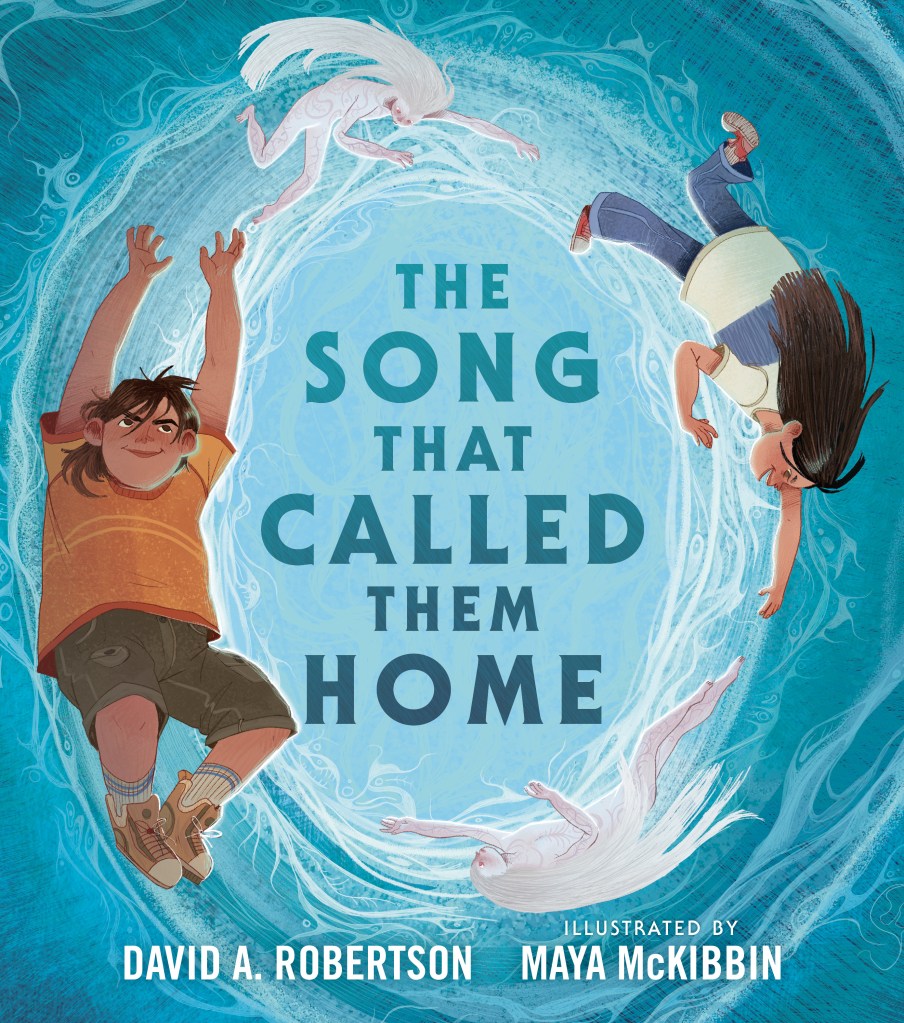
The Song That Called Them Home – written by David A. Robertson, illustrated by Maya McKibbin
Tundra Books, 2023

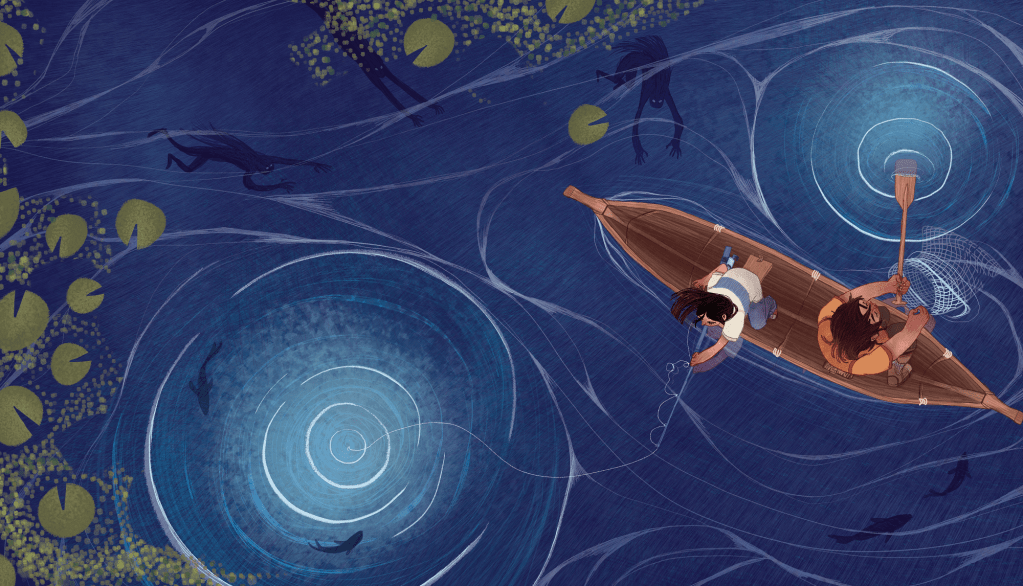
Lauren and James, a sister and brother, take a trip with their moshom (grandfather) to an unspecified destination. They are Indigenous young people and travel by canoe.  Tired from the journey, Moshom falls asleep and, as so many children in both life and folklore do, the siblings set out on their own adventure.  Soon, they are immersed in dangerous waters and Lauren is terrified to see James captured by the Memekwesewak, humanoid creatures who transport him to a portal where his fate will be unknown. Lauren finds the strength to save her brother from “A place she could not see. A place that made her whole body tremble.”

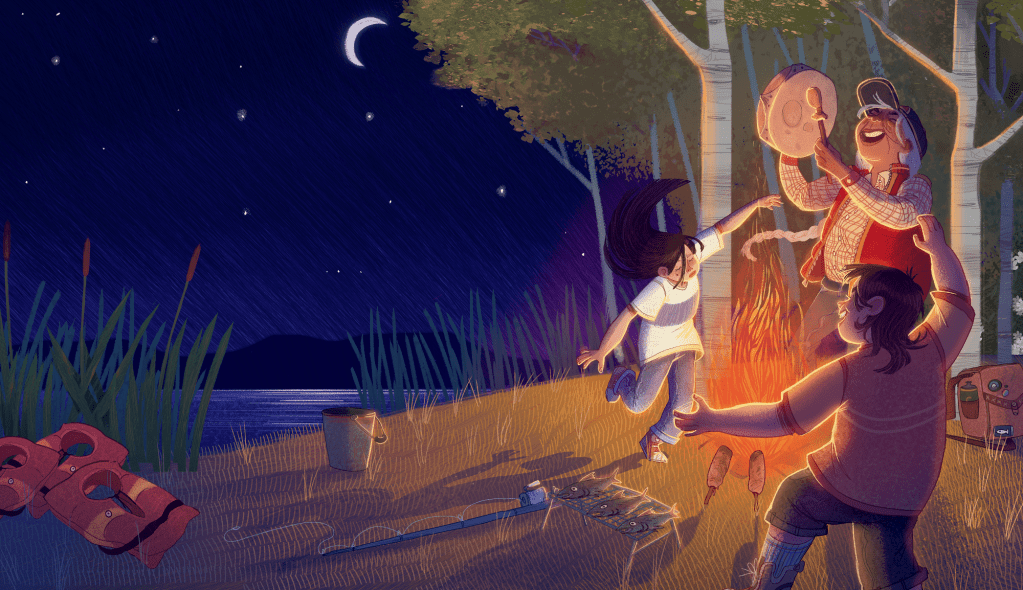
David A. Robertson (I’ve reviewed other books by him here, here, and here) creates tension through subtlety.  Are the Memekwesewak evil? They are pale and ghostly, but Maya McKibbin’s image of their dance surrounded by flames is ambiguous.  Robertson states only that James is “dancing his best,” an understated phrase that conveys Lauren’s confusion.  She enters the ring of dancing, her face showing excitement or fear.

The Memekwesewak are consumed with the conviction of their own superiority.  Robertson describes their frenetic motions, along with their chant about why their captive will never want to leave.  Perhaps their assurance is merited; Lauren begins to forget that her mission was to rescue James, not to abandon the familial love that had sent them on their trip with Moshom. 

To borrow an allusion from a different culture, Lauren and James, like Dorothy in the Land of Oz, remember that home is where they belong.  When they stop dancing and listen, they regain their autonomy in a simultaneous sound and feeling: “The children could feel the drum in their chests, just like the beat of their hearts.” At that point, their return is assured, and only needs to be completed in an immersive series of words and pictures.  The balletic scenes of sister and brother diving, dancing, and then emerging through the portal, reunite them with Moshom. Every element in the book is quiet but resonant. There are no direct references to the power of family, but there is a reassuring tone. Even when the children are under threat, the beating drum of their grandfather’s song leads them to safety.  Robertson’s author’s note explains the traditions that inspired him, but readers from any background will identify with his story of exile and return.

Ingathering

Barefoot in the Sand – written by Hava Deevon, illustrated by Rotem Teplow, translated from the Hebrew by Gilah Kahn-Hoffmann
Green Bean Books, 2023

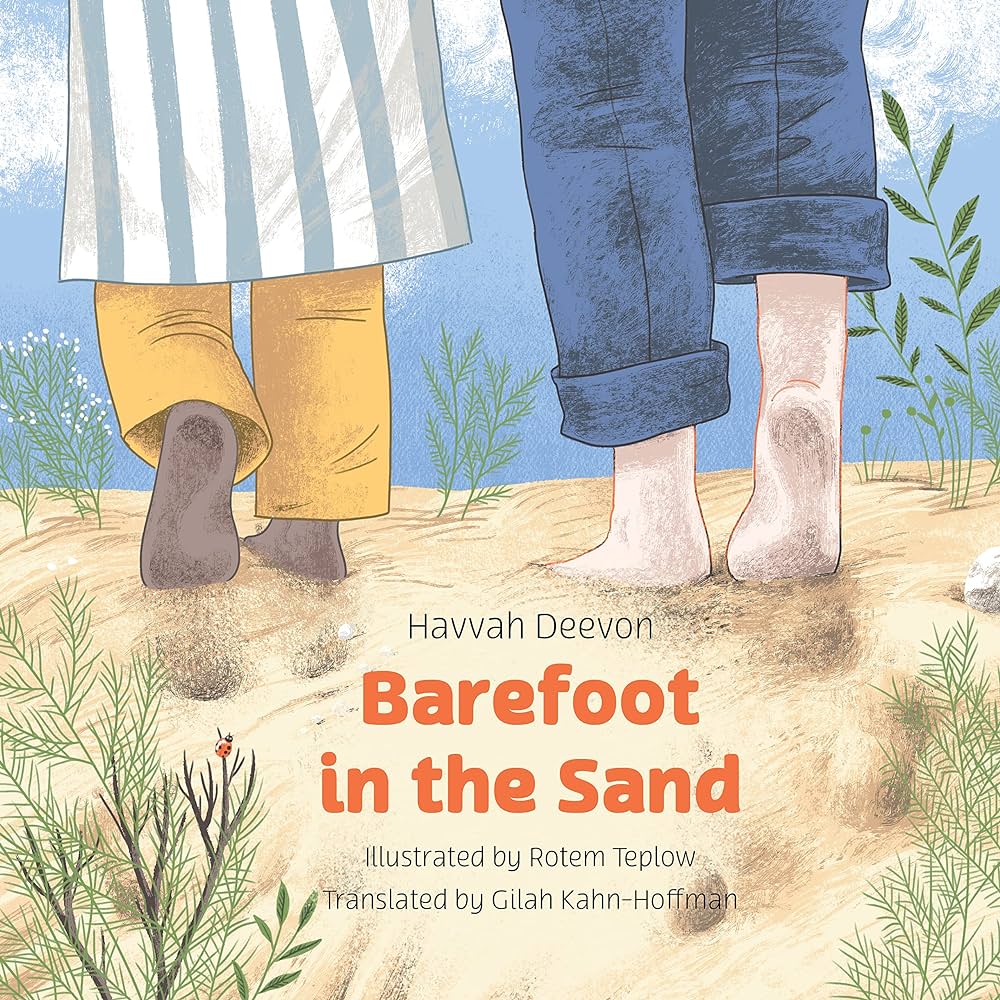
There is sand in this picture book about early immigration to the State of Israel, but there is no line drawn in the sand. Instead, two Jews, one from Romania and the other from Yemen, meet in the land they had dreamed and prayed about.  Maybe the reality they encountered differed somewhat from their long-held image, but they are both deeply grateful to their new home. 

Growing up in Romania, Saul could only wonder what it would be like to “walk barefoot on warm, golden sand.”  Rotem Teplow’s pictures gradually introduce a range of people and objects set carefully against white space (I’ve reviewed other books by her here and here). She depicts Saul in leather shoes and a belted coat, walking through snowy fields and pine trees.  On the facing page, he is still wearing his coat, but his shoes are gone and the pine trees have been replaced by the sea and an unfamiliar skyline.  Years of planning, visualized as a hand-drawn map, a pen and inkwell, and the money for his passage, finally become a reality. He boards a ship to Tel Aviv.  Hava Deevon chooses to omit details about Saul’s background or to the historical events that influenced the timing of his voyage.  The purpose of the book is not to narrate the complex history of Israel, but rather to encapsulate one person’s experience as his dream transitions to fulfillment.

When Saul encounters another refugee, he has a moment of almost cognitive dissonance.  The stranger, Solomon, is from Yemen, and appears almost a biblical figure from Saul’s perspective.  His skin color and clothing are completely different from Saul, who at first lacks a frame of reference for this encounter.  Then both men recite the Hallel prayer of thanksgiving; its solemnity is balanced by their laughter at the melding of contrasting accents intoning the same ancient words.  Israel is strange and yet fundamentally familiar to both of them. Barefoot in the Sand combines the tone of a fable with specific elements of the history that unites Saul and Solomon.  Children will understand its accessible message about persistence and hope, while adults may also read it with foreboding, against an unfolding scroll of recent events.  Both responses are equally meaningful ways to interpret Saul and Solomon’s barefoot trek across the sand.

Bilingual and Delicious

Pizza in Pienza – written and illustrated by Susan Fillion
David R. Godine, 2013

Pizza in Pienza is a distinguished work of picture book art.  It is not only about pizza, nor only about food, not that those would not be legitimate subjects in and of themselves.  Concise and poetic text in both English and Italian relates both the history and meaning of pizza.  Careful design, with richly colored images framed by white space, is as visually delightful as the meals represented. A rich cast of characters includes modern gardeners and shoppers, a queen of Italy, and the Mona Lisa delicately holding a slice of the food consumed by “…Egyptians and Babylonians…Armenians and Israelites,..for centuries.” The abundant back matter includes a pronunciation guide, historical background, and a recipe, of course, for pizza.  In her note from the author/illustrator, Susan Fillion explains why the topic of pizza has both specific and universal value.

The book begins with non-ironic humor, as Fillion juxtaposes a portrait of Queen Margherita in 1889, and one of herself seated on the steps of her home between some lush plants.  Both the pictures themselves and the sometimes unanticipated connections between them remind me of Maira Kalman, and also of cubism, fauvism, and medieval art in their use of perspective and color.  Food is everywhere, sometimes as one element of a scene (“My favorite place to go is Giovanni’s, and my favorite food is pizza.”) and sometimes as the subject of a still life (“Here in Italy, we eat our main meal at midday.”) In addition to pizza there is: l’insalata, il risotto, I biscotti, il formaggio, l’acqua gassata, plus equally beautiful utensils for consuming them.

Fillion leads up to history in a natural transition, as she pictures herself researching history in the library, and the presents the ancient world: “Incredibile! Scopro che la storia della pizza è antica. Davvero moto antica.”  Modern pizza originated in Naples, and readers learn that the mozzarella used in the recipe came from water buffalos, and that the first pizzeria in the United States dates from 1905. If you already knew those facts, you have probably never seen them visualized this way.  A picture of two male and one female soldier enjoying the food after World War II is also poignant, optimistic, and quietly humorous.

Picture books with food themes have become something of a trend, perhaps because adult and young readers both relate to them.  There is nothing trendy in this book, just a carefully composed and insightful look back into the past of a food, and its ongoing relevance to “tutto il mondo!”