A Room of One’s Own

A Room for Cathy – written by Catherine Woolley, with illustrations by Veronica Reed
William Morrow & Company, 1956

Catherine Woolley (1904-2005) was a prolific mid-twentieth century author of middle grade novels marketed to girls.  She sometimes published under the name Jane Thayer, and also wrote and illustrated numerous picture books. While you might choose to dismiss her works as formulaic, or view them with condescending affection, there is a lot to like in her work.   A Room for Cathy, the first in a series of novels about Cathy Leonard and the normal, if sometimes exciting, difficulties she faces coming of age.  Woolley also had a career in public relations at a time when women encountered intense discrimination in those fields.

A Room for Cathy is a look at the American postwar dream gone awry, in a lighthearted way with a happy ending.  Cathy’s father is a businessman who has been awarded “a Promotion” which is lucrative enough to enable their family to buy a big home in a rural area.  Cathy is full of dreams about a yellow decorating scheme for her room, which at last will give her privacy and freedom from her younger sister.  She makes the mistake of telling all her new classmates about their upgraded housing, and has big plans for entertaining everyone, including one proto-mean girl named Bernice.  But even with the economic boom enjoyed by the American middle class, disappointments happen. Her father’s company is moving its headquarters to Pittsburgh, and he can only get his big raise and new job if he is willing to move there.  No one in the family wants to move to Pittsburgh, so at least there is no conflict about the letdown.

The solution is to adopt the downscale measure of taking in boarders, or, as Cathy prefers to call it, renting apartments in parts of the house. Goodbye private room and bath, fireplace and soon to be-acquired piano.  Soon a young man , Mr. Tracy, moves into Cathy’s former suite. Downstairs, Mrs. Hughes and her daughter, Naomi, take over much of the family’s living quarters.  But Cathy adapts. The young tenant plays the guitar and loves kids.  Better yet, Mrs. Hughes is an author who needs space to write her books, and her daughter is, as Anne of Green Gables might have called her, a kindred spirit to Cathy. I was disappointed not to learn more about Mrs. Hughes. All we know is that “She writes girls’ books…for older girls.”  Is she based on Woolley herself, or just a reminder to readers that women can be authors? She is the widow of a United Nations employee and the family had lived in Paris.  Cathy is impressed!  A sophisticated element has entered her life of Brownie meetings, baked beans, and gardening. 

As luck would have it in the world of Catherine Woolley, that big “Promotion” comes through, but owning large properties isn’t the most important goal to Cathy or her parents.  Mr. Tracy will move on, although no one is rushing him out.  But Mrs. Hughes and Naomi matter more than access to a t.v. room or even a fireplace.      

Someone Who’s There When You Need Her

The Care and Keeping of Grandmas – written by Jennifer Mook-Sang, illustrated by Yong Ling Kang
Tundra Books, 2023

Both the words and images of the Care and Keeping of Grandmas, by Jennifer Mook-Sang and Yong Ling Kang, invoke gardening metaphors, although gardening is far from the only activity of the grandma in this book. The endpapers open with ferns and other leaves, and there are scenes of Grandma tending plants.  But tending and growing aren’t limited to this one aspect of the relationship between a girl and her grandmother. Each one responds to the other’s needs, and they communicate those needs to one another with deep respect and love. 

Without giving a name to either character, the grandmother and granddaughter develop organically through the story.  The old woman shows up, alone, to live with her extended family.  The author does not specify that she is a widow, although she probably is.  We see a mom, dad, and sibling in the kitchen, providing a context, but most of the narrative and pictures focus on the central relationship of girl and grandma.  There is no idealization or sentimentality. This grandma looks old, in a beautiful way.  She is strong and determined, as she sets up her living quarters and involves herself in purposeful activities.

The grandma’s vulnerability sometimes surfaces, and the girl always seems to intuit how she can help. Grandma reads the newspaper with close attention, while the girl gently styles the old woman’s hair. In a scene that is poignant, but not tragic, the grandma is “wilted.” Even the most carefully cultivated plants do not always survive.  Her face is deeply furrowed. There is a picture of family members on the wall and the grandma, sitting up in bed, is reading, maybe texting, on her phone.  Gray tones predominate, contrasting with other pictures that feature pastels and brighter colors.  When the girl puts her arms around her grandmother’s neck and they look into one another’s eyes, the text makes her sensitivity clear: “In those moments, I knew just what to do.”

Happiness and implied grief alternate in this moving depiction of the unique relationship of elderly grandparents to their youngest family members.  The minimalist text demonstrates how sometimes words are barely necessary. The pictures of old age, with its contradictions of energetic actions and wearied sadness, are complemented by the portraits of a child who intuitively understands what it means to be old. The girl ensures that joy is still a daily part of her grandmother’s life.

Words and Pictures Inimitably Presented by Beth and Joe Krush

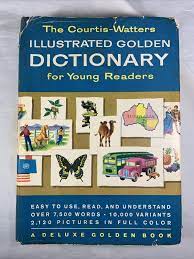
The Courtis-Watters Illustrated Golden Dictionary for Young Readers – by Stuart A. Courtis and Garnette Watters, illustrated by Beth and Joe Krush
Golden Press, 1961, revised version of 1951 edition

Yes, Beth and Joe Krush illustrated a children’s dictionary! If you collect the nearly obsolete genre of children’s print dictionaries, or if you are Beth and Joe Krush fan, you will want to acquire this out-of-print book.  If you are interested in midcentury education, or modern American history, or any other subject that appears within the pages of a dictionary, you might also want to see this book.

If you read my blog, you know about my enthusiasm for every book graced with pictures by the wonderful Krushes.  In addition to the fact that they rarely worked in color, this book is unique since it falls outside all their other categories: fiction, non-fiction, anthologies.  (Joe Krush also illustrated record album covers.) Opening to the endpapers, you are first immersed in a visual tribute to written language.  A cave man paints a bison, a Chinese scribe creates a manuscript, an ancient Jew holds a Torah scroll, and Benjamin Franklin, or someone who looks just like him, stands in front of a printing press.  Inside, the pictures become smaller and more detailed, accompanying and expanding on so many useful definitions.

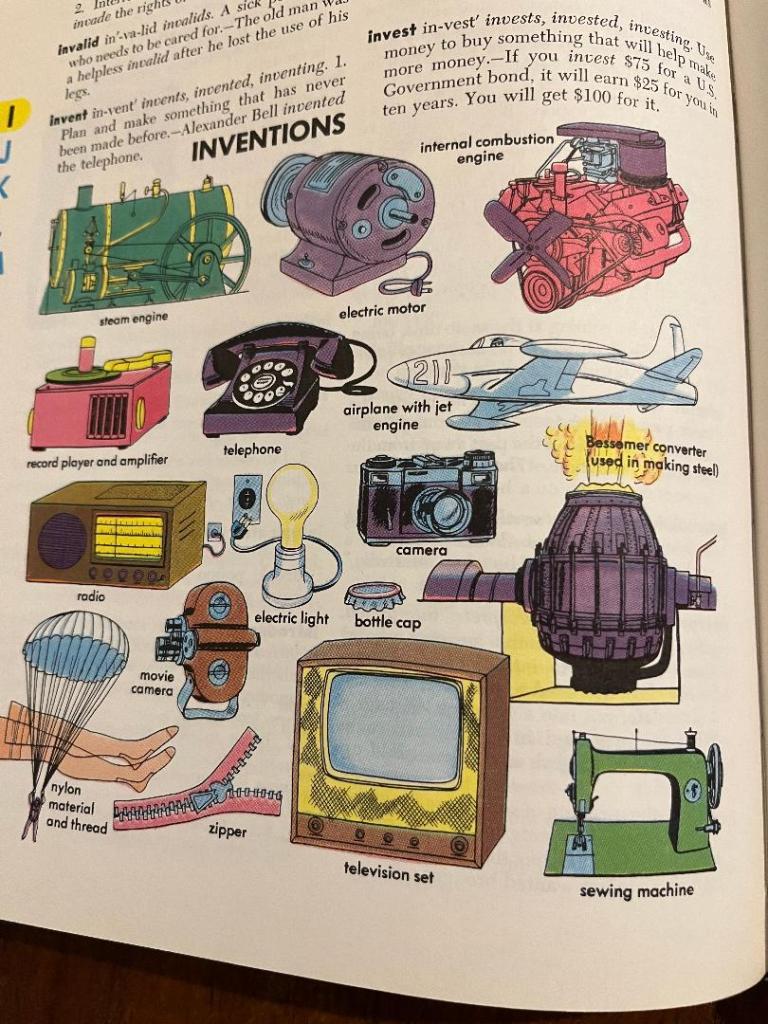
Let’s look at the entry for “Inventions.” Admittedly, some of them may not seem useful today, but they are.  A rotary phone, record player with amplifier, boxy television set, mechanical pencil sharpener and a bulky radio still appear in books, films, and other media.  The zipper,  and the delicate nylon stockings tucked behind a parachute of the same material, were once new, as was the Bessemer converter used in manufacturing steel. The smaller entries are just as valuable and revealing.  We see an adorable set of quintuplets in pink playsuits, bookended by one holding a toy kitten and the other a dog. “Race” depicts two different definitions. Three boys and one equally fast girl compete for speed. A closer look shows an interesting artistic choice, with one guy in a suit and tie, another in a V-neck sweater and tie, a third in shorts and a tee shirt. The girl wears a pink dress with a slip showing under the hem.  All four competitors seem happily engaged in running, regardless of how appropriate, or inappropriate, their attire is for the task.  The second image illustrates “race” as “a large group of people who have the same skin color and kind of hair, and other common traits.”

Obviously, there are some potential challenges there, but the Krushes’ picture shows a Black, white, Asian, and American Indian example.  The skin color on the face of the Chinese boy would no longer be depicted in that shade, which is almost fluorescent, but the other skin colors are also somewhat exaggerated.  Aside from the fact that the point of the picture is comparison, the process used to produce color in the book emphasizes a certain range of bright tones, like a mid-twentieth century illuminated manuscript.  The picture accompanying “blue” is square that matches the cobalt background of “skyrocket,” and the pink of a “melon” is nearly identical to that of a “reel” of film.  Obviously, the illustrators did not control these limitations.

The joy of seeing the Krushes’ incredible eye for detail is one of best features of the dictionary.  A fireman’s raincoat against a cloud of billowing black smoke, an oven range rendered in blue and white with a miniature red saucepan cooking, and a display of different clocks, from grandfather to mantel to cuckoo, all optimize their gift for capturing an object with both accuracy and imagination.  (They are the illustrators of The Borrowers, the creators of the Clock family!)

There’s lots more to love in this book, including the introductory “Getting Acquainted with Your Dictionary,” as if it were a new friend.  It includes helpful and openminded questions and advice, such as “Are both of these words spelled correctly: theater, theatre?” and “Pictures can help us understand what words mean… .  “Find the word accordion…Notice the many full-page pictures and maps in this book.” That especially applies when the pictures are by Beth and Joe Krush.

Multipurpose Distraction

Banana – written and illustrated by Zoey Abbott
Tundra Books, 2023

Let’s suppose someone you know, either a child or an adult, is so consumed with a particular object or pastime that nothing else can compete for her attention.  The focus of fascination might be a cellphone, a Rubik’s cube, or even a book.  In Zoey Abbott’s new picture book, the enraptured person is a young girl’s father and the object in question is a banana. The banana starts as an ordinary purchase, not from a supermarket, but from a “Banana store,” where an expert retail associate with long hair and glasses packages it up for the girl’s dad.  If you are familiar with Abbott’s work, you know that quirky imagination and ability to think like a child are signature elements of her style (see my earlier review here).

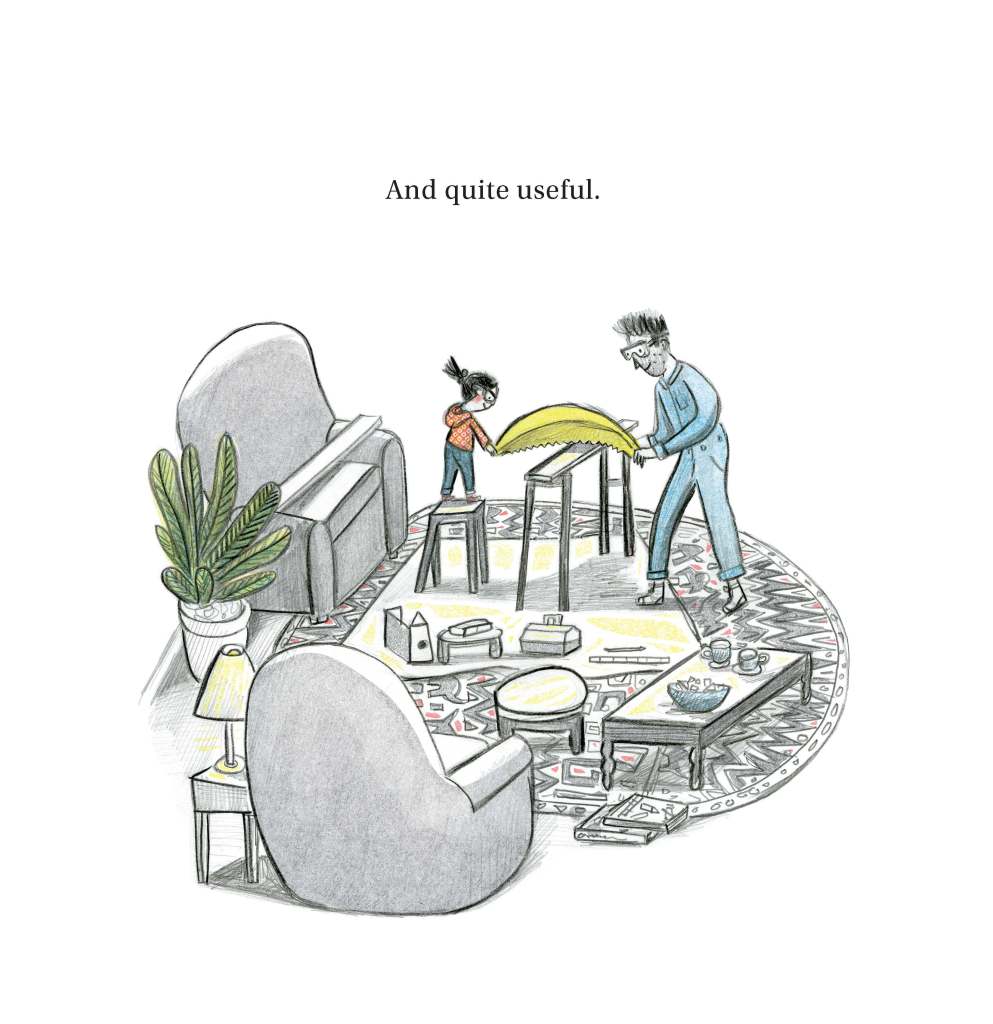
Adults can strike children as scary, friendly, puzzling, ridiculous.  The girl in the book has a terrific dad, who takes her to the beach, wraps her up like a burrito, and, mainly, always has time for her. Then the odd distraction comes along.  The banana starts as a magical connection between them.  Abbott’s pictures use each gesture and element to communicate effectively. Building a banana structure, watching multiplying bananas sail through the air, and using a larger banana as a handsaw.  Father and daughter are wearing safety goggles, of course. 

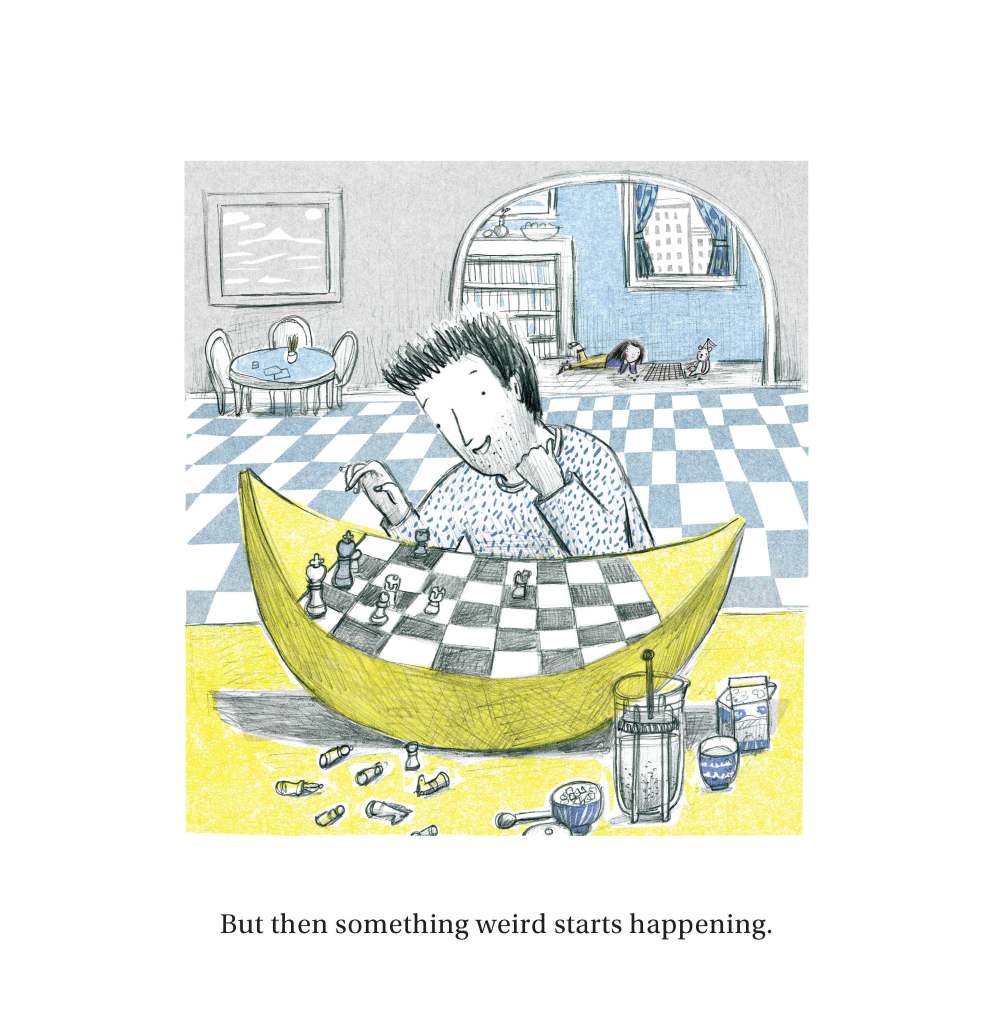
Then the fun stops.  The banana becomes a solitary obsession, and the girl is excluded from her father’s attention.  Even a game of chess takes on a sad aspect, with Dad in the foreground of the picture, and the girl reduced to a tiny perspective in the back of the room.  Abbott succeeds in conveying the see-saw nature of childhood. One minute, a parent is attentive to your needs. Then, he becomes immersed in some pointless activity. Naturally, readers might see a reverse metaphor in the story, as any parent frustrated by a child’s inattentiveness will recognize.  In Abbott’s world, the generations are not in contradiction; they might exchange roles.

When the distance between father and daughter begins to seem overwhelming, she takes the situation into her own hands. Once the banana has been removed from the scene, the father gets angry, but it’s nothing that a little focused meditation can’t fix. The scene shows how order has been restored to the universe. Seated back-to-back, their normal proportions are restored. The room is in order, table set, and pictures carefully composed on the wall behind them. Soon they’re back to being friends, in that companionable but reassuringly unequal way that children need.

A Literate Bear

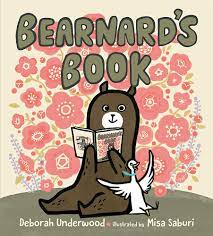
Bearnard’s Book – written by Deborah Underwood, illustrated by Misa Saburi
Godwin Books (Henry Holt and Company), 2019

Bearnard Writes a Book – written by Deborah Underwood, illustrated by Misa Saburi
Godwin Books (Henry Holt and Company), 2022

Bears play many roles in children’s books. They may be big, lumbering friends, or hibernating mammals looking for the perfect cave, or beloved stuffed animals that come to life.  Deborah Underwood and Misa Saburi’s bear is large, friendly, and a bit naïve, but he’s also a lover of books.  In his first appearance, he is thrilled to receive a letter from the Queen of Storybook Land, informing him that he has been chosen to be the character in a book. What could be more exciting?  In the second volume, as often happens to bibliophiles, he determines to become an author himself.  Sweet and witty at the same time, both books invite children to think about what it means to use their imagination, and to take a step beyond into creativity.

Bearnard doesn’t just passively accept his new role as literary character. He weighs the most promising possibilities: astronaut, superhero, knight.  Then he decides to do a little research, and here Underwood draws in parents and caregivers as well as kids. He might emulate “a bear who floated away in an umbrella,” a bear whose favorite food is marmalade, or the three porridge-eating bears who make the mistake of leaving their home unattended. (The endings are not predetermined, with a terrifying monster taking the place of a curious little girl.) Sometimes authors take an easier route, offering in-jokes to parents that will go over children’s heads, but there is none of that patronizing tone here.  Adults can explain the allusions, but even without that input, kids will relate to Bearnard’s earnest approach to his new opportunity.

Saburi’s lovely pictures reflect her own mastery of classic children’s book illustrations, but also great use of color and composition, and sensitivity to the way that children visualize the world.  In one two-page spread from Bearnard’s Writes a Book, our hero sits on a couch reading the earlier story.  He is large and solid, but not out of proportion to the substantial couch, the goose friend sitting next to him, or the sagging bookshelf overlooking the scene.  The facing page gives an extended view of his home, including a refrigerator also topped with books, a water cooler that dispenses honey, and a pair of sturdy boots. He’s a fully realized character. Saburi’s depiction of the writing process is also on-target, as a perfectionist challenged by writer’s block slumps at his desk and litters the floor with rejected manuscripts. The final page resolves the book’s conflicts, with Bearnard and Gertie the goose as collaborators.  They look out a wide window, their backs to the reader, while absorbed in their work.  Goose’s small, elevated platform to reach her desk is the kind of tool every writer needs.

The potential plots that Bearnard considers include some scary pirates and a goose who transforms into a dragon, but also the more mundane challenge of a broken crayon. The joys and frustrations of writing are presented to kids as real and tough, but not overwhelming.  These books are perfect for people who already are drawn to literacy, but also for those just beginning to consider its possibilities.

Trauma

The Story of Bodri – written by Hédi Fried, illustrated by Stina Wirsén
Eerdmans Books for Young Readers, 2021 (Originally published in Sweden, 2019)

This is an unusual book and it requires both courage and sensitivity to share with children. The author, Hédi Fried, (1924-2022) was a survivor of both Auschwitz and Bergen-Belsen. She became a psychologist, and lectured widely about her own experiences and their implications for the world. The first-person narrator of The Story of Bodri is a child, explaining the persecution and imprisonment she suffers and her ultimate liberation. Bodri is her dog; they are separated when the Nazis inflict the Final Solution on Europe’s Jews. I would not suggest reading this with children of the narrator’s age; they are too young. It would be appropriate for older readers, educators, and other people who work with children. The book’s subtle combination of revealing truths too horrible for children to contemplate, and revealing those truths from the perspective of a child, is compelling.

Like many Holocaust accounts, it begins in a normal home of loving family members and a sense of security. Bodri, the Hédi’s pet, is a guard dog who protects the community. Because the narrator’s voice is convincing, there is no irony in her innocent statement that “…I knew Bodri was watching over our family and our little town.”  Hédi’s best friend, Marika, is just like her, in the way that children describe intensely close friendships. There is only one difference. “I was Jewish. Marika wasn’t.” 

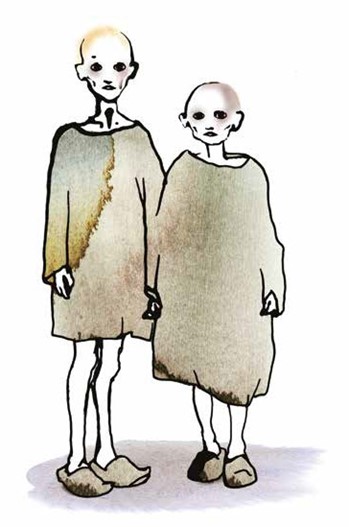
Hédi’s life is shattered when Hitler comes to power. Unlike the vast majority of picture books illustrators, Stina Wirsén has chosen to directly portray the dictator. His horrifying face emerges from the radio in a dark cloud. It appears again, even larger in scale, looming behind the terrified girl and her mother as they walk with arms raised, at gunpoint. Once Hédi and her sister are interned, Fried’s description is a careful distillation of the facts, while still avoiding some of the most terrifying truths. The prisoners are cold, hungry, thirsty, scared. Their uniforms are dirty and their shoes, hard wooden clogs. Wirsén’s picture shows emaciated figures with shaved heads standing behind barbed wire. Descriptions of the actual mass murders are avoided, but neither words nor pictures are sanitized.

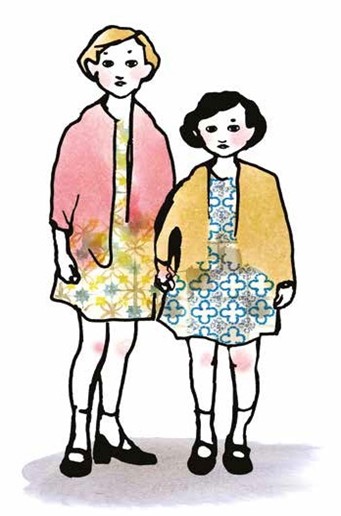
The illustrations have a tremendous impact because of Wirsén’s delicate use of watercolor and ink, as well as digital media, to express the whole range of Fried’s experiences. Her happy family is first rendered in light green and deep yellows, with Bodri a reassuringly solid dark brown. Then, dark clouds of color explode over their home. A scene of beauty in a public park is punctuated by a sign on the bench reading “Für Juden verboten. No Jews allowed.” Later, when the Nazis have been defeated, Bodri sits under a tree with deep green leaves, which turn to “copper-red autumn robes” as the season changes. The natural world has remained a constant while the world of human-caused horrors was buried in devastation. Adjacent pages show Hédi and her younger sister as inmates, and then as girls again in flowered dresses. They will never be the same as they were before the tragedy; this is not a Holocaust book that ends on a false note of hope. Fried’s simple statement of purpose, “So that it will never happen again,” is directed at the future, although it cannot change the past.

Drawing Outside of the Lines

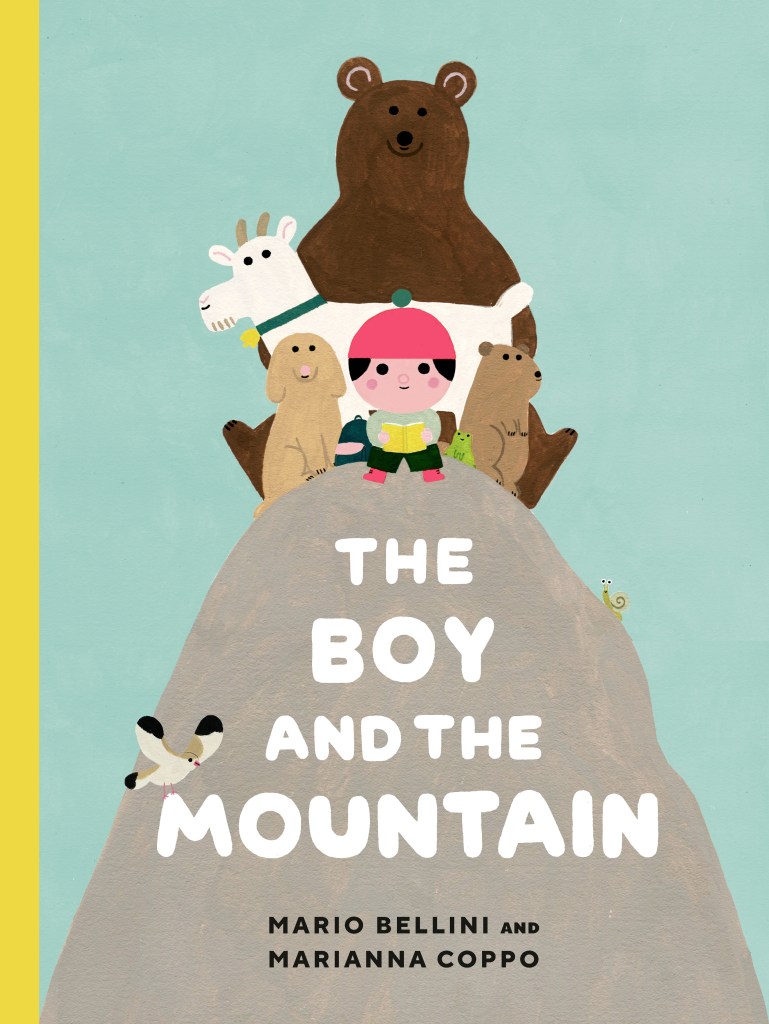
The Boy and the Mountain – written by Mario Bellini, illustrated by Marianna Coppo
Tundra Books, 2022

I’ve reviewed other books both written and illustrated by Marianna Coppo.  In The Boy and the Mountain she partners as illustrator with author Mario Bellini, and the result is terrific. We’re still in the universe of the imagination, where kids successfully navigate the normal perils of childhood in inventive ways. The title would seem to imply a difference in scale; a boy is quite small in relation to a mountain. But when you’re drawing on graph paper, you have the freedom to enlarge, minimize, and equate anything. You hold the pencil and crayons, and it’s up to you.

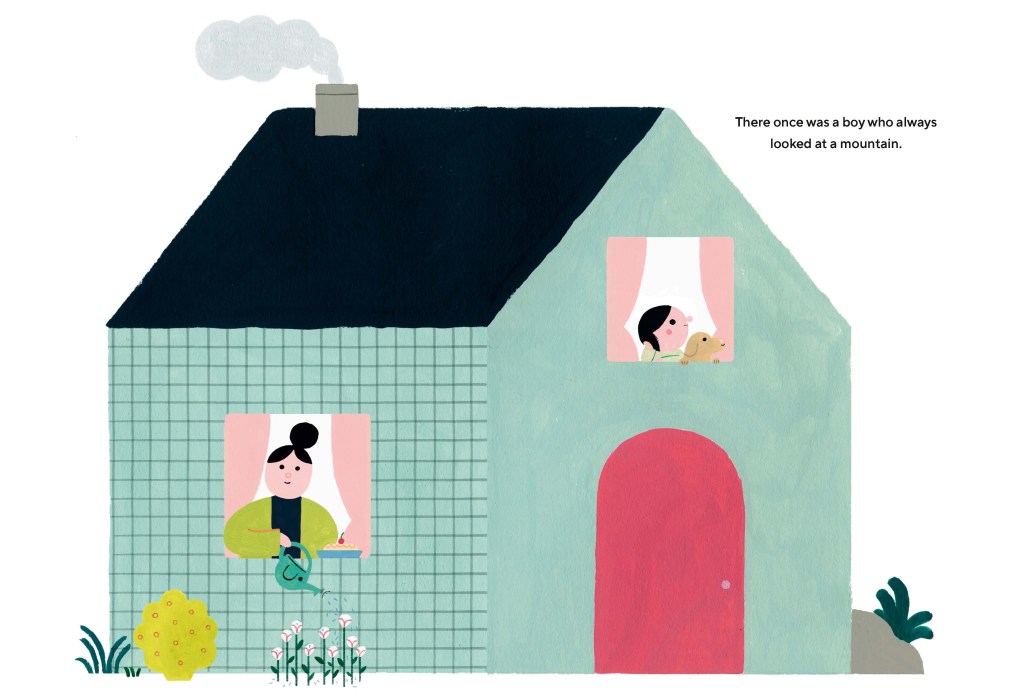
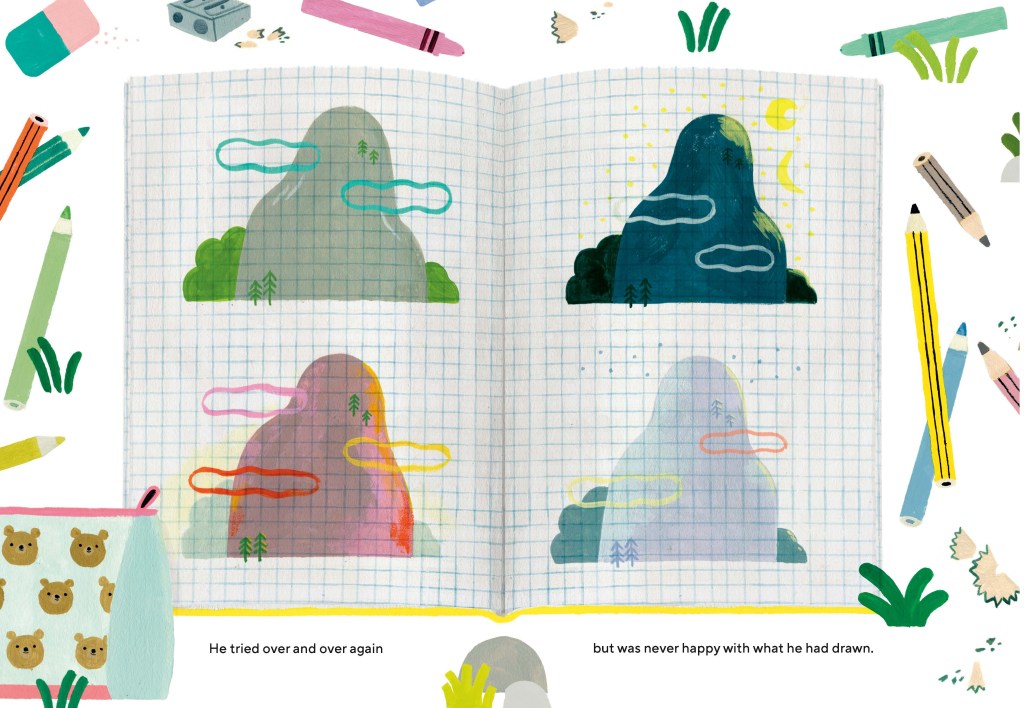
The book is presented as a fable. “There once was a boy who always looked at a mountain.”Why is the mountain so central to his vision? It’s a constant in his life, there when he wakes up and before he falls asleep. Naturally, he wants to capture the mountain as an image, so he can both control it and keep it forever. If you have ever been involved in an art project with a child, you know that she or he can become frustrated when an idea doesn’t easily conform to its realization. Coppo sets the boy’s drawing on graph paper within a frame of writing implements and erasers. The small squares should help him to build his scene, but he still has trouble.

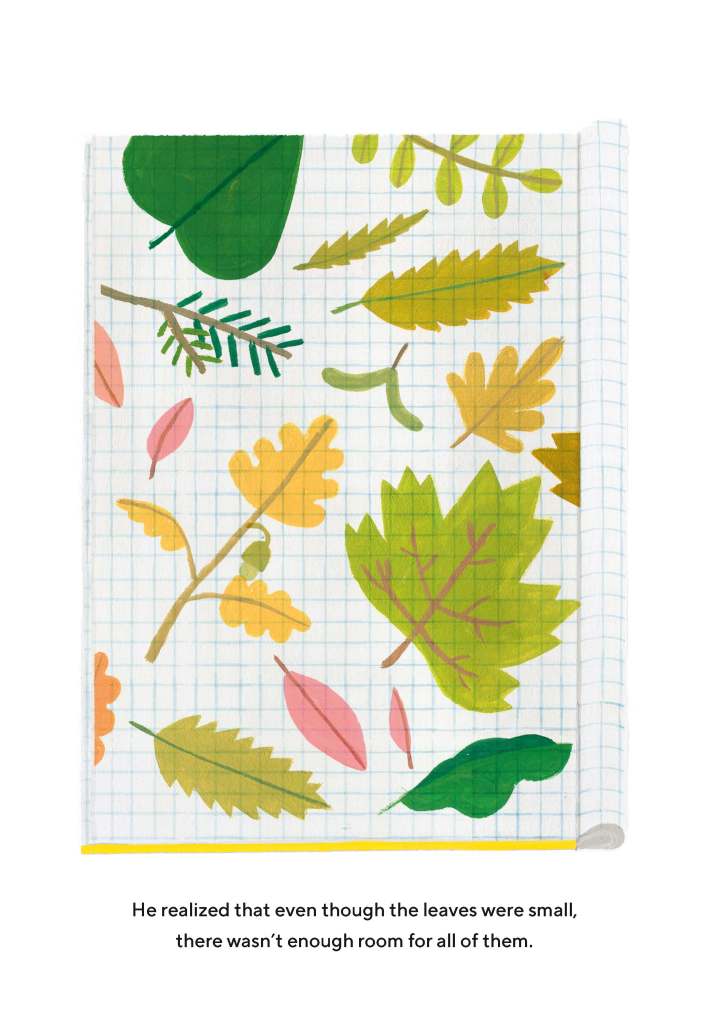
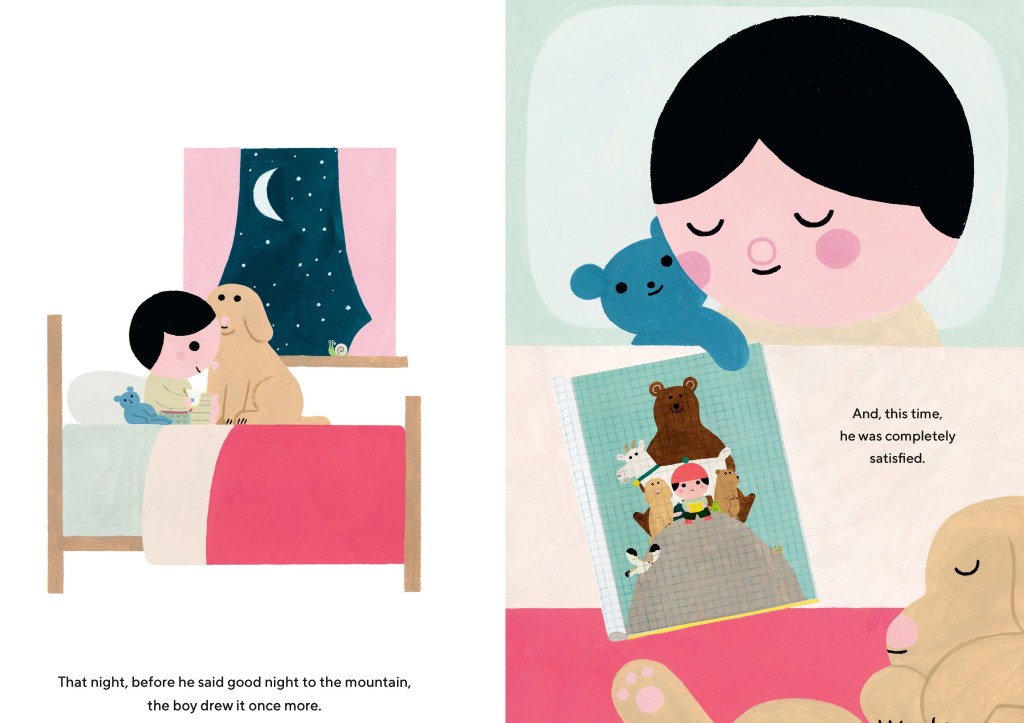
The graph paper element is one of the most interesting choices in the story. There is always tension between using helpful limits, like meter in poetry or figurative requirements in art, and letting your style run free. Children, and sometimes adults, even use stencils or pre-made pictures to color. Graph paper is a compromise. Yet the graph paper never seems to contain the boy’s imagination. Birds in flight, a friendly goat who is pleased with his portrait, even an accidentally smudged blue stream, all assume a life of their own. The boy begins to understand that art cannot be pinned down, even within a set of squares. He cannot draw all the leaves that he sees; “there wasn’t enough room for all of them.” Bellini and Coppo transform a universal moment of the child’s consciousness into an elegant work full of empathy. No one can duplicate all the wonders of the world in a picture, but we can create something new, which is even better. Instead of feeling resigned, the boy is finally satisfied with his efforts, and goes to sleep happy. The Boy and the Mountain does not rely on a facile Zen moment, but rather a deep sense of children’s emotions when they set their favorite mountain on a piece of paper and it looks just right. Adults may have a similar response to this eloquent book.

Union Maid

There once was a union maid, she never was afraid…

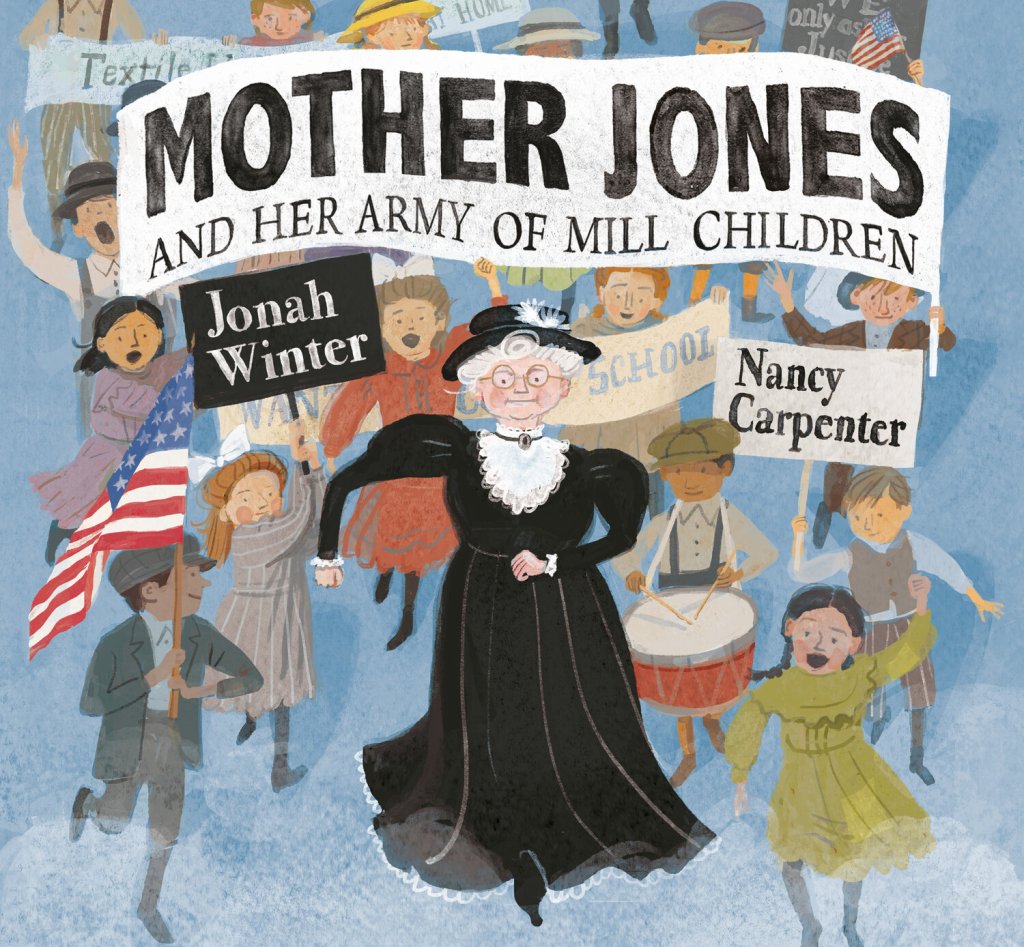
Mother Jones and Her Army of Mill Children – written by Jonah Winter, illustrated by Nancy Carpenter
Schwartz & Wade Books, 2020

Children don’t know enough about the history of labor unions and activism in this country. One solution is to share with them Jonah Winter and Nancy Carpenter’s resounding call for bravery, Mother Jones and Her Army of Courage. It tells the story of how, in 1903, labor leader Mary Harris “Mother” Jones led an army of exploited child laborers across the country, with the goal of exposing the exploitation and cruelty that ruined their young lives. Narrated in her voice and directly addressing the reader, Winter keeps up the pace on every age.  First, we learn that Mother Jones is enraged at injustice. Then, she explains how the wealthiest Americans live in luxury, their conscience-free existences supported by the grueling labor of others, including children.  Then, she reports how she and her army of kids took matters into their own hands, publicizing their cause from Philadelphia to Oyster Bay Long Island, where they hoped to confront President Theodore Roosevelt. They hoped to gain his empathy or at least provoke some shame.

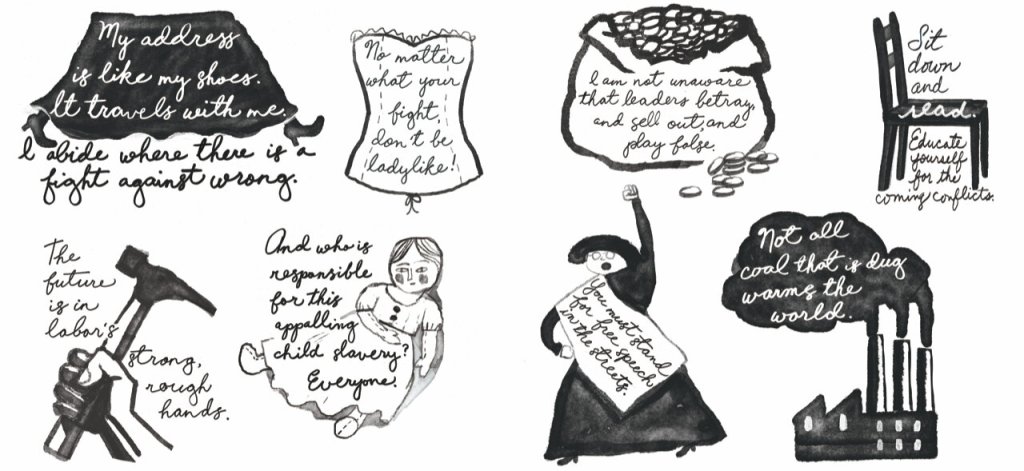
The book begins with quotes from Mother Jones embedded in iconic drawings on the endpapers.  A hammer, a factory, a restrictive women’s corset, are all filled with the words that defined her cause.  One of the best features of Winter’s approach is the way he unapologetically demands attention. There is certainly a place for picture book biographies that narrate events in the third person and explain, or suggest, their significance. That approach is valuable. Here, instead, readers have an informative, factual and carefully researched story framed with high drama.  Children will not be bored reading, or listening to, this book! Interspersed with quotes from Mother Jones herself are Winter’s words; he captures the essence of Mother Jones’s message without merely paraphrasing her.  Quotes and his text work together to move the story forward.

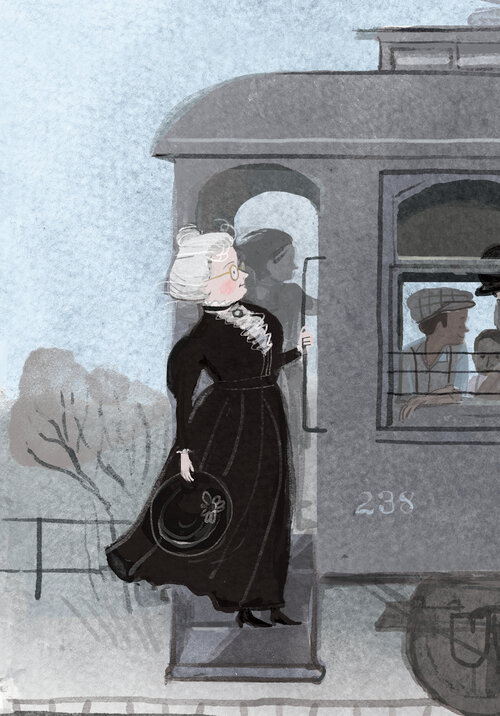
Carpenter’s pictures evoke the early twentieth century economic boom and its dark side.  Barefoot children with delicate limbs work machinery. Robber barons in pinstripes laugh at the apparently pointless attacks on their greed, assuming that they had all the power of monopoly capitalism.  But Mother Jones reveals their potential weakness: “Money is a powerful thing. But there is power in the people. There is POWER in the UNION – the union of workers marching side by side, demanding better lives.”  Carpenter’s Mother Jones is an older woman wearing glasses and an ankle-length black dress, but fronting an army of revolutionary kids, she is powerful.  As for her unlikely attempt to reach Roosevelt: “Flashbulbs flashed, and before you could say ‘Piscataway,’ we’d gotten our pictures in all the local papers….Why stop at New York? Why not march to the fancy-schmancy Long Island summer home of President Theodore Roosevelt himself?”

This past Sunday there was a long piece of investigative journalism in The New York Times about child labor. If you think there is exaggeration for the sake of effect in this book, read the article.  Most of the companies contacted by journalists either refused to comment or promised to look into the situation.  The most obtuse response came from Ben & Jerry’s “head of values-led sourcing,” who shamelessly justified the company’s exploitation of children with the outrageous logic that “if immigrant children needed to work full time, it was preferable for them to have jobs in a well-monitored workplace.” Mother Jones, in Winter’s text, would reply this way:

          I saw children…tying threads to spinning spools, reaching their hands inside the dangerous

          machines that make the fabric, sometimes getting their skirts caught, sometimes getting

          hair caught,…working for hours and hours, never resting…robbed of their childhoods,

          robbed of their dreams, and all for a measly TWO CENTS AN HOUR, while outside the

          birds sang and the blue sky shone.

Add dairy equipment to textiles and slightly elevate the wage, but the motives are the same.

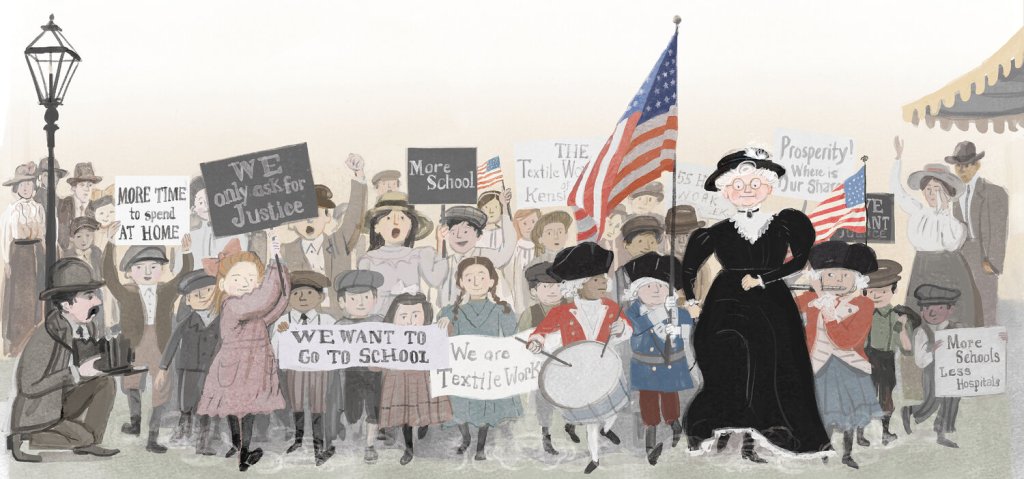
The two-page spread of Mother Jones parade with her children up Fourth Avenue shows the young workers as determined, patriotic, Americans, holding both flags of their country and signs protesting injustice.  Police stand silently by, and onlookers watch from balconies and windows.  This is real social justice activism, with both noble goals and pragmatic solutions.  Lots of people oppressed those children but many other supported them and worked for change. It’s the same today.  Read this book with your kids and students to learn more.

Where the Wild Girl Is

Be Wild, Little One– written by Olivia Hope, illustrated by Daniel Egnéus
Bloomsbury Children’s Books, 2023

There are no quiet indoor voices in this book.  The narrator directly addresses an outgoing and active child whose imagination takes flight in the natural world.  In brightly colored pictures and rhythmic text set in large font, she rides with elephants, wings with chimpanzees, and travels into a storm in her hot air balloon made of dandelion. There is no return home to a hot supper (apologies to Maurice Sendak) and no transition to the everyday world.  Be Wild, Little One is a straightforward celebration of untamed childhood.

There are realistic elements to the girl. She wears a striped t-shirt and shorts, and her hair is no more unruly than might be expected.  When she appears nesting inside a flower or riding on an elephant’s trunk, she is still identifiable as a real person.  The scale of her adventures varies, since in the flower scene she is smaller than a butterfly, but just the size one would expect in relation to the elephant.  She defies gravity when dancing with fireflies, but runs on the ground alongside a rabbit. The colors of nature predominate in Daniel Egnéus’s images: the star white of snow, a fading blue night sky, the deep green of a forest.

Olivia Hope’s words mix description and metaphor, although children reading or listening to the book need not see that distinction.  When the girl is told to “Run with wolves through mountain snow,” there are no perils suggested by that activity.  On the other hand, “Stomp and stamp, clap and cheer. Sing your song for all to hear!” corresponds to any child’s ordinary activities.  There is implied reassurance in the reminder that “Storms will come, but storms will go,” and an allusion to classic fairy tales in the direction to wish on a star.  Every one of these scenarios is part of the definition of childhood as a time of unfettered freedom. 

No doubt, children know that their routines are not defined by befriending wild animals or sitting atop a castle, but they also know that such imaginary journeys sometimes surface in the midst of more mundane events.  By insistently repeating the message to “Be wild,” Hope implies that the two parts of life don’t need to contradict one another.  The book’s assumption is a refreshing one. Sometimes kids just need to be wild, without specifying the inevitable return to reality.

It’s Elementary, in More Ways Than One

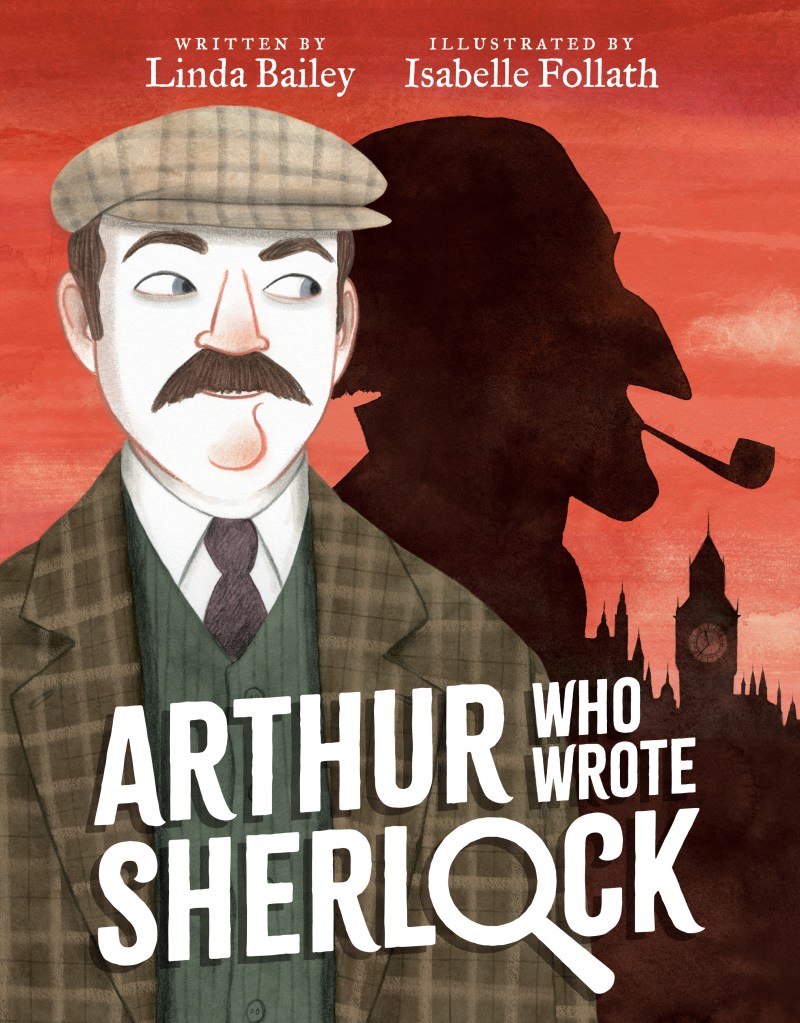
Arthur Who Wrote Sherlock – written by Linda Bailey, illustrated by Isabelle Follath
Tundra Books, 2022

Children love stories, and often mysteries, whether or not they are familiar with the great fictional detective, Sherlock Holmes.  Linda Bailey and Isabelle Follath have used this elementary truth to devise a rational, beautiful, and entertaining introduction to the inventor of one of literature’s greatest sleuths (Bailey has previously written a picture-book biography of Mary Shelley).  Their picture book biography of Arthur Conan Doyle (1859-1930) begins with the premise that young Arthur was always drawn to stories, carrying that quality into adulthood as he added to the pantheon of fictional problem solvers. 

The book begins by posing a question: Wouldn’t it be wonderful, Bailey asks, if you created one of the most popular characters in literature? “Or…would it?”  Holmes’s famous profile, as well as his pipe, violin, and a magnifying glass, accompany this challenge.  Young readers are now prepared to consider the premise that even when dreams are fulfilled, problems may follow.  Arthur’s childhood is not perfect.  His father is severely compromised in the parenting department.  Bailey is careful not to assign blame: “He has problems with alcohol, and when he can’t work, there is even less money.” But, as children no doubt realize, all of these issues have an impact, and young Arthur’s life is tough and unfair.

Fortunately, Arthur has a mother as enraptured by fiction as he is.  Follath (who has also illustrated the great Aggie Morton Series) shows this Victorian mom preparing supper, a book stuffed in her apron pocket, as she regales Arthur and his sister with “thrilling” stories narrated with sound effects. Even the family’s cat pays attention, as fantastic images of knights and mythical beasts emerge from her the steam in her soup pot. Evidently, domesticity is not a barrier to imagination; it’s appropriate to be reminded how much influence a bright and compassionate parent can have on her children.

Eventually, Arthur has to leave the hearth and attend boarding school, in an environment that may not be familiar to young readers. Those equations on the blackboard look rather challenging for the young students, and the teacher’s motivating techniques involve physical punishment and humiliation.  Follath draws this with restraint, but the sadness on Arthur’s face, and the protective way he attempts to cover his slate, make it clear that he is miserable. 

Eventually Arthur becomes a role model to younger children, and then attends medical school.  He is resilient and determined, and still enraptured by books. Bailey connects the disparate parts of his life into a continuous search: studies, a whaling voyage, and the beginnings of his medical practice.  How will an intelligent and rational man reared on tales of wonder put the pieces of his life together? It’s elementary.  He will construct a detective as unique as himself. Holmes will be “brilliant and scientific.” He will observe the world like a hawk and “even look like a hawk.” Surrounded by books and inkwells, Conan Doyle is a seemingly modest and hard-working author. Yet Holmes emerges dramatically, consuming most of the space on the two-page spread. 

Arthur will be persistent in the face of rejection, continually trying new approaches to his literary project.  Eventually, when Holmes stories are serialized in magazines, Conan Doyle finds the success that had been elusive.  (Here is good opportunity to explain to children what serialized magazine fiction meant in the pre-social media era.).  But even success leads to problems.  The now-famous author learns that he is not in complete control when he tries to end his character’s life and career.  Follath drawing literally renders the mechanism Conan Doyle used to bring Holmes back to life, a clearly labeled series of figures making clear that his resurrection was not magical. Once again, reason triumphs, although Bailey points out that the gullibility of fans has played a part.  (There is another good lesson to discuss with kids.)

At the end of the book, Arthur Conan Doyle is an old man, tremendously successful and still surrounded by books. Two young would-be Holmeses follow in his footsteps, literally and figuratively.  Whatever the goals of the children in your life, Arthur Who Wrote Sherlock encourages them to both dream and pursue what they love.  The book includes a wonderfully readable and informative author’s note and a list of sources.