On Board with Anne

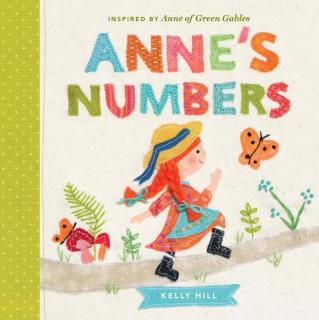
Anne’s Numbers: Inspired by Anne of Green Gables – Kelly Hill, Tundra Books, 2018
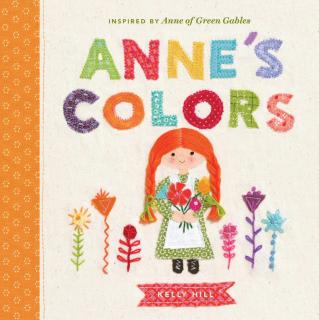
Anne’s Colors: Inspired by Anne of Green Gables – Kelly Hill, Tundra Books, 2018
Anne’s Alphabet: Inspired by Anne of Green Gables – Kelly Hill, Tundra Books, 2019
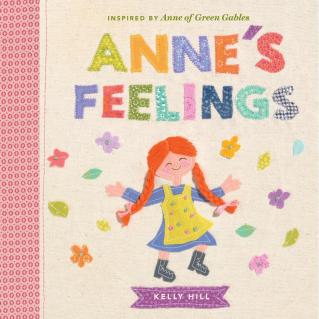
Anne’s Feelings: Inspired by Anne of Green Gables – Kelly Hill, Tundra Books, 2019
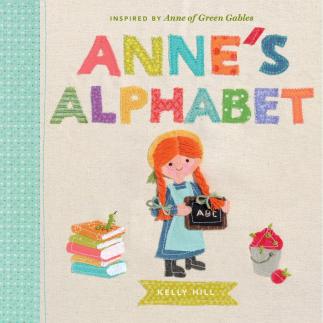
AlphabetCoverfeelingscover

ColorcoverNumbersCover

How young is too young for Anne of Green Gables? The answer to that question is found in Kelly Hill’s two board books for the youngest readers released last year, and two more that will be available on May 7. Children old enough to hold a sturdy board book or sit on a caregiver’s lap and look at pictures while listening to words, can easily enjoy the simple beauty of these books, with images created from Hill’s hand embroidery.  The next question might be, why introduce a child that young to a specific literary figure? Anne, the Prince Edward Island orphan who embodies both the deprivations and the joys of childhood, as well as the challenges and the proud triumphs of being a smart and sensitive girl, bookish and emotional, loyal and truthful to herself and others.  The answer is that Anne is not merely the heroine of one glorious childhood classic, but an evolving character whom we come to love from childhood to motherhood, from her arrival at Green Gables to the impact of World War I on her family. Anne changes and so do her readers.  These lovely books for toddlers and young children present images of the young Anne, her friends and guardians, the natural and domestic worlds.
depthsofdespair

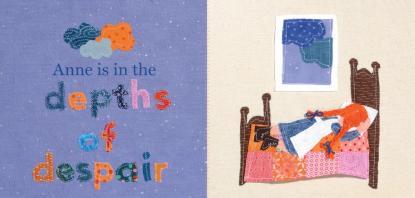
The first appeal of these books to children is that they are designed with bright colors, fabric cut-outs, sewing, and embroidery.  The pictures are easy to interpret, even as they must have been challenging to design and construct.  Some board books based on adult works of literature are clearly marketed to parents.  That’s fine, because they can still be enjoyed on two levels: that of the mom or dad finding the humor in Wuthering Heights or Anna Karenina, minus the tragedy, and also by children who like the pictures and can follow invented narratives by a grown-up reader, or make up ones themselves.  So those books are fun.  These are a bit different. Although there are specific phrases that keep them rooted in the original book, such “depth of despair” to describe one of Anne’s emotions, or “kindred spirit” to identify the letter “K.”  In every case, the clarity of the pictures gives a clear context for explaining to children.  They might not have heard of the beverage “raspberry cordial,” but one hand holds a white fabric cup partially filled with red while another hand pours from a similarly divided pitcher.  Everyone likes fruit juice!
slate

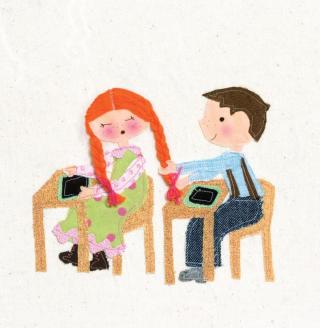
Kelly Hill has created a fabric Anne, three dimensional and fully accessorized.  Such iconic elements from the novel are here as Anne’s puffed sleeve dress, rendered in a rustic brown fabric, and Gilbert Blythe tugging at Anne’s orange yarn braids.  Some of the figures are sewn to a background and many use a variety of embroidery stitches.  Anne’s Alphabet illustrates “imagination” with Anne standing on a tree stump, her hair crowned with an embroidered garland of flowers, and a quilted cape indicating that her imagination is taking flight.
picnic

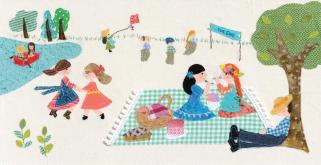
A community picnic layers burlap fabric over the participants in a sack race, while a red fabric rowboat travels on a blue sea.  There are unending carefully chosen details to explore with children, but they are not overwhelming; each page is a stand-alone scene to share and discuss. Characters and objects overlap in the four books.  The puffed sleeve dress from Anne’s Alphabet also appears in Anne’s Colors, where we can see its blue tulle underskirt as Anne joyfully pulls it out of its box.

There is an Anne for every age, as I have blogged on here and here and here and here; and, of course the original, irreplaceable Anne of L.M. Montgomery’s 1908 novel and later ­sequels.   When readers eventually meet her, they will find a familiar friend, maybe even a kindred spirit.


Knitting Together

A Scarf for Keiko – Ann Malaspina and Merrilee Liddiard, Kar-Ben Publishing, 2019

keikocover

Every once in a while a children’s book comes along which seems to fully and originally satisfy its intentions.  A Scarf for Keiko is one of those books.  It is the story of a friendship between a Jewish boy and a Japanese-American girl in World War II era Los Angeles, in the Boyle Heights neighborhood where their two communities shared a common home.  It’s about the tragedy of Roosevelt’s decision to enact Executive Order 9066, interning innocent people in relocation camps due to unjust suspicions of their loyalty.  It’s also the story of a child learning that passively going along with bullies is wrong, and that the values which his parents have taught him will strengthen his resolve to ignore the warnings of his egg-throwing racist neighbors.  It does all this without simply preaching to the inevitable choir of people who like progressive children’s books.  Merrilee Liddiard‘s graphic novel-style illustrations add a dimension of contemporary tastes to realistic settings of a now distant era.  This is a great book.

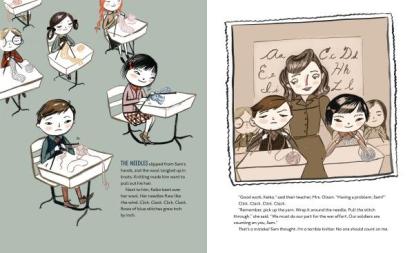
A Scarf for Keiko spread

Sam’s older brother is away fighting in the War, putting a great deal of pressure on him just to emotionally survive. So when his well-meaning teacher promotes a school project of knitting for the soldiers, Sam’s apparent incompetence has his “stomach tied up in knots like the yarn on his desk.” His friend, Keiko, on the other hand, effortlessly creates rows of beautiful stitches.  Her skills and her patriotism are not rewarded by classmates who taunt and bully her. Sam’s friend Jack is convinced that Sam’s brother would not want him to even speak to Keiko, and Sam’s response, natural to a terrified child, is the morally meaningless, “ I didn’t talk to her…She talked to me.”

Sam soon witnesses senseless destruction of Japanese-American’s property, including at the Saito family’s shop where he is sent to buy flowers for Shabbos. Liddiard draws Mr. Saito, neatly dressed with period details of cuffed pants and plaid vest, as he sadly sweeps broken glass from the street, a terrible echo of the violence perpetrated against Europe’s Jews.  Worse, Sam learns that Keiko and her family are being sent to a camp in the desert. Simple language and expressive pictures combine to illustrate Sam’s mother’s gesture of solidarity: “How long will they be away? Sam asked. Mom sighed. No one knows.” The Saitos’ elegant tea set sits on the table, where Sam’s mother has promised to protect it while they are gone.

This is a book for young readers. It is not intended to detail life in the “relocation centers,” as they were euphemistically called, but Ann Malaspina’s detailed “Author’s Note “and photographs explain the destructive effects of the policy.  Sam and Keiko remain hopeful friends, and the knitting continues. Sam may not be as gifted in this area as Keiko, but it’s enough for him to follow his teacher’s instructions:

“Pick up the yarn.
Wrap it around the needle.
Pull the stitch through…

Come home safely.”


In Memory of Marjorie Weinman Sharmat 1928-2019

Nate the Great and the Sticky Case – Marjorie Weinman Sharmat and Marc Simont, Yearling, 2006 (reprint of 1978 edition, with additional material)

natecover

It is no small accomplishment to write even one well-crafted and engaging chapter book for newly independent readers.  Marjorie Weinman Sharmat, who died on March 12, wrote over one hundred books, more than two dozen of them in the Nate the Great series about a smart and somewhat less than modest boy detective who seems to have all the answers. Sharmat’s career was not limited to this series, but, in paying tribute to her long career, one characterized by great intuition about what children would like to read, it seems appropriate to remember what is innovative and durable about him.

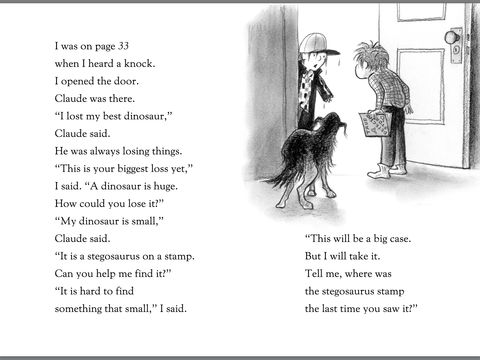
Nate has a sense of humor, one appreciated by those beginning their journey in literacy.  In Nate the Great and the Sticky Case, when Nate’s friend Claude is bereft by the loss of his stegosaurus stamp, Nate reassures him: “It is hard to find something that small…This will be a big case.”  Nate loves his mom. So, considerately, he leaves her a note when he departs to go out on his latest case:  “Dear Mother, I am on a sticky case…Love, Nate the Great.”

Nate’s stories include challenging vocabulary and content.  It’s one thing to like dinosaurs, another to learn about distinctions between the tyrannosaurus, ichthyosaurus, and stegosaurus.  Claude’s collection of dinosaur stamps in extensive.

Nate is loyal.  Nate’s dog sludge is “not a great detective” and sometimes gets in the way, but Nate tolerates this flaw. Nate’s friend Rosamond is a little odd. In this book, she has the enterprising idea of selling cat hairs.  Her cats have scary names, like Big Hex and Plain Hex, but her very quirkiness is part of why Nate likes her.

When Nate becomes discouraged, he doesn’t give up.  After a plate of pancakes, he is better able to focus: “Suddenly I, Nate, felt great.  I had pancakes in my stomach and a good idea in my head.”

Nate can dream up crazy ideas and think outside of the box: “I, Nate the Great, wished that I had two brains and that one of them would solve this case.”

After the conclusion of a successful case, Nate keeps his perspective, calming walking home with his dog Sludge: “We were careful not to step in any puddles.”

nateinterior

Nate the Great is a little bit Sam Spade for kids, a little bit Philip Marlowe. Each of Sharmat’s books about him has a satisfying predictability, which is a great asset for beginning readers. They also have surprises and twists, and dramatically detailed pictures by Marc Simont.  The new reissues of the series include additional activities; Nate the Great and the Sticky Case has several, among them a brief history of the U.S. postal service, a diagram with the parts of a stamp, and a recipe for dinosaur lollipops.

It’s no mystery that Marjorie Weinman Sharmat’s contributions to children’s literature, identified with, but not limited to, Nate the Great, will not disappear.

Friendship that Starts in the Soul

Anne’s Kindred Spirits – Kallie George (adapting L.M. Montgomery) and Abigail Halpin, Tundra Books, 2019

cover

Anyone who has read Anne of Green Gables knows that friendship is not just a pleasant link between two people, but a life-transforming bond. If you are a poor, bookish orphan who has never found anyone as understanding as her own reflection in a mirror, meeting someone who becomes a “bosom friend,” and a “kindred spirit,” is an affirmation of her own value as a human being.  In Kallie George and Abigail Halpin’s second in a series of adaptations of Anne for middle grade readers, they once again achieve the near-impossible, preserving the eloquence and passion of Montgomery’s work while making it accessible to those who will read the original book a bit later.

hlding hands

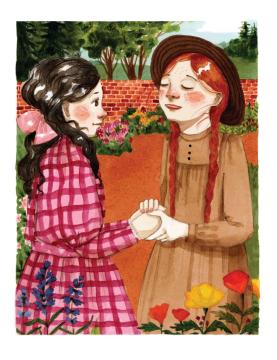
As in their earlier volume, George and Halpin focus on a limited series of events, rather than trying to encapsulate the whole classic.  Anne meets Diana Barry, who loves reading as much as she does, although Diana’s “hair was black as a raven’s wing, not red.”  They learn that their inner similarities outweigh their outer differences, and make a vow, “to be faithful to my bosom friend as long as the sun and moon endure.” (link to image of girls holding hands)  The meeting between Anne and Diana was a close call. Having been warned by her guardian, Marilla, to downplay her irrepressible oddness, Anne almost sabotages the new bond by responding to Mrs. Barry’s formulaic “How are you?” with “I’m good in body, but rumpled in spirits, ma’am.”  Even as George simplifies some of the original novel’s language, she retains its intensity and depth.  There have been many other attempts to adapt classics for a younger audience; this one is exceptional.

pie

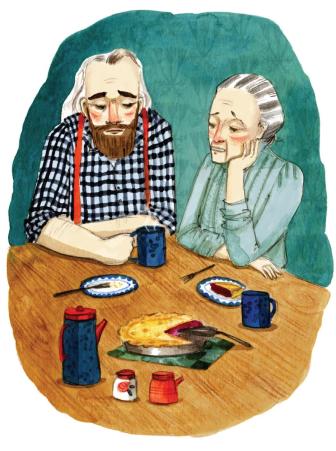
The book also includes the episode of Anne’s unjust punishment by Marilla when a favorite brooch disappears from Marilla’s pincushion.  George conveys the frustration of a child who is misunderstood by adults, but is not free to express that frustration.  Marilla is also frustrated at her apparent failure to have taught moral lessons to her foster child.  Halpin’s beautifully profound illustration of this sorrow shows Marilla and her bother Matthew seated at a table, with a sliced pie in the center.  Matthew’s plate is empty, but Marilla’s serving is untouched. She rests her head on her elbow and looks overwhelmed, trying to process the facts: “I’ve looked everywhere…Anne took it. That’s the plain, ugly truth.”  Every picture in the book is in close harmony with the accompanying text; children will truly read both text and pictures. (link to image)

braids

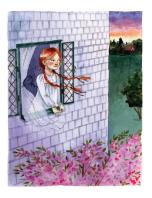
In another image, Anne leans out the window in her nightgown, her braids lifted by the wind like a Prince Edward Island Rapunzel.  Instead of waiting for her prince, she is terrified that Diana will not understand why she is not attending the community picnic.

wagonride

Another picture subtly captures Anne and Marilla’s opposite personalities. They are riding in a their carriage, Marilla holding the reins firmly and looking down, but also listening to Anne, whose verbal stream both puzzles and amuses her: “Do you think amethysts might be the souls of flowers?”  The book’s final two-page spread is really a testament to the author and artist’s vision.  Everyone is enjoying the closeness of a town too small to have strangers; Halpin has introduced people of color, who have a rich history in the Maritime Provinces. Their presence in the scene is one more piece of evidence of Halpin’s deliberate artistic choices.

picnic

Reading Anne’s Kindred Spirits, and sharing it with children, is an elevating experience.  The book is a reminder of how innovation and awareness of tradition can work together to make a great children’s book.

Upstairs Boy, Downstairs Mouse

Matzah Belowstairs – Susan Lynn Meyer and Mette Engell, Kar-Ben Publishing, 2019

Matzah-Belowstairs-cover

There is an undeniable appeal to the suggestion that mice, adorable anthropomorphic ones, live parallel lives hidden in our own homes. Beatrix Potter’s lifelike creatures lived among other animals but also interacted with humans.  In Beverly Donofrio and Barbara McClintock’s modern classics, Mary and the Mouse, the Mouse and Mary, and Where’s Mommy? (Mary and the Mouse), a girl and a mouse develop a friendship based on the parallel parts of their respective lives.

In the world of Jewish children’s books, Phoebe Gilman’s Something from Nothing gives us a similar glimpse into the mouse world, as the author and illustrator relate the story of a traditional folksong. Florence Zeldin’s A Mouse in Our Jewish House introduces Jewish holidays through cut out paper pictures of an enthusiastic participant, who happens to be a mouse. The story that Susan Lynn Meyer tells in  Matzah Belowstairs follows this tradition, although Engel’s illustration style is more in tune with modern animation than with the nostalgic images of other mouse stories.

It’s Passover, and the Winkler family in apartment 4B is getting ready to celebrate with the ritual Seder and meal.  Belowstairs, things are much more hectic, because Miriam Mouse and her family cannot find a single piece of matzah: “There won’t be anything to remind us of the time our mouse ancestors left Egypt in too big a hurry for the bread to rise!”

matzomouseinterior

Their cozy apartment looks busy, nonetheless, with Miriam and her parents reading the book of Exodus on their couch, while the grandparents chop vegetable in anticipation of the holiday’s beginning. They reassure Miriam that it is not her fault that the matzah is missing, blaming the Winkler’s acquisition of a new tin box, so securely closed that no mouse-size pieces have fallen out and landed below the floorboards. Eli Winkler’s dad hides the afikomen, a piece of matzah that Eli will need to find and return to the family, in order to conclude the festive meal and begin the last part of the Seder.  In searching for this valuable piece of unleavened bread, Eli runs into an anxious Miriam.  Who will get the piece of matzah which both families are seeking?

Mette Engel’s pictures are sure to please young readers.  The characters’ facial expressions clearly signal their moods, whether a bereft Miriam left in tears at the thought of an incomplete Seder, or a surprised Eli meeting Miriam on a bookshelf as they both do their jobs.  There are images which give the perspective of small people and smaller mice, as one where young Eli stands amidst a group of adult guests shown only from their feet to their waists, while, belowstairs, the mouse family is busily engaged in holiday preparations.  I particularly like the mouse grandparents: Grandpa with his matching, slightly dorky, zigzag print sweater and yarmulke, and Grandma, wearing pearls and delicate half-glasses.

Matzah Belowstairs is a playful and clever addition to Passover books for kids, as well as to the age-old genre of mice and their secret lives.

Haiku for Everyone

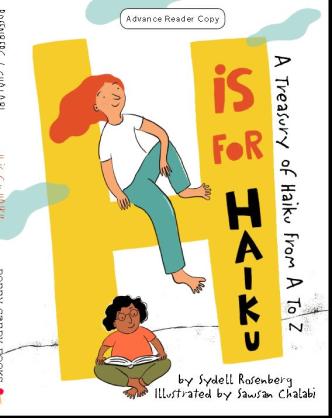
H is for Haiku: A Treasury of Haiku from A to Z – Sydell Rosenberg and Sawsan Chalabi, Penny Candy Books, 2019

haiku cover

Haiku is a poetic form that seems to demand less, but really demands more.  In only three lines of five, seven, and five syllables, the artist asks for our attention to the essential, and revealing, parts of life.  As author Sydell Rosenberg’s daughter writes in the introduction to this collection of her late mother’s work, “What’s most important about writing haiku is to focus on those many small moments we may overlook and make them special.” If you thought that writing haiku meant that you had to address nature, or conform to other requirements of the traditional Japanese form, then focus intently on this quirky collection before you grab your pen, or sit down at your computer. Rosenberg wrote about children, umbrellas, monsters, beauty parlors, and trash cans, all related to one another with delicate humor and verbal assurance.  The pictures that accompany the poems are bright and expressive, equally accessible to children and adults.

H is for Haiku is not the first collection to expand the form beyond its origins.  There are other lovely examples, such as Celeste Mannis and Susan Kathleen Hartung’s One Leaf Rides the Wind, Betsy E. Snyder’s sweet I Haiku You, and the detailed guidelines of Patricia Donegan’s Write Your Own Haiku for Kids. Rosenberg’s collection is a bit more irreverent and dream-like.

wash

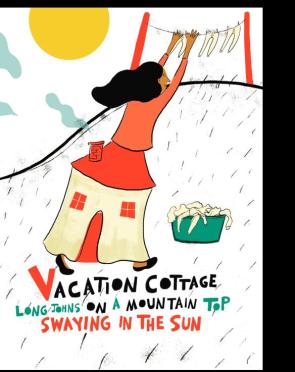
Sawsan Chalabi’s picture of a woman hanging out wash on a line captures the arresting lines, “Vacation cottage/long Johns on a mountain top/swaying in the sun.” (In the book, the words are all capitalized, with letters alternating color and angle to one another.) The woman’s skirt is the house itself, with windows and chimney facing the reader as she concentrates on her task.  There is an authentic slice of New York City life, as workers suffering from the summer heat indulge in a refreshing moment: “Queuing for ice cream/sweat-sprinkled office workers/on Queens Boulevard.” That “sweat-sprinkled” is just right, as the patient line of people, of different ethnicities, enjoy a moment of respite as brief as the poem itself.

The book concludes with brief profiles of author and illustrator. Ms. Rosenberg was a public school teacher for many years, as well as a charter member of the Haiku Society of America.  Ms. Chalabi is a versatile illustrator and designer. As a short introduction to the form by Rosenberg aptly declares, “Haiku can’t be gimmicked; it can’t be shammed.” H is for Haiku illuminates how and why this form of poetry is unique, in all its non-gimmicky, sham-denying beauty.

In Memory of Paul B. Janeczko

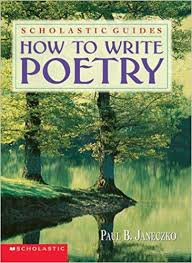
How to Write Poetry: Scholastic Guides – Paul B. Janeczko, Scholastic, 1999

janeczko

I was saddened to hear of the death of poet and author Paul Janeczko, one of the most thoughtful and innovative practitioners of the art of poetry and of teaching poetry writing to children.  Both his own poems and his anthologies, some illustrated by Chris Raschka and Melissa Sweet, among others, are joyful and serious introductions to verse, for example A Poke in the I, Dirty Laundry Pile, and The Death of the Hat.  Reading these beautifully organized and presented collections is a lesson in itself; they convince children and teens, as well as adults, of the excitement and the relevance of the genre.

poetrycover

One modest book which stands out when I think of Janeczko’s work is the practical guide published by Scholastic, How to Write Poetry. While there are other books which give aspiring poets formulas and tips, this one stands out for its unassuming but assuring format.  Each chapter approaches a different task essential to writing, exploring different types of poems, and analyzing how each one responds to that task.  The book is physical simple, but appealing, with text boxes of grey or green embedded to highlight “poetcraft” and “writing tips.” “Try this” sections are accompanied by a small icon of a book and pen.

Rather than structuring the book around rules and recipes for specific verse forms, Janeczko develops each chapter as a work-in-progress, a map of the poet’s work.  For example, the chapter on “Writing Free Verse Poems” includes list poems and poems of address, quotes from poets, advice on word choice and figurative language, and even checklists for the writing process.  The tone is focused, respectful of the difficulties as well as the rewards of writing poetry.

Recently, there have many children’s and young adult authors who have had success with verse novels or memoirs in poetic form: Jacqueline Woodson, Kwame Alexander, Debbie Levy, Karen Hesse, Sharon Creech, Marilyn Nelson, and others.  Paul Janeczko’s guide offers a complement to reading those authors, an inside look at the nuts and bolts which poets use to build their inimitable structures and to suggest that kids can learn how to write poetry, too.  Janeczko will we remembered for his unique contribution and his inspiring vision.

Peanut and Moe are Back!

Now? Not Yet! – Gina Perry,  Tundra Books, 2019 (June 4)

notnowcover

This story, about two friends with somewhat dissimilar personality traits, will delight young children. We first met Peanut and Moe in Gina Perry’s Too Much! Not Enough!, and they are back, this time ready to meet the challenges of a camping trip: tents, s’mores, and all the rest.

While Mo Willems’ Elephant and Piggie are clearly an elephant and a pig, Moe and Peanut are not so easily identified by species.  Peanut looks a little like a peanut with bunny ears, while Moe’s bigger and bluer frame and long pink nose make him more like the creature of a child’s imagination.  Their sometimes frustrating but ultimately resolved differences are funny and comforting at the same time.

Moe and Peanut are both looking forward to an action-packed day outdoors, but their priorities are not always in sync.  Peanut wants to swim; Moe wants to hike.  Then Moe needs a snack, gets them lost, and insists on putting up their tent. It’s not even a disagreement, just a seemingly unending series of interruptions, which is the way young kids often see the obstacles placed in the way of doing what they want.  Eventually, the swimming happens!

notnowcampfire

Then Perry reveals that Moe isn’t just a killjoy, but is actually a wise and almost adult figure, who knows that fun has to happen in its own time, and that after the fun, there is more stuff to do.  Children reading or listening to the book will understand this subtle message, as they experience the sequence of events: delaying the fun, having fun, and meeting unanticipated joys afterwards: “Now we are dry…Now we are cozy…Now we are warm…Now we are happy…”

notnowshouting

Gina Perry’s pictures are as accessible as her text. The colors are bright, but not flashy. Green and brown plants and earth meet Peanut’s bright pink toy bunny and candy-striped floaty. Some of the characters’ outbursts erupt in oversized and neon letters.


notnopwrocks

There is a lot of activity on each page, but it isn’t frenetic.  On the title page, we see Moe carefully putting the ingredients for a snack in a small plastic bag, while Peanut hangs upside down from the top of his bunk bed.  The excursion is full of little surprises and distractions. A tiny worm crawls on Peanut’s ear, and both friends deal with burrs and pinecones sticking to their fur.

While adults might view those as incidental, from a kid’s perspective they are inextricable parts of the event itself.  Now? Not Yet is a happy combination of child empathizing and adult perspective, where a camping trip becomes a colorful metaphor for the way that, sometimes, things just work out.

notnow bunkbed


Girls, Horses, and Power

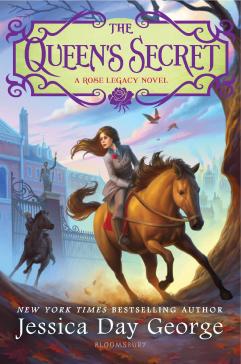
The Queen’s Secret (A Rose Legacy Novel) – Jessica Day George, Bloomsbury Children’s Books, 2019

horse cover

Sometimes older genres are rejuvenated by rethinking conventions; this is certainly true in series fiction primarily marketed to girls.  In The Queen’s Secret, the second book in Jessica Day George’s fantasy series about girls set in a fictional kingdom torn by conflict, Anthea Cross-Thornley is brave and assertive, and also possesses the Way, a kind of superpower that allows her to communicate with horses.  Her relationship with her mother is conflicted, and she does not hesitate to question authority. There is quite a lot in the book to intrigue and entertain middle grade readers, and also encourage them to think.


The book is set in a far-off, but not so far-off, land, both in time and in space.  The characters’ names clearly invite associations with Britain, and the locations also have a European flavor.  While at first the reader may assume she is in the distant past, references to motor cars and cameras quickly correct that impression.  The author succeeds in balancing the fantastic and realistic elements in the narrative by alternating them smoothly and believably.  Anthea’s uncanny ability to speak to horses is woven into the other strands of the story: political intrigue, historical allusions, and feminism.

The most interesting part of the novel to me was its theme of mass hysteria and the need to use science to correct misplaced fears of progress. Because a deadly disease with nineteenth-century overtones is attacking people indiscriminately, they seek easy answers and cling to the falsehood that it is transmitted by horses.  Here is where readers attracted to the book by the promise of a good story about girls and horses will not be disappointed.  Chapters narrated by the horses themselves are interspersed throughout the book, complementing Anthea’s perspective and strengthening the idea of her commitment to save these noble animals from prejudice and hatred.

The solution to the mass terror is the rational solution of inoculating people against the dreaded illness; the discovery that those who are immune to the relatively innocuous “ring pox” are immune to “the Dag” is an obvious historical allusion to physician Edward Jenner’s similar route to protecting patients from smallpox.  Jessica Day George has subtly introduced some medical history into her story.  Less subtle, but just as welcome, is the prominent role played by women in resolving the book’s central dilemma: “All the scientists were indeed women,” begins one chapter. These women, like the others in the book, are not two-dimensional heroines, but flawed and complex human beings.

The Queen’s Secret should have broad appeal to an audience of middle grade readers. While it may have been envisioned as a book for girls, it should not be a secret that boys can enjoy it, too.


Not a Secret: A Brilliant Book

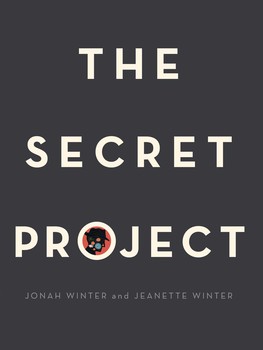
The Secret Project – Jonah Winter and Jeanette Winter, Beach Lane Books, 2017

the-secret-project-cover

In a recent forum in the New York Times, author Jonah Winter finally had the opportunity to express his frustration at the swerve in responses to his book The Secret Project. Initially praised enthusiastically by The Horn Book, Kirkus Reviews, School Library Journal, and other publications, the book became the focus of attacks by some readers who condemned inaccuracies in its presentation of the Native Americans who lived and worked in the region of the Project.  I am not writing to defend the book, because it doesn’t need my defense.  I would like to post an appreciation of its immense value as an informational book which also has a mythic dimension, and as a beautifully realized artistic production.

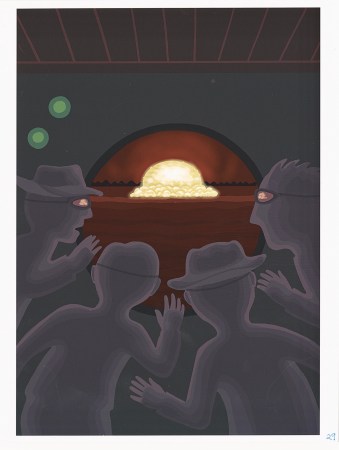
The idea of writing a picture book about the Manhattan Project for young readers is fraught with risk.  How can one present the history of a mission designed to save lives through massive destruction without merely terrifying? Author Jonah Winter and his mother, distinguished illustrator Jeanette Winter, bring readers to the New Mexico desert, a land of beauty and rich traditions, including of the native peoples who had lived there for generations.  The artist Georgia O’Keeffe also makes a cameo appearance, although she is named only as “an artist,” as if to emphasize the collective nature of the description.  Then come the scientists.  A school has been closed to make way for them, and local workers come to the new site without any knowledge of what is taking place there. Winter and Winter depict their dedication with text and images that match one another in mystery.  “What they are working on is so secret, they cannot even call it by its real name,” one line intones beneath a dark building with windows and door peopled by silhouettes.  Other pictures show visions of splitting atoms above a scientist’s head, and a group of “shadowy figures,” gesturing to one another in profile below a complex set of equations in a cloud.

the-secret-project-inside

Readers learn a minimal number of facts; more information appears in a detailed “Author’s Note,” which is stunningly placed as black font against a grey background, and a black border of mourning. There is also a list of further resources.  The notes and resources complement the text itself; this is an informational book, but one which resembles a work of theater or a film, as it creates an atmosphere where “Crouching down in their bunker, the scientists prepare themselves for something…so earth-shattering…it is hardly even imaginable.”  The final pages of the book visualize the tension and the unprecedented destruction of the mushroom cloud, followed by blackness.

Informational books are not the last word on a subject, but, especially for children, often the first.  There are many resources available for opening the discussion of science, technology and society, the morality of war, and the role of civilians during military conflicts. If you expect The Secret Project to be a comprehensive history of the Manhattan Project, or a sociological study of the different ethnic groups and socioeconomic classes impacted by its presence in their community, you may be disappointed. Anyone who recognizes integrity and artistic brilliance in books for children will not be.