
When We Flew Away: A Novel of Anne Frank Before the Diary – by Alice Hoffman
Scholastic Press, 2024
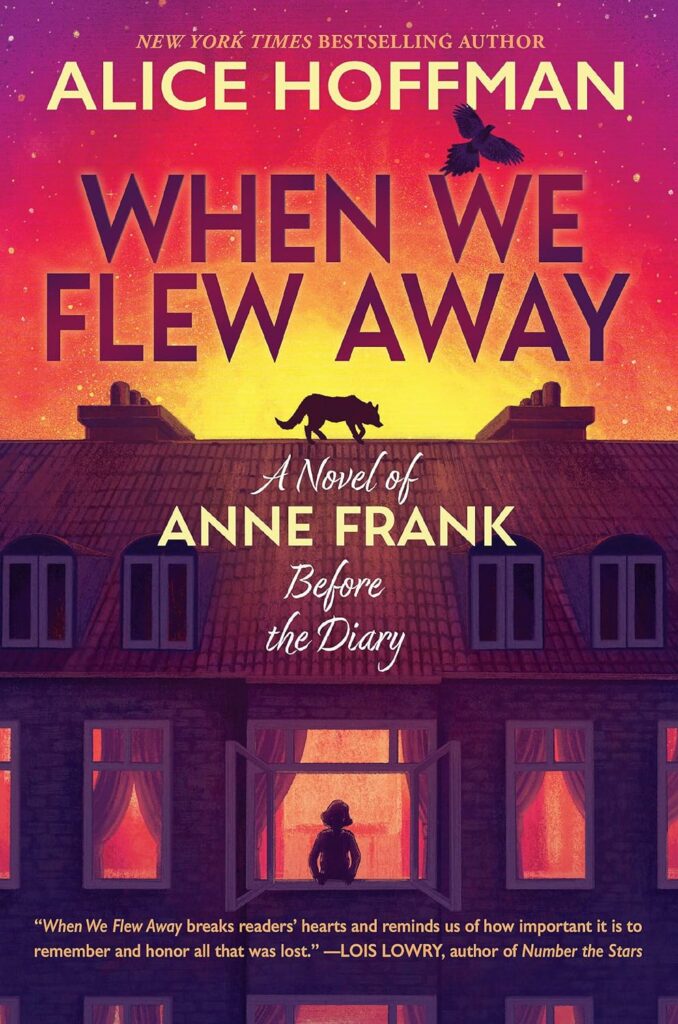
When I first learned about When We Flew Away, I was slightly skeptical, even though Alice Hoffman is a very fine author. There are so many attempts to simplify or universalize the experience of Anne Frank, as well as honest misunderstandings of her life and legacy. Before reading this middle-grade and young adult novel, I recommend two adult books that do an excellent job explaining and contextualizing Anne Frank and her diary. These are Ruth Franklin’s The Many Lives of Anne Frank (2025), and Francine Prose’s Anne Frank: The Book, The Life, The Afterlife (2009). Cynthia Ozick wrote a powerful article in The New Yorker in 1997 on the same theme, called “Who Owns Anne Frank?”
As the above-mentioned authors have both clarified and deplored, Frank’s message has been distorted in order to convert her into a bland symbol of universal forgiveness. The history of the Holocaust, as well as her own understanding of Jewish culture, religion, and identity, were lost in the process. More accurately, they have been deliberately erased. Alice Hoffman does not attempt to document Frank’s experience in hiding. Instead, she imagines, based on the record and her own interpretations, what the young Anne was like before her family was forced into their desperate choice. This novel is about a young girl’s family, her emotions, and her response to the development of violent antisemitism in the Netherlands, the country that was supposed to have been a refuge for her German Jewish family. (To correct misconceptions about the alleged heroism of most non-Jewish Dutch citizens, read Nina Siegel’s thorough account in the anthology The Diary Keepers: World War II in the Netherlands, as Written by the People Who Lived Through It.)
Anne’s close relationship with her father is central to the story, but Hoffman also offers a much more nuanced view of Anne’s mother than the limited perception of their tensions. The diary does record conflict, but Hoffman includes the plausible view that Edith Frank had a deep love for her daughter, although her personality caused her to express this in a less direct way. Ruth Franklin corroborates this idea in her work.
The move to the Secret Annex is preceded by increasing levels of oppression. “Life became smaller. People stopped talking about the future.” Without imitating Anne’s own future writings, Hoffman captures the sense of confinement, which would gradually worsen. The metaphor of flight, which will never become literally possible, is woven throughout the narrative. Looking at a Jewish boy who has been tormented by children in the street, Anne perceives the truth about their present lives: “Anne looked at the boy and he stared back across the distance between them. They lived in a land without birds, a country in which there were no laws that would protect them, a place where it wasn’t possible to be a child anymore.”
When We Flew Away is understated in its ambitions, but it does succeed in restoring a measure of realism and humanity to Anne Frank in the form of a compelling and believable story.
 Imaginary Elevators