Uri Shulevitz 1935-2025

Uri Shulevitz died on February 15.  The breadth of his artistic vision was outstanding, demonstrated both in books which he wrote and illustrated, and in others that he illustrated in collaboration with another author.  Many were deep explorations of Jewish themes, while others were more universal in scope. Chance was a masterpiece, integrating his entire life’s work in both words and pictures (I have also written about him here and here). The title indicates his conviction that his survival as a refugee from the Nazis, and, therefore, his entire career as an artist, was fundamentally a result of random events.  The book earned many distinctions; unfortunately, a Sydney Taylor award was not among them.

I would like to call attention to one long out-of-print work by Mr. Shulevitz, his quirky, and even disturbing, Toddlecreek Post Office. (Farrar, Straus and Giroux, 1990). Like several of his other books, it adopts a tone from folklore. The small village of Toddlecreek has a small post office. It resembles an ordinary house, with tall windows, flower boxes, and an American flag indicating its purpose. The name of the postmaster is Vernon Stamps, reinforcing the idea that the story is something of a parable. (Some of his neighbors are named Mrs. Woolsox; Charlie Ax the logger; and the garrulous and nostalgic Dexter Shuffles.) Mr. Stamps is busy and efficient, but also compassionate, helping everyone in the community and even welcoming animals to his overcrowded enterprise.

Into this paradise, one unfortunate day, the postal inspector intrudes.  Her presence is immediately disturbing, and the animals react before she even sets about her task. “Birds’ songs diminished…Bees’ buzzing ceased, or so it seemed. The small dogs stopped barking, and stared.” The inspector examines the post office’s records, as well as the evidence that unofficial, but humane, activities are also promoted there. There are books to read, and announcements for barn dances on the bulletin board. She announces that the post office will be closed. Vernon is stunned, but he senses that resistance to this decision is futile. He locks up and leaves.
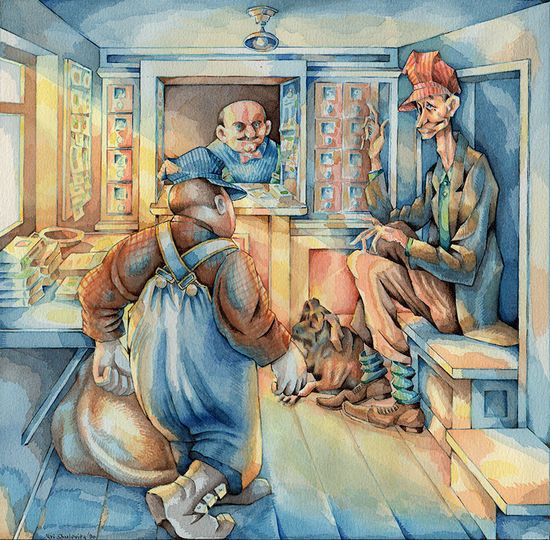
If readers are not already saddened by this point, Shulevitz makes clear that the post office’s closure leaves a terrible gap in the life of the community.  There is a sense of shock in the rumors about Silken, Vernon’s part wolf and part sled dog companion. The animal has disappeared. “Some say she went north to join the wolves. Others say she was killed by a hunter.” 

What motivated Shulevitz to end the book on an unambiguous note of sadness? He was a great artist and humanist who had lived through the worst conditions imposed by tyranny.  Toddlecreek has been ruined.  “It is not on any map, it is bypassed by travelers and forgotten by time. And now, like any other small village, Toddlecreek has no post office.” Yet, unlike the residents of this unfortunate town, he did survive to produce an unforgettable body literature and artwork for both children and adults.

Miniature Medicine

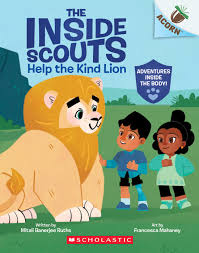
The Inside Scouts Help the Strong Cheetah – written by Mitali Banerjee Ruths, illustrated by Francesca Mahaney
Scholastic, 2024

The format of this early readers graphic novel matches the content.  A compact 7×5 1/2 inches, it easily fits the hands of a young child.  The Inside Scouts series, by Mitali Banerjee Ruths and Francesca Mahaney, features the veterinary adventures of Sanjay and Viv, who shrink to fit the inside of animal in need of medical attention. (It may make you think of The Magic School Bus Inside the Human Body by Joanna Cole and Bruce Degen.) The title is intriguing. If the cheetah is strong, why does he need help?  With minimal text and bright graphics, young readers learn about the causes of muscle cramps and how much they can hurt.  Don’t worry; Sanjay and Viv are on the job.

The heroes of the story exchange their everyday clothes for uniforms with robotic arms and legs, tool packs, and shrink suits.  When Zora the cheetah pops up on their computer screen, they locate her and spring into action. Even with their high level of motivation, they are still kids. Sanjay briefly complains about the heaviness of this tool pack, but Viv reminds him that the cheetah needs help. There’s a Doctor Doolittle element to the story; the cheetah talks to them and explains his problem. They take him to the care lab, a doctor’s office with reassuring pictures of animals on the walls.

Fact and fantasy combine in the story. Navigating inside the cheetah’s body in their jump rocket, Sanjay and Viv use power tools to access the animal’s muscle, described as “bunched up ropes” that “look stuck.”  At the end of the book, “Fun Facts About Muscles” provides some more specific information about the musculoskeletal system.  (The author is a pediatrician.) The book’s best feature is its matter-of-fact approach to learning about science. The superhero approach is minimally elaborated. There is no back story about how Sanjay and Viv met or when they discovered their power to help animals.  Instead, their special identity is presented as a given, as is the underlying message about using one’s abilities to help others (even when a heavy backpack seems a burden). Educators and caregivers can certainly use the book as a starting point for learning more about the topic, but it also stands alone as an attractive and engaging story that blends fact and fiction.  On the penultimate page, Sanjay and Viv plan to rest, in anticipation of their next adventure.  Zora will not be the last animal who needs their help.

Owl Writes by Candlelight

Cozy Winter Day – written and illustrated by Eliza Wheeler
Nancy Paulsen Books (Penguin Random House), 2024

Here is another one of my many posts about past, imaginary, or longed-for snow (for example here and here and here and here and here and here). It also falls into the category of personified animals performing sweet, graceful, and productive tasks (Miguel Tanco is another master of this art).  Beautifully realized scenes of domestic interiors, as well as the outdoors also characterize this lovely new picture book by Eliza Wheeler (I reviewed another of her books for Jewish Book Council). Not only does an owl compose the story of her village by candlelight, but a hedgehog weaves baskets and a rabbit, who uses a wheelchair, paints at an easel.

The endpapers and the introductory list of characters immediately made me ask, where are the toys? I don’t mean this with any disdain at all! The brightly colored and detailed figures are reminiscent of the kind of traditional, non-electric miniature animals you can still find as playthings.  The Hopps family have names out of a mid-century t.v. sitcom: Bud, Dot, Sis, and Herb.  However, Herb is the artist with a disability, setting this story in the fortunately more realistic and inclusive present.  The beaver family is of Celtic origin, judging by their name, McPaddy.  An interesting choice was to include both Ms. Polly, a porcupine, and Otto and Una Heddle, who seem to be hedgehogs. 

The book’s plot is not the main point. Rather, it is the warm and harmonious community of creatures enjoying the winter.  In the Hopps’ family kitchen, Pop is frying up something delicious on an antique wood stove while Dad enters with a bag of groceries. The baby, sitting in his highchair, seems impatient, but not enough to make the parents frantic.  Otto the hedgehog “gathers bundles of yarn,” although it’s not clear if he is going to knit or if he is helping Una, who is bringing snacks.  All the animal parents are clearly nurturing.

The featured adjective in the title is “cozy,” and miniature spaces represent the essence of this quality. There are two pages explaining the characteristics of a “nook.” These small areas can be dedicated to different purposes: reading, painting, eating breakfast, or hiding.  Sometimes they are shared, but often they are places where animals can be quietly alone. On the other hand, Acorn Village requires a lot of labor, if you can apply that term to making paper chains and building with blocks, as well as pulling children on sleds and preparing food.  Consuming food is also a big part of life here.

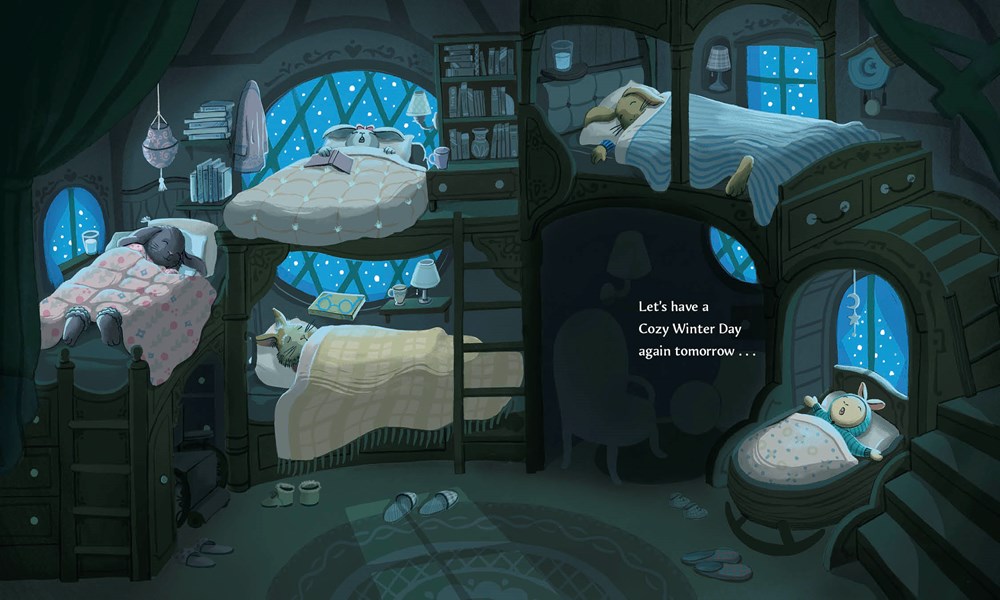
Everything in the book adds up to restful sleep. The bedtime scene is dark, with pastel-colored bedding and a blue and white starry night sky.  “Let’s have a Cozy Winter Day again tomorrow.” Capitalized letters make it clear that tomorrow will involve repetition of today. That reassuring quality is the point of living in Acorn Village.