Parent-Child Conversations

Fantastic Lou: Little Comics from Real Life – written and illustrated by Qin Leng
Tundra Books, 2025

All good children’s books are also good books for adults, but some seem specifically designed for both audiences. Qin Leng’s graphic chapter book, picture book, or collection of “little comics,” is definitely in the latter category. The cover, with a brightly smiling child radiating assertiveness, alludes to some of the mid-twentieth century comic classics. The wry interpretation of parenting issues also brings to mind the work of Liana Finck. Yet Fantastic Lou is also fantastic for children, reflecting their thoughts and feelings about everyday situations and important relationships.

The interminable experience of playing a board game is, at the same time, a way to have some quiet and meaningful interaction with a Lou, her child.  The existential unfairness, mixed with boredom, might even be irritating to adults. “You fell in a hole. That means you gotta go back to square one.” An adult might feel bereft at that news, but a child’s understandable rage is difficult to dismiss. Leng captures the whole range of responses in her lively and delicate pictures, drawn in ink and digitally colored.
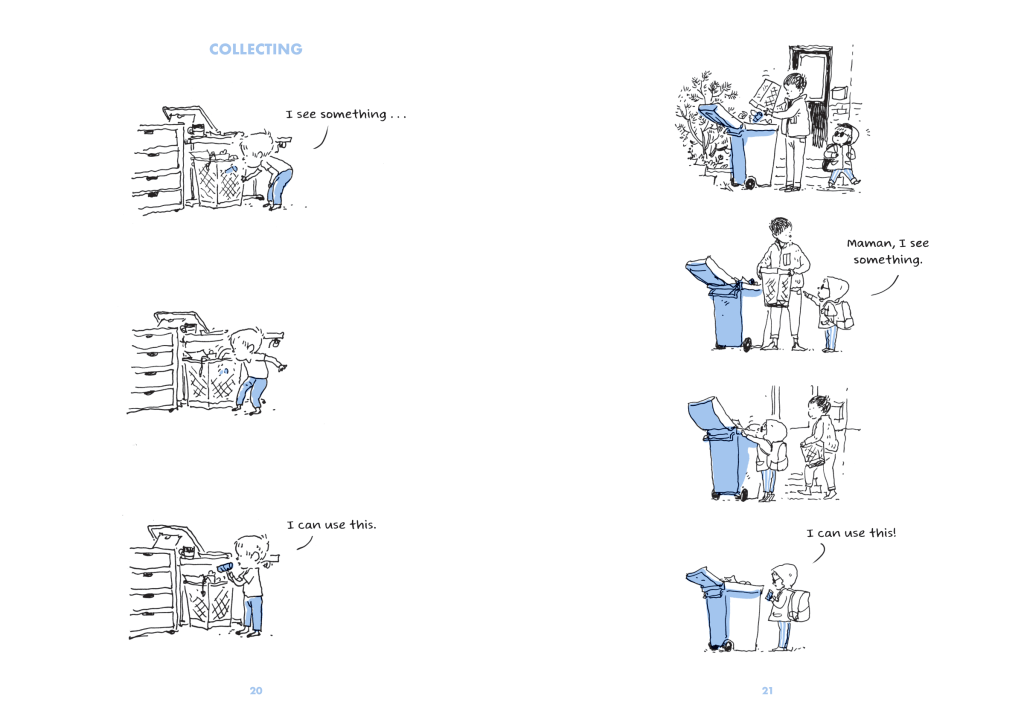
Collecting may have different meanings for children and adults. Leng focuses on how a child finds meaning in an object that seems useless to his parents.  Forget well-intentioned recycling. Lou extracts a series of items, explaining the process with clear simplicity. Language also reflects the difference between Lou and Maman: “I see something, Maman. I can use this.”  What further justification is needed for pulling things out of the trash?  The reader is left to imagine the infinite uses implied in Lou’s artistic vision. 

Lou’s image of his future self is as clear as his prospective plans for thrown-away collectible. In “When I Am Bigger,” he divides his life so far into two stags, and projects a third one based on growing size and increased power.  After all, that is how adults appear to children.  The adjacent chapter, “Montréal Trip,” takes that abstract idea and offers a concrete example of his special status as a child.  The prospect of boarding the plane is exciting enough, but, in fact, his small and vulnerable size is granted equal status to the most privileged travelers: “Priority boarding for VIP members and passengers traveling with young children…”

Children are VIPs in Leng’s work. Sequences of constant motion, flights of imagination, and attempts to make sense of adult decisions, add up to childhood itself.
Family Stories and Food

Electra and the Charlotte Russe – written by Corinne Demas Bliss, illustrated by Michael Garland
Boyds Mills Press, 1997

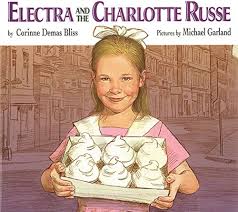
When I was growing up in New York, the charlotte russe was a popular pastry, though the peak of its popularity was already gone by the post-World War II era. At the time, I wasn’t aware that I was enjoying a part of New York food lore in its decline, but that still had meaning for my parents’ generation.  In Electra and the Charlotte Russe, a Greek-American family, living in an ethnically mixed Bronx neighborhood, is the center of the nostalgic story.  In her author’s note, Corinne Demas Bliss writes that the book is based a story which her mother, Electra, had related about her own Bronx childhood in the 1920s.  Whatever your background, and whether or not you have ever eaten the delicate pastry enclosed in a paper sleeve, you will probably respond to the essence of Demas’s tale and Michael Garland’s almost photorealist pictures.

Once upon a time, there were many children’s picture books with extensive text. Electra opens with a portrait of the little girl and her mother. Electra is entrusted with an important errand. She will go to the local bakery to purchase six charlotte russes for her mother’s guests. These are Mrs. Papadapoulos, Mrs. Marcopoulos and her daughter, Athena. The guest without a melodic Greek last name is Miss Smith, who is learning Greek from Electra’s mother, in preparation for her upcoming marriage to Mr. Demetropoulis.  If you think this is an overly idealized portrait of immigrant communities, the motive behind the Greek language lessons is for the future Mrs. Demetropoulis “to understand what his relatives said behind her back.”

On the way Electra meets her friend, Murray Schwartz, whose tongue has turned green from eating a gumball.  A much older neighbor, Mr. Melnikoff, waxes nostalgic about the charlotte russes of his own past, calling them “a dessert fit for a princess.” The extended text occupies some pages, while others have only one or two sentences. A typical New York City apartment building, as rendered by Michael Garland, seems shaded in ombre light and colors, accompanied by the brief instructions to Electra not to run even though she is in a hurry.  Mrs. Zimmerman at the bakery repeats that prophetic warning to her young customer.

When Electra trips, damaging the exquisite works of art in her bakery carton, she tries to fix them. This leads, of course, to eating some of the whipped cream. A two-page spread shows four scenes of Electra’s face and hands as she attempts to even out the cream.  Every step of the process is detailed in sequence, from Electra’s entrance into her apartment building, to her settling on several landings with the pastries, and finally reaching her home. “They didn’t look quite like charlotte russes anymore, but at least they did look all the same.”

Fortunately, Electra’s mother had prepared other delicacies: baklava, diples, loukoumades and kourabedes. The guests enjoy the now transformed and unidentifiable charlottes russes. After they leave, Electra’s mother explains to her the concept of remorse. “Remorse is when you wish you hadn’t done something that you did.” But she isn’t angry with her daughter, and the book closes with Electra sitting on her mother’s lap.  Perhaps she would have been less forgiving if her guests had not enjoyed the gathering, or the pastries denuded of whipped cream. But I doubt that would have made a difference.

Miniature Medicine

The Inside Scouts Help the Strong Cheetah – written by Mitali Banerjee Ruths, illustrated by Francesca Mahaney
Scholastic, 2024

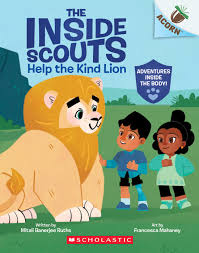
The format of this early readers graphic novel matches the content.  A compact 7×5 1/2 inches, it easily fits the hands of a young child.  The Inside Scouts series, by Mitali Banerjee Ruths and Francesca Mahaney, features the veterinary adventures of Sanjay and Viv, who shrink to fit the inside of animal in need of medical attention. (It may make you think of The Magic School Bus Inside the Human Body by Joanna Cole and Bruce Degen.) The title is intriguing. If the cheetah is strong, why does he need help?  With minimal text and bright graphics, young readers learn about the causes of muscle cramps and how much they can hurt.  Don’t worry; Sanjay and Viv are on the job.

The heroes of the story exchange their everyday clothes for uniforms with robotic arms and legs, tool packs, and shrink suits.  When Zora the cheetah pops up on their computer screen, they locate her and spring into action. Even with their high level of motivation, they are still kids. Sanjay briefly complains about the heaviness of this tool pack, but Viv reminds him that the cheetah needs help. There’s a Doctor Doolittle element to the story; the cheetah talks to them and explains his problem. They take him to the care lab, a doctor’s office with reassuring pictures of animals on the walls.

Fact and fantasy combine in the story. Navigating inside the cheetah’s body in their jump rocket, Sanjay and Viv use power tools to access the animal’s muscle, described as “bunched up ropes” that “look stuck.”  At the end of the book, “Fun Facts About Muscles” provides some more specific information about the musculoskeletal system.  (The author is a pediatrician.) The book’s best feature is its matter-of-fact approach to learning about science. The superhero approach is minimally elaborated. There is no back story about how Sanjay and Viv met or when they discovered their power to help animals.  Instead, their special identity is presented as a given, as is the underlying message about using one’s abilities to help others (even when a heavy backpack seems a burden). Educators and caregivers can certainly use the book as a starting point for learning more about the topic, but it also stands alone as an attractive and engaging story that blends fact and fiction.  On the penultimate page, Sanjay and Viv plan to rest, in anticipation of their next adventure.  Zora will not be the last animal who needs their help.