The Moon is a Melon

How Do You Eat Color – written by Mabi David, illustrated by Yas Doctor, translated by Karen Llagas
Eerdmans Books for Young Readers, 2025

The answer to the question posed in the title of Mabi David and Yas Doctor’s new picture book might be obvious to a child. Color is one of the first categories that children learn to identify. It then becomes integrated into both their imaginary and real worlds. Food, of course, is inextricably associated with color.  How Do You Eat Color, translated from the work of a Filipina author and illustrator, combines simple language with deep metaphors, and images in oil on paper, to express all these connections. 

David poses questions, gives answers, and offers suggestions. (Karen Llagas is an experienced translator, as well as a poet, and the text reflects her expertise.)  The book opens with an intriguing series of inquiries that establish its theme: “Do you know how red tastes?…Is green sweet and cold like your favorite sorbet?”  If so, or if you have never considered those ideas but would like to, then “Feast on color when you eat fruits and vegetables.” Each two-page spread considers the possibility of looking at a color in a new way, as the setting for a multisensory experience.

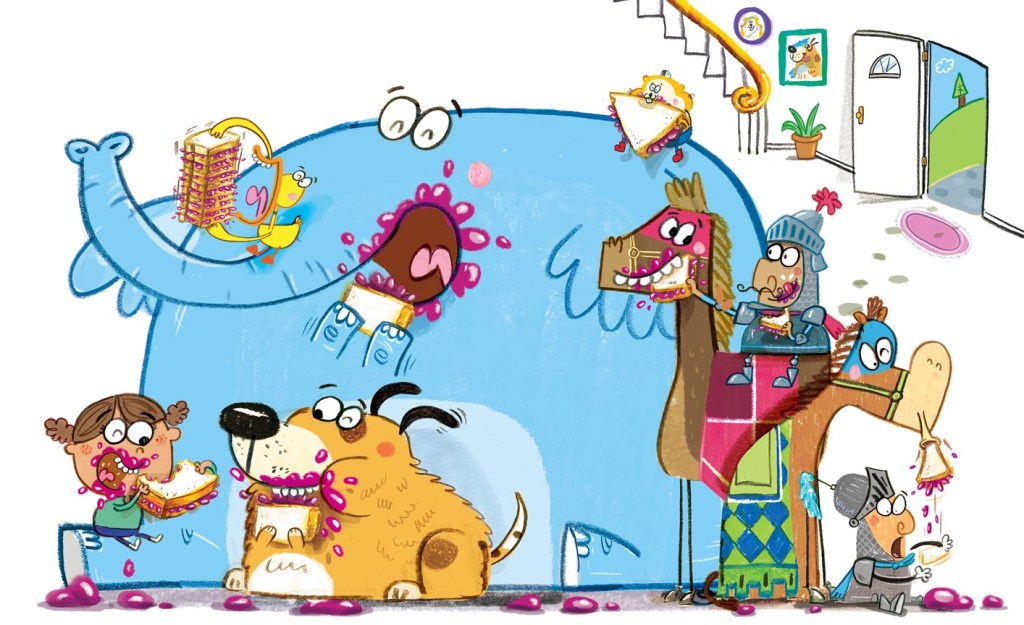
Yellow first appears as a river surrounded by giant pineapples and ears of corn. A boy and girl, and their lizard friend, row in boats made of mangos. After this journey, they rest on bunches of bananas. The scale and composition of the pictures inverts the sizes of people and plants, with tall carrots rising against the sky as the children, receding into the background, run towards half an orange as the setting sun.  The purple pages mix fruits, vegetables, and human activity, “As you tuck yourself in like a yam, bundled like plums in a basket.” Horizontal stripes on the girl’s dress contrast with the vertical ones on her blanket, as she clutches oversized plums. 

After the core of the book invites children to appreciate the artistic and joyful natures of food, there are several more pages introducing the actual characteristics of different foods and their health benefits.  Instead of a chart, the format is a dialogue, with answers to questions about each food’s definition, how to eat it, and why it is healthful. Finally, David and Doctor complete the circle, emphasizing how a variety of foods, in their rainbow of colors, have both physical and aesthetic benefits. An in-depth exploration of a simple idea, How Do You Eat Color, suggests multiple answers to that fundamental question.

You’ve Got Delicious Cuban Food

Guava and Grudges – by Alexis Castellanos
Bloomsbury, 2024

Sometimes it seems that there are an infinite number of possible homages to The Shop Around the Corner and You’ve Got Mail, specifically in young adult fictionGuava and Grudges, by Alexis Castellanos, more than justifies a new entry in this category, with strong characters, great description and dialogue, and affectionately accurate allusions to Cuban American culture.  The protagonists spar, but can’t deny their attachment to one another from their first encounter.  Family opposition is tough, if not on the Romeo and Juliet level.  Food obsession is far from essential to liking this novel, but dedication to one’s craft, in this case cuisine, is certainly central to the plot.

Ana María Ybarra and Miguel Fuentes are both Cuban American high school students whose families own popular bakeries in Seattle.  They meet in L.A. at a college tour, although Ana María has serious doubts about her future as a U.C.L.A. student.  Her dream is to become a pastry chef, unconstrained by the traditional expectations of her father, who has always been wary of innovations at Café y Más, their establishment.  (Ana María’s original ideas have been kept “a dark secret” from her family.) Miguel’s last name is Fuentes, but he is a member of the Morales family through his mother.  As Ana María painfully admits, “hating the Morales family was something I was born into and that I had accepted as a family tradition.” In case you needed a reminder that some family traditions can be ugly, here it is.

The plot contains elements of miscommunication, but the core of Ana María and Miguel’s affection is never seriously in doubt.  The looming specter of college applications only forces Ana María to a different commitment, and to hope that her entry in a culinary contest run by her favorite publication will lead to a scholarship. The outcome of the competition is handled well in the novel, as Castellanos carefully avoids pandering to the reader’s expectations.  Social media is also part of the story, because expertly produced food without a visual media presence is worthless, as everyone knows.  The author’s verbal flourishes create images that are just as powerful. Mishandled groceries lead to damaged goods: “‘Stupid milks,’ I mutter, dropping down to the floor with the desiccated croissants in my hands. They look so shriveled and sad. Is there a market for croissant raisins?”

The support of Ana María’s mother helps to offset her father’s often-oppressive parenting. A great best friend and a sister whose personality serves as a foil also enrich the cast.  Miguel isn’t perfect, but nor is he a self-centered male who must be redeemed by a girl’s love.  Guava and Grudges is rich is more ways than one, and includes a recipe for guava cream cheese thumbprint cookies.

Family Stories and Food

Electra and the Charlotte Russe – written by Corinne Demas Bliss, illustrated by Michael Garland
Boyds Mills Press, 1997

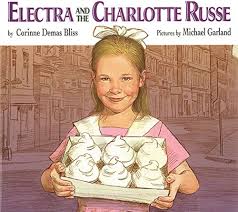
When I was growing up in New York, the charlotte russe was a popular pastry, though the peak of its popularity was already gone by the post-World War II era. At the time, I wasn’t aware that I was enjoying a part of New York food lore in its decline, but that still had meaning for my parents’ generation.  In Electra and the Charlotte Russe, a Greek-American family, living in an ethnically mixed Bronx neighborhood, is the center of the nostalgic story.  In her author’s note, Corinne Demas Bliss writes that the book is based a story which her mother, Electra, had related about her own Bronx childhood in the 1920s.  Whatever your background, and whether or not you have ever eaten the delicate pastry enclosed in a paper sleeve, you will probably respond to the essence of Demas’s tale and Michael Garland’s almost photorealist pictures.

Once upon a time, there were many children’s picture books with extensive text. Electra opens with a portrait of the little girl and her mother. Electra is entrusted with an important errand. She will go to the local bakery to purchase six charlotte russes for her mother’s guests. These are Mrs. Papadapoulos, Mrs. Marcopoulos and her daughter, Athena. The guest without a melodic Greek last name is Miss Smith, who is learning Greek from Electra’s mother, in preparation for her upcoming marriage to Mr. Demetropoulis.  If you think this is an overly idealized portrait of immigrant communities, the motive behind the Greek language lessons is for the future Mrs. Demetropoulis “to understand what his relatives said behind her back.”

On the way Electra meets her friend, Murray Schwartz, whose tongue has turned green from eating a gumball.  A much older neighbor, Mr. Melnikoff, waxes nostalgic about the charlotte russes of his own past, calling them “a dessert fit for a princess.” The extended text occupies some pages, while others have only one or two sentences. A typical New York City apartment building, as rendered by Michael Garland, seems shaded in ombre light and colors, accompanied by the brief instructions to Electra not to run even though she is in a hurry.  Mrs. Zimmerman at the bakery repeats that prophetic warning to her young customer.

When Electra trips, damaging the exquisite works of art in her bakery carton, she tries to fix them. This leads, of course, to eating some of the whipped cream. A two-page spread shows four scenes of Electra’s face and hands as she attempts to even out the cream.  Every step of the process is detailed in sequence, from Electra’s entrance into her apartment building, to her settling on several landings with the pastries, and finally reaching her home. “They didn’t look quite like charlotte russes anymore, but at least they did look all the same.”

Fortunately, Electra’s mother had prepared other delicacies: baklava, diples, loukoumades and kourabedes. The guests enjoy the now transformed and unidentifiable charlottes russes. After they leave, Electra’s mother explains to her the concept of remorse. “Remorse is when you wish you hadn’t done something that you did.” But she isn’t angry with her daughter, and the book closes with Electra sitting on her mother’s lap.  Perhaps she would have been less forgiving if her guests had not enjoyed the gathering, or the pastries denuded of whipped cream. But I doubt that would have made a difference.