Snail Mail

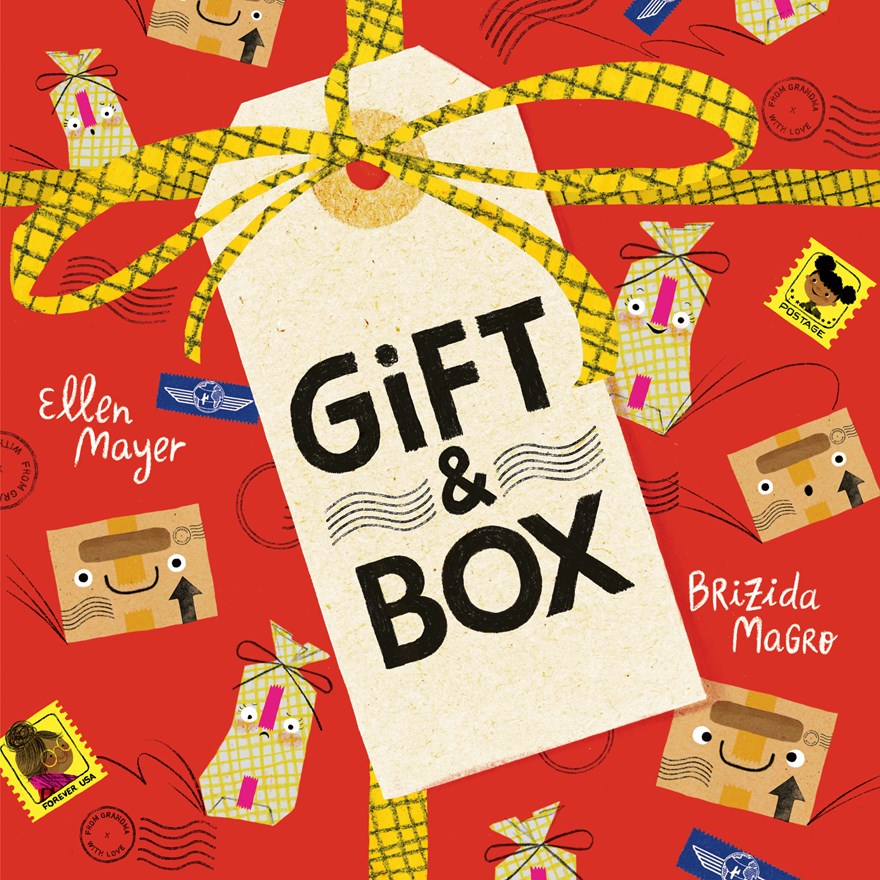
Gift & Box – written by Ellen Mayer, illustrated by Brizida Magro
Alfred A. Knopf, 2023

It’s good to know that there are still authors and illustrators celebrating the postal system.  Ellen Mayer and Brizida Magro’s wonderful addition to this genre opens with endpapers that display visually specific examples of snail mail. There are some real stamps, invented ones, postmarks, and snippets of correspondence.  In the tradition spanning Tibor Gergely’s Seven Little Postman, Rosemary Wells’s works, and Zoey Abbott’s I Do Not Like Yolanda, Gift & Box describes the unique experience of sending a letter or package via USPS. 

Two personified objects, a gift and a box, meet and employ their complementary skills to make someone happy.  The pictures are composed artfully.  The love between a grandparent and grandchild is also at the center of the story. (Regular readers of this blog know that picturebooks about grandmothers are one of my favorite subgenres; see here and here and here and here and here and here.) We see Grandma happily tying a bow on a bag decorated with lovely eyes and a friendly smile.  A scissor, string, tags, and scraps occupy the bottom of the page, with white space in between. There are also images of real stamps.  They are real not only in the sense of legitimate, but they are from the era when stamps were actually engraved, on woven paper in a range of beautiful colors. These three appear to be deep green, carmine, and bright blue-green. (If you look closely, the one cent “Industry and Agriculture: For Defense” stamp is reproduced with inverted lettering. This might be a deliberate choice.)

The gift and box work together.  Mayer emphasizes the cooperative aspect of their task: “Gift’s purpose was to delight. Box’s purpose was to protect.” Their long journey may be important, but it is also tedious at times, involving a lot of waiting. There is even some danger involved. There are collage elements in many of the pictures, reflecting the artist’s use of several media. (“The illustrations were created using rolled printmaking inks, crayons, handmade stamps, and paper collage, then assembled digitally.) Busy city streets are a context for the gift’s voyage, with earth and jewel-toned vehicles passing apartment buildings. The human figures have an Ed Emberley-style simplicity.

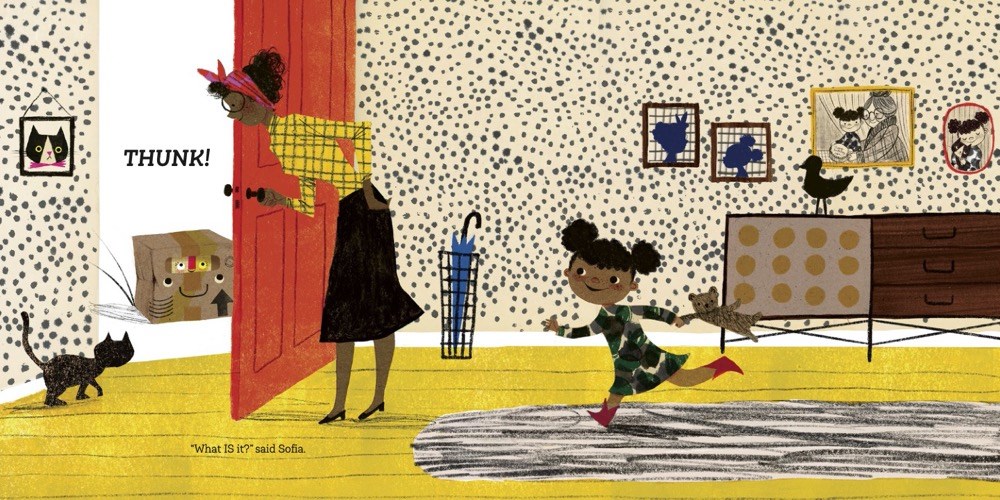
Eventually, the package arrives. A little girl, Sofia, asks her mother about the loud noise outside the door. Her mother opens the door expectantly. Their home is filled with mid-century design: a streamlined bureau, a bright blue umbrella in a wire stand. The pictures on the wall include one of Sofia and Grandma.  Sofia is delighted with her gift, but is reluctant to part with the box. Readers have been prepared throughout the story for the moment when gift and box, having accomplished their goal, will part. Instead, Sofia’s energy and imagination transform them into something new.

A Sesame Street Hanukkah Classic

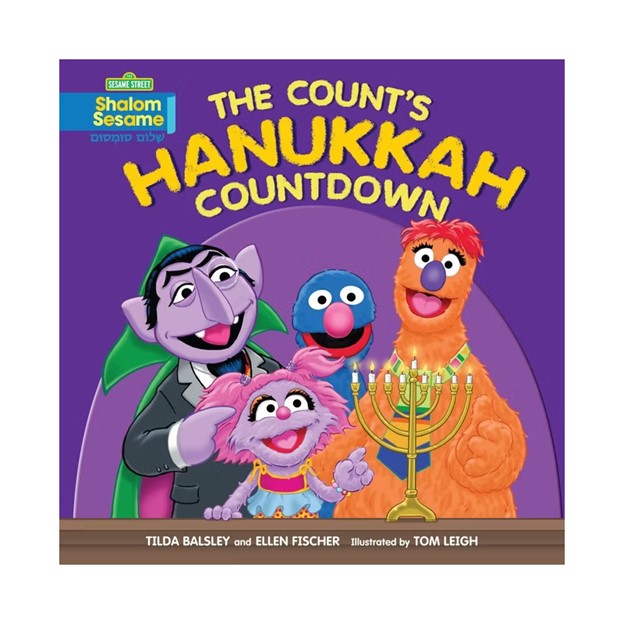
The Count’s Hanukkah Countdown (Shalom Sesame) – written by Tilda Balsley and Ellen Fischer, illustrated by Tom Leigh
Kar-Ben Publishing, 2012

Sesame Street Hanukkah classic books are, admittedly, a somewhat narrow category.  If you know Count Count, you probably realize that Hanukkah is a terrific holiday for him, since it allows him to obsessively enumerate the festival’s eight days and everything associated with them. 

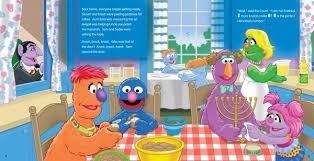
The book opens with Grover grasping a chanukiah (Hanukkah menorah) clutching a dreidel, and welcoming you to the celebration of the Festival of Lights.  Numerals in the text are in bold, making it fun for young children learning to count, but there is also an extended narrative. Grover begins by presenting a shopping list of ingredients to the Count, and modestly asks if that expert at counting had not realized that “furry blue monsters are excellent shoppers.”  The list comprises all the ingredients to make potato latkes (pancakes).

The scene moves to the kitchen of their Israeli friends and extended family.  Sesame Street monsters all have different color skin. Uncle Joe is purple and Aunt Sara is green.  The whole mishpacha (family) are busily engaged peeling potatoes and measuring oil. The Count enters. He is thrilled to see the multi-branch chanukiah, but confused that, on the first night, only one candle plus the shamash (helper candle) is lit. Even though he is the title character, everyone plays an important role in this family-centered holiday. Uncle Joe, seated in his easy chair, relates the historical events commemorated by Hanukkah. His language is so vivid that the children imagine the Greek soldiers riding on their elephants, depicted in a word-bubble-like cloud. They desecrate the Temple, but Uncle Joe quickly advances to the counting element, fortified by heroism. There was only enough oil for 1 night, but it miraculously lasted for 8.

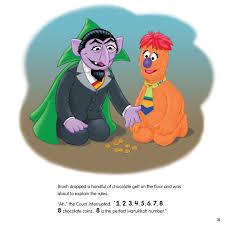
Then comes the consumption of latkes. Count Count evens out the number by eating one, and everyone follows his zany example by taking 8 bites of every food item. These include not only latkes, but the equally traditional sufganiyot (jelly doughnuts).  The game of dreidel, fortunately, also involves the counting of chocolate gelt (coins). The dreidel game scene shows everyone seated in a circle on the floor. The Count is viewed from the back, with his triangular green cape pointing upward.  Even among Muppets, he looks distinctive. Presents also lend themselves to counting. We see only their colorful gift bags, so we can use our imagination about what the bags may contain.

Readers will agree with Grover that Hanukkah, to use his favorite adjective, is “totally awesome,” and to the Count, the “8 is the perfect Hanukkah number.” It’s hard to disagree with him.