Paddington in the Garden – written by Michael Bond, illustrated by R.W. Alley
HarperCollins, 2002
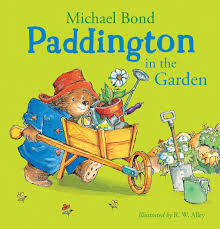
At the beginning of Paddington in the Garden, the bear we all love is, typically, engaged in an act of gratitude. He is making a list of “all the nice things” about his life with the Brown family. Paddington is not one to overlook the simple joys of life: “a room of his own and warm bed to sleep in.” Of course, he singles out the availability of marmalade, which in Darkest Peru had been only a weekly treat. R.W. Alley pictures him seated at a table in his own garden, where climbing trellises of red and purple flowers and a bird sipping from a fountain set the scene.
Mrs. Bird, the housekeeper whose wisdom is matched only by her kindness, suggests finding space for Paddington, along with the Brown children, Jonathan and Judy, for their own sections of the garden to tend. At first Paddington is perplexed, learning that gardening is challenging, especially for a bear. He decides to go shopping, in search of some inspiration. In the local market, he comes upon an old copy of an apparently popular guide, How to Plan Your Garden, by Lionel Trug.
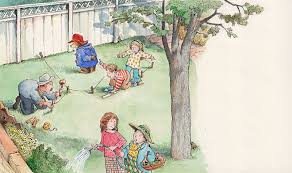
I recently read an obituary in The New York Times that suggested a real-life model for the gardening expert, who eventually awards Paddington a medal for his quite original entrance in the National Garden Day competition. Mr. David Hessayon was, according to the subtitle, “a fixture of British life for half a century.” He earned this status with a series of how-to volumes on gardening, with titles such as Be Your Own Gardening Expert (1959), Be Your Own House Plant Expert, and The New Flower Expert. The books appealed with their straightforward advice and unpretentious tone. Then I read that Mr. Hessayon was the children of immigrants from Cyprus. By their names, his parents seem to have been Jewish. His father was a watchmaker, immediately calling to mind Paddington’s friend, Mr. Gruber, tinkering in his antique shop. Michael Bond was an outspoken advocate for immigrants; Paddington himself found refuge in Britain after a long sea voyage. He was fortunate to be met by the family who took the instructions, “Please look after this bear,” to heart. (link to my previous posts on Bond.). He specifically linked the character of Mr. Gruber to his memory of having seen Jewish children arriving during World War II, on the kindertransport program.
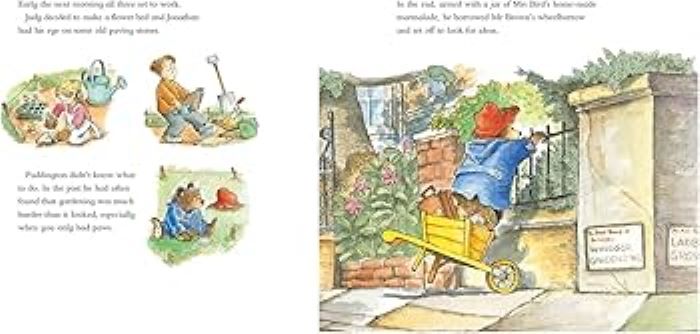
In the book, Mr. Trug has gray hair and sideburns and wears a tweed vest and a green sports jacket. Paddington’s naiveté often highlights some human foible. Upon first glancing through the book, the bear had remarked that Mr. Trug, who appears on the back smoking a pipe, seems to “do most of his planning while lying in a hammock.” He seems a bit full of himself as he marches towards the recipient of his prestigious award. I’m sure that Mr. Hessayon, shown in the Times grinning broadly in a greenhouse with his geraniums, was not pompous at all. In fact, I’m sure that Paddington would have been his friend.


 Imaginary Elevators