Words with Wings and Magic Things – written by Matthew Burgess, illustrated by Doug Salati
Tundra Books, 2025

Designing a book of poetry for children is not an easy task. There are outstanding collections of classic poems accompanied by different artists’ interpretation. A Child’s Garden of Verse alone has been illustrated by, among others, Jessie Wilcox Smith, Gyo Fujikawa, Alice and Martin Provensen, and Eloise Wilkin. Recently, Rosemary Wells had the courage to apply her own individual vision to a selection of A.A. Milne’s poems from When We Were Very Young, although they are inextricably linked to the artwork of Ernest H. Shepard. There are modern classics by such disparate poets as Jack Prelutsky, Shel Silverstein, Bobbi Katz, and Julie Fogliano. Words with Wings and Magic Things joins this distinguished company, while adding level of originality and beauty that stands on its own.
On the one hand, children are natural drawn to rhyme and rhythm. On the other, after a certain age they sometimes approach it with skepticism. Where is the plot? Maybe enough humor will compensate for that, and some poets try to hard by overloading their work with this feature. Matthew Burgess seems to have chosen the subject and form of each poem with respect for children’s intelligence. The book is organized into thematic sections, each introduced by a two-line poem. “Wild” summarizes excursions into that territory. “The animal inside of us who longs to wander free,/the sparkling specks of stardust that make up you and me.” The poems use different rhyme schemes, alliteration, and stanza lengths, and address subject matter ranging from whimsical to philosophical. There is not a pretentious note in the book.


Doug Salati’s pictures show a kind of exuberance, whatever the subject of the poem he is illustrating. There are two-page spreads with lavish colors and smaller image set against white space. Some pages feature cut-out windows to the following picture, allowing a moon, for example, to transform into a polar bear’s fur. His allusions to classic children’s books are not eye-winking secret messages to adults; they are wonderful homages that set his own work within a lasting tradition. The lions in “Living with Lions” recall Sendak’s Pierre: they appear somewhat sly, as if unsure about whether to act as predators. “When they wake,/bake a cake,” the girl in the picture wisely decides.


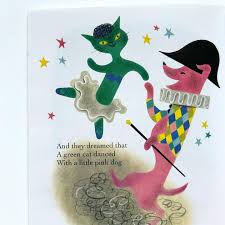
The dog next to the slide in “Wild” is definitely related to Margaret Bloy Graham’s Harry the Dirty Dog. If children don’t recognize these forbears of Salati’s characters, it would be a great opportunity to introduce them. He also shows up accompanying the beginning of “Whoops and Whallops,” about life’s inevitably embarrassing and difficult moments, eating popcorn, and along with his human friend, enjoying a show. The performing dog recalls the harlequin-costumed animals of The Color Kittens.

Maybe it seems obvious that yetis’ favorite food is spaghetti. Burgess twists the strands of language into invented words that make perfect sense in Salati’s scene of feasting monsters. Twist the fork into your noodles;/Meatball, meatball, and spagoodles.” By the end of the poem, the elongated pasta returns to normal: “Now eat it up, you hungry yet;. Meatball, meatball, and spaghetti.” Poets and artists can accomplish magic.

 Imaginary Elevators