
Sound: Discovering the Vibrations We Hear – written and illustrated by Olga Fadeeva, translated from the Russian by Lena Traer
Eerdmans Books for Young Readers, 2025

Imagine for a moment that you are about to pick up a children’s book explaining the physics of sound. How do we hear and transmit noises? Then being to page through it, noticing that the illustrations, in acrylic paint and water, would be worth the proverbial price of admission. Then, as you begin to read, you realize that the ambitions behind this project go way beyond the scope of what you had anticipated. Author and artist Olga Fadeeva has produced an information-rich picture book that moves among physics, biology, history both distant and recent, spoken and signed languages, culture from music to architecture, and technology. That list is still incomplete.

Sound requires careful attention and rewards it on every level. Opening the book, we see a mother cradling a baby; this is the setting for how we first experience sound. Then, we enter a kitchen, the familiar setting for objects emitting noises, so ordinary that we might ignore them: a boiling teakettle, a clock, a phone, a pot of soup. There is no division between the informational and artistic components of this picture, or in any other section of the book. Aware of how attention is naturally segmented, Fadeeva places her intriguing introductory premise in a rhombus that is actually in inside of an open window. The metaphor is perfect. A window is opening onto the meaning of sound.


Some pages use different sizes and colors of font, and have captions, as well as words that are sound effects framing the text. There are carefully employed graphics, such as a line indicating the intensity of decibels, or the organs of hearing and speaking labeled and described. The progression among topics is not frenetic; every idea is clearly linked to the ones preceding and following. While Fadeeva cannot anticipate every question about sound, there are many common sources of wonder that are clarified. How do bats hear? What are some common birdcalls? What is distinctive about underwater sounds?

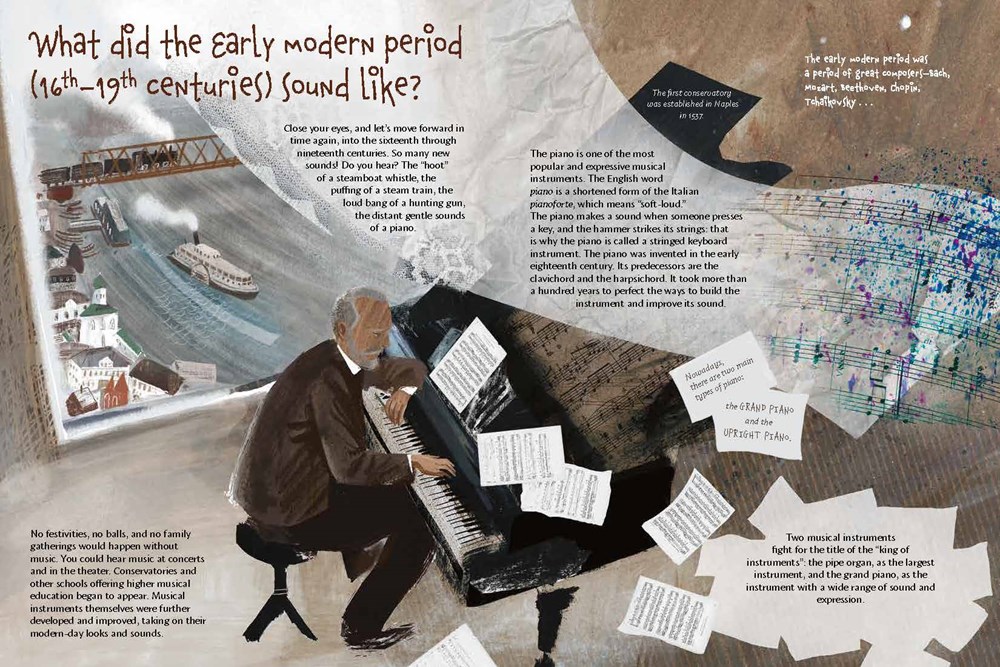
There are other angles from which to explore sound and Fadeeva credits young readers with the curiosity to include them. She actively engages them with invitations to consider different contexts. What was sound like in prehistory? How did the audience hear in the amphitheaters of the ancient world? (images). Medieval music makes an appearance, visualized with the excitement of charging knights and the lovely concert of flute, timbrel, bagpipe, and lute. Musical notation has its own pages. Even if children have never read music, they will be drawn in by the basic premise: “How can you write down music on a page – and turn it back into sound?” Glamorous performers and intricate pages of notes give the effect of collage. Pages on recording sound includes images of antique devices, and the question of “How do you fill the world with sound?” is followed by a concise but detailed answer superimposed on a dial telephone. Even the cord is covered with words.
The concluding endpapers feature brightly colored pictures and instructions for experiments. Even after this incredible excursion into the world of sound, children may still want to fill a plastic bottle with buttons or beans, and create an orchestra. Sound is an intricate and engaging performance for children and adult audiences.
 Imaginary Elevators