I Would Give You My Tail – written by Tanya Tagaq, illustrated by Qavavau Manumie
Tundra Books, 2025

This tender, subtle, book, about a boy awaiting the birth of a sibling, is set among the Indigenous people of Nunavut, northern Canada. It is both unique to their culture and universal in its expression of gratitude, both to people and the environment in which they live. The title refers to a conversation between two hares, echoed by other animals, and finally by the brother welcoming his new sister to the world they will share. The language seamlessly weaves together the language of the physical world and metaphor. The pictures, created in colored pencil, draw from Inuit folklore, as well as the specific qualities of the characters. Sharing is a concept central to the book, part of the overall vision of happiness passed from one generation to the next.

Assuming a child’s perspective in a book for children may seem natural, but it’s not so easily accomplished. Here, from the first page, readers will empathize with the boy, Kalluk’s, feelings of expectation and some anxiety, as he awaits a profound event in his life. Tanya Tagaq is straightforward in presenting the situation: “Kalluk’s mother is in labor and about to have a baby.” Even the repetition of seemingly redundant terms, “labor,” and “about to have a baby,” reflects the way that children incorporate reality. Qavavau Manumie’s illustration shows the pregnant mother touching her kneeling son in a gesture of reassurance, before he sets out to bring his grandmother to help.

Unhappiness is, realistically, part of Kalluk’s range of feelings at this moment. He asks two hares why they are happy, and learns how the qualities that they need to survive, speed and cleverness, are fulfilling ones. A brook is happy because of the fish who inhabit it. Mothers, animals or human, are happy with the offspring to their care. Explanations are kept to a minimum. Kalluk can sense the sincerity of all the responses.
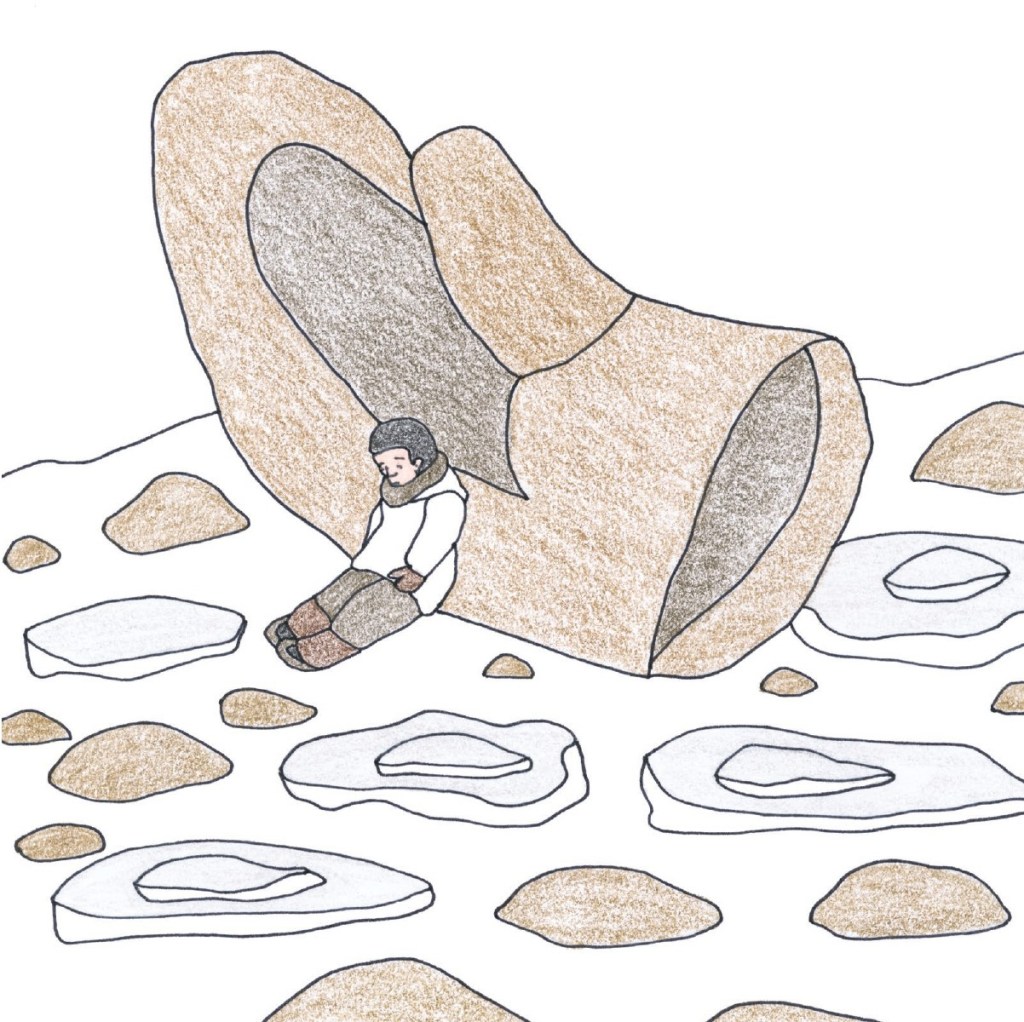
A picture of Kalluk seated with his back against a giant mitten embodies his feelings of gratitude tinged with sadness. He clearly misses his mother, thinks of the warm mittens she has created for him, and sends her “all the love in his heart.” The way in which that message is convened does not need to be articulated.
Meeting his grandparents, Kalluk has reached the confirmation of all the previous lessons about gratitude and love. His grandmother, Anaanattiaq in their North Qikiqtaaluk dialect, is unapologetically depicted as old; she “stands up slowly, bones creaking and cane shaking.” Any diminished physical strength is no obstacle, as she states purposefully, “Let’s go greet the new one.” Walking home, the boy asks her about her source of happiness. When she answers “peace,” he requests an elaboration. This dialogue is different from those with the animals. She tells him in the most direct language that peace grows inside each person, as he or she makes a series of choices in life. The right choices will make you proud, and grant “lots of peace,” the kind that is meant to be shared.

When Kalluk and Anaanattiaq come upon “a conspiracy of ravens,” the squawking, lively birds are friendly towards them. Their requirement for happiness is “knowledge,” a slight variation of the other animals’ answers. Their grandmother, the ravens assure Kalluk, is full of knowledge. That knowledge is put to the most important use when she arrives at Kalluk’s home, where his mother has already given birth and his breastfeeding the baby whom he is now prepared to teach everything he has learned. Gratitude for food, water, family, and the ability to choose well, are the gifts he brings to her, as well along with a declaration of love. I Would Give You My Tail is like a perfect circle, enclosing the reader in the complete circle of Kalluk’s journey.
 Imaginary Elevators