Books and Freedom

Love in the Library – written by Maggie Tokuda-Hall, illustrated by Yas Imamura
Candlewick Press, 2022
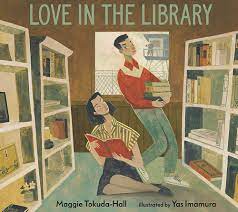
Two bookish young people fall in love in a library.  In Maggie Tokuda-Hall and Yas Imamura’s picture, book, based on events in the lives of the author’s grandparents, that library is not a quiet and safe space of contemplation.  Tama works in the library of the Minidoka internment camp during World War II, when President Franklin Roosevelt’s Executive Order 9066 implemented the unjust policy of incarcerating Japanese Americans, both citizens and residents, because of the alleged threat they posed to the United States.  (This topic is also covered in the children’s book A Scarf for Keiko.)  When a young man, George, becomes a regular library patron, Tama finds her job enhanced with greater meaning.  This is a book about two people who fall in love against a background of hatred, finding in one another not only consolation, but evidence of hope for the future.

The books endpapers depict fences and barbed wire, and readers learn the basic facts surrounding Tama and George’s imprisonment.  The author and illustrator depict Minidoka realistically, neither minimizing nor embellishing its horrible conditions. Tama had been “relocated,” to use the misleading euphemism, from the West Coast to the Idaho desert, where extremes and heat and cold, along with spartan living conditions, were a cruel daily reality.  In understated text which conveys Tama’s emotions, Tokuda-Hall captures the inner life of a frightened and frustrated young woman: “Constant questions. Constant worries. Constant fear.”

Yet there is also a sense of community, as well as Tama’s liberating access to a rich imagination.  Outside, men and boys play baseball. Inside, while she helps select books for others, and sits immersed in them herself.  “Tama loved books,” a matter-of-fact statement, becomes a key to her preservation of life before the war and maybe after, as well.  There is underlying sadness, and tension between the joy Tama still finds in reading and the pointlessness of life within the fences and watchtowers of the camp.
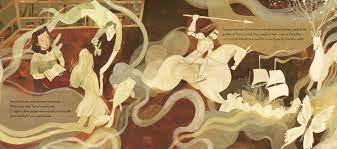
George is not a knight-in-shining armor rescuing a distressed maiden.  But he is constant, the same adjective used to characterize Tama’s fears.  Imamura’s pictures mix reality and its alternative, literary dreams and dreams of a future.  Figures from fairy tales and medieval lore emerge from the pages of a book. 
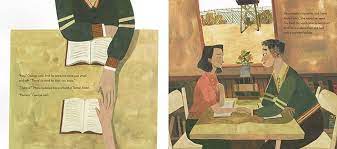
Tama and George sit across from one another at a table amid stacks of books, while outside the window the guard tower is clearly visible.  They both search for the right words to express their anger, buried beneath the surface of accommodation to circumstances beyond their control.  “Everyone at Minidoka knew. ‘I try not to complain. I know this isn’t fair…I try not to be afraid.’” The composition of images also reflects this need for a sense of control, as Tama and George join hands across two open books on an otherwise empty surface.

The concluding pages present the vision of a new postwar life for the young couple and their family, but also a two-page spread returning to their past in the camp.  In an almost utopian scene, a guard holds a rifle, but an elderly couple socialize, children happily play, and Tama and George embrace.  The author comments, “That was humans doing what humans do best,” a modest summation of her tribute to family, community, and anyone struggling to survive oppression. 

Aggie Morton, Trailblazing Again

Aggie Morton Mystery Queen: The Seaside Corpse – written by Marthe Jocelyn, with illustrations by Isabelle Follath
Tundra Books, 2022

Aggie Morton, confident girl detective, is back. In the fourth adventure (reviews of the others can be found here and here), she and her loyal friend and interpreter of clues, Hector Perot, are participating in a paleontology dig.  Socially, if not geographically, far from her well-appointed home, Aggie is the first female Morton to sleep in a tent, as her brother-in-law James observes without an ounce of condescension.  If you haven’t read the previous Aggie Morton books, they are crime novels loosely based on an imaginative approach to Agatha Christie’s childhood. Each book stands alone with no knowledge of Christie’s work required, although fans of both Christie and Marthe Jocelyn will be thrilled to find Aggie and Hector once again confronted with an apparent unsolved murder.

The novels are rooted in historical reality; The Seaside Corpse reflects early twentieth century fascination with dinosaurs, as well as the ongoing popularity of less scientific area attractions. An American millionaire and a British Barnum-like entrepreneur would both like to get their hands on a fossilized ichthyosaur, but first husband and wife team of Howard and Nina Blenningham-Crewe will need to excavate “Izzy” from fossil-rich beaches of Lyme Regis.  Although a book for middle-grade readers and older, Jocelyn does not shy away from marital conflict, in this scenario observed by the young apprentice scientists. Aggie and the other female characters are challenges to stereotypes of women and girls, and Hector is the ideal, supportive boy who will undoubtedly grow up to be the same kind of man. Aggie’s no-nonsense Grannie Jane there is also on the scene, demonstrating how strong young women can develop into equally assertive older women. 

Jocelyn is funny without descending to parody.  Her control of language is as precise as the rational methods which Agatha and Hector applying to solving mysteries.  No wonder Agatha is successful! Her dedication is far stronger than the limited expectations of her class for affluent, if intelligent, young women: “I had a moment’s pang, thinking how lovely it would be to stay another night in the hotel…but that was not to be.  We had a murder to attend to! If Hector could face mosquitoes and nettles, I most certainly could do without a bergamot bubble bath.”

Interspersed throughout the chapters are newspaper articles, accurate, understated, but also laced with sensation.

Isabelle Follath’s black-and-white drawings are like delicate accessories added to chapter titles.  “A Lovely Respite” is accompanied by a tiered display of sandwiches and cake, while “An Unanticipated Truth” features two glasses, one ominously fallen on its side.  As in the other novels, the book opens with portraits of everyone the reader will meet, each one labeled for handy reference.  An author’s note and list of sources clarify Jocelyn’s framework for the story and reflect her obvious love of the project.  A description on the flyleaf refers to The Seaside Corpse as Aggie and Hector’s “fourth and final mystery,” but, if Arthur Conan Doyle could revive Sherlock Holmes, maybe readers could hope for more from this young team. In the meantime, there is plenty of rewarding material here for readers, young and older, who enjoy informed, literate, and inventive fun.

Not Number 17 Cherry Tree Lane

The Adventures of Miss Petitfour – written by Anne Michaels, illustrated by Emma Block
Tundra Books, 2015

The Further Adventures of Miss Petitfour – written by Anne Michaels, illustrated by Emma Block
Tundra Books, 2022

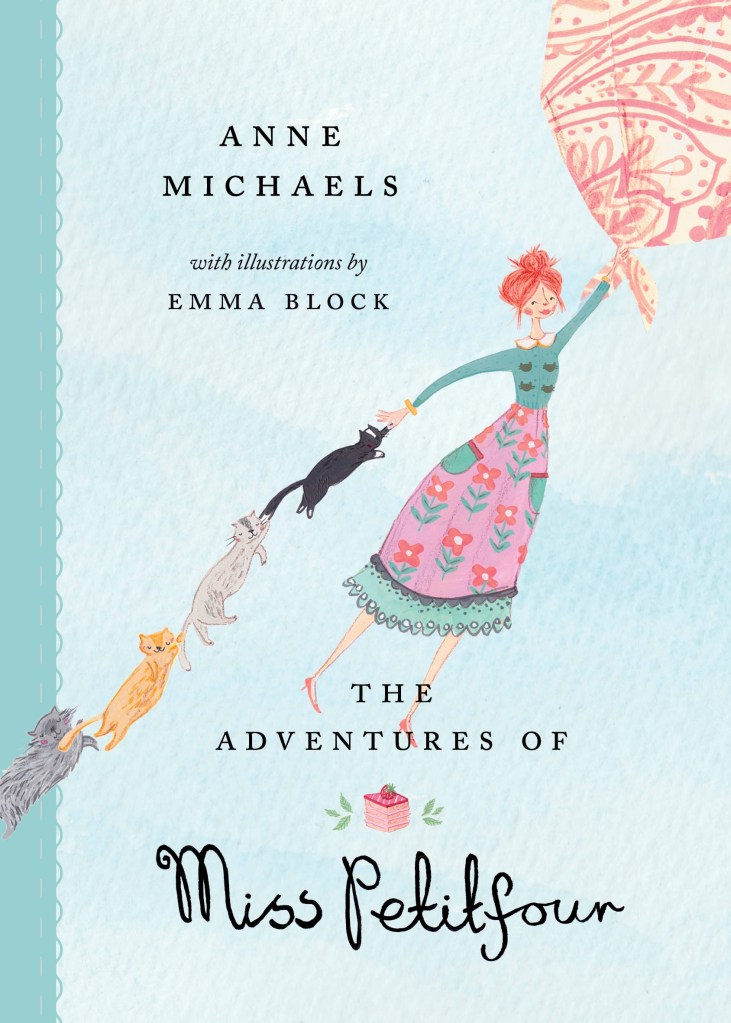
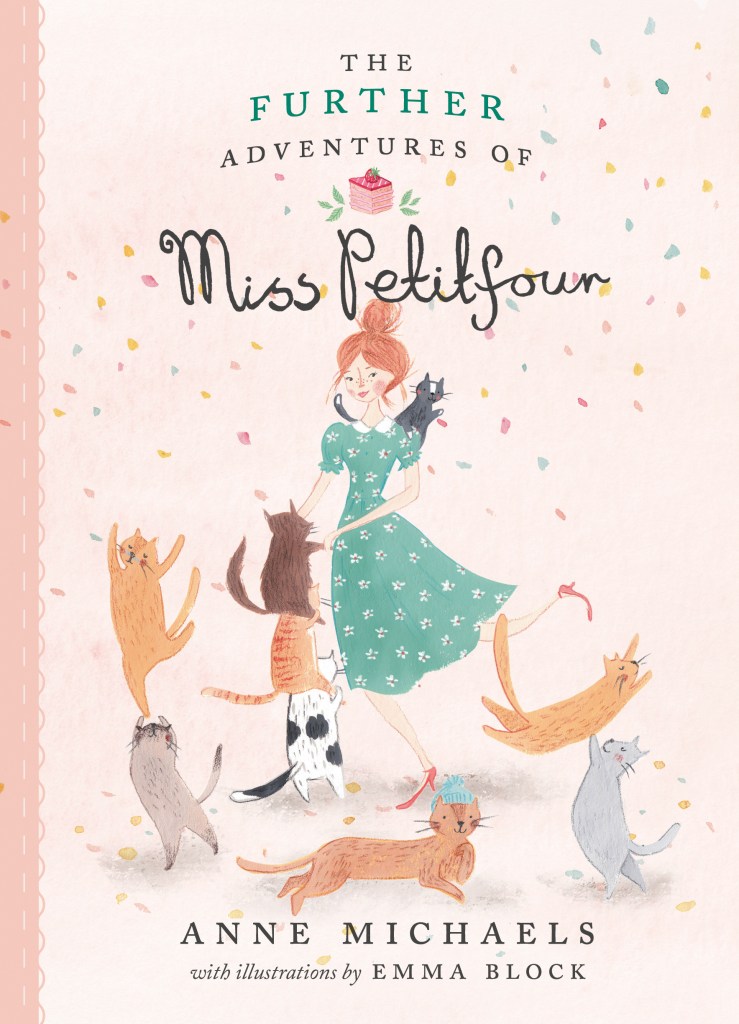
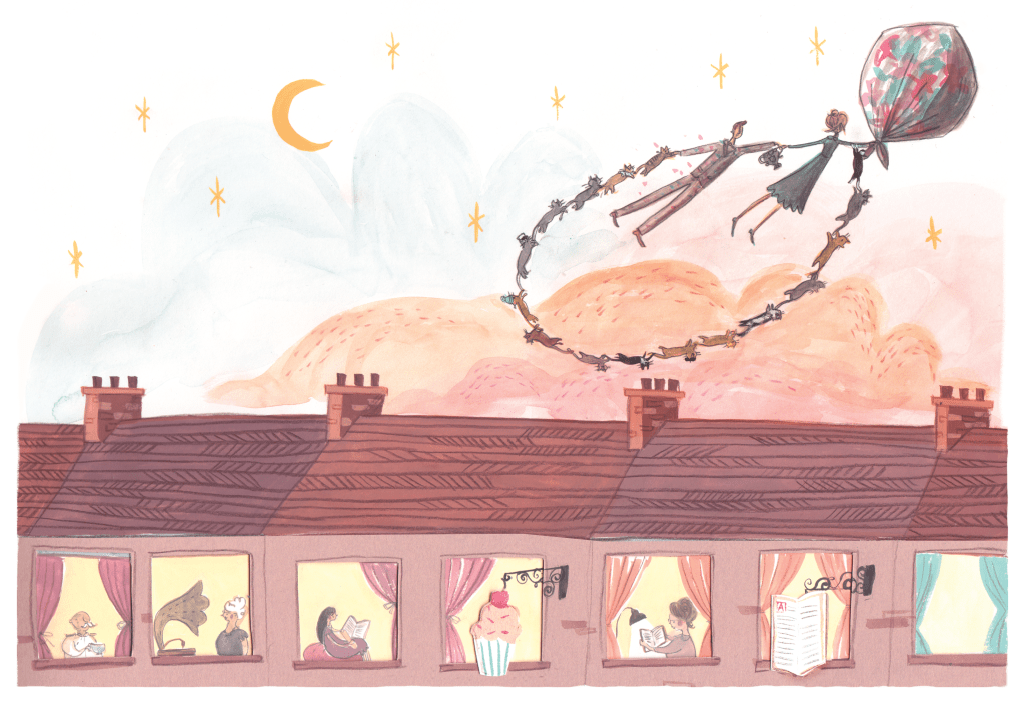
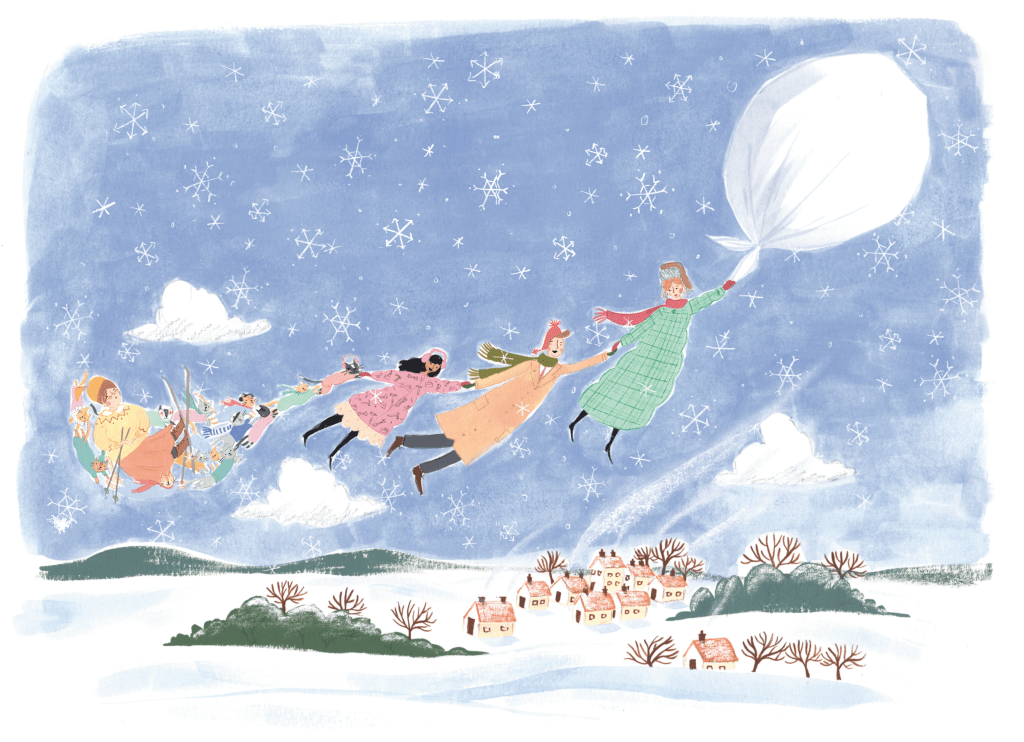
Miss Petitfour is not Mary Poppins.  She does like children, and she can fly, but both her eccentricities and her empathy set her apart from one of her most obvious inspirations.  In two episodic collections, so far, readers follow her, along with her human friends and collection of cats, as she helps her neighbors, indulges in creative pastimes, and evokes both fun and sophisticated lessons about language for children and adults alike.

As you read about Miss Petitfour, you will learn to like the fact that much of what happens is a digression, a word highlighted by both italics and a different color font.  Similarly, a child named Carlos Cornelius Carruther sits, not in a stroller, but in a perambulator, and festooning appears as a way to decorate a Christmas tree. Most important, you will learn that eccentricity means “a quirky thing we like to do just because.” That definition summarizes the whole experience of the two books, with the quirkiness matched by the lovely illustrations by Emma Block.

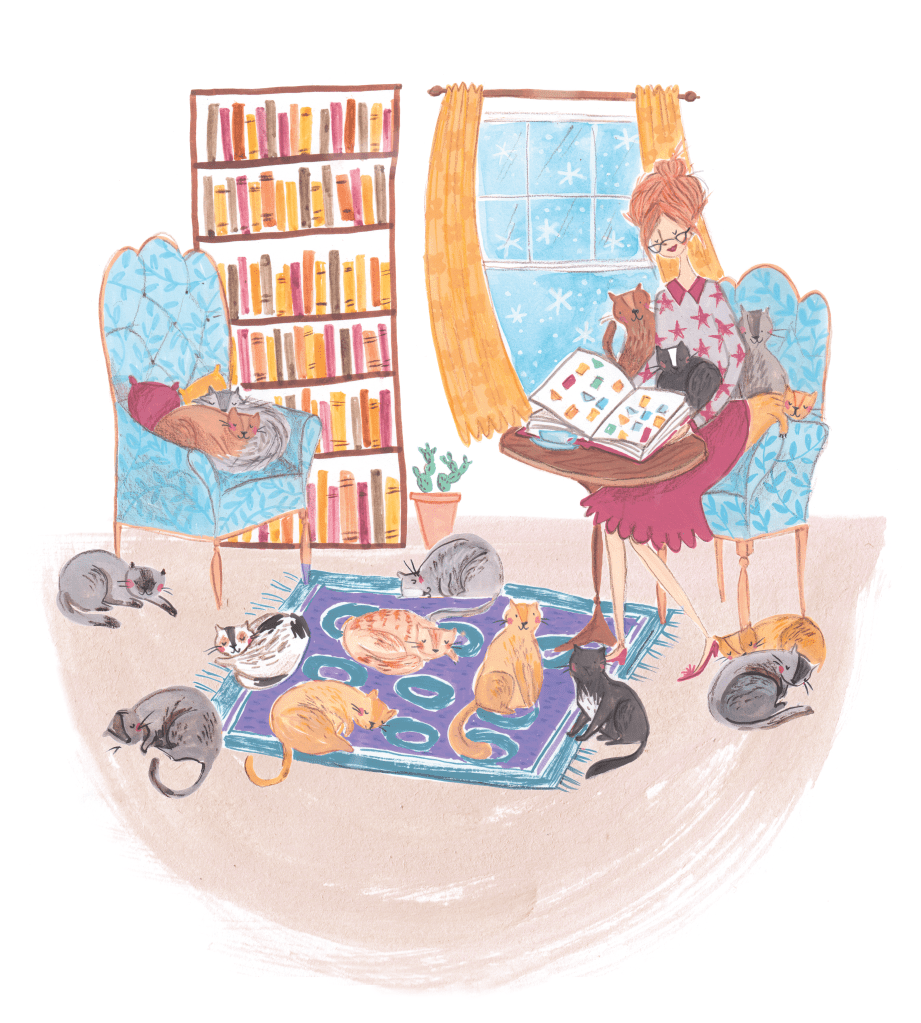
Each chapter of Miss Petitfour’s adventures can stand alone, although in total the stories add up to a portrait of a colorful and compassionate character. Unlike Mary Poppins, who often gaslights her young charges (“Up in the air?…What do you mean, pray, up in the air?”), Miss Petitfour kindly helps out at the jumble sale in the first book, and teaches her young friend, Pleasant Patel, about anagrams in the second. One of my favorite chapters in The Adventures features Miss Petitfour’s philately (stamp collecting) and a near mishap with the extremely valuable first British postage stamp, the Penny Black. As the author, Anne Michaels, describes it to children or stamp neophytes, this stamp features “a lovely little picture of Queen Victoria wearing her crown, with her hair pulled back in what looks like a ponytail.  Imagine a queen with a ponytail!” The description of Miss Petitfour captures the essence of pure fun without a practical purpose, as she pores over her album on a snowy day, accompanied by her cats.

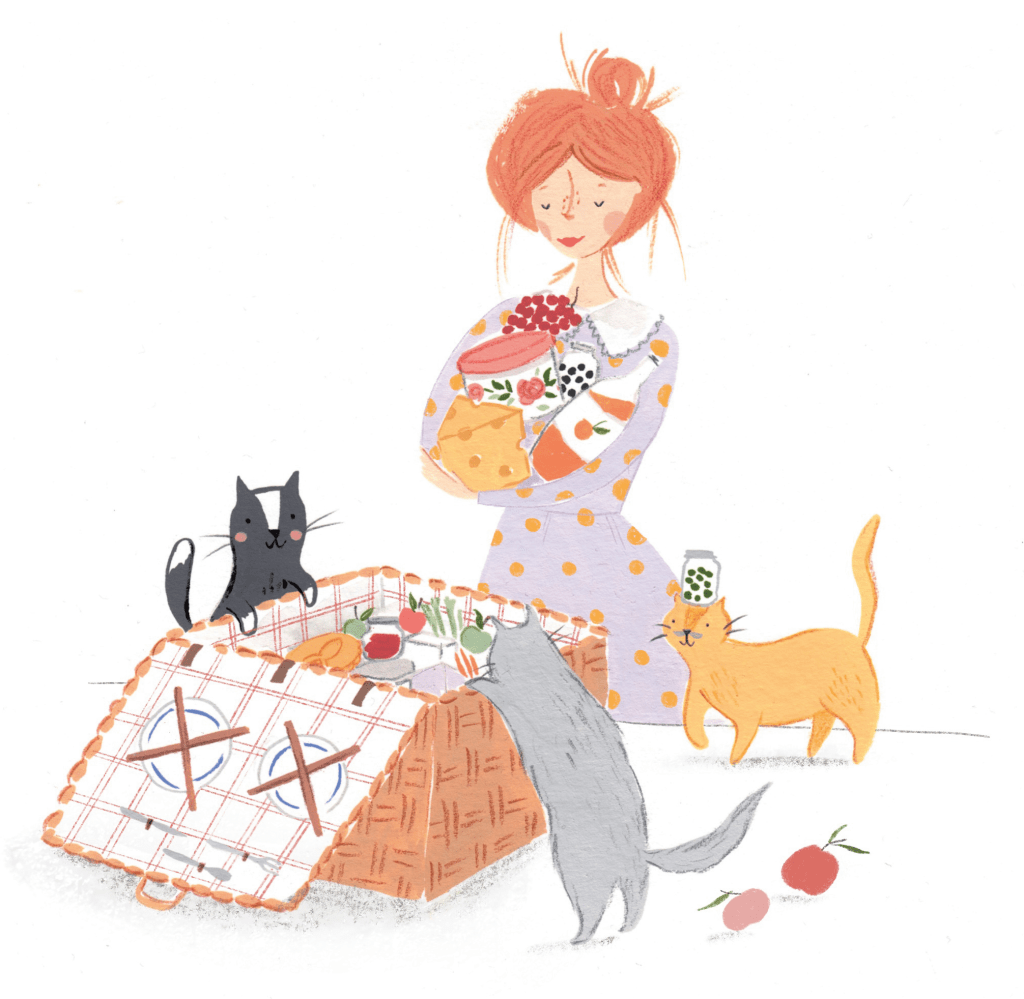
When the valuable stamp sticks to a cat’s paw, and then takes flight out the window, chaos ensues, but everything is ultimately resolved with the help of friends.  The combination of patience, chance, and community spirit add up to a satisfying conclusion.  In the second book, Miss Petitfour prepares a picnic lunch, or burgoo, for the local racing event.  As always, the text and pictures complement each other perfectly; readers will visualize the “piles of carrot swords and celery paintbrushes” along with seeing the illustration. Of course, there is a digression about the history and different varieties of olives.  There is some confusion involving runners, cats, and a lucky charm, but the day ends happily with a delicious meal. By the way, “tail” and “tale” are homophones. Both and homage to classic children’s books and an up-to-date excursion to a slightly quirky world, both Miss Petitfour books are worth the trip, no flying is necessary.

Tokyo Holiday

Jasmine Toguchi, Brave Explorer – written by Debbi Michiko Florence, pictures by Elizabet Vuković.
Farrar, Straus and Giroux, 2022

Debbi Michiko Florence graciously dedicates this fifth installment in the Jasmine Toguchi book series to all her readers who requested more about Jasmine. I am one of those readers, and I was not disappointed by Jasmine’s latest adventure.  (I had reviewed the earlier four Jasmine Toguchi entries here and here and here and here, and another Debbi Michiko Florence middle grade novel here).  While the series is about the challenges of childhood and Jasmine’s emotional growth, there is an actual element of adventure in this one, as Jasmine and her family visit Japan, affording her an opportunity to finally encounter the country of her heritage, previously experienced through her parents’ and grandmother’s experiences.  As always, Florence captures subtleties not always present in chapter books for young readers.  Jasmine is a real person. Her delight in the sights and tastes of Tokyo is as tangible as her frustration at confronting the immovable force of a difficult older sister.

The book is not a pretext for a brief introduction to Japan. Jasmine’s excitement, her parents’ empathy, and her older sister Sophie’s apparent failure to understand Jasmine’s perspective are thoroughly believable. At the same time, the setting, a new departure for the series, adds a distinct dimension.  The reader views Tokyo Tower, a glimpse of Mt. Fuji, and the simultaneously new and familiar aspects of Japanese food through Jasmine’s eyes.  Although Jasmine, unlike Sophie, has not undertaken a systematic study of language and customs, she is more open to assimilating all she sees. As the novel progresses, we learn why Sophie’s methodical approach may not be more sophisticated than Jasmine’s, so much as different. 

Journal entries alternate with the narrative, both written in the first person.  Jasmine’s observations are those of a bright, curious child, and they ring true.  A trip on the subway is a radical departure from the familiar: “It was quiet as a library. People were reading books or looking at their phones. Kids like me were sitting silently…How was I supposed to know this rule?”  Jasmine is adaptable because she pays attention, summarizes, and notes her discomfort. Then she learns.  What matters to children may not be as significant to adults, but Jasmine’s parents are attuned to their daughters’ needs.  Visiting the Sensoji Temple, Jasmine is impressed by the “…ginormous red lantern with Japanese kanji in black written on it,” and the ritual of burning incense, but she is also captivated by the omamori (good luck charms) available for sale.  Her parents explain everything and also indulge her with souvenirs.

The pictures are an integral part of the story. In fact, it’s difficult to imagine Jasmine with a different illustrator! They give a sense of Elizabet Vuković reading the story and stopping at key points to enhance it with her images. Of course, that’s not the way the process necessarily works, but a reflection of the way that the text and pictures seem to be seamlessly connected.  The careful attention to facial expressions, as well as important objects and foods, advance the plot but also encourage the reader to pause for emphasis. In her author’s note, Florence provides instructions for using hasi (chopsticks), and a recipe for dorayaki pancakes, accompanied by Vuković’s graphics.  But all the illustrations coordinate closely with the text, not in the sequential form of a graphic novel but with a similar kind of clear correspondence.

The next volume of the series, Jasmine Toguchi, Peace-Maker, is due to appear in March, and it continues the setting in Japan.  In many ways, Debi Michiko Florence reminds me of some of the best classic authors for children in her ability to remember and communicate what it is to be a child.  Reading Jasmine Toguchi, Brave Explorer, I was reminded of Patricia Reilly Giff’s wonderful Polk Street School books. Although perhaps best known for her Newbery winning Lily’s Crossing (blog), her series fiction was also memorable. In the special editions, Next Stop, New York City! Look Out, Washington D.C. and Oh Boy, Boston! the kids broaden their horizons by learning about new places.  Of course, Jasmine’s connection to Japan is more specific, but both authors know how to elevate these cultural forays above the level of social studies textbooks. Wherever Jasmine goes, we hope to follow her.

Sailing Back Home on a River of Borsch

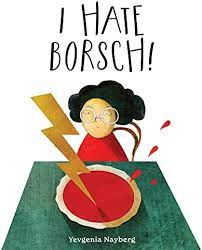
I Hate Borsch!- written and illustrated by Yevgenia Nayberg
Eerdmans Books for Young Readers, 2022

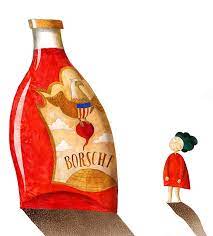
Proust had his madeleines; Yevgenia Nayberg has her borsch. Unlike Proust, who didn’t seem to have memories of being force-fed his favorite pastry, Nayberg associated the bright red beet soup with childhood instructions to consume everything on her plate, or in her bowl.  Later, like many of us, she returned emotionally to the point where negative memories become infused with nostalgia, and separated from the kinds of rebelliousness that converted perfectly delicious foods into nightmares.  In her picture book about this experience, Nayberg’s inimitable gifts make this universal experience into a poignant, colorful, and joyous reflection on identity. (I have reviewed other books by her here and here and here.)

I admit I was partly drawn to the subject of this book because I, too, was fed borsch as a child.  Since I am Jewish American, I spelled and pronounced it “borscht,” an error which Nayberg rightfully mocks.  Sometimes my mother or grandmother made the soup, but other times, it did indeed deserve the author’s condemnation: “It came out of a jar and tasted like…nothing!” (I also hated halvah, but would always eat a little bit when my grandfather gave it to me, to avoid hurting his feelings.)  

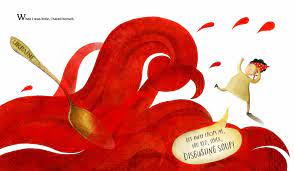
Nayberg grew up in Ukraine before emigrating to the United States. Her dramatic opening illustration shows a sea of red rising in a wave like a Hokusai painting.  A spoon labeled “Ukraine” dips into the soup, and a young Nayberg, who has confessed to hating it, chants an ineffective spell: “Get away from me, you red, thick, disgusting soup!”  The rest of the book charts her course from borsch hater to borsch supporter, as she puts back together the pieces of her child and adult lives.

Part of the book’s brilliance lies in its composition.  Oversized beets, carrots and tomatoes dominate two pages. Then, a rhapsodic, leaping man demonstrates the obligation to love borsch in his homeland as he carries the ingredients to prepare the dish. A table covered with labeled dill, sour cream, and black bread may appear inviting, but the author feels stranded, “…Robinson Crusoe, stuck on a deserted island of sour cream in a red sea of borsch.” Each image is completely original, yet also resonates with the reader’s memories.  Two angels surround a golden sunflower, although it is not an approved ingredient for borsch.  Ukrainian knights, as legend has it, pour borsch on their enemies. Pictures with collage elements of photos and postage stamps signify Nayberg’s voyage to the land of peanut butter and American cheese. Eventually, two black pages with one line of white text each state the truth: something was missing from Nayberg’s life.  Something which she had once hated, but now longed to prepare becomes the book’s focus.

I Hate Borsch! concludes with a lovely author’s note and a recipe.  But the book’s message and stunning imagery remain with you, like Proust’s madeleine, or your own long-absent food from a childhood, especially one controlled by immigrant parents and grandparents desperately committed to feeding and loving you.  Yevgenia Nayberg has produced a poetic and graphic house of memories, free of sentiment but as rich with evocative sense impressions as a red bowl of soup.

No Match for Hershel

Hershel and the Hanukkah Goblins: 25th Anniversary Edition – written by Eric Kimmel, illustrated by Trina Schart Hyman
Holiday House, 2014 (reissued 2022)

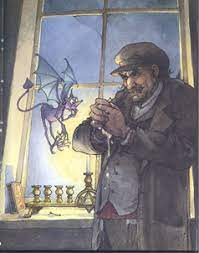
The wicked if foolish goblins who try to destroy the darkness-challenging festival of Hanukkah are no match for Hershel, the determined character from Jewish folklore who refuses to be scared away.  The goblins are also no match for two stars of children’s literature, author Eric Kimmel and late illustrator Trina Schart Hyman.  This beautiful slip-cased edition, which includes a poster, reminds readers how gifted artists can offer unique interpretations of classic tales.  There are many children’s books about Hanukkah which emphasize heroism, but Hershel’s clever mechanisms to outwit would-be destroyers of Jewish tradition is different.  Kimmel’s twist on tradition, and Hyman’s glorious depictions of the story make this an unforgettable Hanukkah book. (I’ve reviewed other Kimmel Hanukkah books here and here.)

In a thoughtful afterword, Kimmel explains the book’s genesis.  He had developed the idea of creating a Hanukkah story “along the lines of Charles Dickens’s Christmas Carol.Hershel is decidedly not an imitation, nor is it a project implying that Jewish children inevitably want, or need, to celebrate Christmas. (One of the worst offenders of many in this category is Shmelf the Hanukkah Elf, but the more subtle and well-intentioned Dear Santa, Love, Rachel Rosenstein sends the same message.) Kimmel gives an entirely Jewish character the opportunity to act autonomously within a recognizable Eastern European setting–one with which Jews are all-too-familiar—with attacks on Jewish culture and lives.  Kimmel writes of how thrilled he was to learn that Trina Schart Hyman would illustrate his book: who wouldn’t be?  As Hyman graciously and accurately wrote to him, “I can’t tell you what a pleasure it is to work on a manuscript that implies great visual stuff, but know enough to stop at the implication.”

In his village of Ostropol (link to image of Hershel of Ostropol), Hershel learns that his fellow Jews will not be able to celebrate Hanukkah that year because of a menacing group of goblins. These nasty, if mythical, antisemites are blowing out Hanukkah candles, as well as destroying dreidels and tossing out potato latkes.  But Hershel is fearless.  His language, and all of Kimmel’s narration, are understated.  When he confronts the monsters, whether those “no bigger than a horsefly” or grotesquely huge, he knows just which words to speak in order to undermine their project. Instead of showing terror at the King of the Goblins himself, Hershel responds calmly, “Don’t be silly. You’re one of the boys from the village. You’re trying to scare me.” When he teaches one goblin how to play dreidel, Hershel counters the creatures’ relentless negativity with “Don’t go…Stay awhile. We’ll have fun.” He is also adept at using simple mind games against his enemies. If a goblin is so greedy that he finds himself unable to pull his hand out of pickle jar, it’s easy enough for Hershel to convince him that the jar has supernatural powers.

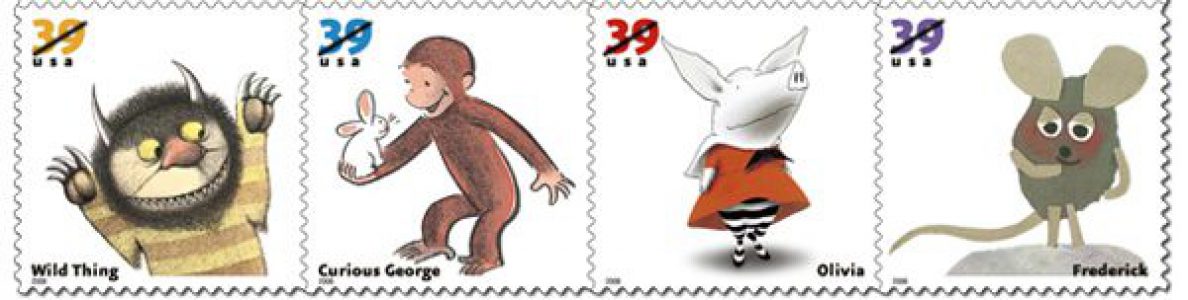
Hyman’s goblins are both demonic and hilarious.  Hershel is humble but dignified. The buttons on his vest are not all closed and his coat swings around as he taunts his nemesis, the pickle eater, who stamps his foot in frustration like Rumpelstiltskin. The town is poor, but strengthened by love and loyalty.  Cousins to Sendak’s wild things, if somewhat more grotesque, the artist’s goblins are reptilian, with allusions to Greek mythology and classic fairy tales.  Hershel’s expressive facial expressions contrast with the exaggerated ones of his opponents. Playing dreidel, Hershel looks calm, while the baffled goblin stares at his diminishing pile of coins.  When Hershel finally succeeds in defeating the goblins and the fierce storm they had provoked, the peaceful town is covered in snow, as Hershel’s invincible menorah glows. Even better, “…there was no reason to worry. In every window there stood a menorah with nine gleaming candles to light the way.”  It takes more than some angry goblins to spoil Hanukkah in Ostropol, when Eric Kimmel and Trina Schart Hyman are there to tell there story.

Punctuation Ends Confusion!

Babble!: And How Punctuation Saved It – words by Caroline Adderson, pictures by Roman Muradov
Tundra Books, 2022

Babble! Is one of the most inventive illustrated children’s books that I’ve seen in a long time.  Begin with the somewhat improbable concept of making the meaning of punctuation both exciting and accessible to young readers. Then, add a fable-like tone that immediately brings to mind James Thurber at his best. Finally, add pictures that combine the wry essence of mid-century language textbooks with European traditions of comics and animation, and you have a quietly powerful lesson that respects the intelligence of children, and allows adults to join them.Is punctuation an appropriate topic for kids? Yes, it is! While there is a young readers’ edition of Eats, Shoots, & Leaves, that useful volume simply does not serve the same purpose as Babble! Caroline Adderson (I’ve reviewed her other work here and here) and Roman Muradov have created a universe of symbols and turned them over to the quirky residents of a village.

These people have problems! Conflict is the norm and chaos reigns. Then, one day, a small child who “wore clothes that were older than she was” as well as a cloth bag around her neck filled with some mysterious and magical items arrives.  She brings the gift of punctuation, converting senseless babble into the art of communication.  Periods are tiny dots which you can carefully lift and examine.  Question marks are existential symbols: “Is this bear chasing me? Should I look back?”  Quotation marksgrant each speaker autonomy and demand responsibility: “They knew they were speaking when they spoke and that they were thinking when they thought.”

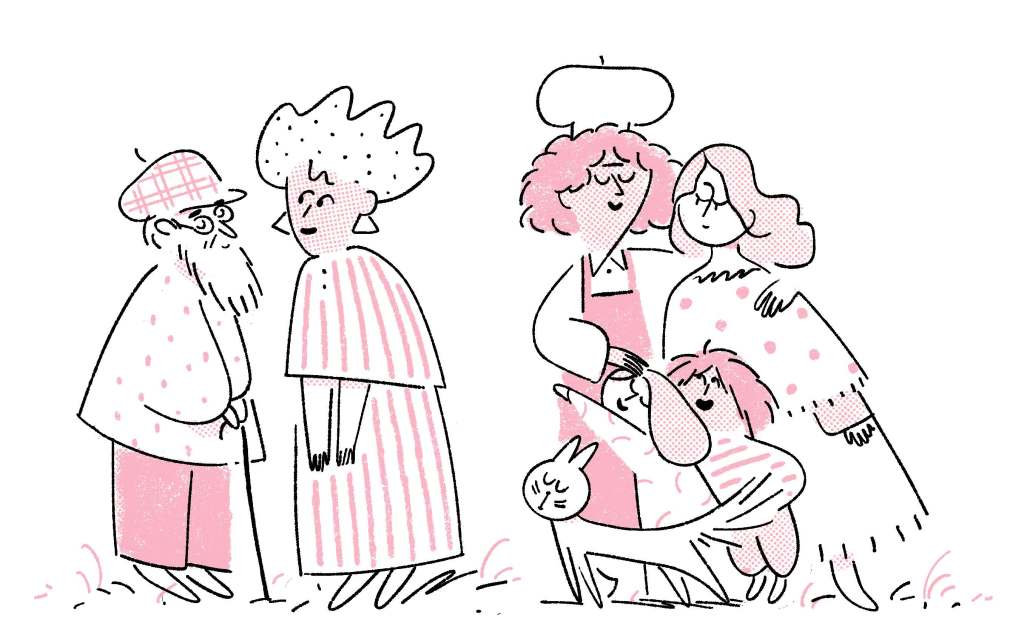
The book’s design by John Martz (himself the brilliant illustrator of Crocodile Hungry and How to Give Your Cat a Bath in Five Easy Steps) combines carefully spaced text in black font with pink punctuation marks, along with pink and black illustrations offset by plenty of white space.  Reading the book is both relaxing and challenging. How is the reader expected to pronounce each symbol she encounters? Not all sentences demand that the reader articulate the name of the symbol: “Grab it!” a father calls to a girl flailing in the water. The baseball bat appearance of the exclamation point lands dramatically on several pages.  In other sequences, such as the gift of a period to stop speech in its tracks, the reader admires the tiny dot without a name: “The stranger let the mother hold the  .  on the tip of her finger.  The mother brought it very close to her eyes.” (image that tiny dot in red, as it is in the text.). How could something so small change everything?  Naturally, the superpower of a nano particle is a fact which children will trust and appreciate.

And who better than kids to understand the role of the exclamation point, shouting “Look at me!” in a well-deserved bid for attention. This gift deserves a party, and it gets one. A feast, a fountain, and kinetic activities celebrate the new reality, where residents can now speak, listen, shout, whisper, and both ask and answer questions.  Humor surfaces on every page, as when the humble comma gets to transform their town by assuring that “Soon we will eat Grandpa” becomes an invitation, not an act of barbarism.  Adderson and Muradov ensure that readers leave the book with a healthy respect for words and the tools they need to do their job. Babble!’s subtle mix of practical knowledge and poetic fancy will send readers back to the book many times, waiting for the girl to patiently make meaning out of chatter.

Curious George and Nostalgia for Dictionaries

Curious George’s Dictionary (From the Editors of the American Heritage Dictionaries) – illustrated in the style of H.A. Rey by Mary O’Keefe Young. Additional illustrations in the style of H.A. Rey by Anna Grossnickle, Greg Paprocki, Vipah International, and Martha Weston
Houghton Mifflin Harcourt, 2016, 2008

Children’s dictionaries in general are the subject for a separate post, but Curious George’s is a really good example of the genre.  The entire project of a print dictionary for kids is now an exercise in nostalgia.  Schools still have some potential use for them, but it is probably rare to acquire one for home use.  Before the digital era, students routinely learned how to use a print dictionary, including how to alphabetically locate entries using guide words at the top of the page.  This skill probably is no longer considered a productive use of limited class time.  On the other hand, if anyone still buys children’s dictionaries, illustrated picture book-types for the youngest readers may be more popular than the student homework tool for use with academic assignments.  I recommend this one!

The elephant in the room, to refer to one of George’s friends in this book, is the adaptation of the Reys’ work (Margaret and H.A.) as an industry, supplying the public with numerous story books outside of the original canon, as well as t.v. shows and toys.  I don’t have an issue with that, as long as the classic books remain the core of George’s readership (and see specific blogs here and here and here and here). I recognize that qualifier may be optimistic.  The imitation-of-Rey pictures are not bad. They are nice facsimiles of the inimitable character, appealing and pleasant.  I strongly prefer them, and the older animation based on them, to the PBS program. The latter show is wonderful, but I’m not sure why they did not preserve an homage to the Reys’ style; perhaps there were copyright issues.

This dictionary is great for toddlers through early elementary grades.  Each section begins with a brightly colored and patterned upper-and lower-case letter, as well as the letter highlighted in the context of the entire alphabet.  The introduction, “George Learns How to Use the Dictionary,” is a story in itself, as the man with the yellow hat teaches his little charge how to make use of the dictionary.  His method is encouraging and interactive: “Do you think we can find your favorite fruit?”  Across the bottom of each page in this short section there are additional pointers in blue and green font, including the fact that words spelled the same way may have different meanings.

Not all the words are nouns, by any means. On the “Ee” page, readers see George carrying two different objects in each hand, and learn that a mother and baby bunny wake up early. There are people, places, and concepts. The “Ll” pages place George in a library, show him asleep with light shining through the window, and indicate that there is only a little milk inside a glass. (It isn’t even half-full, but that certainly doesn’t imply that George is a pessimist.) Some of the pictures refer to events in the George books, such as the puzzle which turns out to put him in the hospital when he eats one of the pieces in Curious George Goes to the Hospital Those that are not connected to a George narrative could still have an implied story.  Why is he scratching his head on the “Ss” page?  Whose scarf is that? 

The pictures connected to the George books should send caregivers and teachers to their bookshelves, libraries, or stores to DECIDE which Curious George books to get.  Whether getting a job, undergoing a short hospital stay, or furthering research on space travel, George speaks to toddlers even without using words.

Bring Your Rabbit to School Day

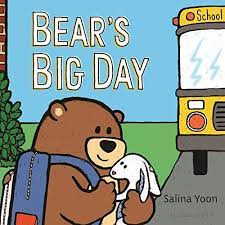
Bear’s Big Day – written and illustrated by Salina Yoon
Bloomsbury’s Children’s Books 2016

There are countless books designed to help children overcome their fears about beginning school. Even some of the less stellar ones can be serviceable, and it’s hard to tell when any particular story will appeal to an anxious child.  Some of them have a particular angle, such as the special challenges of beginning school in a new country or culture, such as Anna Kim’s wonderful Danbi Leads the School Parade. Others use humor, but not all as inventively as Tara Lazar and Melissa Crowton in Your First Day at Circus School. Salina Yoon weighs in the on the truly difficult issue of whether or not it is a good idea for a young child to bring a transitional object, whether a teddy bear, doll, or in this case, Floppy Bunny.  Her answer is yes, and she makes a compelling case for allowing this source of comfort.

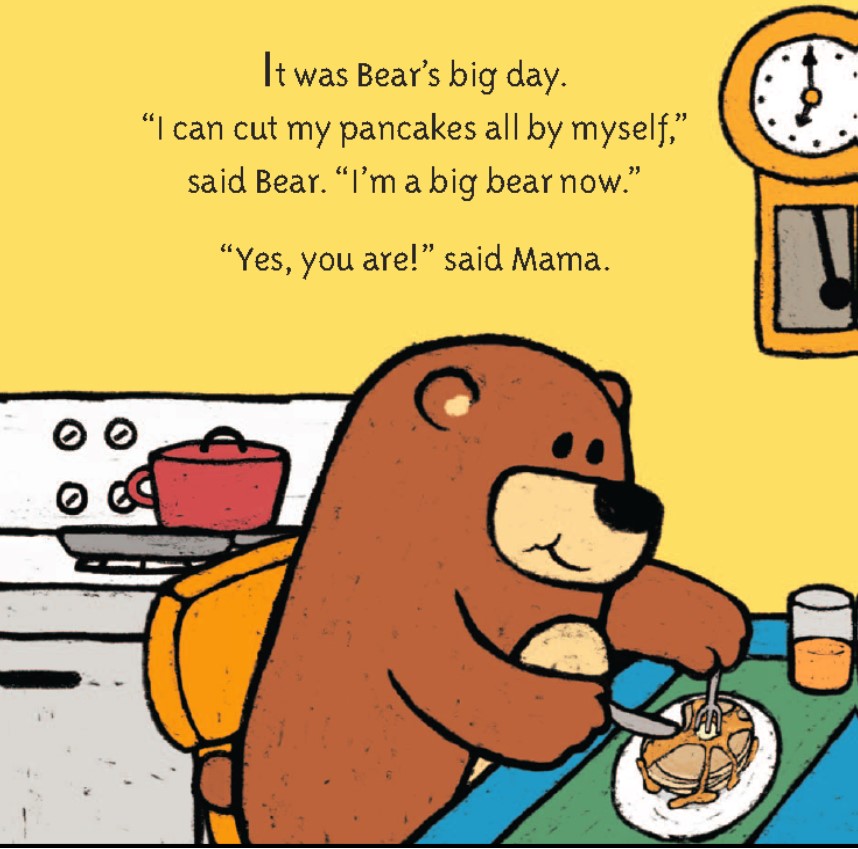
Even though Bear has a great morning eating pancakes with his parents, and agrees to leave Floppy Bunny at home, the pressures of beginning school are tougher than he had anticipated.  Yoon’s animals are recognizably members of their species, but also personified enough to satisfy children’s need to identify with them. The grey-furred Miss Fox, a kind teacher with glasses, plays a key role, as she empathizes with Bear’s difficulties. The key point is that some children easily adapt, but Bear is not what of them. 

Lunchtime is a trial for Bear.  The other students happily consume their meals, Panda using chopsticks and a beautifully arranged bento. (A bento is a Japanese lunchbox with compartments; it is also used in other parts of Asia.) Bear stares into space. His lunchbox, wryly decorated with Yoon’s character from her Penguin books, remains closed. Naptime is, naturally, the worst.  A sleepless Bear stares at the ceiling while his friends happily dream of ice cream, kites, and whatever appears in Lamb’s dreams. 

Miss Fox doesn’t only permit Bear to bring Floppy to school. She actively engages her anxious student in an art project that becomes a kind of compromise step towards independence.  At the same time, Bear learns that his classmates’ impressive adaptability had a similar key to success.  The endpapers of the book feature brightly colored backpacks, each as individual as the child who carries it to school.  Yoon’s combination of empathy, simplicity, and attention to the small details that occupy children’s minds, all add up to a happy conclusion.

How Many Pigs Does It Take to Make a Story?

Too Many Pigs and One Big Bad Wolf – written by Davide Cali, illustrated by Marianna Balducci
Tundra Books, 2022

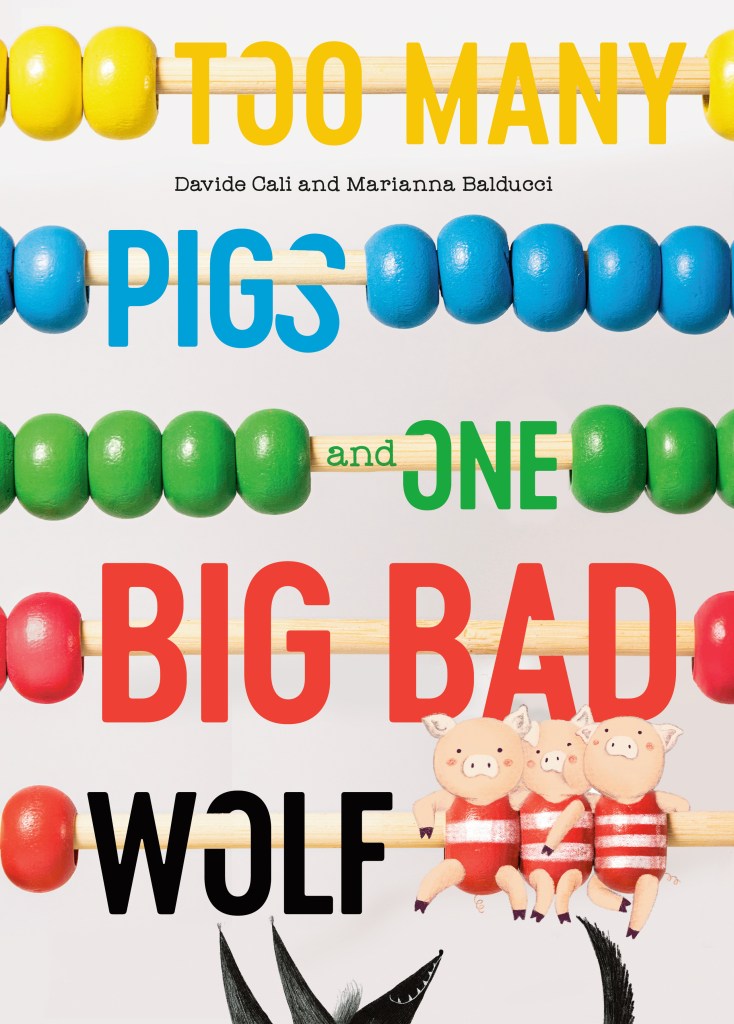
Children know what makes a good story; in Too Many Pigs and One Big Bad Wolf, Davide Cali and Marianna Balducci provide a funny and clever example of how to create an engaging tale.  The humor is accessible to kids without appealing to the lowest common denominator. The pictures (photos by Balducci and Fabio Gervasoni) are sharp and bright, and the book’s design by Kelly Hill constructs the perfect frame for the whole project. (The artwork is one of the featured at the Society of Illustrators Original Art Exhibition of picture book illustration this year.)

The original, and terrifying, fairy tale about the three little pigs existed in many versions, but this one is only incidentally about a predator devouring smaller animals.  In fact, as the author and illustrator make clear, the events of a book alone do not necessarily add up to a good story. Using a wooden toy-like abacus featuring pig-shaped beads, Cali and Balducci calculate what exactly holds our interest as reader’s when we suspend disbelief and enter a fictional world.  If the story seems too abrupt, just adding random events will not work.  If the characters seem a bit similar, maybe giving them crazy names, one beginning with each letter of the alphabet, will improve the pace.  How about having the pigs form an improbably sounding soccer team? Once the laughter dies down, it becomes clear that the story still needs “a beginning and a middle and an end!”  The alternating black and red font highlights the fact that this is a dialogue between reader and creator. Even such fine points as punctuation and conjunctions play a part. Instead of using commas, the repetition of “and” and the exclamation point show that the stakes are high.  Children need the story to captivate and make sense at the same time!

Throwing in a little math and the fascination with leap years, the author tries another experiment. What if the fierce animal timed his attacks to once a month, choosing the weirdest month in the calendar? Each possibility reinforces the idea that mechanical pacing, wild variations, and ridiculous jokes do not add up to a great book. Yes, we all know that there are some highly successful children’s book authors whose careers defy that premise, but when we present young readers with outstanding work, they can discern the difference. 

A bowl of wooden pigs swimming in milk, with all the appeal of junky breakfast cereal, is an unforgettable image, especially with the hungry wolf posed above, spoon in hand, and ready to dive in.  But even this suggestion is not enough to tie the loose ends together, and readers commiserate with the exasperated text: “I can’t take this anymore!”  By the end, the “author” of this experiment has lost all credibility, but the real author, illustrator, and designer, have raised questions about the challenges of creation that children will think about for a long time.