Carla’s Glasses – written by Debbie Herman, illustrated by Sheila Bailey Flashlight Press, 2024
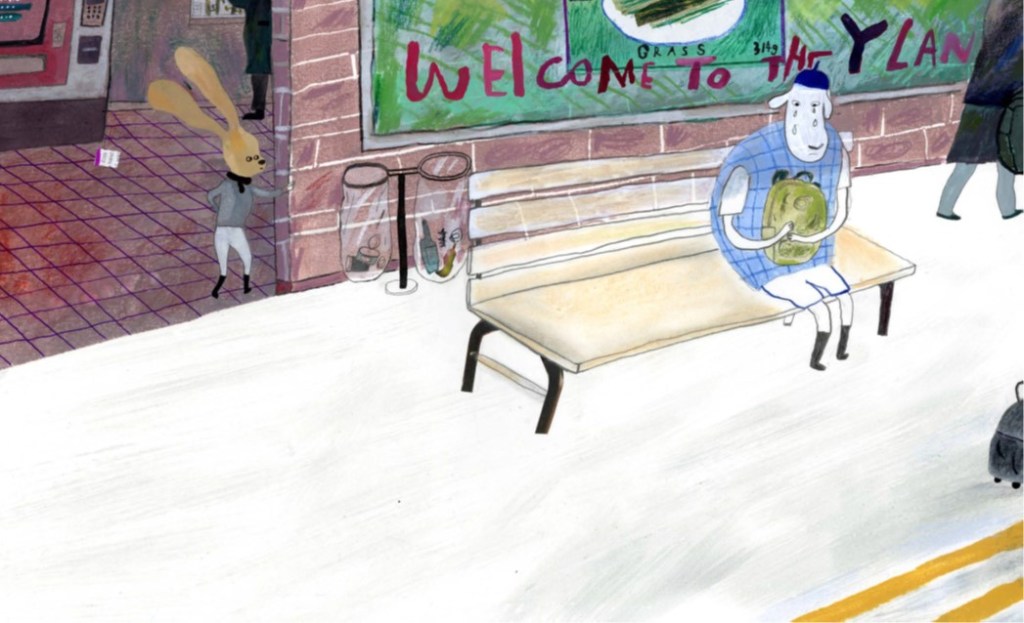
You might expect Carla’s Glasses to be about a girl who needs to acclimate herself to having less than perfect eyesight. On the cover, she seems excited to be trying on a purple, glittery, pair of glasses that are hardly inconspicuous. Instead, this warm and entertaining picture book is about the difference between being a person who wants to stand out, and one who hopes to blend in. Carla wants to wear glasses, but, unfortunately, she has 20/20 vision. Her friend, Buster, does not. They don’t trade places, and they don’t change one another.
The issue at the center of the book is serious, but the tone is light and reassuring. When the classroom teacher is named Ms. Pimento, you can expect some humor along with the conflict. Carla is outgoing, somewhat non-conformist in a Ramon Quimby way. She wears clothing that deliberately calls attention to herself. When Ms. Pimento announces a vision screening, Carla is expecting the most exciting outcome. While the other children seem a bit hesitant, or at least noncommittal, Carla creates her fantasy vision of the future out of craft sticks, glitter, and construction paper. “This pair really accentuates my eyes,” she tells her friends about this new accessory.
When the real eye exams begin, Carla is ready. In spite of her zeal, she doesn’t deliberately throw the test. Honesty is apparently another one of Carla’s personal qualities. She’s also an optimist, believing that not being able to read even the tiniest line of print means she will qualify for glasses. Buster is not so fortunate, at least from his perspective. Unlike his friend, his nightmare is being obvious, and he has the insight to understand the contrast to Carla: “I’m the opposite. I like to blend in.”
Debbie Herman is sensitive to the way children feel, but doesn’t overwhelm them with overbearing empathy. Sheila Bailey’s pictures center Carla’s starring role. She is visually arresting everywhere she appears, and also in the scenes where her viewpoint dominates. When the whole class puts on the exotic array of glasses that emerged from the craft treasure box, everyone looks equally excited, including Ms. Pimento. Intervening scenes, including Buster’s visit to the optometrist and his anxious car ride home, are more subdued.
Carla’s Glasses is perfect for children facing this particular situation. It’s equally encouraging for anyone who doesn’t want to stand out like the giant letter “E” on the eye chart, but can appreciate a friend who does.
Little Red Ruthie: A Hanukkah Tale – written by Gloria Koster, illustrated by Sue Eastland Albert Whitman & Company, 2017
I’m writing about a Chanukah book in July. Recently, I was looking for less terrifying versions of some of the more violently disturbing fairy tales by the Brothers Grimm and others. Yes, I know that sanitizing children’s books is not ideal, but for some young children, and adults who remember childhood nightmares, they are appropriate. Bruno Bettleheim, who was wrong about many aspects of child psychology, wrote in The Uses of Enchantment that these traditional stories helped children deal with conflict. Maurice Sendak had contempt for the idea that frightening books were necessarily harmful, and In the Night Kitchen, his Three Stooges bakers are evidence of that. (Yes, they also resemble someone much worse than the Three Stooges, but I found that trio to be terrifying enough.)
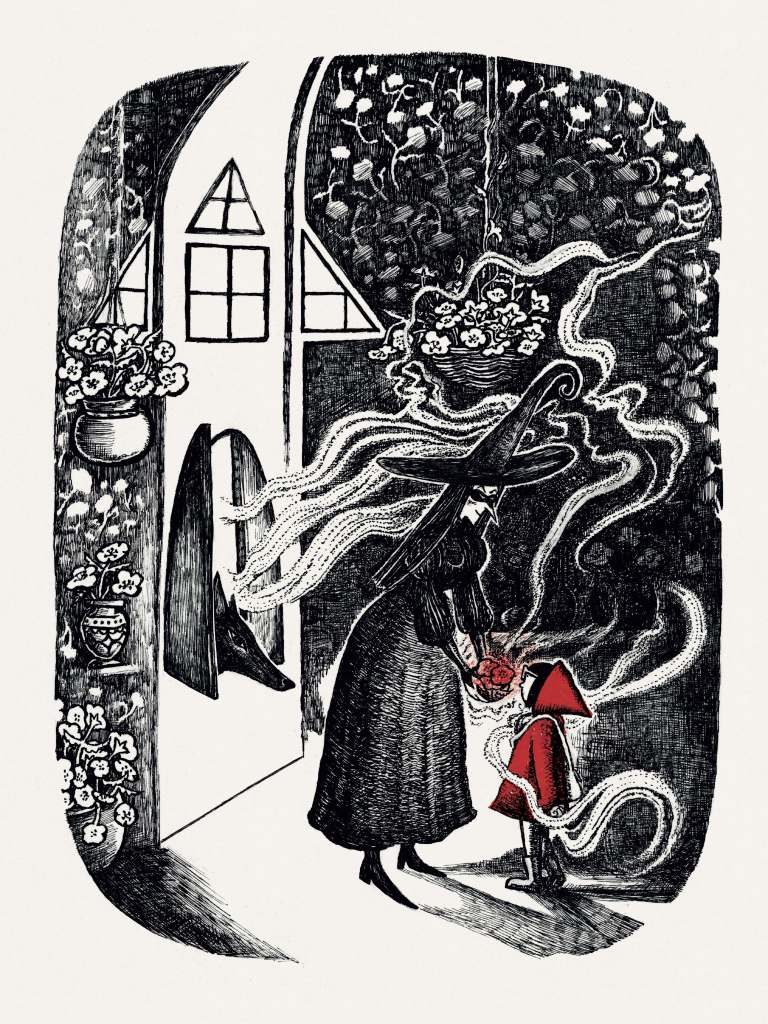
Little Red Ruthie, by Gloria Koster and Sue Eastland, still has the young girl, a grandmother, and a ravenous wolf, but the resolution is comforting, perfect for the winter holiday of Chanukah. You can also read it throughout the year. Ruthie gets ready to go to her Bubbe Basha’s house to bake potato latkes (pancakes). She has a puffy red parka and boots, and she happily waves goodbye to her mother. A wolf with long furry arms and sharp teeth emerges from behind a tree.
Since this is Chanukah story, Ruthie “wanted to be brave as the Maccabees,” the Judean heroes who fought the Greek oppressors. She is not only brave, but smart and level-headed, negotiating with the wolf to buy time. But when he arrives at Bubbe’s house in pursuit of Ruthie, a sign on the door says that her grandmother is shopping in the village. He’s not a patient wolf, but he amuses himself by dressing up in Bubbe’s clothes (!). She also has red boots, but they have elegant buttons down the side.
While frying the latkes that Ruthie has promised to eat so that she will become fatter and more delicious, she buys more time by narrating the story of the Maccabees’ victory and the miracle of the oil that burned for eight days. At this point, the wolf is slumped over the table and one of Bubbe’s boots has fallen off his foot. Ruthie is energetically grating potatoes. By the time Bubbe returns, the wolf is an exhausted and overindulged creature who looks a lot less scary. Bubbe Basha gives him a jelly doughnut (sufganiyot are another traditional Chanukah food), and sends him on his way.
The kitchen is a mess, but Bubbe and Ruthie light the first candle on the chanukiya (Chanukah menorah) and enjoy an intimate dinner. It’s a bit unusual that they are the only two people celebrating together, but it preserves elements of the original fairy tale. If her mother, and other relatives and friends, just showed up for the meal, Little Red Ruthie would differ too much from the Brothers Grimm, Charles Perrault, and centuries of folklore devised to frighten, entertain, and teach children. Here the lesson is to think fast, avoid wolves if possible, and enjoy the warmth of your grandmother’s home. Don’t forget to be as brave as the Maccabees.
The Apartment House on Poppy Hill – written by Nina LaCour, illustrated by Sònia Albert Chronicle Books, 2023
My title for this review is a reference to Kay Thompson and Hilary Knight’s Eloise. The high-spirited heroine of The Apartment House on Poppy Hill reminds me a bit of her, if Eloise were kind and thoughtful instead of annoying and bratty. Eloise lives at the Plaza Hotel in New York City, while Ella Josephine Norwood lives in a Victorian multi-unit Victorian house in San Francisco. For all Eloise’s wealth and privilege, her parents are absent, while Ella has two loving moms who are involved in every one of her activities. But both the pictures and words bring to mind a girl who takes chances and sometimes oversteps boundaries. In Ella’s case, her tendency to do that leads to kindness and friendship.
When a new couple, Cleo and Leo, move into 1106 Wildflower Place, Ella is determined to help them, on her own schedule and with her own priorities. When Cleo asks her to move out of the way as she and her partner lug in heavy furniture, Ella interprets the formulaic “Excuse me” as an apology, instead of a polite request. (“If I’m in your way, don’t say ‘excuse me’ when you really want me to excuse myself! That’s just confusing!”) When Cleo and Leo do ask for her help in lighting their stove, Ella complies only after giving them a tour of the building. Like everyone else in this residence, they come to rely on Ella’s assistance and to accept her for the quirky and irreplaceable kid that she is. Words and pictures work together in this illustrated novel. Sònia Albert’s pictures of Ella placing a jaunty beret on her head, or watching the laundry spin while seated in beach chair, complement Nina LaCour’s descriptions and dialogue in building character.
If her boldness is somewhat like Eloise’s, and her confusion about literal language akin to Amelia Bedelia, the odd assortment of tenants has something of Louise Fitzhugh’s Harriet the Spy. There is Matilda, “a woman in purple pants and with long red hair” who addresses Ella as “darling.” She uses a giant ostrich fan instead of an air conditioner and plays an instrument whose booming sound mimics an earthquake. Matilda could certainly have turned up Harriet Welch’s secret notebook. Although Ella is much more tolerant, like Harriet, she has her suspicions of people. In this case, they are an elderly couple named Gertrude and Archibald Robinson. Making assumptions based on faulty information is not the route to being a good neighbor. Eventually, everyone’s role at 1106 Wildflower Place makes sense. The flowers embedded in the address’s name play a key part in the plot and its resolution.
Sonia Sotomayor: A Judge Grows in the Bronx/La juez que creció en el Bronx – written by Jonah Winter, illustrated by Edel Rodríguez Atheneum Books for Young Readers, 2009
Tomorrow is July 4, Independence Day. We can all judge for ourselves the tremendous value of Sonia Sotomayor’s courage and her attempts to preserve democracy in the United States. Jonah Winter and Edel Rodríguez’s bilingual picture book biography of this American heroine is essential reading, or re-reading, with the children in your life. Someone from, as Winter calls it, “an unexpected place,” can use her strength to achieve success. In Sonia Sotomayor’s case, her widowed mother and extended family provided a nurturing beginning, allowing her to confront the obstacles which, seem to never end.
Winter has a flair for incorporating spoken language into his written text. He begins by explaining the most significant facts of Sotomayor’s early life. Her mother, a widow, worked unstintingly to support the family, who lived in public housing in the Bronx. Gatherings with relatives featured the warmth of Puerto Rican music, food, and warmth. Books were also a constant presence, both textbooks and the adventures of girl detective Nancy Drew. When Sonia was diagnosed with diabetes, she questioned whether persistence and imagination would be enough to solve problems like her literary role model, but she decided that the law would still be open to her as a career. Rodríguez’s pictures show Sonia’s emerging identity, immersed in a book, imagining herself as a detective, and finally raising her high school diploma high in the air.
Next came Princeton University. Winter captures the alien nature of this environment for Sotomayor. “Where were the subways? Where was the merengue music? Where were the people who looked like her?” Continuing his metaphor of the title, she became “like a flowering vine that would not stop growing.” When she became a lawyer, and then a judge, the same qualities of diligence and honesty that had defined her life became central to her professionalism. Impatient with lawyers who were not prepared, and as well as with judges who lacked empathy, she refused to dichotomize the intellectual and emotional qualities necessary to being fair and impartial. “In the world of judges, this made Sonia very special.”
When President Obama appointed Sonia Sotomayor to the Supreme Court, she confronted the ironic accusation of racism because of her pride in being Latina. The daughter of an indomitable mother, she has contended with prejudice and disability her whole life and dedicated herself to public service at the highest level. Winter and Rodríguez do not offer a fairy tale about miraculous coincidences. Some of Sotomayor’s gifts were innate; others were inculcated by her mother. She has flourished both in spite, and because of, adversity. Whether Princeton University, or a corrupt Supreme Court, “She would not just survive this strange new world, she would thrive.” On this July 4, we can only hope that the same is true for our fellow Americans.
It Bears Repeating – written by Tanya Tagaq, illustrated by Cee Pootoogook Tundra Books, 2024
It Bears Repeating is an exceptional counting book for young children. If you are skeptical that “exceptional” is an accurate adjective for books in this category, this one will prove you wrong. The text and the pictures work together as a poem, characterized by an effective use of composition. Every page places the bears in a similar, but not identical scene. Every word counts, and they appear in both English and Inuktitut, with a translation and pronunciation guide included. Tanya Tagaq is an improvisational singer from the Nunavut region of Canada. Cee Pootoogook is a carver and printmaker, also from Nunavut.
Opening the book, the illustrations have a kind of silent beauty. Once you begin reading, the rhythmic words seem to set the bears in motion. Pootoogook’s artwork is rendered in colored pencils. This is a medium which is both flexible and demanding. The color palette is deliberately limited, with blue and white backgrounds and pale yellow bears. Each bear is filled in with hatching, closely drawn dark vertical and horizontal lines. They have personalities, with the first bear being proud, tall, and long. As more bears enter, the pictures are full, but not crowded. “Four swimming bears./Icy water is their playground./Four cool bears.” The scene is both realistic and stylized, with the bears forming a pattern around the fish who share their home.
Each word resonates and tells a story. In the scene of six bears, the animals surround a hole in the ice, having stationed themselves carefully. There is a brief description: “Six staring bears, then a warning, “Seals beware!” and a further description that adds to the anthropomorphism, “Six crafty bears.” Children think this way about animals, and every culture also envisions their role in the universe and the way that humans perceive them.
Once the bears have eaten, in the scene for eight, they are “full,” “round-bellied,” and dancing together with obvious joy. They vary in size and color. They raise their arms and one bear in the front row kicks his foot so that readers see the bottom of his paw, the only bear in the picture to reveal that angle. The book seems perfectly crafted to engage a child’s attention, as well as for adults to appreciate its artistry.
It Bears Repeating is culturally specific and universal, and rewards repeated readings that are refreshing both literally and figuratively.
This is a short post, just to celebrate the wonderful distinction earned by acclaimed artist and author, Uri Shulevitz. The Eric Carle Museum announced their 2024 Honors; Mr. Shulevitz was selected for the Artist Honor, and three outstanding organizations and publications, We Need Diverse Books, KidLit TV, and The Horn Book, were recognized in the categories of Angel, Bridge, and Mentor:
Later, I will post more about Mr. Shulevitz’s work, but please check out my previous work about this luminary of his field here and here.
Naturally, The Horn Book promptly reported the awards, as Publishers Weekly. When I did not notice a post on School Library Journal, I contacted them. Here is their announcement that they subsequently posted.
There is a paywall on their site, so if you are not a subscriber, you may not be able to access the article. However, you will notice that the subtitle reports that “The Horn Book, We Need Diverse Books, and KidLit TV are all honored by the Carle Museum of Picture Book Art.”
Of course, the brief article itself does list Mr. Shulevitz’s award, fourth in the list of Honors. The press release from the Museum, listing the Artist Award first, is included. The order of the Awards in no way diminishes the importance of the Angel, Bridge, or Mentor categories. It simply reflects the fact that the Carle Museum is dedicated to the work of picture book artists. If that seems arbitrary, think how it would appear if the American Library Association, in announcing their children’s literature awards, opened with those selected in the categories of translation and informational books. Both those categories are important! Nevertheless, the tradition has always been to first reveal the winners of the Newbery and Caldecott Medals. The Honors were not given in 2023, when a new executive director was hired by the Museum.) In 2022, the SLJ announcement listed Faith Ringgold first, as the artist honored.
What would explain this unusual decision by SLJ? Here is a link to my earlier post about their marginalization of Jewish American Heritage Month.
Uri Shulevitz is an outstanding artist. Although I am ambivalent about the value of awards, they function as a kind of shorthand for recognition. He has won a Caldecott and three Caldecott Honors, as well as numerous others. He is 89 years old. His whole career has been dedicated to bringing, in Keats’s words, truth and beauty to the world of children’s books. Whatever the intention behind SLJ’s choice to avoid celebrating this latest distinction, it is the sad continuation of a trend based on selective appreciation of artists and writers based on their background.
Honey and Me – Meira Drazin Scholastic Press, 2022
In a reversal of sorts, I would like to start my appreciation of Meira Drazin’s middle-grade (and older) novel with her thoughtful author’s note. She raises the somewhat contentious issue of identity in children’s books. Do we only relate to characters who duplicate, at least in some key ways, ourselves, or do works of literature transcend that type of categorization? Like Meira Drazin, I’m Jewish, and I grew up reading books in which Jewish characters rarely appeared. I loved those books—Little Women, Anne of Green Gables, Noel Streatfeild’s work—so I appreciated Ms. Drazin’s mention of them as touchstones.
However, I also loved and was greatly impacted by, Sydney Taylor’s All-of-a-Kind series, which I have written about in this blog, and for several other publications (see, for example, here and here and here and here). What Jewish girl did not? Actually, I bet there were some, and maybe now Taylor’s books, with their glow of nostalgia, seem too distant to some Jewish readers. Of course, Ella, Henny, Sarah, Charlotte, and Gertie, like Meg, Jo, Beth, and Amy, reach out to any reader, regardless of ethnicity, race, or gender. Honey and Me is a thoroughly original work, and also an homage to books about friendship, books about girls, books about imperfect families, and just…books.
Milla Bloom and Honey Wine are best friends. (Their names are among the best devised in modern children’s books.). They are both Orthodox Jews, but here is where identity creeps in. Some readers will bring to the book their knowledge of what it means to be Orthodox in the Jewish world today, but others will not, and Drazin lets them know without lengthy explanations. Milla’s family integrates more aspects of modernity into their practice, while the Wines approach Judaism more traditionally. There is virtually no judgment about this difference in the novel. Honey’s family is larger than Milla’s. Honey has a brother on the autism spectrum. Milla has an independent and creative aunt who needs the find the right guy. Honey’s mom seems almost perfect to Milla, a paragon of steadfastness and enveloping love. Milla’s own mom is complicated. She made sacrifices for her career and she had some difficulties with becoming a mother.
The exploration of friendship in the novel is deep. It’s not a mean-girls story, or one about competitiveness with a facile resolution. In fact, the girls in this book are really nice! Siblings are supportive, but also annoying. There are some wonderful teachers in the girls’ school. Feminism is an undercurrent, and it comes up against Jewish tradition but, at the same time, finds opportunities within that tradition. Anne Shirley came up against some implicit gender bias, right from the moment when Mathew and Marilla are disappointed that she is a girl. Remember when Charlie is born, and Papa finally has a son? Or when Aunt Lena and Uncle Hyman celebrate the birth of their first son with a pidyon ha-ben ceremony? (link to my article). (If you haven’t read the All-of-a-Kind books, this would be a good time to start.). To celebrate become Jewish adults with their bat mitzva, both girls engage with Jewish texts. Honey reads from the Megillah (Book of Esther) in front of other women. In the context of her own family, she is pushing boundaries. If readers expect that women should have no limits on public recitation of Torah, they may feel both pride, and disappointment at both the limits and expansion of women’s roles. Authors write books not principally to reassure, but to challenge.
The dysfunctional family seder scene is particularly terrific. Drazin acknowledges that holiday celebrations are not always moments of unmitigated joy. Sometimes children leave the table in tears and a mother “sits in stony silence.” Even if it is one moment in time, it may feel like an eternity. I recommend reading Honey and Me and returning to some of the fertile sources for Drazin’s unforgettable characters. This novel is not an homage to Sydney Taylor, nor is at an intellectual demonstration that Orthodox Jewish girls have inner lives. But within the richness of her book, Drazin has brought in those precedents and allowed them to take their own direction.
Once Upon a Sari – written by Zenia Wadhwani, illustrated by Avani Dwivedi Tundra Books, 2024
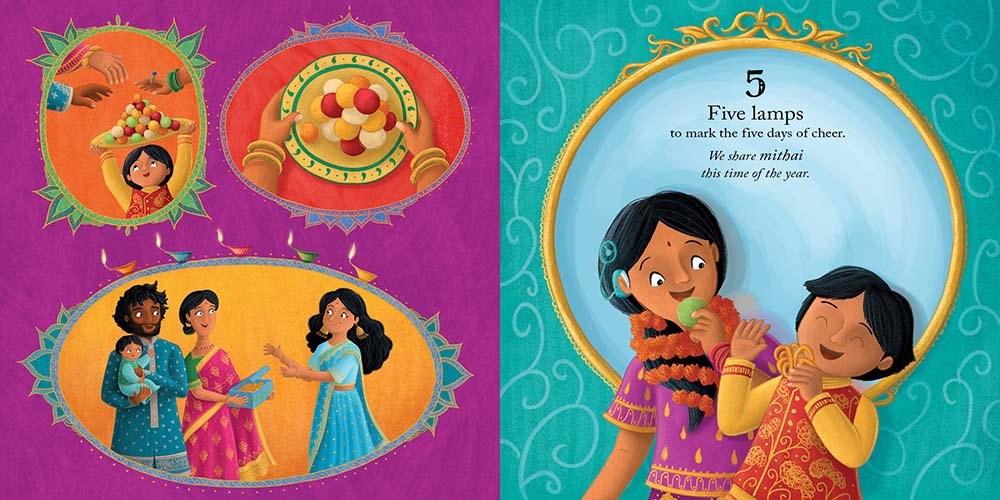
Once Upon a Sari is a gorgeous and profound book. It opens with a girl standing on a stepstool to reach a wardrobe. She opens it, and explores her mother’s collection of saris. The profusion of color and texture emerges in a description tinged with synesthesia: “…rivers of turquoise, pistachio, and mehndi greens…Hues of spicy turmeric, paprika and cinnamon browns.” The girl, Avani, is overwhelmed with beauty. The two-page spread is covered in the garments that remind her of “…a million shining stars…a bed of red and pink roses.” Beginning as a celebration of Indian culture, family, and the delights of lovely clothing to a child, it then expands to consider the impact of historical events on individual people. Zenia Wadhwani makes this transition seamlessly, as a mother teaching her child an important lesson while leaving some aspects unsaid.
First, the mother does not become upset at the mess her daughter has created. She empathizes with her curiosity, revealing that she had also been drawn to her mother’s saris and had created the same bit of temporary chaos. Although she is smiling, the mother’s comment, “Every sari has a story,” foreshadows how the stories may not all be as wonderful as her daughter anticipates. One sari is a gift from Avani’s grandfather to her mother, and another was worn at her uncle’s wedding. Seated at her vanity, Avani’s mother is dressed in gold, picking up the same gold of a glowing lamp. She mentions specific locations imbued with memories: Gujarat, Tamil Nadu, the city of Delhi.
Eventually, Avani’s mother picks up a sari that evokes a different kind of memory, one of fear and danger, as partition divided the Indian subcontinent. Her narrative of this time uses carefully chosen words. Life was not safe anymore. Avani’s grandmother, Nani, and her family, like so many refugees, had to “…leave their home and make a long and difficult journey.” Avani Dwivedi’s picture shows both suffering and dignity. The darkness of a night flight turns to the light of a new home, one that is safer, but also lonely for Nani. The colors in succeeding pictures alternate between ones where darkness or light predominates, along with earth and jewel tones.
Avani wants to learn about the sari itself. She asks her mother to return from her thoughts about the past, and her mother senses that Avani is both curious and anxious. The sari that had belonged to Nani on her flight has become a symbol of strength, and ways to “create joy” after experiencing tragedy. That responses exactly reflects the process of the book itself, where author and illustrator fold the difficult realities of one family’s history into a fabric of language and art.
I have decided to post about School Library Journal’s belated reference to Jewish American Heritage Month, which is shared with Asian American and Pacific Islander (AAPI) Heritage Month. SLJ posted three reviews of Holocaust-themed books, beginning on May 23. All appeared on the blog, Good Comics for Kids. The first review’s title does not connect it to Jewish American Heritage Month, but the review’s first sentence does. It appeared over Memorial Day Weekend with six days left in the month. These are some of recent the posts for Asian American Heritage Month, along with the date they first appeared:
Finally, on May 29, the same reviewer on the Good Comics for Kids blog posted this. The review opens with this surprising assertion: “It seemed like a bit of fate to find this book just as the month of May wraps up and AAPI Heritage and Jewish Heritage Month come to an end.”
I respect the reviewer’s choices of books to cover and I do not doubt the sincerity of her endorsement. It is not “a bit of fate” that she found the book. The book was published last September (when I reviewed it for Jewish Book Council). It is a distinguished work of graphic historical fiction, and also the third Holocaust-themed book reviewed on the Good Comics blog this month. Several posts about upcoming June holidayswere posted on SLJ before any of these reviews.
Not only did SLJ begin to celebrate Asian American Heritage Month at the end of April, but, as readers will see from the partial list above, the articles feature books on a variety of subjects. Some were featured on the front page as the main headline, with the Heritage Month connection as part of the title.
Meanwhile, as mentioned, there have been three recent book reviews, all about the Holocaust, all on the Good Comics for Kids blog, all graphic works. I am definitely not opposed to YA books about the Holocaust. I do not share the opinion that this subject has been overexposed or that attention to the Holocaust necessarily detracts from an emphasis on other, more uplifting, aspects of Jewish history. However, in the context of May’s Heritage Month, it is significant that Asian American literature is presented with an appropriate focus on many experiences, not all of them tragic. The choice of a Holocaust book may simply reflect the fact that SLJ did not begin coverage earlier in the month, and was then necessarily restricted to a narrow range of topics. The decision to feature them all on the Good Comics blog is less clear.
The custom of designating certain months for awareness of an ethnic group in the United States dates to 1926, when the eminent Black historian Carter G. Woodson chose one week in February (later expanded to the full month) to focus on the under-recognized past of Black Americans. Although there is no one official resource about this greatly expanded custom, it now includes many more groups and their achievements in different areas. Asian and Jewish Americans share the month of May, a fact widely acknowledged by many organizations and publications as well as the U.S. Government. (Other Americans, including women, LGBTQ people, and people with disabilities, also have months selected to raise awareness about their importance.) My concern here is specifically with children’s literature, within the larger context of Jewish American Heritage Month, specifically with the question of why a major source of information about children’s books would selectively endorse only one of the two groups in May. Here are some examples of institutions that did not commit this oversight and recognized May as both Jewish American heritage Month and AAPI Heritage Month, from journals in the same space as SLJ to public libraries to private publishers: The Horn Book; The New York Public Library; and Lerner Publishing Group.
One week into the month, when I noticed that several publications had not yet posted about Jewish Americans, but had honored Asian Americans, I contacted editors and corporate staff members. Publishers Weekly Children’s Bookshelf Newsletter had not yet posted any Jewish-themed material; they responded on May 20 that they intended to do so shortly. On May 23, a list of featured Jewish heritage-themed books appeared. (Kirkus Reviews had posted about Asian American, but not Jewish, heritage, and also still has not responded)
I contacted the Editor-in-Chief of School Library Journal on May 7, and I heard back on May 13; her one-sentence reply thanked me for my feedback. I contacted her again, asking when I could expect a post about Jewish American Heritage, but I did not hear back. Although it is still May, they have included several posts about Father’s Day, Caribbean Heritage, and the Muslim holiday of Eid al-Adha, all of which are observed in June (Eid al-Adha follows a lunar calendar, but coincides with June this solar year). As pointed out in the list above, articles in May have specifically referred to Asian-American Heritage Month. This is an important distinction. Recognizing their participation in this half of May’s Heritage Month program confers value on Asian American literature, while denying that value to its Jewish American counterpart.
Why does this matter? One could argue that “heritage months” are nothing but tokenism, and that they have been commercialized to the point of negating their original purpose. Perhaps they are now the equivalent of greeting card holidays, like Mother’s and Father’s Days. Do mothers need flowers one day a year, or better access to health and child care all the time? Yet no one could credibly argue that Father’s Day merits attention, but Mother’s Day does not. It is also valid to consider if overall coverage throughout the year is not more significant than a brief, if more publicized, focus. Again, that assumption would hold for other groups, not only Jews. Given that Asian and Jewish Americans share the month of May, it serves as a test case in marginalization. Clearly, it requires a conscious decision to honor one group but not the other during their assigned month, regardless of any coverage they may receive throughout the year. I prefer to avoid the terms “cancel” and “erasure,” both of which have been largely co-opted by the right, but sadly, they would seem to apply to this deliberate exclusion of Jewish heritage. As noted above, as of today, SLJ has featured severalpieces celebrating Asian American Heritage in 2024. If SLJ, or any other publication, had determined that “heritage months” had become irrelevant, that decision would logically apply to the general program.
What outlook is this pointed decision really expressing? As recently as 2022, SLJ did post about Jewish heritage in May. The title of that piece, which ran on May 12, 2022, was “29 Books that Celebrate All Aspects of Jewish Life/Jewish American Heritage Month.” The distinction between that all-encompassing tone and the last-minute addition of three book reviews, all about the Holocaust, all in one literary form, could not be more pronounced. If the current policy of ignoring Jewish Heritage Month is due to the horrific events in Israel and Gaza, that reaction would be unjustifiable. Heritage months are about American diversity. They do not imply approval of any country’s actions, nor do they place blame on Americans of diverse backgrounds for the suffering of innocent people. If that were true, SLJ and other publications would have to exclude any group whose origin can be traced to a nation with an illiberal government. Of course, this would include many Asian Americans, as well as Americans whose ancestry is rooted in Europe, Africa, the Americas, virtually everywhere on the globe. A tactical choice by a publication might be to avoid recommending Jewish-themed children’s books about Israel. I am notadvocating that policy, but merely mentioning it, because it would provide a clear way to signal respect for Jewish Americans without implying support for Israel, if an editor considered that message essential. (Of course, adopting that approach would potentially raise questions about current conditions and conflicts involving other nations and groups.) In any case, readers would reasonably expect an explanation for this recent development, not an abrupt departure from a more inclusive position.
Antisemitism is an ongoing reality. Like other forms of prejudice and hatred, it includes both overt and subconscious forms. In trying to confront these internalized biases, those against Jews are not granted an exemption. One month should offer enough time and space to equally celebrate the rich heritage of two different groups that have enhanced the cultural mosaic of America.
I’m Afraid, Said the Leaf – written by Danielle Daniel, illustrated by Matt James Tundra Books, 2024
This is a picture book about children feeling afraid, and finding support in the natural world. Animals and plants, even when they are not figuratively anthropomorphic, have implied human qualities, so the book is also about welcoming help from those around us. The text is poetic, the pictures deep and resonant. I’m Afraid, Said the Leaf is direct in its appeal to children, and also stunning visually.
Everyone experiences difficult emotions and sensations, including hunger, fear, boredom, and sadness. There are different ways of engaging children in confronting those states. Danielle Daniel and Matt James present a child and the natural world, unmediated by discussion or plot. A horse is cold; the sun offers him warmth. A squirrel is hungry, until a nut offers to feed her. The ubiquitous problem of worry finds a solution when tall blades of grass surround an anxious deer, enclosing the animal in a protective environment.
Some of the pictures include both the child and an animal, who share the comfort of a solicitous natural element. A thirsty skunk is offered a drink by a stream, while the child crouches over the water. He may be taking a drink, but also seeing his reflection, in a kind of reverse allusion to the myth of Narcissus. Instead of being consumed by his own reflection, he is sharing happiness with other creatures. What child has not complained of boredom? Here, a mushroom with expressive eyes finds simple pleasure in playing with a mouse.
James’ illustrations were created with acrylic paint on Masonite. The book’s paper is thick and glossy, and the colors appear as rich as paintings in a gallery. The use of background space and the careful composition of figures contribute to the sense that each picture is an individual work of art. The child smiles intently at a butterfly, which appears to be part of the human face as it covers one eye. Sleepy, the child rests his feet on a wolf, transformed from a predator to a pillow. A bear suffering from the heat is shown in profile without facial features. When he bathes in a creek, his eyes open and his claws emerge from the water. It’s easy to imagine sharing this book with a child by both talking about the message and interacting with the physical beauty of its images.
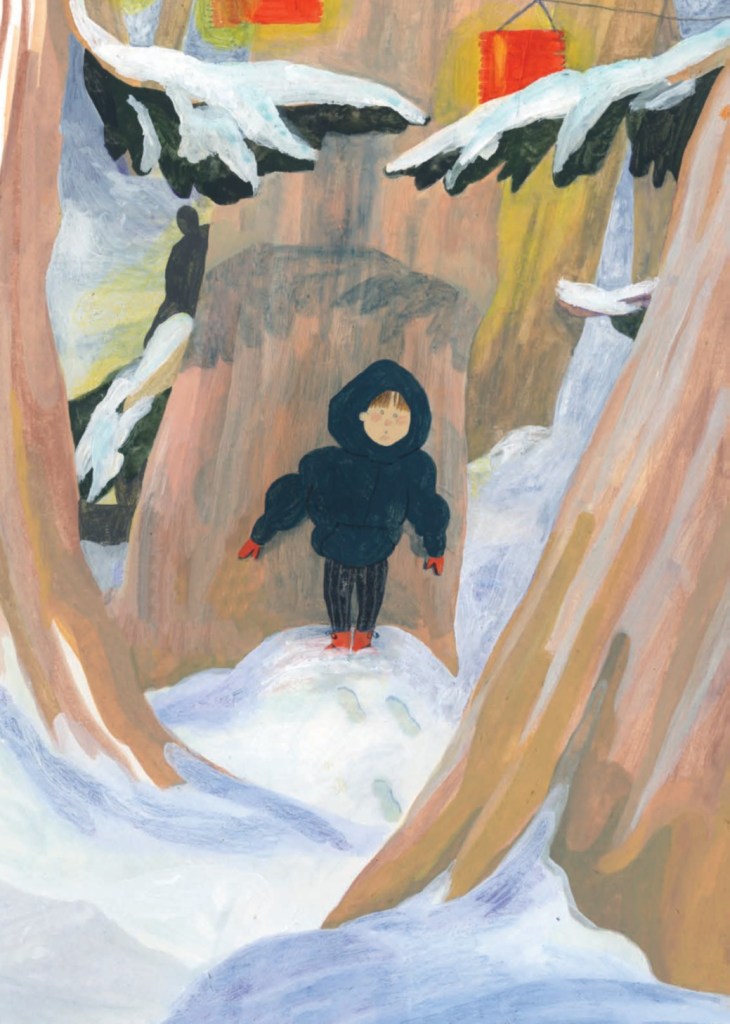
“Close your eyes,/said the moon” closes the story, and the child follows those instructions. Resting on his hair are dark silhouettes of animals, resembling the ancient beauty of cave paintings. I’m Afraid, Said the Leaf will offer new connections to the natural and human worlds each time you read it with a fortunate child.