Owl Writes by Candlelight

Cozy Winter Day – written and illustrated by Eliza Wheeler
Nancy Paulsen Books (Penguin Random House), 2024

Here is another one of my many posts about past, imaginary, or longed-for snow (for example here and here and here and here and here and here). It also falls into the category of personified animals performing sweet, graceful, and productive tasks (Miguel Tanco is another master of this art).  Beautifully realized scenes of domestic interiors, as well as the outdoors also characterize this lovely new picture book by Eliza Wheeler (I reviewed another of her books for Jewish Book Council). Not only does an owl compose the story of her village by candlelight, but a hedgehog weaves baskets and a rabbit, who uses a wheelchair, paints at an easel.

The endpapers and the introductory list of characters immediately made me ask, where are the toys? I don’t mean this with any disdain at all! The brightly colored and detailed figures are reminiscent of the kind of traditional, non-electric miniature animals you can still find as playthings.  The Hopps family have names out of a mid-century t.v. sitcom: Bud, Dot, Sis, and Herb.  However, Herb is the artist with a disability, setting this story in the fortunately more realistic and inclusive present.  The beaver family is of Celtic origin, judging by their name, McPaddy.  An interesting choice was to include both Ms. Polly, a porcupine, and Otto and Una Heddle, who seem to be hedgehogs. 

The book’s plot is not the main point. Rather, it is the warm and harmonious community of creatures enjoying the winter.  In the Hopps’ family kitchen, Pop is frying up something delicious on an antique wood stove while Dad enters with a bag of groceries. The baby, sitting in his highchair, seems impatient, but not enough to make the parents frantic.  Otto the hedgehog “gathers bundles of yarn,” although it’s not clear if he is going to knit or if he is helping Una, who is bringing snacks.  All the animal parents are clearly nurturing.

The featured adjective in the title is “cozy,” and miniature spaces represent the essence of this quality. There are two pages explaining the characteristics of a “nook.” These small areas can be dedicated to different purposes: reading, painting, eating breakfast, or hiding.  Sometimes they are shared, but often they are places where animals can be quietly alone. On the other hand, Acorn Village requires a lot of labor, if you can apply that term to making paper chains and building with blocks, as well as pulling children on sleds and preparing food.  Consuming food is also a big part of life here.

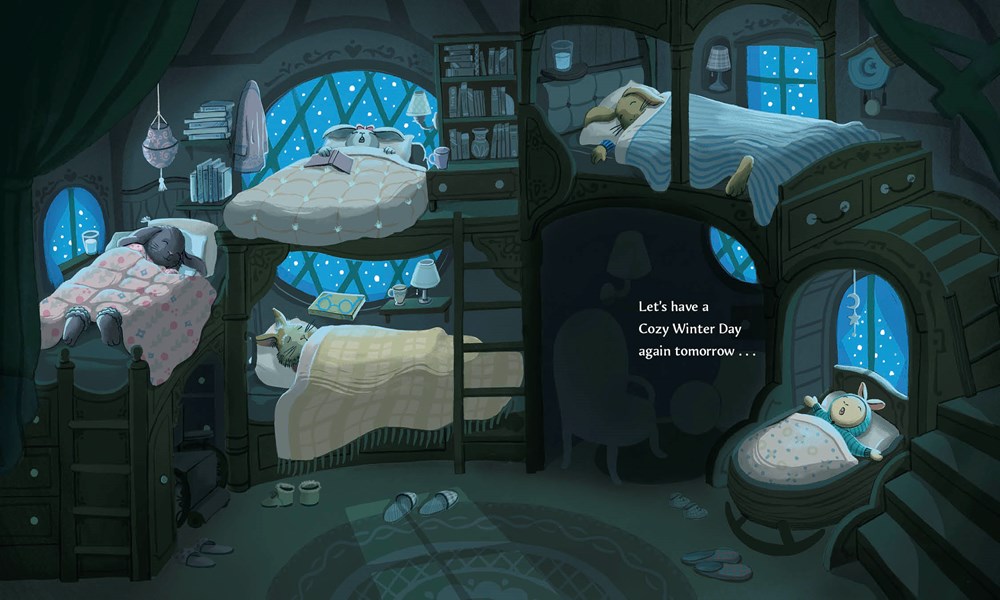
Everything in the book adds up to restful sleep. The bedtime scene is dark, with pastel-colored bedding and a blue and white starry night sky.  “Let’s have a Cozy Winter Day again tomorrow.” Capitalized letters make it clear that tomorrow will involve repetition of today. That reassuring quality is the point of living in Acorn Village.
Animals by the Numbers

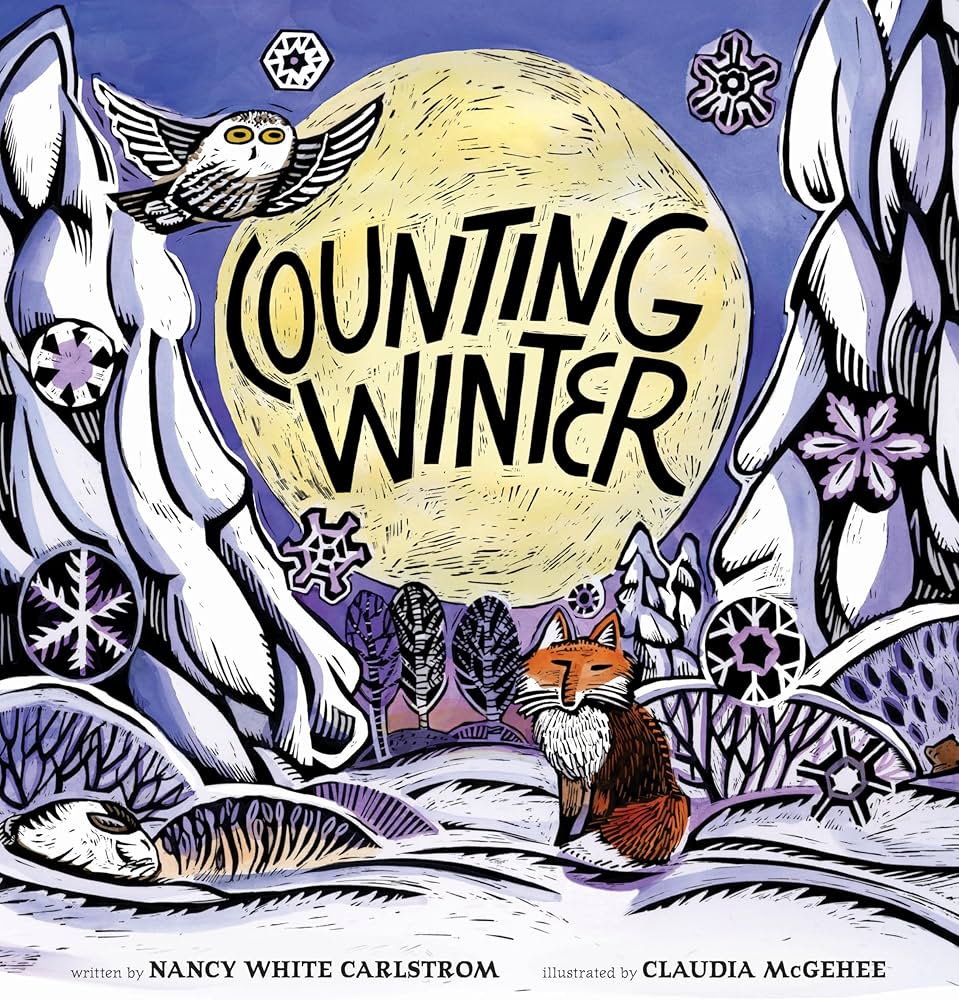
Counting Winter – written by Nancy White Carlstrom, illustrated by Claudia McGehee
Eerdmans Books for Young Readers, 2024

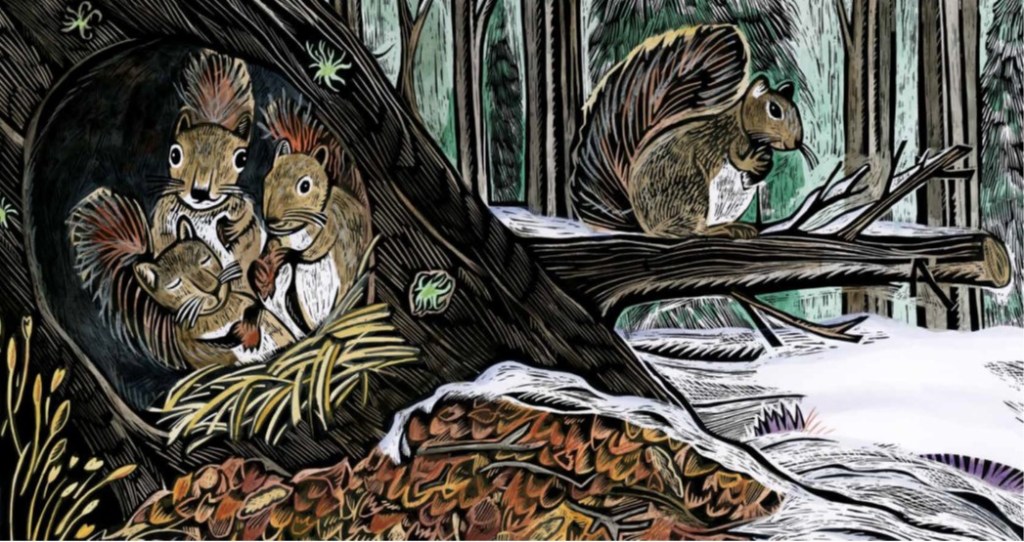
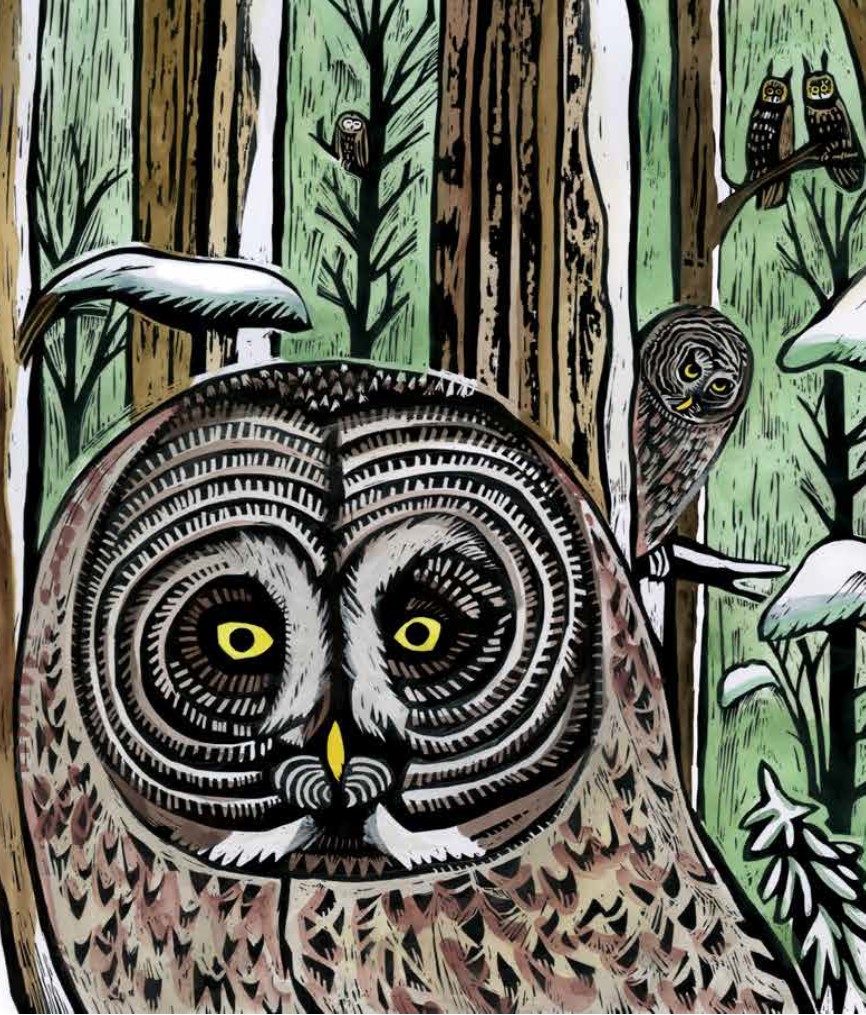
Nancy White has written more than sixty children’s books, including the Jesse Bear series about ordinary moments and their significance in the lives of young children.  In Counting Winter, she enumerates different animals who are native to the Alaskan environment where her children grew up.  Claudia McGehee’s scratchboard and watercolor pictures are both accurate and expressionistic, giving musk oxen, sled dogs, owls, and others a lifelike character. The book is a work of great beauty, both for children learning to count and for those way beyond that milestone.

The text has the illuminating power of Haiku, capturing snapshots of natural life. “Four red squirrels feast/ at their midden full of cones/hungrily/cracking winter.” The poetic resonance of the words makes this far more than an effective counting book. The use of “midden” defamiliarizes the scene a bit, inviting an explanation.  The squirrels are feasting, rather than just eating, and the metaphor of “cracking winter,” rather than nuts, elevates the tone without any pretension.

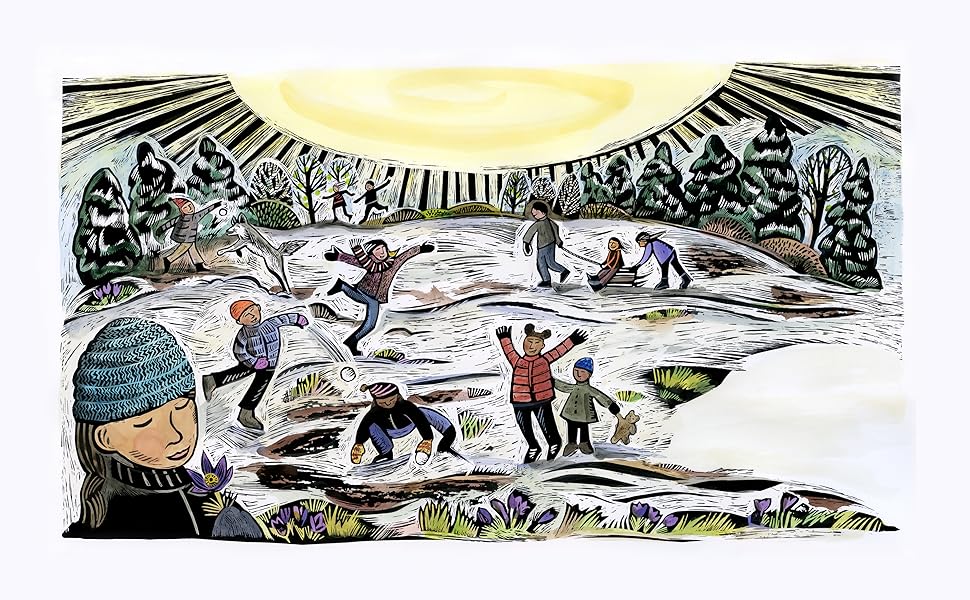
Personification of animals is appealing. McGehee’s applies this with subtlety. Her owl looks out at the reader intently, but definitely as the member of a different species. A sled dog races through the snow, his panting tongue and determined eyes could belong to a human runner. In the final two-page spreads, people enter the picture. They ride sleds and throw snowballs along with the wild creatures. One figure stretches her arms out to embrace the whole universe of winter.     Descriptions of the animals, as well as extended author’s and illustrator’s notes, shed light on the background and methods of the book’s creators.

They Came in Peace

We Are Definitely Human – written and illustrated by X. Fang
Tundra Books, 2024

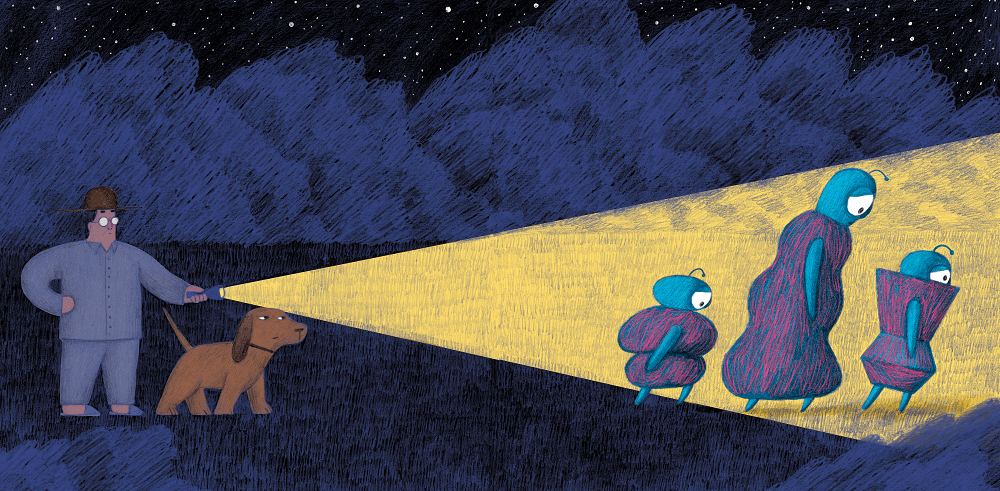
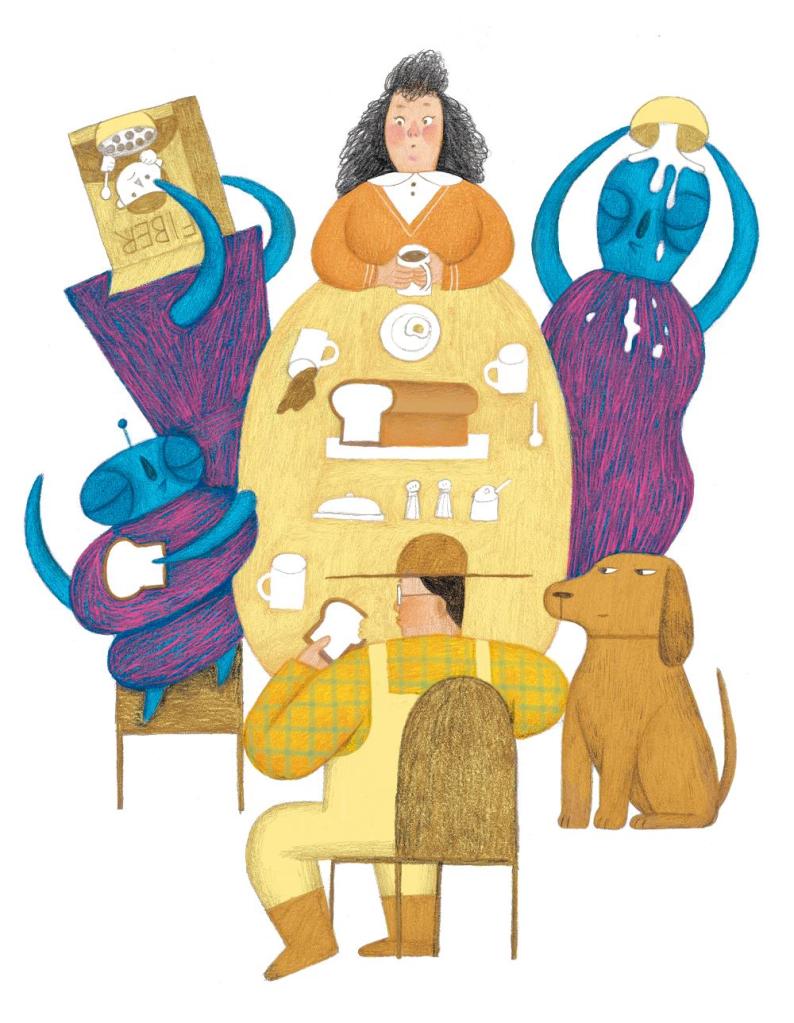
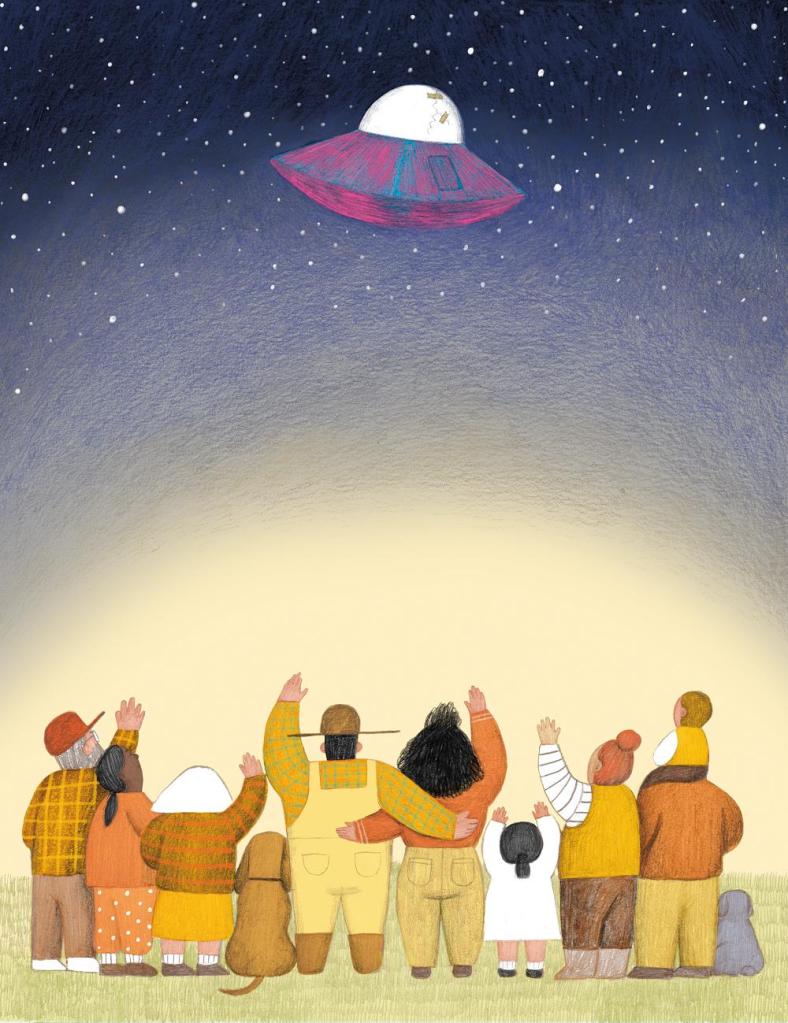
The creatures who surprise the unflappable Mr. Li in X. Fang’s newest picture book are definitely human. Well, sort of. They may look oddly dressed and their skin is blue, but Mr. Li is kind. When they offer a barely plausible explanation of who they are, he invites them in.  If you have read X. Fang’s wonderful debut book, Dim Sum Palace, you won’t be surprised at her humor, or her characteristically rounded people and objects peopling the tale.  When extraterrestrials land on earth, they are greeted by friendly and helpful inhabitants of the planet, who dance, eat, and help them fix their spaceship.  In the tradition of Laurent de Brunhoff’s Babar Visits Another Planet, and the work of Jon Agee, children learn that hostility and suspicion are misplaced.  We all have a lot in common.

Mr. Li is not completely irrational. When the strangers, clad in bubbles that look like the leftovers from a 1970s designer, first request help with fixing their “car,” he points out that the stores are all closed. They look bereft, and Mr. Li empathizes with them. Soon they, along with Mrs. Li, are sharing a breakfast. For visitors supposedly from Europe, they are not adept at handling utensils. Even the Li’s dog looks faintly suspicious.  In Fang’s illustrations, shapes, composition, and blank space can suggest anything from frantic activity to calm acceptance of a weird situation.

After breakfast, and some attempts by the “Europeans” to assume the personas of businessmen, athletes, and people who wear hats, it’s time for a visit to the General Store. Where is this store? It could be in Brooklyn, Portland, or Middle America. A burly guy in plaid shirt and a baseball cap, women with striped shirts and crossbody bags, and friendly cashier, are all busy shopping for their DIY projects.  If they notice that one of the strangers has placed a toilet plunger over his face, they are too polite to mention it.

The repetition of the phrase, “we are definitely human,” will appeal to children; how could adults possibly believe something so obviously untrue. But by the time the visitors leave in their vehicle, which has been repaired through friendly cooperation, the insistent reply begins to make sense. On the ground, their new friends stand together and raise their hands in a warm farewell.  Even if the odd crew who came out of nowhere aren’t just like their hosts, they share enough qualities to understand one another.

Woman of Heart and Mind

Joni: The Lyrical Life of Joni Mitchell and illustrated by Selina Alko
HarperCollins, 2020

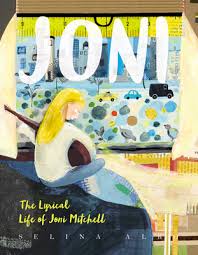
When Roberta Joan Anderson, eventually known to the world as Joni Mitchell, was in school, she had an inspiring English teacher. Mr. Kratzman advised her to approach her writing as she did her visual artworks: “If you can paint with a brush, you can paint with words.”  Selina Alko’s picture book biography of Mitchell embodies that principle in both its text and pictures, which are inextricably linked in this voyage through the singer and composer’s life and work. The author/illustrator and her subject are perfectly matched, making her book accurate, illuminating, and a stunning work of art in itself, as are her earlier books.

Combining acrylic paint and collage, including found objects, Alko creates a complete vision of Joni’s (as she refers to the singer), early life and subsequent development as an artist.  The young Joni is identifiable as the mature woman, and the elements of both “heart and mind,” as one of her memorable lyrics, are intertwined.  First we see Joni as a young girl on the prairie of western Canada, dancing to the sound of birds. Her parents stand in the background, and a train, composed of geometric shapes, collage elements and stamps, passes by.  Every page frames Joni’s life in this inventive format, each object attracting the reader’s eye with a specific relevance to the narrative. A bird’s-eye view of Joni playing the piano shows both her hands and the top of her head, which is crowned with a helix of words, notes, and ink-like spots.

Joni recovers from the childhood scourge of polio. She listens to Pete Seeger and Elvis Presley, attends art school in Calgary, and performs in coffeehouses.  Alko does not omit her failed marriage to folk singer Chuck Taylor, but she chooses not to discuss the painful decision Joni made to give up her daughter for adoption. Nevertheless, this trauma obliquely appears in a picture of Joni writing the lyrics to “Little Green” in dark, bold pencil. Alko could not have referred to every formative experience in her subject’s life, yet she is committed to acknowledge as many of them as possible.

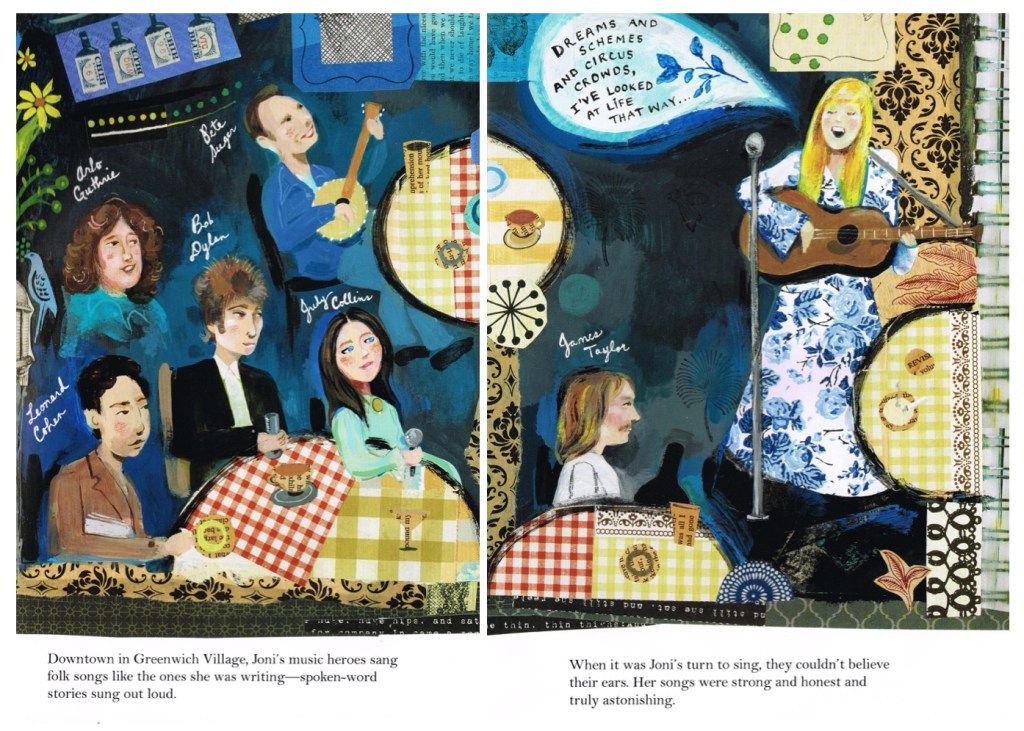
The two pages that chronicle the genesis of Chelsea Morning are another example of this fidelity. Everything is there: the butterscotch curtains, the traffic, the bowl of oranges. You can practically smell the incense.  When Joni performs in Greenwich Village, there are cameos of Leonard Cohen, Judy Collins, Bob Dylan, and other engrossed listeners. Here is your chance to explain to children who these great innovators are.  It will not be difficult to convince kids that listening to Joni “helped people feel understood,” or that, when her fans demanded her older style rather than experiments in jazz, “Joni didn’t care.” 

Alko includes a discography, bibliography, and a thoughtful author’s note explaining why she was drawn to write and illustrate Joni. The result is an explosion of color and poetry, along with a meticulous record of Joni Mitchell’s legacy. This book is for children, teens, and adults.

One Human and One Bear

Hiro: Winter and Marshmallows – written and illustrated by Marine Schneider, translated by Vineet Lal
Eerdmans Books for Young Readers, 2024

Two creatures from two different species are initially afraid of one another, but later make friends. A book needs to be innovative to stand out in this category.  Marine Schneider (no relation), using carefully selected words beautifully translated by Vineet Lal, conveys the mutual hesitation of both boy and bear, neither one unwilling to break rules.  Her striking images, rendered in colored pencils, watercolors, acrylic paint, and markers, accompany the words, but also operate as silent scenes full of impact. The parallel emotions of Émile, the boy; and Hiro, the bear, are familiar to children and evocative to adults, as well.

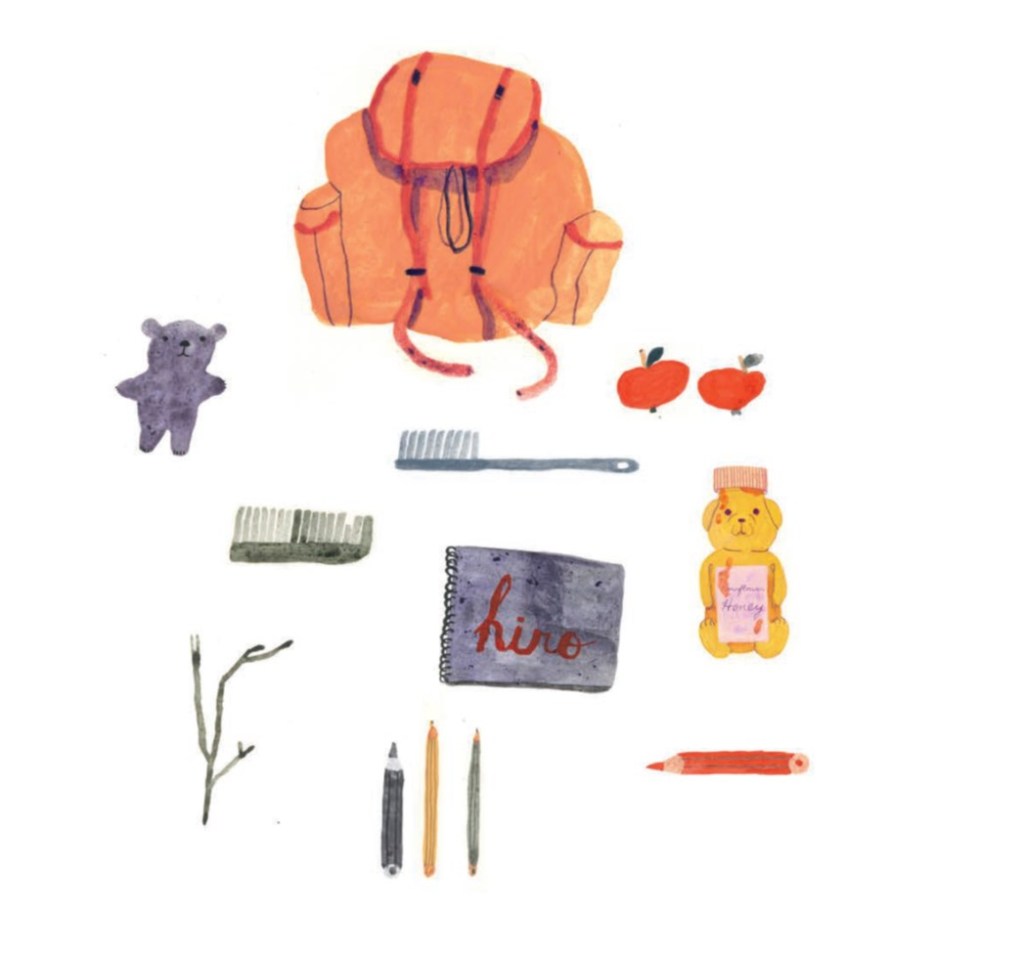
The title page features a backpack sitting in the snow, hinting at the outdoors, the articles both characters carry, and the needs they have in common.  Hiro’s large family is full of enthusiastic hibernators, but she is dissatisfied at the idea of endless sleep. Her mother, as mothers will do, warns her of dangers, but Hiro decides to take her chances.  Although she “isn’t the kind to disobey,” even compliant children, and bears, find within themselves traits that they had not suspected. Soon Hiro is packing her backpack with honey, pencils, and a comb.

Hiro uses all her senses to observe the world around her. Tracks in the snow, noises, and the smell of wood and marshmallows, lead her to a clearing.  At this point in the story, three wordless two-page spreads show a changed world. With all the activity of a painting by Brueghel, the pictures pull readers into an immersive scene of play in the snow.  Young humans are toasting marshmallows and enjoying the icy cold, but then they flee, leaving a space littered with objects left behind. Fear has changed everything.

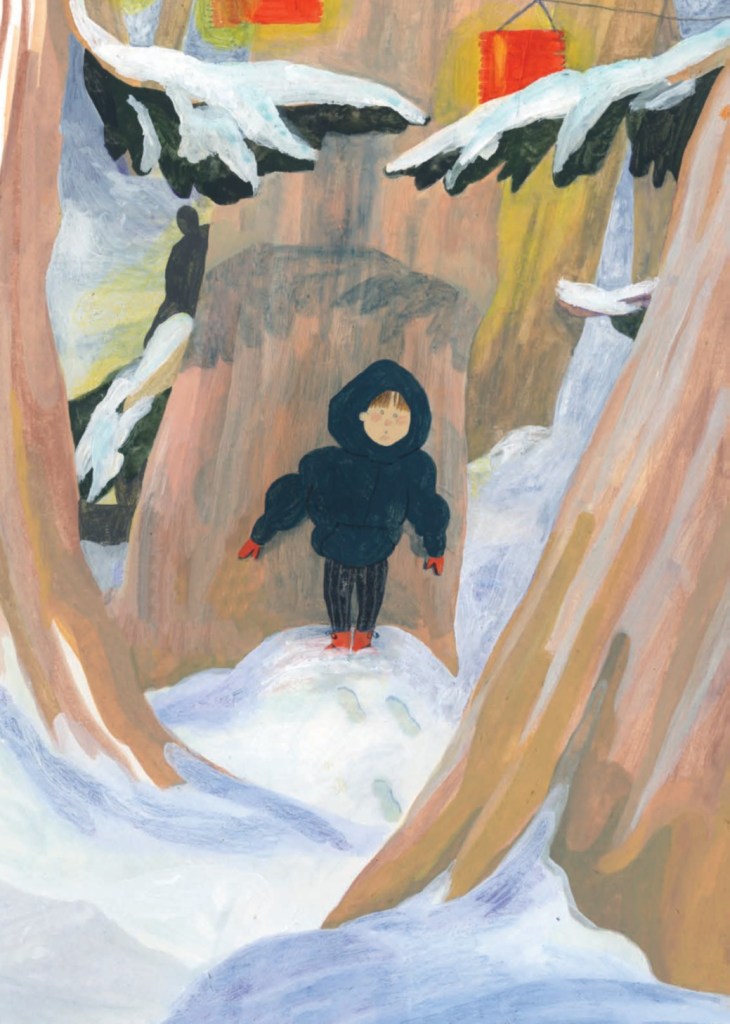
Émile stands behind a tree, a small boy in a black snowsuit with bright red mittens and boots. Although he has some trepidation, he is curious, and assures Hiro that he is “a marshmallow expert.” The two begin to converse about the most basic, and profound, idea: what is it like to be a bear, and also to be an Émile. Note that Hiro’s question is not generic. After all, Émile may be unique, or representative of all the other children who disappeared.

Schneider varies the scale of her images.  By the time they have become friends, Émile looks larger, and Hiro, enormous.  They are happier, having stepped outside their boundaries and connected. The blazing flames of their campfire rise high. Eventually, they return home, to the security of family and sleep.     


Lights in Autumn

Garland of Lights: A Diwali Story – written by Chitra Soundar, illustrated by Amberin Huq
Bloomsbury Children’s Books, 2024

Garland of Lights using a counting book format to inform readers about the essentials of Diwali, the Hindu celebration, shared by some other Asian religions, that commemorates the end of the summer harvest and the transition to a new season.  The intergenerational emphasis, lush colors by Amberin Huq, and enthusiastic text by Chitra Soundar, will resonate with young readers, whether they are already familiar with the festival or come to the book with little knowledge of Hindu observance.

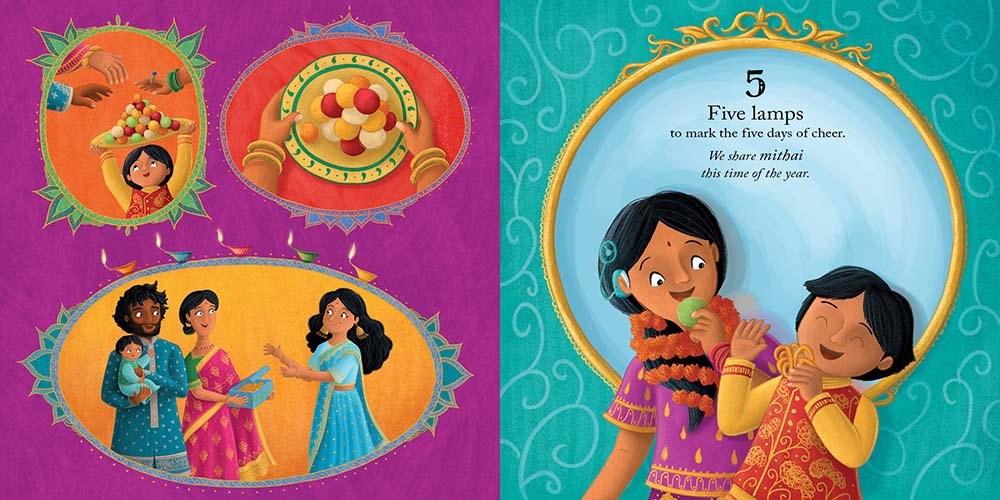
Each two-page spread begins with a numeral and a number of lamps associated with one aspect of Diwali.  Italicized text emphasis an important concept in terms accessible to children.  The first lamp represents the goddess of wealth, and her significance in offering blessings of wisdom and health. Three lamps signal a personal and communal obligation to heal conflicts. Seven lamps remind readers of hospitality, and eight lamps correspond to the festive fireworks display lighting up the night.  The book’s backmatter includes and essential explanation of the festival and a glossary; adults might choose to share this with children before beginning to read the book.

Light is the central concept of the book, and the illustrations reflect this in bright jewel tones. Different skin and hair colors of the holiday’s celebrants, as well as the broad span of ages, make an appealing package. The overall effect of turning the pages, reading the words, and enjoying the images, adds up to immersion in the festival’s multifaceted practices.
In the scene for six lamps, the rangoli, floor decoration, crosses the book’s gutter, and displays the lamps. Each lamp is separated from the others by enough space to emphasize its difference.  Babies, children, and young and old adults span the picture in a semi-circle; like the lamps, each person’s clothing is a different bright color. The grandmother’s deep red dress is surrounded by emerald-green, sky blue, and magenta outfits of her family members.

The holiday of Diwali encompasses a number of seasonal, religious, and historical events and beliefs.  A Garland of Lights strings together and illuminates several of them with graceful words and pictures.

Sisters vs. Goblins

Into the Goblin Market – written by Vikki VanSickle, illustrated by Jensine Eckwall
Tundra Books, 2024

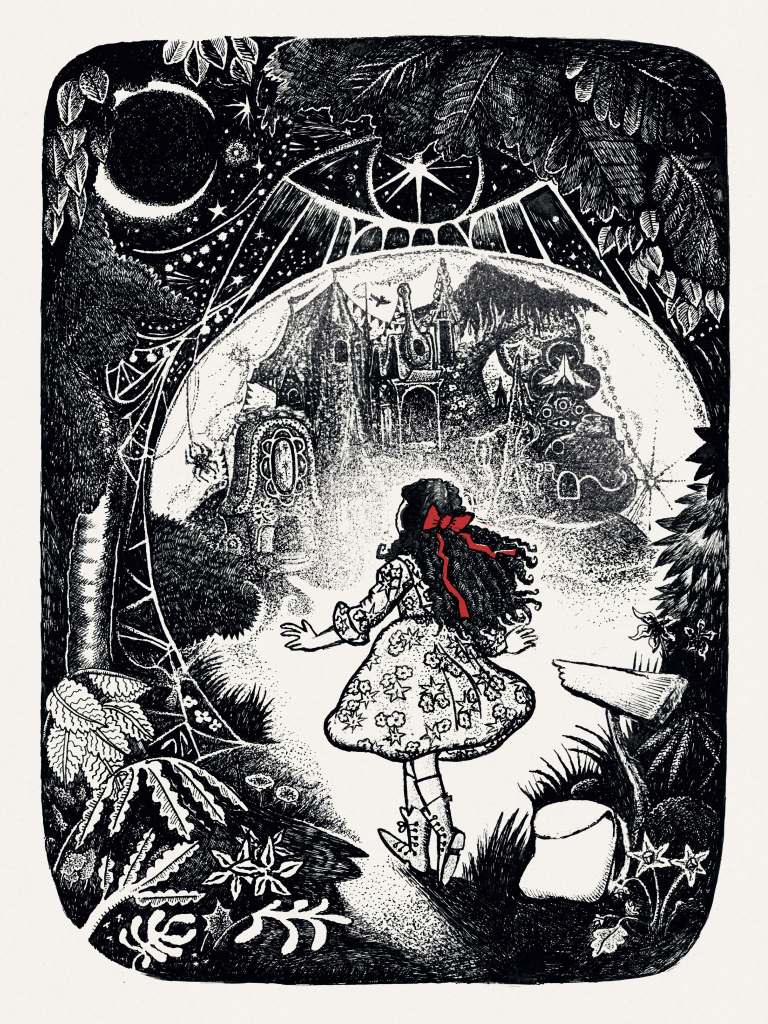
Into the Goblin Market is not a young reader’s version of Christina Rosetti’s (1830-1894) provocative poem, but the picture book is an imaginative response to that work. Even if you knew nothing else about this fantastic, in both senses of the word, work, you would have to be impressed at the choice of this literary homage.  But Into the Goblin Market stands out all on its own.  Two sisters, Mina and Millie, use the strength of their unbreakable bond when Mina disappears, perhaps to be consumed by malign forces.  Millie, confronting the supernatural terrors of classic fairy tales with an undertone of Rosetti’s feminist poem, rescues her beloved sibling and they return home. The poetry is hypnotic, the pictures are stunning, and the sisters are undefeated through their love.

On the cover, (link to image) in Jensine Eckwall’s ink-drawn and digitally edited, illustration, Millie is seated in an alcove reading a book, while Millie looks down on the scene, as if thinking of ways to escape.  As Vikki VanSickle writes with concision and humor, “Millie’s manner was reserved/but Mina had a lot of nerve.” Those qualities set the scene for their adventure.  While her sister is sleeping, Mina leaves the safety of their farm, and stumbles on the land of the goblins, where she will disappear. Their tempting sales pitch works on a girl eager for change, but their high-stakes words contain an implicit warning: “Make a choice and make it quick!/Make it while the magic’s thick.”

Meanwhile, back in their home, Millie is awakened by a dream that communicates her sister’s flight.  With visions of goblins making her uneasy, she looks for Mina but does not find her.  The interior of their house, like every scene in the book, is rendered in black with deep red touches highlighting elements of importance.  Millie looks through a window from one bedroom to another, her face and upper body surrounded by a jagged red halo. Downstairs, a red cloak, alluding to familiar fairy tales, hangs on a hook. A bookish girl, she naturally turns to her books, searching through them for resources on how to rescue her sister.  Finally, it is time to take action and she assembles the tools for her journey: “She took some wool, a crust of bread/and donned her cloak of crimson red.” 

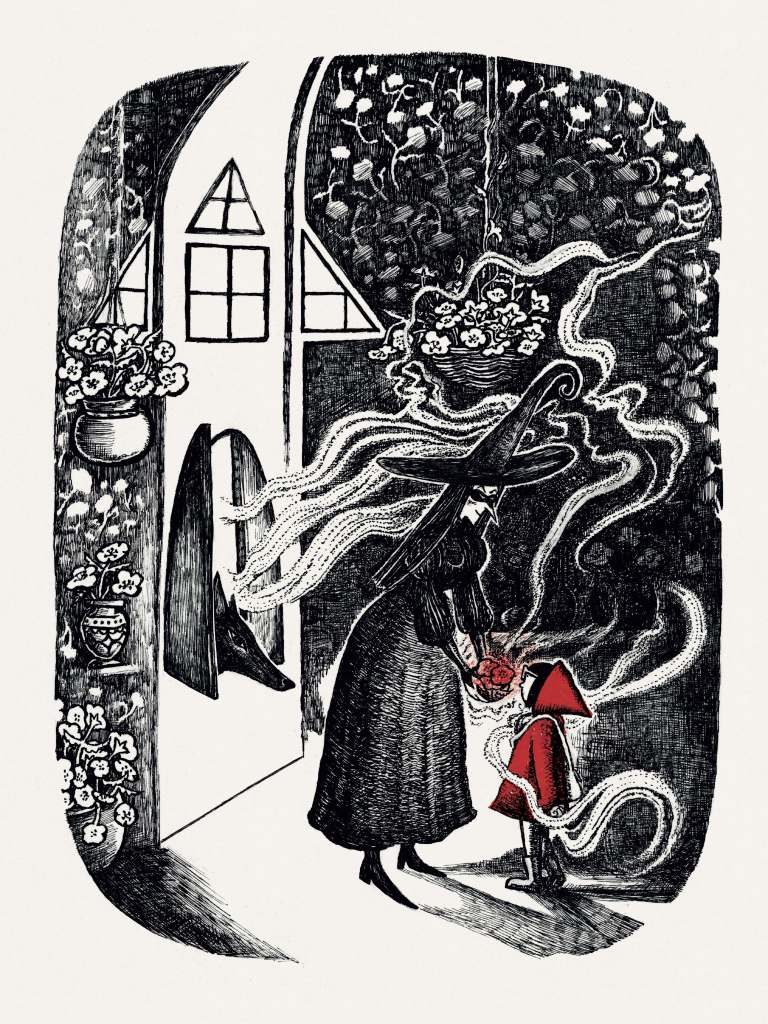
VanSickle employs the language of classic folklore without resorting to overt imitation. Her images, too, recall this literature, but take the form of eclectic blends.  A tall witch-like figure hands a bouquet of red poppies to Millie, wearing her red cloak.  Emerging from the figure’s home is the elongated face of a wolf.  Those poppies are as potent as a poison apple, and soon Millie’s “consciousness began to drift.” 

Finally, the sisters are reunited. They sit together in a bed of flowers, surrounded by the comforts of nature and the knowledge of Millie’s bravery has saved their lives and relegated goblins to the past. But without Mina’s urge to challenge boundaries, there would not have been a book.

Enjoying Coffee Together

It Is Okay – written and illustrated by Ye Guo
Eerdmans Books for Young Readers, 2024

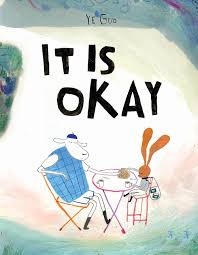
Goat and Bunny, who are simply named but hardly generic characters, enjoy more than just coffee. They are best friends, although their personalities are different.  They complement one another, accept the ways they are not the same, and understand that changing each other is definitely not a good goal. It is okay to be who they are.  Ye Guo’s words are reassuring in their simplicity, and her pictures, composed in pencil, colored pencil, wax pastel, watercolor pen, ink, and collage, are perfectly balanced and exquisitely detailed.  From the plaid endpapers to the relaxing meal together surrounded by books, sweetened coffee, and grass on toast, their friendship is one for both children and adults to admire.

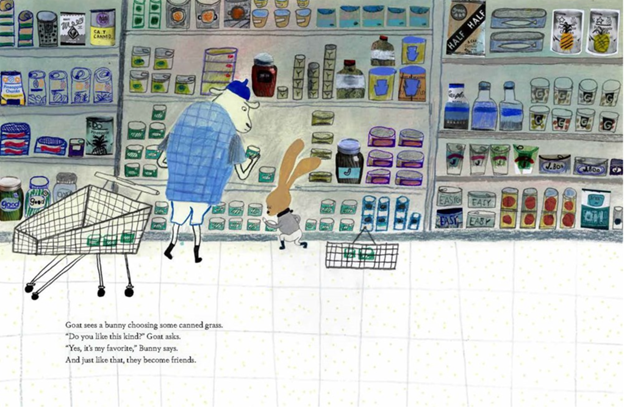
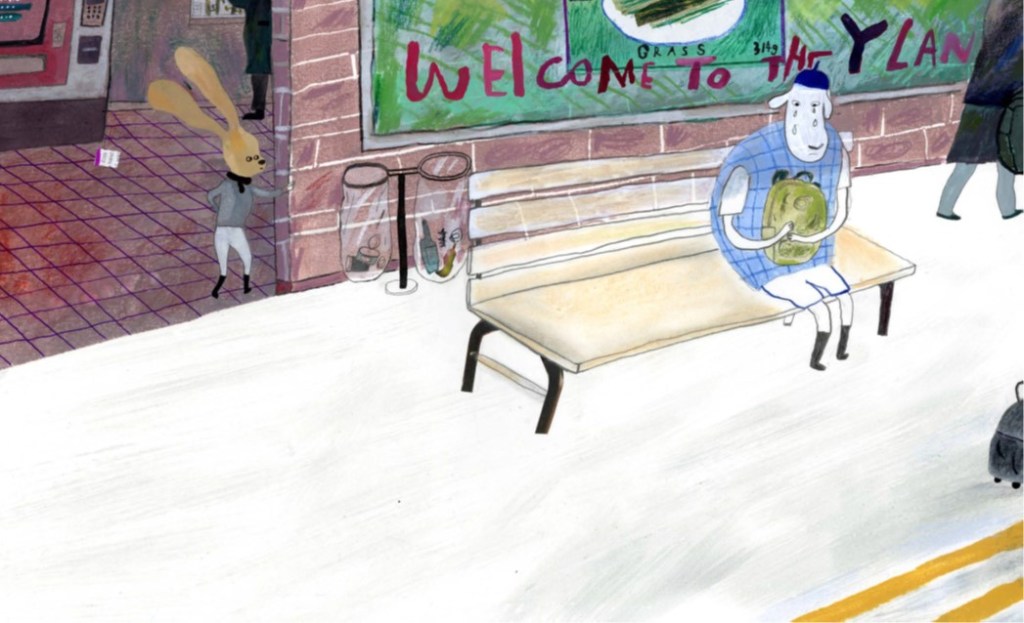
They meet in the supermarket, a visit prompted by Goat’s realization that he is out of canned grass, which he always eats on toast. We meet him with his back turned, crouching into the cabinet from which he has pulled out a number of foods, none of them canned grass.  The two-page spread of the spacious room is a delight, with perspective provided by the angles of the furniture, and each item carefully drawn, colored, and set against either white space or an appropriate surface.  Subdued greens and browns are punctuated by the bright red on a label. Goat’s outfit is deep blue windowpane plaid. Children will focus on the intricately rendered objects: a slice of bread with a slash of dark green for the grass topping, a picnic blanket with a long loaf crossing the book’s gutter, Rabbit happily carrying a tray with two coffee cups to share with Goat.

At the supermarket, the foods are neatly laid out on shelves.  Goat asks Bunny for advice about canned grass, and “from that day onwards,” that food becomes a connection between them.  They also like the same coffee shop.  But in so many ways that seem more fundamental than food brands, they would not seem like kindred spirits.  Guo keeps explanations to a minimum.  Disagreeing about how much sugar to put in coffee, they still both find it “delicious.”  Bunny has trouble navigating the outdoors, and Goat becomes anxious when they miss their train.  Sitting in the station, he is terrified, and clutches his backpack. Bunny waits patiently, standing off to the side to avoid embarrassing his friend.  “But it is okay, because they can always catch the next train.” The Zen-like repetition of the words in the title confirms that idea, without unnecessary elaboration.

The final words of the book are its essence. “But it is okay.” The sentence isn’t followed by a “because;” by this point, children know why it is okay to be friends with someone different.  No because is needed. 

Audrey

Audrey Hepburn – written by Emily Easton, illustrated by Ellen Surrey
Golden Books (Penguin Random House), 2024

As you may know, while Golden Books still publish their classics (such as Daddies, or The Seven Little Postmen), they have added many other different subjects, which appear at an astounding rate (for example, here). Tony Bennett, Taylor Swift, Carol Burnett, Dolly Parton, Simone Biles, and Ruth Bader Ginsburg all have their own gold-spined mini-biographies. I used to think I was a Golden Book completist, but I can no longer say that is true. I’m limiting myself to books whose subject attracts or inspires, and those with decent to good illustrations. (I may have to compromise when those two qualities are in conflict. Since I love Audrey Hepburn, I had to write about this one. (Some other examples are here and here and here).

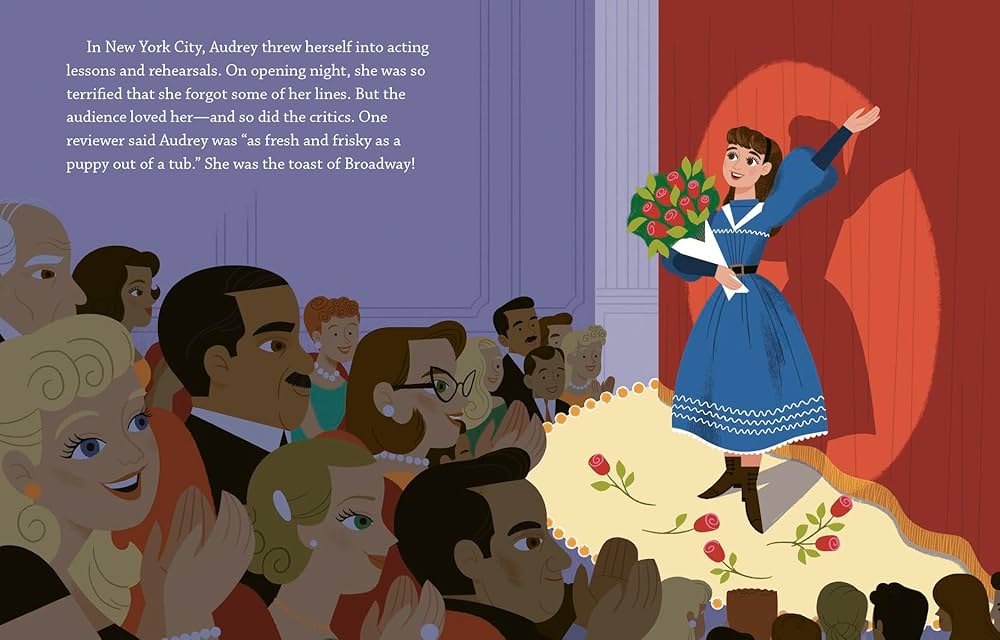
It’s impressive how much biographical information these slim books include. Readers learn about her ancestry. Did you know that her father claimed a distant connection to Mary, Queen of Scots? The book, written by Emily Easton and illustrated by Ellen Surrey, details Audrey’s abandonment by her father, her training as a dancer, and her family’s deprivation during World War II. Although she is best known as a film actress, there is a scene where she meets Colette, who personally insisted that Audrey be casted in the original stage production of “Gigi.” Even her Tony Award for “Ondine” finds its way into the book! The text is punchy, with a tone of excitement when Audrey works for the Dutch Resistance, becomes “the toast of Broadway,” and becomes a fashion icon. “Women wanted to dress just like Audrey! And her style is still beloved today.” So true.

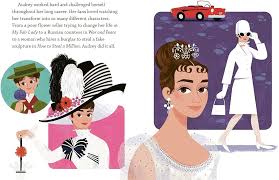
Of course, her cinematic fame follows, including “My Fair Lady,” “How to Steal a Million,” and “Breakfast at Tiffany’s.” After retiring from her acting career, Hepburn dedicated the rest of life to working on behalf of the world’s children, principally with UNICEF. If you assume that the book’s expected audience are adults, you’re probably right. There is definitely a nostalgia component of grownups who remember reading The Poky Little Puppy and would love any story that comes in this container. Nevertheless, Golden Books do offer an opportunity to introduce children to unfamiliar figures and cultural products that are not Disney. (Many of the Disney Golden Books are, by this time, classics.)

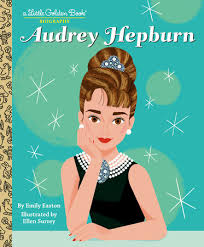
Audrey is on the cover in her little black dress and pearls from Breakfast at Tiffany’s. In the World War II section, she wears a plaid dress and a lavender scarf as she gladly accepts chocolates from an American G.I. He is down on one knee as he presents them, as if proposing marriage. Well, she is Audrey! Scenes from Funny Face show case both her gorgeous Givenchy gown, and the classic black turtleneck and cigarette pants with white socks worn for her Beatnik-inflected dance number. It will be fun to explain the cultural significance of these to the children sharing the book with you.

As the book tells reader, Audrey had two sons, although “her marriages to their fathers didn’t last.” But the author’s upbeat interpretation links her devoted care for her own children with her activism in children’s causes: “Audrey used her star power to draw attention to their needs.” That sunny sentence is consistent with the whole idea of Golden Books, but it’s also true.

Everything is Different

A Star Shines Through – written and illustrated by Anna Desnitskaya
Eerdmans Books for Young Readers, 2024

Anna Desnitskaya, an accomplished author and illustrator (see my earlier review here), became a refugee when Russia invaded Ukraine.  She has written an important book, a work of great beauty and simplicity about what it means to be uprooted from one’s home.  Even if the book were not illuminated by beautifully minimalist words and images, it would still matter. It would still succeed as a human document. However, its outstanding effect is inseparable from its haunting tone and careful composition.   A Star Shines Through is worth your time, and a space on your own bookshelf and that of your school and library.

In her author’s note at the end of the book, Desnitskaya explains its origins. She and her family were on vacation in Cyprus when they learned of the brutal attack on their country.  Their home in Moscow, epitomized by the large star-shaped lamp that hung in their apartment’s window, would no longer be their lives’ anchor, as they fled to different places of, perhaps temporary, refuge.  Standing within a beam of white light on a dark street, mother and daughter shelter under an umbrella.  The residents of a foreign city speak a different language; the word bubbles above their hands are filled with incomprehensible white swirls.

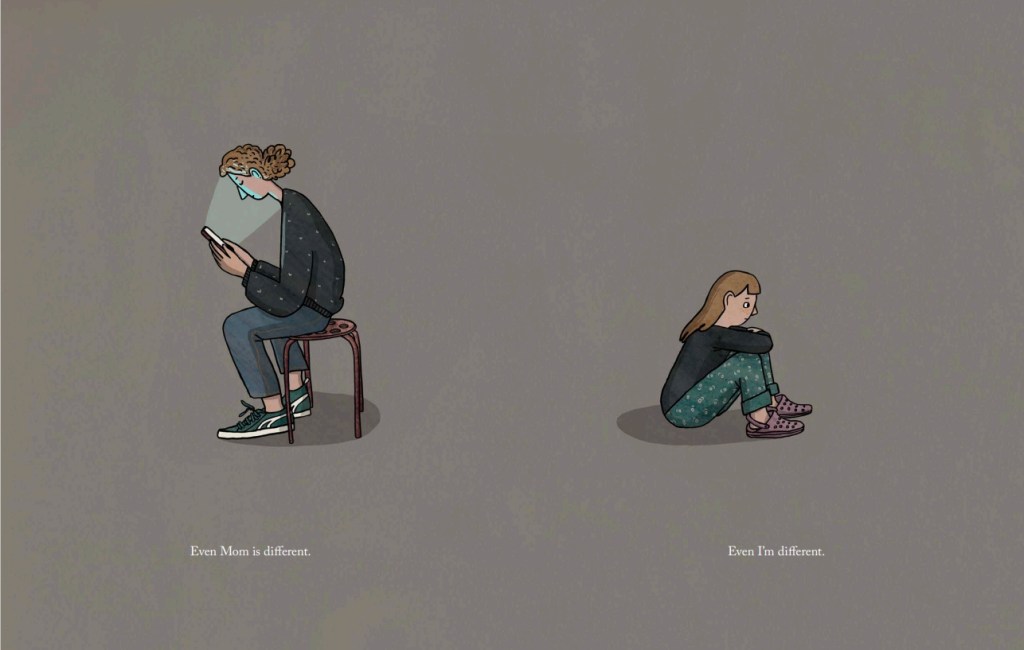
Each picture is a portrait of disconnection.  The girl sits on a windowsill looking out at the darkness while holding a book. The smiling family who, after all, still have one another, eats around a table, but the text reveals a great deal in the one phrase, “Different food.” Even people themselves are not the same.  On facing pages, the mother and daughter look in opposite directions as the adult stares at a cellphone and the girl sits alone, contemplating the fact that “Even I’m different.”  Desnitskaya does not attempt to elaborate on these thoughts, which convey both sadness and dignity.

Then they make a star.  A similar star appeared in earlier scenes, but perhaps it is a ghostly memory of the one in Moscow. Now they create a new one; when they display it in the window, it transforms everything.  Although their star cannot replace their old life, it partly restores what seemed to have been lost completely. An ice cream truck on the street and its string of bright lights indicate that their new home is welcoming. The foreign language that surrounds them begins to make sense.  Mother and daughter sit under the star together, accepting that nothing is the same, but everything is better.  Shades of blue contrast a busy apartment building against the darker night sky, but the gold star in the upper window holds our attention.  Even if you have shared other books about the refugee experience with the children in your life, this one fills its own niche.  Communal support, gradual acceptance of change, and acknowledgement of sadness coexist in this honest portrayal of one family’s upended life.