Mona Hasan Spells It Out for All of Us

The Secret Diary of Mona Hasan – Salma Hussain
Tundra Books, 2022
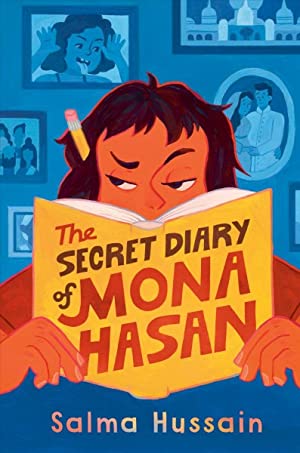
Mona Hasan’s diary may be secret, but Salma Hussain’s novel should not be.  This book, for middle-grade, young adult, and adult readers, surprised me on every page. When I started to read it, I expected another entry in the burgeoning field of novels about smart, imaginative girls struggling to find their place in a specific world.  Sometimes they find the process more painful, while other heroines are optimistic and full of joy. They are from many different cultures, races, religions, and nationalities, and these differences differentiate them from one another, with more or less nuance.  The Secret Diary of Mona Hasan begins with this template, but its originality and authenticity place it in a different category. It is a truly sophisticated work of literature that transcends its category. 

Mona lives in Dubai during the 1991 Gulf War when the book begins. Her parents are originally from India and Pakistan. She has a younger sister, Tutoo, who is the cause of annoyance and also the object of her protective love.  Mona attends a progressive school for Muslim students; its headmaster tries valiantly to promote equality for girls while not falling afoul of conservative religious standards. Mona’s mother is a frustrated feminist, and her kindhearted father goes to work in his financial job every day with paradoxical goals. Affluence is important to him, and yet, he is as unfulfilled as his wife: When Tutoo asks him why he is paid so much ‘to look at numbers all day,” replies, “No one would do this job otherwise.”  Mona is caught in a vortex of hypocrisy. No wonder she confesses all her doubts, confusion, and anger to her diary.  But she is also sharp, clever, bold, and ironic.  She has a strong sense of class consciousness, an acute awareness of prejudice, and a conviction in her unique strengths.

Describing the plot of Hussain’s book doesn’t do it justice. Her language, sometimes mildly funny and lighthearted in other books of this genre, is explosively honest. Mona’s New Year’s resolutions include both “I will save a life from danger!” and “I will occasionally make my own lunches for school.” Aware of her record of academic excellence, Mona sometimes spells out words, as well as the concepts that drive her life: Her parents will hear “gushing accolades —–a-c-c-o-l-a-d-e-s” from the teachers who are fortunate to instruct her.  When a word, such as “SLUTS,” is unfamiliar to her, she concludes that it must be misspelled.  Will her pride and confidence lead to eventual disgrace? Actually, no. Mona will never suffer the consequences of uppity women and girls that she reads about in other books, such as Jane Eyre, even within a culture which bombards her with oppressive messages about her gender.  In fact, she will take what she finds best about that culture and include it in the formation of her character. Her thought processes about both choosing to wear a head covering and later rejecting one are typical of Mona’s sense of empowerment, not thoughtless rebellion.

Mona refers to books several times, including to the popular series of British novels beginning with The Secret Diary of Adrian Mole, Aged 13 ¾.  Although she never mentions Judy Blume’s pathbreaking Are You There God? It’s Me, Margaret , it is inevitable to compare Mona’s urgent appeals to Allah to Margaret’s poignant conversations with God, about everything from puberty to her confusions about her religious identity.  Mona’s exasperation is more pointed than Margaret’s. When her father asks Mona to help her mother more in the kitchen, she naturally asks him why he cannot pitch in.  His reaction to this idea as “ridiculous,” because he is a man leads Mona to ask Allah, “Isn’t it this world that You’ve created, that is completely ridiculous?”

Mona is not just an angry iconoclast. Her father is not a parody of male foolishness. Her mother is not hopelessly subjugated. No one in the novel conforms to facile stereotypes.  Yes, at one point Mona concludes that both her parents are “feeble,” but she eventually comes to understand, and even appreciate, the forces that have made them who they are.  When the family emigrates to Canada, Mona’s father suffers displacement and loss of status, and her mother continues to experience depression. They both adapt to change.  Hasan’s characters develop within a believable range, while still challenging the reader’s expected trajectory for their lives.  Watching the movie Aliens with her sister, Mona instructs Tutoo in the inspirational value of its tough female protagonist, “I pointed at the screen. ‘Look closely. We don’t have to play nice. Look at where anger can take us.’”  Anger, courage, self-awareness, and love all stand out in this remarkable book.
Claudia Meets a Kind-of Mean Girl

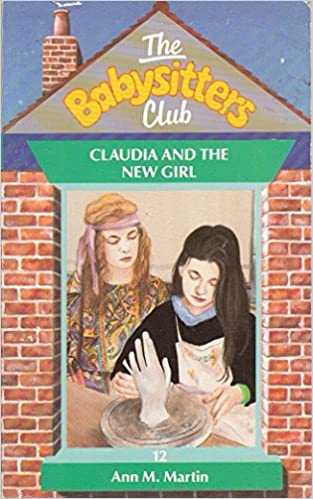
Claudia and the New Girl: The Baby-Sitters Club – by Ann M. Martin,
Scholastic Press, 1988

I recently read a fascinating collection of essays by and for adult fans of the Baby-Sitters Club books. (We Are the Baby-Sitters Club: Essays and Artwork from Grown-up Readers, Marisa Crawford and Megan Milks, eds., Chicago Review Press, 2021).  There’s a lot about gender, and some essays, inevitably, will appeal to some readers more than others.  Claudia Kishi appears in several of them, as a relatively unusual Asian American character in a children’s book of that era. 

Reading Claudia and the New Girl did not bring new respect for Ann M. Martin or Claudia, because I already had tremendous respect for both the real author and her fictional creation. But the book, from a series which includes something for almost everybody, made an impression from the first chapter. Martin brings in literary allusions, specifically about the Newbery Award for excellence in children’s books, in the context of Claudia’s challenges with academic subjects.  There is also a scary new girl in Stoneybrook who just might break up the Club. (There is also a graphic novel version, but I’m focusing on the original book.)

The first chapter sets up Claudia’s conflict.  (The second chapter, as always, reviews the Club’s genesis and its rules. It seems that some veteran readers skip this repetitious section, but I feel as if you have to read in each time to preserve the structure and renew your interest, and just prove your loyalty to the series.) Claudia is a “reluctant reader,” to use the educational euphemism, except for Nancy Drew novels. Her enthusiastic English teacher, Mrs. Hall, has designed a curriculum around novels that won the Newbery Medal. It’s a bit arbitrary, since some of those winners are not great, while other outstanding books never win the award. Claudia admits to having read only one winner, Sarah Plain and Tall, which, unlike its heroine, is short (58 pages.). Even though Claudia doesn’t like to read, she has revealed that one criterion for including a book in the curriculum has become brevity, a concession to lack of patience with big books. There are also references to The Westing Game, The Yearling, and A Tree Grows In Brooklyn.

Then Ann M. Martin, who obviously loves books, has Claudia mention the fact that E.L. Konigsburg’s From the Mixed-Up Files of Mrs. Basil E. Frankweiler features a heroine named Claudia (Kincaid).  Words from the novel show up on a spelling test, Claudia’s nemesis. Later in the book, when Claudia finally tackles Konigsburg’s Newbery winner (one of two, plus one Newbery Honor), she is uncharacteristically drawn into the story:

          I read until 5:15. The story wasn’t bad. After all, there was a girl named Claudia in it.

          Furthermore, this Claudia felt that she was a victim of injustice. When I looked up

          “injustice” and found out what it meant, I was pretty interested. I often think things

          in my life are unjust, particularly where school or my genius sister Janine is concerned.

Once again, Martin has managed what made her series an incredible success. She doesn’t patronize Claudia. She doesn’t minimize her problems. She allows her to sound like an actual kid.  She is attracted to the idea of “injustice” but not overwhelmed by it.  The book is, in her considered opinion, not bad.

Much of the rest of the book involves Claudia’s tortured relationship with the new girl, Ashley Wyeth.  Ashley dresses in hippie clothes, familiar to Claudia from “this bizarre movie called Woodstock.” Just like the image on the lovably garish cover (of the original edition), Ashley favors hiking boots, silver bangle bracelets, and long skirts. Claudia isn’t exactly making fun of her style; she wouldn’t do that. She is noting the discrepancy between who Ashley aspires to be and who she really is.  The girls of the Baby-Sitters Club are nothing if not sincere. Ashley is, as Holden Caulfield might say, something of a phony.

Of course, it’s not her fault.  Claudia gradually comes to understand how and why Ashley is manipulating her, and why she, Claudia, is vulnerable to praise from a girl who is a great artist, at least in her own estimation. Actually, she is good in other people’s estimation, too. When she wins an award for her sculpture of a hydrant, I felt disappointed. Why? Can’t people who aren’t nice create good works of art? I guess I learned that, along with Claudia.

By the end of the book, Claudia is back in the club, and all the girls feel secure to welcome Ashley, to their circle, if only to a limited degree.  She never breaks down, realizes the error of her ways, or becomes a baby-sitter.  It’s a wonderful, and almost inexhaustible, series.

Three Bears but Countless Stories

Professor Goose Debunks Goldilocks and the Three Bears -written by Paulette Bourgeois, illustrated by Alex G. Griffiths
Tundra Books, 2022

Like many folktales, the story of Goldilocks and the Three Bears seems inexhaustible. With so many different versions, from traditional to whimsical to ironic, it takes courage to introduce a new interpretation of this mysterious story.  Some of my favorites are Feodor Rojankovsky’s classic Golden Book, Valeri Gorbachev’s in which the father plays the violin and the mother wears earrings, Gerda Muller’s lovely and comforting one, and Byron Barton’s beautifully simple board book for the youngest readers. 

Now Paulette Bourgeois and Alex G. Griffiths have truly raised the bar with their combination homage and informational look at the little girl who appears out of nowhere and violates rules, only to disappear. 

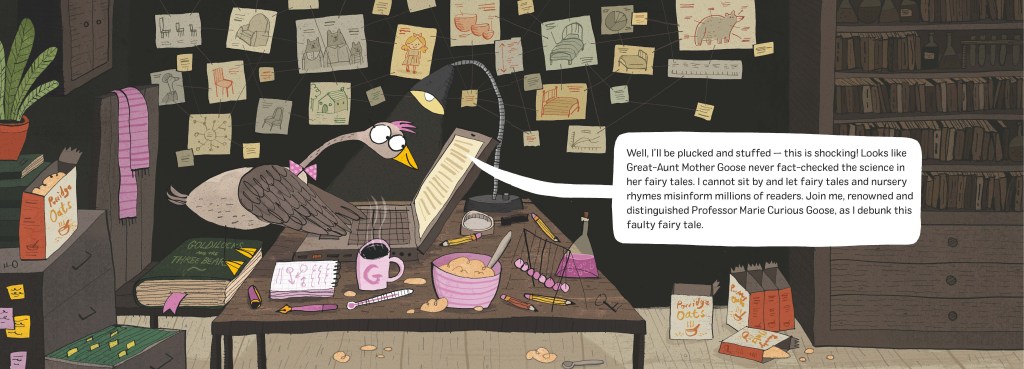
If you are skeptical at the premise, how much do you know about bear’s supposed hibernation through the winter? Maybe you need to be reminded about the fight or flight response.  Even if your child doesn’t yet know that bears don’t, in fact, “live in cottages with curtains on the windows,” adding these important facts won’t compromise their enjoyment of the story’s underlying drama.  In fact, children reading or listening to the book will relate to the way in which it bounces back and forth between two kinds of truth: factual and literary.  Expectations are both fulfilled and surprised when Professor Marie Curious Goose, her wings tapping on the laptop keys, gets to work on uncovering the hidden elements.

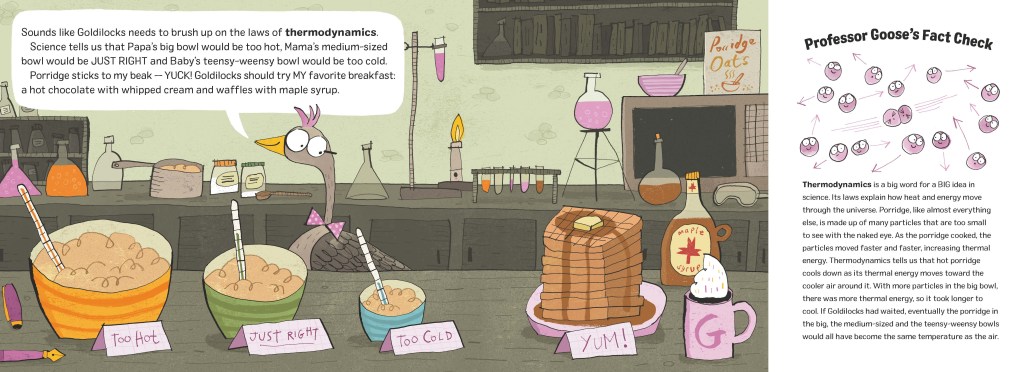
Bourgeois reassures readers that she is not going to divest the story of its “once upon a time” nature. In fact, the book begins by establishing what everyone knows: “Once upon a time, there was a papa bear, a mama bear and a baby bear who lived in a cottage by the woods.”  The family lives in the forest but they’re dressed for the modern world, with Papa in a plaid shirt and Baby carrying a backpack. Professor Goose is annoyed at the prospect of bears living in cottages; she explains about natural habitats, and bears’ actual eating habits. For children, these interjections are both fascinating and funny. After a few pages, the method begins to make sense.  Watching Mama Bear cook porridge and learning a simple lesson in thermodynamics makes the narrative work on different levels at the same time, which is the way in which they experience their own world.

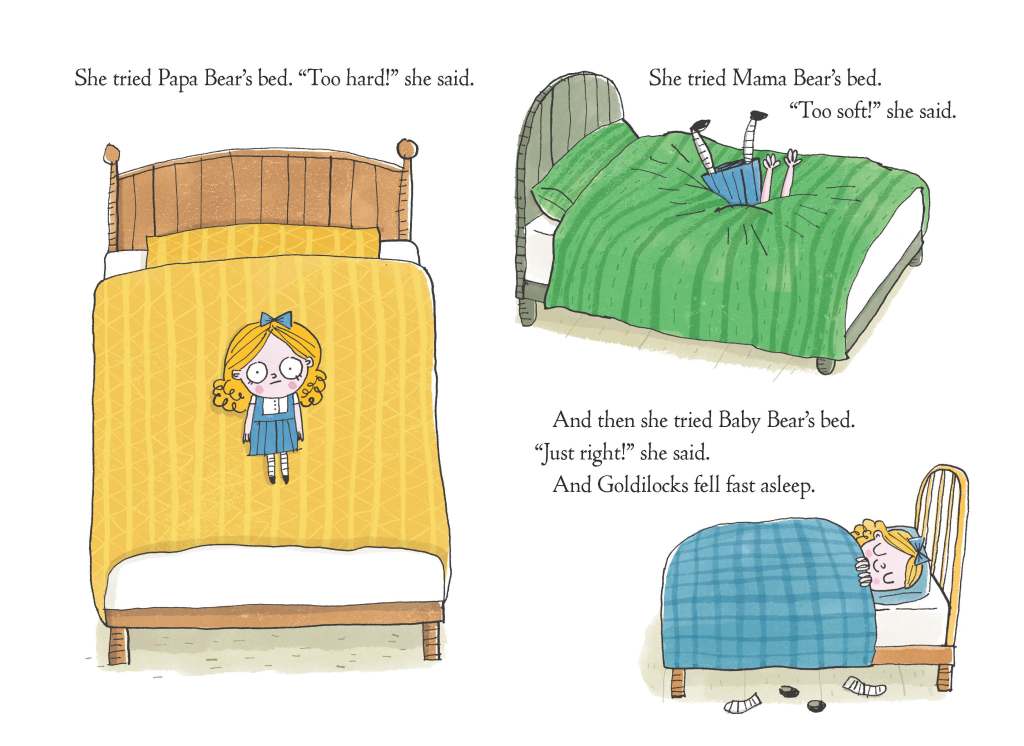
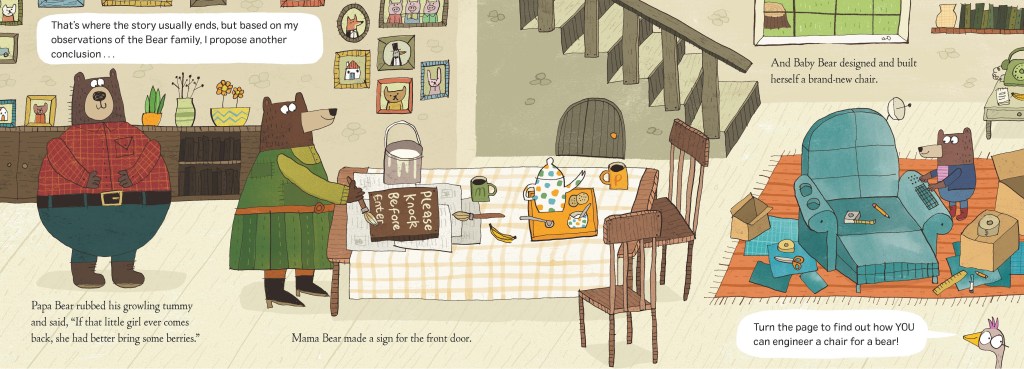
Goldilocks, as in most versions of the story, is quite small in relation to her environment. That can be scary; no wonder she looks, in succession, awkward, uncoordinated, and then relaxed. Griffiths coordinates busy details and blank space in her pictures.  Instead of the lush images of Central European traditions, there are exaggerated facial expressions, gesturing limbs, and comic proportions.  The strangely open-ended conclusion of the story (for grownups, see Maria Tatar’s The Annotated Classic Fairy Tales,) becomes an upbeat and pragmatic answer to the odd disruption of Goldilocks. Engineering a new chair when a stranger has broken your favorite one makes sense, even if Baby Bear still doesn’t know why a surprised Goldilocks believed that her refuge was uninhabited. Some questions have answers, solutions, but others remain as invitations to dream.

Predators and Prey

We Are Wolves – written by Katrina Nannestad, art by Martina Heiduczek
Atheneum Books for Young Readers, 2022

The author’s note preceding this novel for middle-grade readers and older reveals its basic premise: “The wolf children were German children left alone in East Prussia at the end of the Second World War…The wolf children were victims of war.”  I have no argument against that statement. Children are always victims of war. It does not matter if the adults who started the war were brutal dictators, those who supported these men, or those who failed to stand up to them.  Therefore, German, Japanese, and Italian children were victimized by the terrible conditions during and after World War II.  Since We Are Wolves is told from the perspective of Liesel, a German child, we cannot expect the novel to balance her feelings of victimhood against the historical reality of Germany’s deeds, which led to worldwide suffering, but also specifically to the annihilation of two-thirds of Europe’s Jews. 

However, Liesel’s story is not completely unmediated. It is a work of historical fiction, not the transcript of a child witness.   The main problem with the book is that Katrina Nannestad fails completely to acknowledge, or even to imply, that Liesel’s perception is limited.  This leads to the unfortunate erasure of the book’s missing Jews, and the presentation of all the German characters as innocent of wrongdoing. 

Liesel, her brother Otto, and their baby sister Mia, are separated from their mother at the end of the war, left hungry and without shelter. Their father has been drafted into the German army and they eventually leave their beloved grandparents behind in their attempt to escape the Russian army, whom they view as invaders, not liberators.  It is certainly true that the Soviets inflicted terror on the defeated Germans, and on other peoples of Europe, as well.  There is no reason for a novelist to minimize that fact, and Nannestad even portrays some Russian soldiers as humane exceptions.  But the Russians are the only villains in the story. At a few points in the narrative, Liesel briefly questions whether Germans had also perpetrated evil, yet she never follows through with her thoughts. It seems evident that these relatively implausible digressions are the author speaking, attempting to introduce some degree of realism to this historical novel.

Liesel’s father has been drafted.  Nannestad refers to anti-Nazi sentiment in the family, but she never elaborates on it. Otto makes numerous jokes and scatological references to Hitler, but there is no context, aside from his understandable frustration at the loss of his father.  On the other hand, there are many warm descriptions of German culture, which has ostensibly been destroyed by the Russians as they defeat the Nazis.  Liesel and her siblings long for German food, folktales, language, and Christmas celebrations.  Why wouldn’t they? In contrast to the absent Jews, these parts of a stolen past are lovingly detailed, constantly giving the impression of their beauty and value.  There is no distance, no irony, no implied tragedy of the way in which children like Liesel simply cannot understand what the adults in their lives have done, to their own country and to its victims.  Here is just one example, a description of a German home which has been raided by Russian soldiers:

          This is a house frozen in time.

          Knives and forks lie crookedly across plates that contain a half-eaten supper – casserole,

          mashed potato, sauerkraut.  The end of a loaf of bread sits in the middle of the table,

          surrounded by crumbs…

          A prayer book lies open beside the plate at the head of the table, a pair of spectacles

          resting on top.  I wonder if they got to “Amen.”…

          “Perhaps the Russian Army took them by surprise,” I suggest. One moment they were

          safe and warm, enjoying their supper. The next they heard cannons and guns and

          rockets, so they ran.”

It is simply not sufficient to claim that this passage reflects the perspective of a child. The language is clearly that of an adult creating an elegy for the past: the disembodied spectacles, the delicious ethnic food, the prayer book.  There is not even a glimpse of the Jews who were dragged from their homes, imprisoned, and murdered.

Maybe Liesel never knew anything about Jews. First, this cannot be true. German children were forced to participate in Hitler Youth, the League of German Girls, and other preparatory clubs for the youngest among them.  A large part of their indoctrination involved violent antisemitism.  In fact, Nannestad introduces a character, Karl, who meets up with Liesel and her siblings on their search for safety. He tearfully admits that the SS forced his Hitler Youth group to kill Jews.  Liesel reassures him that it was not his fault because he is only a boy, but, conveniently, he somehow escaped by throwing a gun at the SS officer, without having participated in the murder.  By offering this improbable outcome, the author evades the problem of how to incorporate a character who had actually killed Jews into her story of German victimhood. (Even if it were possible that he escaped in this way, a novel, unlike life itself, needs to be plausible, not only possible) There are a couple of other references to Jews, specifically to schoolteachers who disappeared, interrupting the education of Christian German children.  There is no reference to the many Jewish students, \ former classmates and instructors of children like Liesel, who were expelled from schools all over Germany.

Finally, the book concludes when the children find shelter in Lithuania. Liesel would not have known that 90% of the Jews in that country were murdered by the Nazis, often with the collaboration of the local population. But those incontrovertible facts cannot be simply ignored.  Liesel, Otto, and Mia are welcomed in the Baltic country. The worst treatment they encounter is from some families who demand payment for food, but their lives are saved by a compassionate and loving couple who have been devastated by the Russian occupiers.  Even if German children could not be expected to understand the acute irony of the situation, the author is not absolved of the responsibility for elaborating her characters’ story within historical reality.  The fact that she occasionally alludes to the terrible truths of the era, only to turn away from them, is not enough. Yes, German children displaced by war were victims.  Using that fact as the center of the novel requires care for the truth, which would not have diminished the intensity of the children’s  experience, but would rather have drawn a fuller picture of what actually caused their tragedy.

Generations

My Neighborhood – written by María José Ferrada, illustrated by Ana Penyas, translated from the Spanish by Kit Maude
Tapioca Stories, 2022

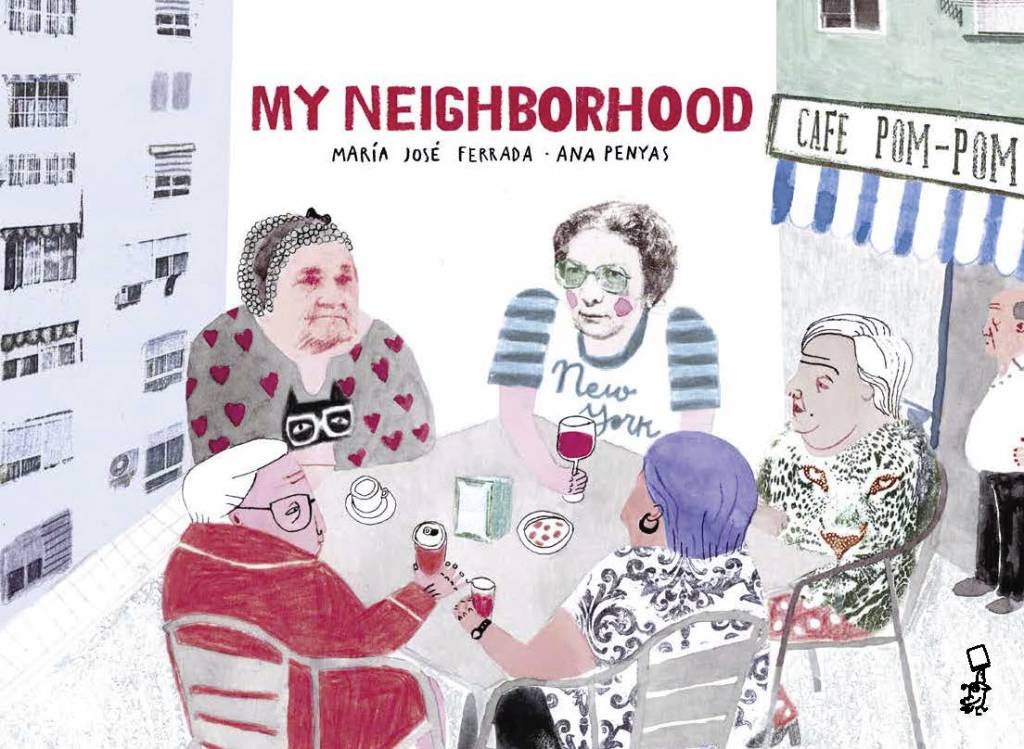
My Neighborhood (originally published as Mi Barrio, Alboroto Ediciones, Mexico, 2018) is a picture book about old women, perfect for both young and older readers.  The old women who live in Ms. Marta’s neighborhood are friendly, but not defined by their relationships to family members and not necessarily warm and affectionate, at least not all the time. 

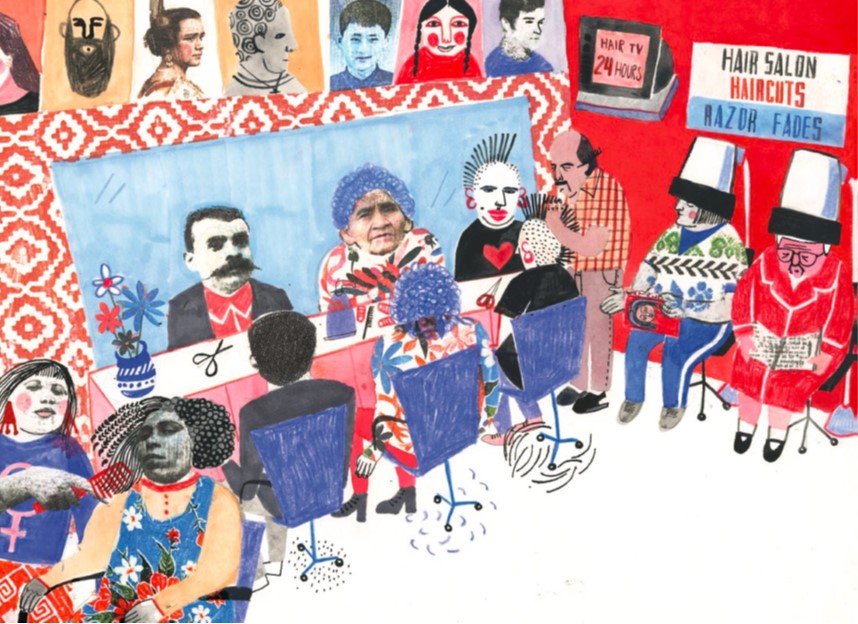
Marta’s approach to life is to begin each day ready to “check that the world is just as she left it.” That goal may seem modest, but it involves a sequence of steps not necessarily shared by children, including visits to the hairdresser, doctor’s office, and card game. But children do understand routines and the importance of continuity.  Maybe they will conclude that old people are not so unlike themselves.

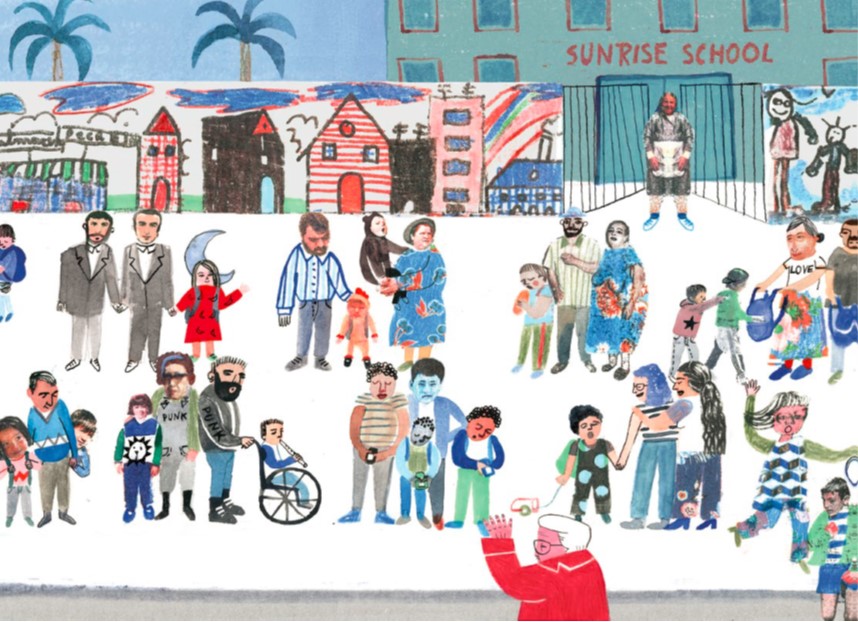
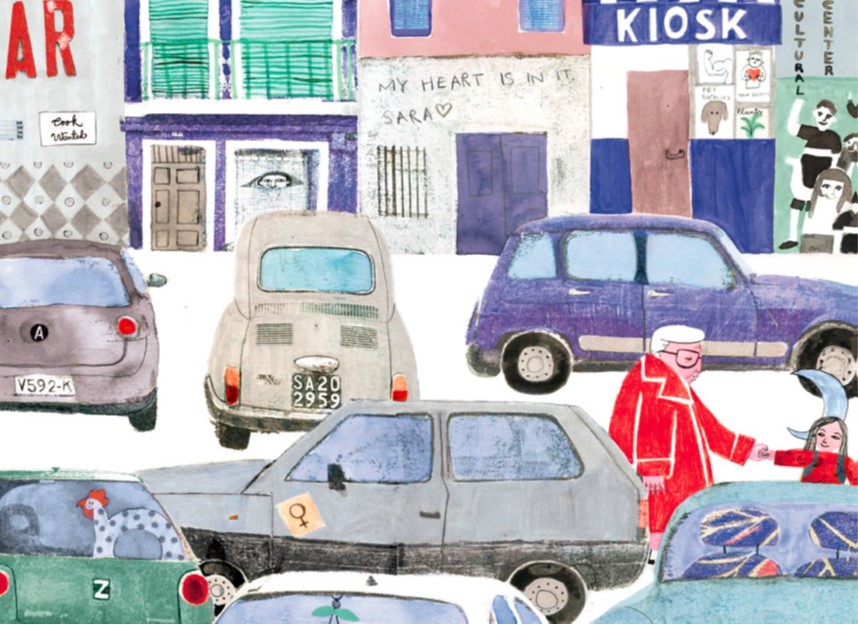
One hint of that connection happens when Marta passes a school, where a seven-year-old girl greets her and calls her “beautiful.”  Another is an old people yoga class held in the local park, where a child playing is visible in the corner of the page, just to the left of Marta’s bench.  Ms. Marta crosses the street holding the hand of a smiling girl. The two main categories of people who may need help crossing a street are, after all, children and old people.  It’s reassuring for both of these groups to recognize that “The good thing about living in the neighborhood is that Ms. Marta Knows everyone and we all know her.”

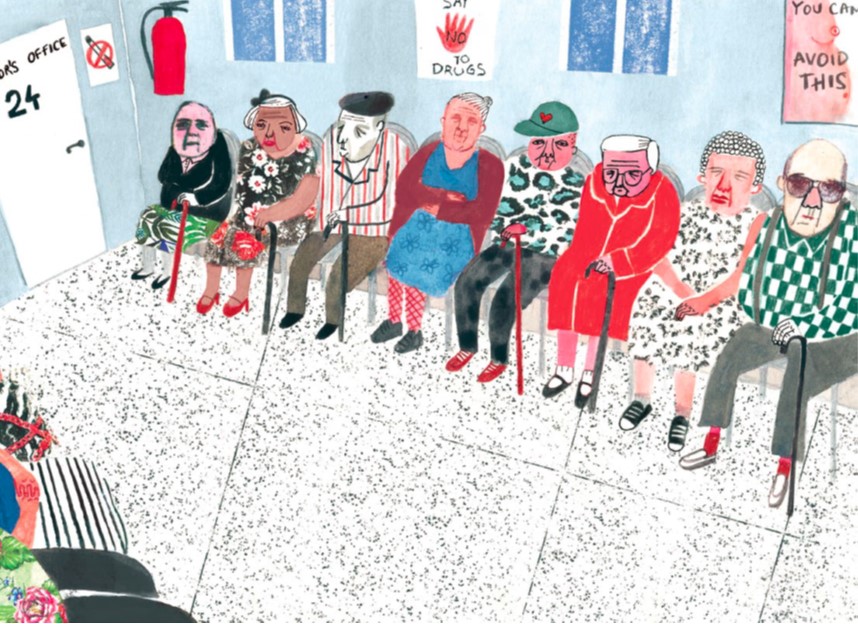
Some environments, however, reveal some confusion about who they are serving.  The doctor’s office, full of somber patients, is a place where one must not laugh at the word “funeral.” Meanwhile, posters on the wall warn those waiting to “Say no to drugs,” and to avoid pregnancy. 

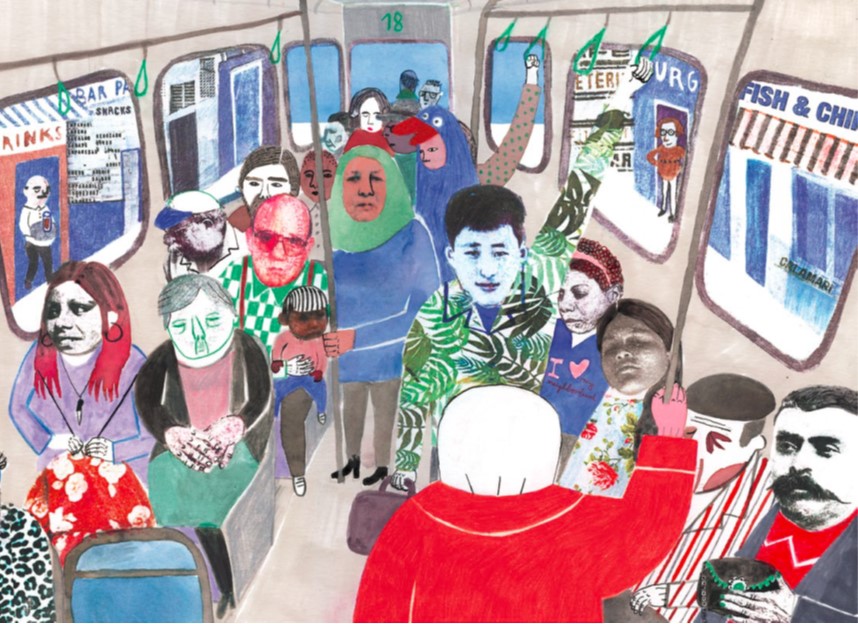
Marta is standing on the crowded bus home, although there are younger people sitting. Perhaps no one offered her a seat, or it could be that she prefers to stand.  If you wonder what children would guess about this picture, ask them.  María José Ferrada’s offers clues but not conclusions.  The bus is the same one Marta has ridden for fifty years, but a picture of her in a full parking lot raises a question: “The same bus?” Even fifty years is not forever; people age and even daily check-ins cannot forestall changes. Luckily, Ms. Marta’s neighborhood is full of predictably helpful residents, young and old.

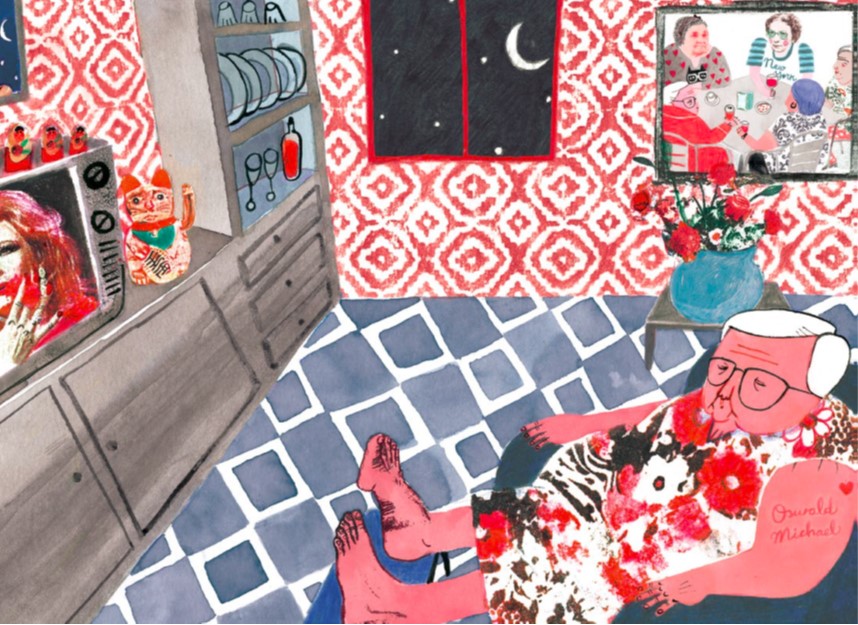
Ana Penyas’s portrayal of Ms. Marta’s world is both imaginative and brutally honest. Combining colored drawings with digital images, she places Marta in a specific community, but draws on  universal aspects of being old.  From the diverse set of clients in the hair salon, to the funny content of graphic t-shirts in the yoga class, and the menu viewed from inside the moving bus, Marta’s neighborhood is everyone’s and hers alone.  When she relaxes by putting up her probably swollen feet and watching a glamorous star on TV, adults may feel a touch of sadness along with relief. Children will wholeheartedly agree with Ms. Marta that “lives, like socks, are elastic,”  as they also know that changes are beyond their control.

Do Chickens Have Wheels? Maybe.

Wheels, No Wheelswritten and illustrated by Shannon McNeill
Tundra Books, 2022

For adults, there are endless ways to categorize the world, but for young children the range may be more limited. There are animals and people, adults and kids, places where I live and places where I don’t live, things to eat and things to not eat. O.K. There are quite a few possibilities, but they are still less confusing than for adults, in general.  In Shannon McNeill’s Wheels, No Wheels, the author and artist suggests one pair of potentially overlapping objects: things with wheels and those without them. Some things move and others don’t. Within the world of moving things, there are wheels, and no wheels. That is the inventive and funny premise for this picture book. 

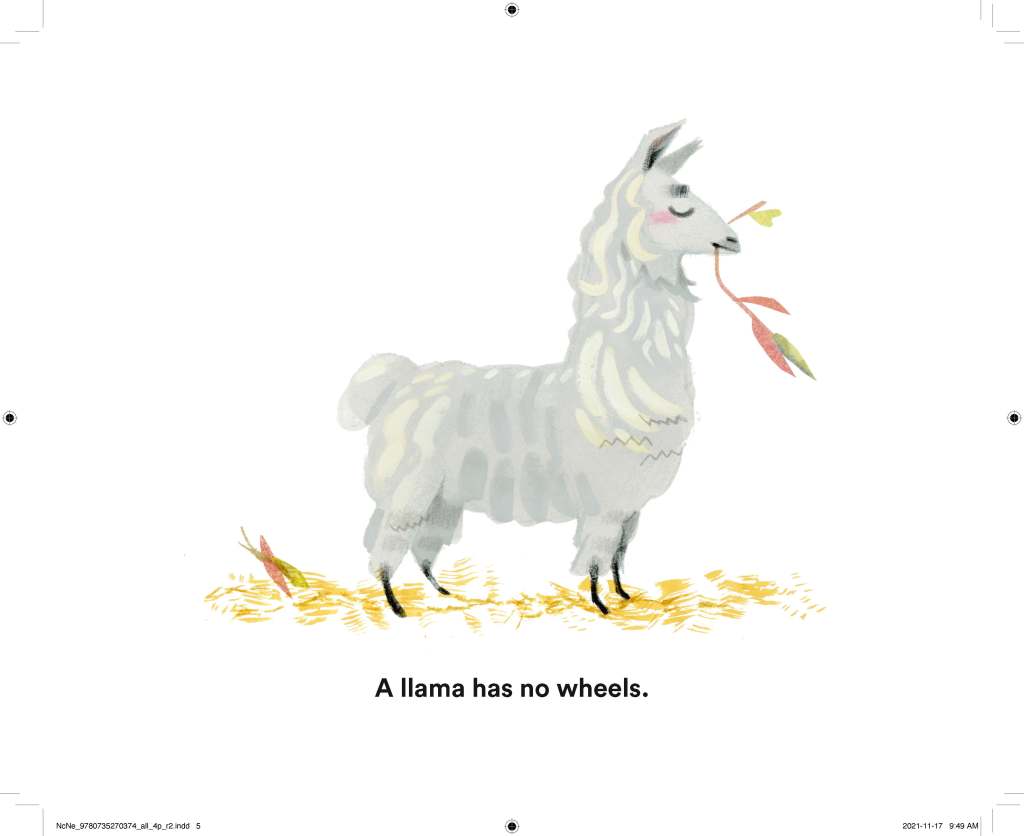
First, a llama has no wheels, but a bike has wheels. Like the other initial images in the book, these first appear as static objects, the very definition of each one. The llama stands in profile, eating a leaf; this is an animal that chews its cud.

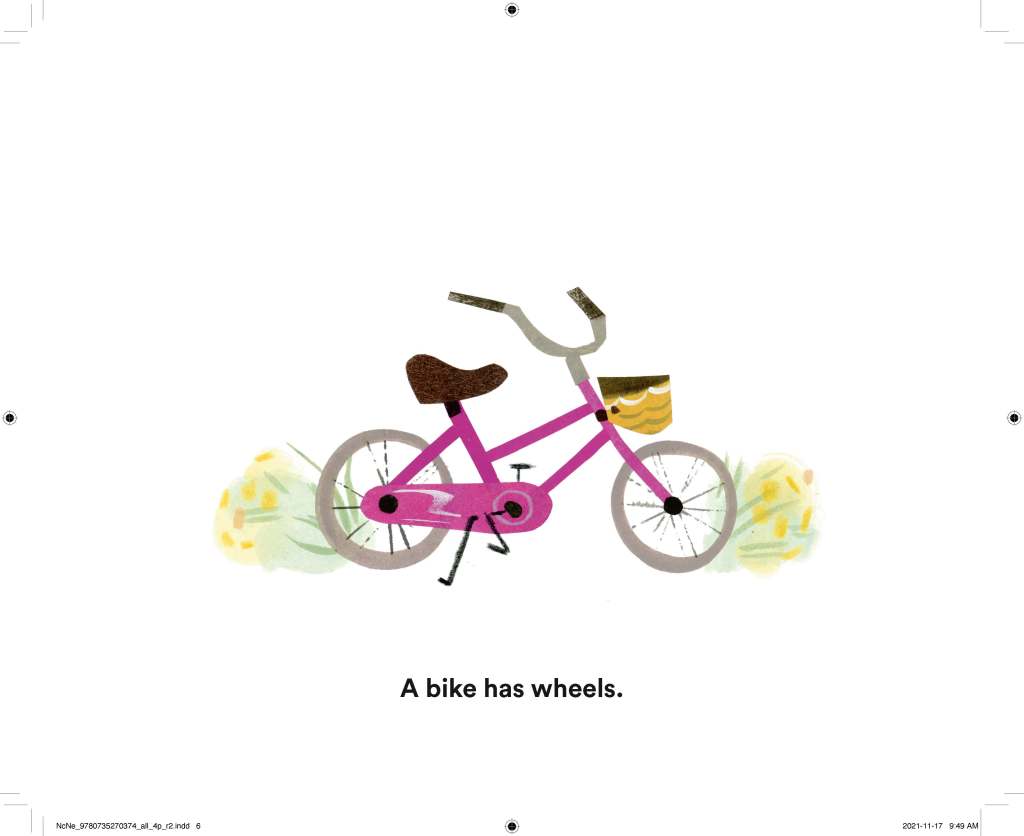
The bicycle is viewed from the same angle, but it has wheels, a basket, a kickstand, and no leaf to chew.  Differences that are so obvious as not to merit notice by an adult may be very new to children; McNeill acknowledges that by the way in which the sequence of events develops. The farmer, a child in overalls and a straw hat, becomes surprised and frustrated when the respective objects don’t act in the way which their qualities should predict. 

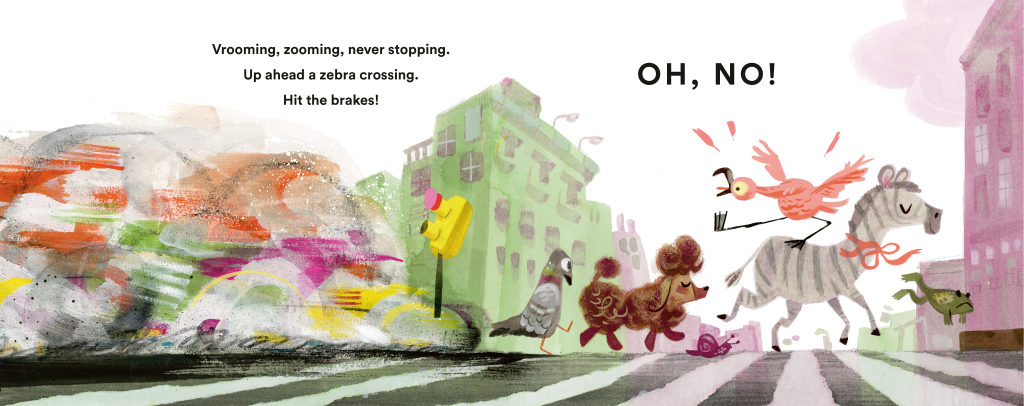
All of a sudden, a cat, turtle, and llama all have vehicles, and the farmer is left behind.  Children often have trouble keeping up with bigger or more mobile beings. Here the farmer is excited to encounter an ox pulling a cart, concluding “Here’s a friend who walks and rolls.”  An animal and an inanimate object together become a friend, and the farmer’s problem seems to be solved.  Kids love to find solutions!   But when an odd assortment of animals crosses the street, the incredible speed of the ox, cart, and farmer combination becomes a problem. The mode of transportation collapses, both wheels and no-wheels dissolving into a blur of speed. Allusions to folklore and jokes are subtle elements of the background, reminders of “Hush Little Baby’s” ox and cart, and the proverbial chicken crossing the road.


With bold colors, and images that accelerate from static poses to chaotic motion, McNeill tells an appealing story with a point.  Some ways of interpreting the world seem reliable, but they are subject to change.  Even wheels vs. no wheel may need adjustments and a new perspective. One minute, “Nobody has wheels,” and the next, “Everyone has wheels!”  Children have an adaptive approach to reality, and Wheels, No Wheels packages that truth with humor and understanding.

American Library Association’s Panel on Censorship: Information vs. Propaganda

I am a strong supporter of freedom of speech and the right to read, including books which I personally find offensive.  If you follow news in the world of children’s books, you may have heard of the heated response to the American Library Association’s recent panel discussion on censorship.  After a series of angry tweets ensued, School Library Journal apparently felt that they needed to address the issue, particularly since it involved Holocaust denial, and potentially racism.  Rather than analyzing broader issues of free speech, I would like to focus on why this particular article is extremely slanted, functioning as propaganda for the ALA,  rather than a carefully sourced report on a specific event.

I’ll begin with the title, and also refer to the language which the author, Kara Yorio, uses throughout the piece.

This article is filed under “News and Features.” The title, “With a Joyful Return to In-Person, ALA Hosted a Censorship Discussion. A Twitter Controversy Ensued.” The adjective “joyful” clues the reader in to what will happen next: a wonderful and open-minded forum is attacked by unreasonable people spreading rumors without information. If my conclusion seems alarmist, please note the following phrases:

“The… conference prompted a lot of book love, joy and celebration and at least one Twitter-fueled controversy threatening to shadow some of the positive feelings…”

The “Twitter firestorm” regarding the potential necessity of including Holocaust denial books in libraries was “joined by many who were not at the panel.”

I myself, when I first heard of the events, decided to withhold judgment until more information became available. However, almost all Twitter “firestorms,” by definition, involve people without direct knowledge of events. That is the nature of the medium.

Some of the Twitter “firestorm” involved accusations that librarian Nancy Pearl, who originally raised the issue of Holocaust-denying books, was provoking attacks on distinguished author Jason Reynolds.  Yorio refers to the danger of Holocaust denial, and to “the pressures that people of color face in live, public forums.” The problem with this parallel is that, while people of color do face particular pressures in public forums, as do women, in neither case are either people of color, or women, immune to the possibility of saying something offensive or simply controversial.  In this case, it seems obvious that people hearing of the event would be far more interested in anything Jason Reynolds said than in the opinions of Nancy Pearl. He is a highly successful and esteemed author who has earned numerous accolades and frequently makes public statements. 

Then Yorio selects one librarian at the conference, Christopher Stewart, who expresses confusion and dismay over the response to what he experienced as a wonderful event:

“Christopher Stewart was shocked by (the) original tweet, saying that no part of the conversation felt controversial or tense to him…”

I am sure that Mr. Stewart is honestly expressing his feelings about the panel discussion, but his report of its collegial nature is not definitive, and certainly does not preclude the fact that other members of the audience might have felt differently. I don’t know if they did. I don’t know how many Jews were present, although I would hope that some non-Jews would be sensitive to Holocaust denial.  Were some people afraid to speak out at the time? Ms. Yorio simply doesn’t include any contrasting or opposing points of view in her article. Mr. Stewart’s use of the word “shocked” is particularly emphatic, suggesting that any controversy must have been imagined.

Stewart then goes on to characterize the process of raising controversial issues as part of the “Socratic method” of learning.  Here I was, if I may borrow his language, “shocked.” There is no Socratic method in considering the phenomenon of Holocaust denial. There is only deliberate, provocative, hate-filled disinformation, and the attempt to expose those who promote it.  There are no “important conversations with those people with whom the students may vehemently disagree.” 

Yorio explicitly states her interpretation of the controversy here:

“The emotional debate distracted from the original intent of the panel: a discussion focused on those fighting for the freedom to read…”.

I believe that this statement is perfectly clear.  Those people upset by including Holocaust denial are “emotional,” and are impeding the struggle for “the freedom to read.”

Nora Pelizzari’s comparison of Holocaust denial to Hitler’s Mein Kampf is poorly chosen.  Hitler’s odious book is a primary source in which he clearly proposes the Final Solution.  It is absolutely necessary to read when studying the Holocaust, grade level is a crucial consideration when including it in a curriculum or a library’s collections. Holocaust denial, while necessary for attorneys, activists, and other professionals, is simply not in the same category. Where would the library include such materials? It certainly isn’t history, anymore that the denial of evolution belongs in a science collection. It is merely inflammatory lies meant to provoke hatred and violence. People claiming that the gas chambers which killed millions of Jews were a hoax do not need a platform for their mission.

Finally, there is a transcript of “relevant portions of the panel.” I will limit myself to Jason Reynolds, central contribution to the discussion. I do not believe that Mr. Reynolds is antisemitic:

“And books written by Holocaust deniers.  And you know immediately my knee-jerk reaction is like ‘that feels dangerous.’ But…the hard truth is, that if we are going to fight against book bans, it includes all the books…it may not be a thing that you’re comfortable with…it still belongs on the shelf, it still deserves to live…because when that book comes up that triggers you, suddenly, you’re not there.”

The phrase “knee-jerk reaction” means something quite specific. It refers to an initial emotional response to learning new information before one then rationally reconsiders and realizes that the response was incorrect.

Here are some books that may “trigger” readers: Oliver Twist with its Fagin caricature of Jews, A Fine Dessert, in which some readers found the image of enslaved people “enjoying” their food, numerous books and films with degrading images of women.  Holocaust denial is a cruel and purposeful attack on history itself.  There are not two sides to the issue.  The ALA and SLJ seem determined  to blame the controversy on troublemakers upsetting a “positive” event, rather than wrestling with the underlying issues. 

Urban Bear

The Bear Ate Your Sandwich – written and illustrated by Julia Sarcone Roach
Alfred A. Knopf, 2015

When bears show up in cities, unusual turns of event may happen.  If you remember Don Freeman’s Corduroy, you know that a small stuffed bear confuses a department store with a palace, and in Amy Hest’s When You Meet a Bear on Broadway a live version of the same animal needs to be reunited with his mother.  In Julia Sarcone Roach’s The Bear Ate Your Sandwich, the endpapers feature beautifully individualized pictures of different sandwiches, but the main point of the story is about a girl, a missing lunch, and a loveable, but possibly less than honest, pet dog.

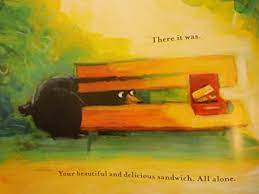
The story starts with the bear’s reassuring origin in the forest. He stretches in the morning air and then catches a ride on a produce truck. Before long, he wakes up in a big city. There’s a fairytale element in his falling asleep and then finding himself in a different world, but the world is definitely a real one. There’s a suspension bridge and fast-moving vehicles, all rendered in impressionistic lines and colors. “It was like nothing he’d ever seen before.” Like Corduroy, this bear is confused.  Cement is mud beneath his feet, walls are bark for scratching, and the smell of garbage is just part of life in the forest.  We see the bear peering with big eyes through the slats of a park bench, where he spies a lunch.  As we watch him devour the sandwich, the bear’s predatory nature becomes evident. But soon, he wants to go home.  (So does Corduroy, but, until the end of the book, he doesn’t have one.)

Ears also stand out in this book, both literally and figuratively. Again, in Corduroy, one of the more memorable scenes features the toy bear asleep in the department store bed, with only his tiny ears sticking out from the covers. This bear’s ears are part of his personality, intent on exploring. We see them on the cover, and protruding like uncombed hair in almost every picture.

After he returns home, a terrier appears; we see only the back of his head and ears. He is telling a young girl that her missing sandwich was taken by a hungry bear.  “I tried to save your sandwich. I was able to save this little bit of lettuce here.” It’s not clear if that clever detail convinces her, but she certainly doesn’t appear angry. Facing the dog, she looks down kindly at him with a half-smile. In her spotless white dress she could be a neater, calmer, Goldilocks, but with beautiful dark skin and hair.  So that’s what happens when a bear comes to the city, steals a sandwich, and takes off, or at least when Julia Sarcone Roach imagines the story through the eyes of a child.  Sometimes the most interesting explanations are the least plausible.

Connect the Dots

My Lala – written by Thomas King, illustrated by Charlene Chua
Tundra Books, 2022

My Lala celebrates one of the most endearing misconceptions of childhood. When toddlers decide that they are the center of the universe, and own everything that surrounds them, they might come into conflict with other family members or classmates. But Thomas King and Charlene Chua choose to celebrate the glorious recognition by one little girl that she owns the world. By focusing only on her, and the red dots that identify all her possessions, they interpret this state as one of pride in a growing autonomy. The book is funny and tender, with a rhythmic text and bold graphics. Children and adults will both relate, from different angles, to Lala’s joy in taking control.

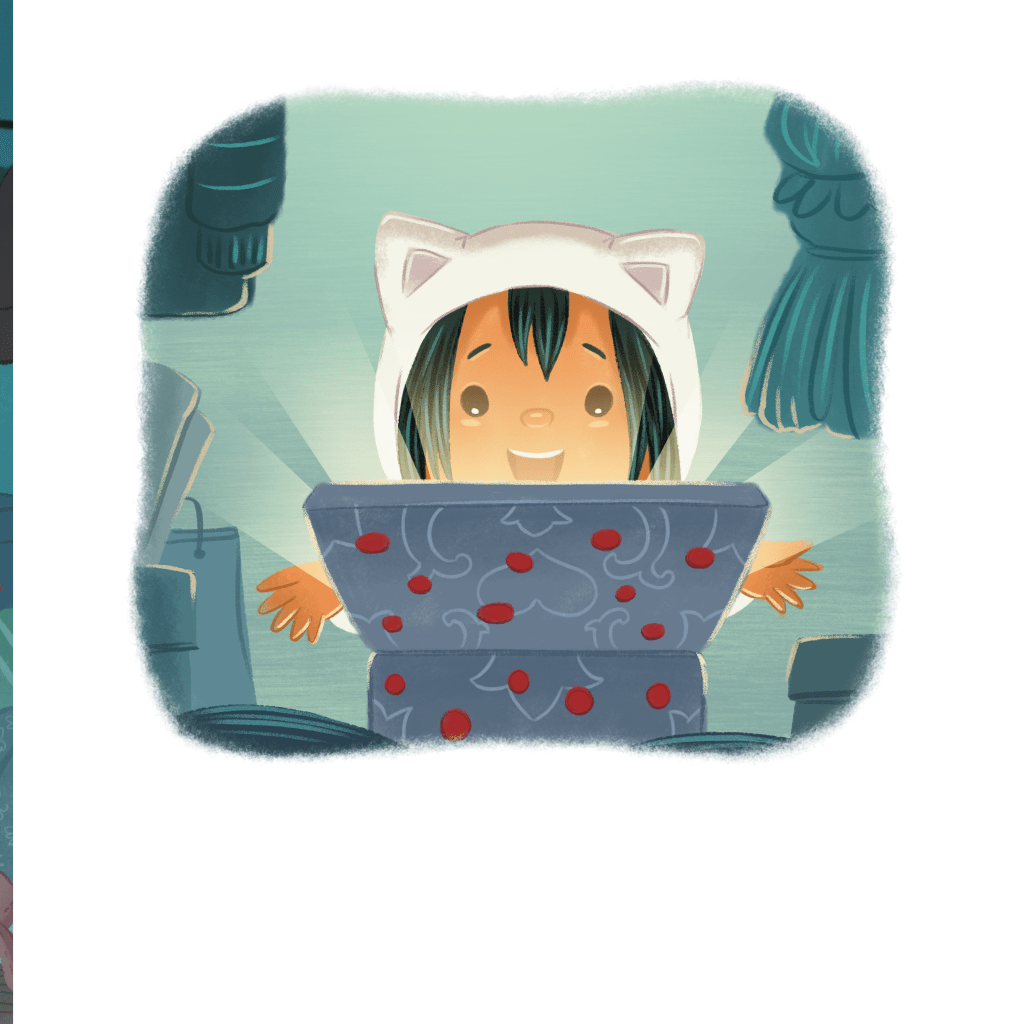
Lala both collects and creates red dots. They open and close the endpapers of the book, and mark every page in between. Lala’s sense of self-awareness begins when she wakes up one morning with a sudden epiphany: “One morning when morning came bright as a pear,/Lala decided that she owned the world.” Note that King describes this development as a decision. Lala is happy, determined, and energetic. Her animal costume pajamas suggest a small creature in the wild, but she is not reckless.  King and Chua depict childhood play as looking chaotic on the surface, but actually governed by purpose.  Her Lala box is magical and stuffed with treasures. 

She uses the dots to identify and claim special objects, from blankie to book, to the bright yellow raincoat hanging on a hook. In addition to affixing the red dot to each item, she awards them her own name: “One for My Lala blankie and My Lala book.” Lala tries on clothes to prepare for the weather. She tapes a red-dotted pirate hat on her hapless cat.

Naturally, she is an artist, clutching the markers that she uses to transform her bedroom walls into a gallery. Each picture shows the excitement of a child transforming her small stature relative to adults into an asset, by inhabiting every inch of space without inhibitions.  There is only one time in life when this is allowed; King and Chua let children know that it is a wonderful opportunity.

Resources are finite, but Lala doesn’t know that. In fact, when she runs out of dots, this temporary obstacle inspires her to action. Her coloring, snipping, and pasting are filled with frenetic energy, as she dances from page to page. The constant motion in this book is like a dance choreographed by a child. King and Chua convey complete empathy with Lala’s project, while maintaining the slightest distance from her perception of the universe. Lala’s insistence on ownership has no sense of envy, fear, or anger. She simply loves every article in her life and expresses that happiness in a bright, red dot.  My Lala captures that fleeting stage with simple perfections.

Making Ice Cream and Making News

The Sweetest Scoop: Ben & Jerry’s Ice Cream Revolution – written by Lisa Robinson, illustrated by Stacy Innerst
Abrams Books for Young Readers, 2022

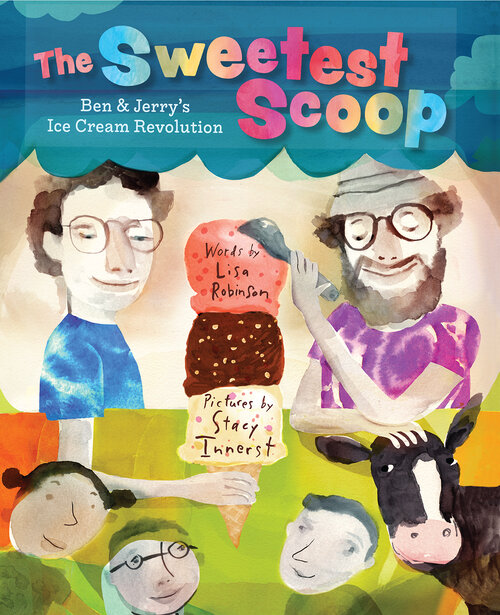
Any picture book biography for young readers will necessarily simplify its subject’s life.  Even the most laudable people usually have acted in ways which make them vulnerable to criticism.  Authors need to decide, based on the length, scope, and audience of the book, what needs to be included.  Ben Cohen and Jerry Greenfield are incredibly successful entrepreneurs who created a product and figured out how to market it.  They deserve credit for their accomplishment.  In Lisa Robinson’s account, the pair’s social activism really sets them apart, perhaps even more than their Chunky Monkey or Cherry Garcia.  The result is a kind of iconography, but with clever text, lots of humor, and outstandingly expressive pictures by the inimitable Stacy Innerst (see other of his books I have reviewed here and here).  The book is indeed sweet, even if Ben and Jerry’s ostensible role as revolutionaries is a bit overstated.

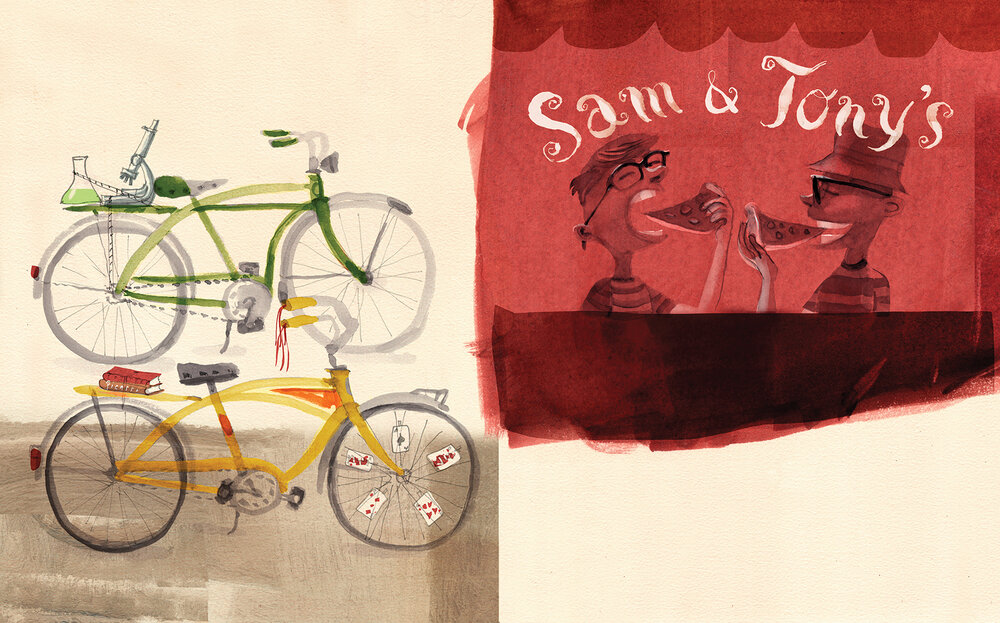
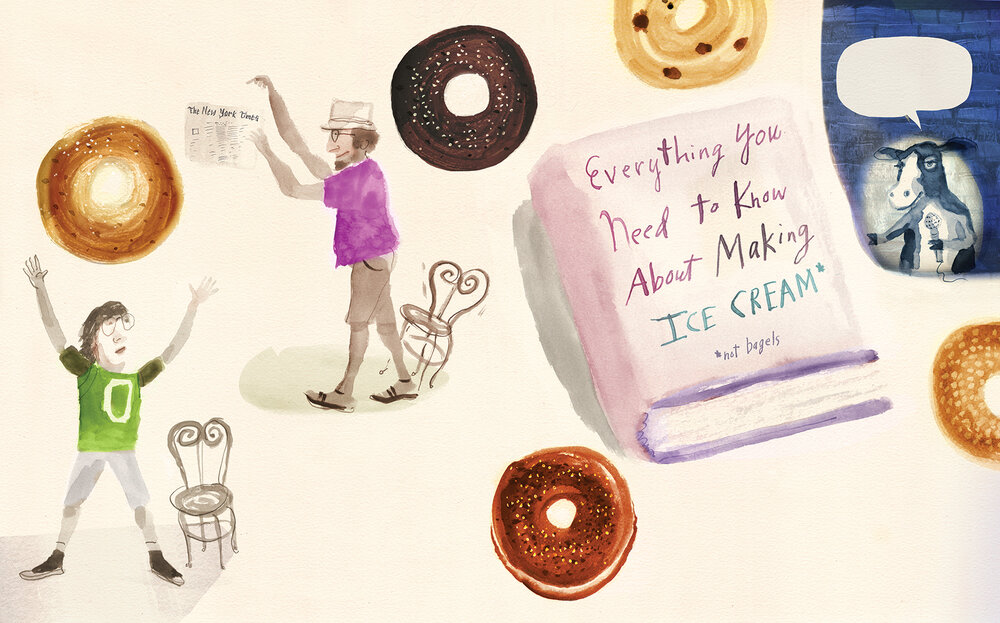
First, the best part of the book is Innerst’s art.  Whatever subject he illustrates, his pictures become an embodiment of that person and his or her era.  There are lifelike drawings that capture Ben and Jerry’s personalities, and fanciful elements such as joking cows and possible ice cream ideas floating over their inventors’ heads. Innerst’s color palette shouts “ice cream,” but the reader does not live by food alone. There are the boys’ bicycles with playing cards in the wheels’ spokes, the young pair confronted with a broken toilet in their gas station, and the serious faces demonstrating for peace in the 1960s.  Pictures offer free association, as in the small American flag atop a serving of Empower Mint, or again, those cows, this time taking a meeting with Ben and Jerry outdoors, under pastel clouds.

Young readers will be engaged by the legitimate story of Ben and Jerry as underdogs. They me as kids. They loved biking, art, science, and, of course, food. They showed an impressive work ethic, but met with many disappointments. When they decide to start their own business, “they will be their own bosses,” a goal attractive to children and adults alike.  Conceiving and developing every aspect of their unusual plan, Ben and Jerry go from mixing ingredients to getting it onto store shelves. When the corporate behemoth Pillsbury threatens to shut them down, these two socially conscious guys from Long Island complain to the Federal Trade Commission. Eventually, they have the last laugh, selling huge quantities of their ice cream all over the U.S. 

But this part of their story is almost a preamble, because “…the believed that they could use ice cream to help make the world a better place.”  Robinson describes their committed environmentalism, their foundation they started to fund social activism, and their advocacy for inclusion and diversity.  All this information is valuable, and inspiring to kids who may not have thought about corporate success linked to corporate responsibility. In fact, Ben and Jerry, like most people, have not always lived up to their own standards. Although the book emphasizes their concern for workers, they have sometimes opposed unionization in their company and their relationship with migrant workers in the dairy industry has included conflict. It is to Robinson’s credit that she includes on her “Timeline,” Ben and Jerry’s sale of their company to Unilever, “a multinational food corporation.”

Here’s an obvious part of Ben and Jerry’s biography which Robinson chose to leave out; they are Jewish.  So many aspects of their lives, from their Long Island beginnings, to Jerry’s rejection from medical school leading to better things, to the bagels and cream cheese, and the very social activism which defines the book’s message, are partly rooted in their Jewish identity. This identity is conspicuous by its absence.  Another absence from the book is their stand on selling ice cream in Israel’s Palestinian territories. No, they do not support the BDS movement, just Israel’s policies in that contested part of their country. But whether or not readers disagree with Ben and Jerry on this decision, there is no disputing its prominence in their public image.  They have every right to take that stand and to publicize what they consider to be an important issue.  Given Robinson’s explicit mention of so many causes espoused by them, from Black Lives Matter to LGBTQ rights, reparations for slavery, environmental protection, and giving their workers “free” ice cream, one can only assume that the author avoided the one issue which she thought would be controversial. Yet, there are undoubtedly readers who oppose all of Ben and Jerry’s other causes as well.  Who is the audience for this book?  Most likely, they are generally sympathetic to the Ben and Jerry story.  At the end of the day, Ben and Jerry’s persistence, creativity, and drive made a lot of ice cream lovers happy. Whether or not this equals a revolution, kids can learn a lot from their tale.